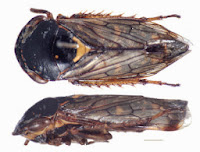
Hairy Cicadas, Tettigarctidae, are considered to be the most primative group of Cicadas. Today they are largely a relict group, with only two surviving species, one found in southeastern Australia and the other in Tasmania, but they have a long fossil record, with species kown from the Triassic of England, and later Mesozoic of Eurasia, Australia, Africa and South America, though they appear to have become less abundant in the Cainozoic, with only a few known fossils from Europe and New Zealand.
In a paper published in the journal Acta Palaeontologica Polonica on 20 June 2016, Jun Chen of the Institute of Geology and Paleontology at Linyi University and the State Key Laboratory of Palaeobiology and Stratigraphy at the Nanjing Institute of Geology and Palaeontology, Haichun Zhang, also of the State Key Laboratory of Palaeobiology and Stratigraphy at the Nanjing Institute of Geology and Palaeontology, Bo Wang of the State Key Laboratory of Palaeobiology and Stratigraphy at the Nanjing Institute of Geology and Palaeontology and of the Key Laboratory of Zoological Systematics and Evolution at the Institute of Zoology of the Chinese Academy of Science, and Yang Zheng, Xiaoli Wang and Xiaoting Zheng, also of the Institute of Geology and Paleontology at Linyi University, describe three new species of Hairty Cicadas from the Middle Jurassic Daohugou Lagerstätte of Inner Mongolia.
The Daohugou Formation outcrops around Daohugou Village, and has
produced a large number of exceptionally well preserved Insects, which along with similar fossils from the associated Jiulongshan Formation form
what is commonly known as the Daohugou Lagerstätte, part of the Yanliao
Biota. The fossils are thought to be late Middle Jurassic in origin,
from the boundary between the Bathonian and Callovian eras, making them
about 165 million years old. This provides a valuable insight into
insect diversity in the Jurassic, before the appearance and rapid rise
to dominance of Angiosperms (Flowering Plants), an event which radically
reshaped Insect faunas. The Daohugou beds are interpreted as a lake environment, with
largely still waters.
All three new species are placed in a single genus, Sanmai, which means 'three-branched' in reference to the M-vein of the forewing, which has three branches.
The first new species is given the name Sanmai kongi, in reference to Kung Fu-Tsy (Confucius), the founder of the Confucian philosophical system. The species is described from two specimens, a female preserved as part and counterpart on a spilt slab and a male preserved on a single slab. The female is 22.3 mm in length with a forewing 18.8 mm in length and 7.1 mm in width, with a well preserved circular compound eye, part of the antenae and an ovipositor. The male is less well preserved, 21.7 mm in length, with a forewing 17.5 mm long and 6.6 mm wide.

Hairy Cicada Sanmai kongi from the upper Middle–lower Upper Jurassic Daohugou beds. (A) Female specimen. Photograph under alcohol (A1), explanatory drawing (A2). Abbreviations: A, anal vein; CuA, anterior branch of the cubitus vein; CuP, posterior branch of the cubitus vein; M, media vein; RA, anterior branch of the radial vein; RP, posterior branch of the radial vein; ScP, posterior branch of the subcosta vein; u, ulnar cell. Chen et al. (2016).
The second new species is named Sanmai mengi, in honour of Meng Tsy (Mencius), one of the sages of Confucianism. The species is described from a single female specimen preserved in lateral aspect (side on) on a single slab. The specimen is 23.6 mm in length, with large eyes and a forewing roughly 19.6 mm by 7.8 mm.

Hairy Cicada Sanmai mengi, female specimen, from the upper Middle–lower Upper Jurassic Daohugou beds. Photograph (A), explanatory drawing (B). Chen et al. (2016).
The final species is named Sanmai xuni, In honour of Xun Tsy (Xuncius) one of the sages of Confucianism. The specimen is described from three female specimens preserved in lateral aspect on slabs. The specimens range from 23.5 to 25.4 mm in length.

Hairy Cicada Sanmai xuni, from the upper Middle–lower Upper Jurassic Daohugou beds. (A). First specimen. Photograph (A1), explanatory drawing (A2), enlargement of head (A3). (B) Second specimen. Photograph (B1), explanatory drawing of hind wing (B2, horizontal mirror), photomicrograph of ovipositor and pygofer (B3). (C) Third specimen. Photograph (C1); photomicrograph of antenna, showing segments of flagellum (arrowheads) (C2); photomicrograph of part of rostrum (C3). Abbreviations: CuA, anterior branch of the cubitus vein; M, media vein; RA, anterior branch of the radial vein; RP, posterior branch of the radial vein. Chen et al. (2016).
See also...
 Protoplecid Flies from the Middle Jurassic Daohugou Biota of Inner Mongolia. Protoplecid Flies are a group of True Flies, Diptera,
known from
Jurassic deposits across Eurasia. They are thought to be ancestral to
the
modern Bibionidae (March Flies and Love Bugs) and the...
Protoplecid Flies from the Middle Jurassic Daohugou Biota of Inner Mongolia. Protoplecid Flies are a group of True Flies, Diptera,
known from
Jurassic deposits across Eurasia. They are thought to be ancestral to
the
modern Bibionidae (March Flies and Love Bugs) and the... Parasitic Fly larvae from the Middle Jurassic of Inner Mongolia. A wide range of modern Insects survive as ectoparasites of
vertebrates, either by living permanently on their hosts, as with Fleas or by
visiting animals to feed, as with Mosquitoes...
Parasitic Fly larvae from the Middle Jurassic of Inner Mongolia. A wide range of modern Insects survive as ectoparasites of
vertebrates, either by living permanently on their hosts, as with Fleas or by
visiting animals to feed, as with Mosquitoes... A new species of Cicada from Sichuan Province, China. Cicadas (Cicadoidea) are large members of the True Bug order...
Follow Sciency Thoughts on Facebook.