
Exospheres are gas envelopes around planets and moons too thin to be considered true atmospheres. Unlike atmospheres, the gasses in exospheres are not thought to interact with one another, rather individual molecules are thought to be lost from the body's surface, spend some time in the exosphere, then either be lost into space or resettle onto the surface. The presence of thin exosphere's of oxygen and carbon dioxide has been established on the Jovian moons Ganymede, Europa and Callisto, and such exospheres have also been detected on Saturn's moons Dione and Rhea. However the exospheres of Dione and Rhea have proven hard to understand, as repeated passes of the two moons by the Cassini spacecraft have detected exospheres with very different densities and proportions of the two gasses.
In a paper published in the journal Icarus on 2 March 2016, Ben Teolis and Hunter Waite of the Space Science Division at the Southwest Research Institute examine data from a number of passes of Dione and Rhea made by the Cassini spacecraft, and the development of a model that explains the behavior of the two moons' exospheres.

Teolis and Waite found that the density of Dione and Rhea's exospheres was related to the seasons; the gasses increased in density aound the moons' equinoxes, and lost density around the solstices, suggesting that the behaviour of the gasses is largelly determined by the amount of Sunlight different parts of the moons recieve.
They calculate that both gasses are lost from the surface of the moons as ice is warmed by direcr Sunlight on their daysides. Some of the carbon dioxide is precipitated back on the nightside of the moons, though this can be lost again as the nightside rotates back into sunlight. Around the equinoxes, when all of the moons recieve around the same amount of Sunlight each day, this is all that is happening, and the exosphere of the moons slowly becomes more dense. Hoever at the solstices, when of the poles is pointed away from the Sun and is in permanent darkness, he temperature falls low enough for both gasses to be precipitated, and as the polar regions remain in darkness for Earth years at a time (one Saturn year is euivalent to 29 Earth years) these gasses are lost from the exosphere for long enough to alter it loose density.

See also...
 Fissure eruptions from the southern polar region of Saturn's moon Enceladus. Observations of Saturn's
moon Enceladus by the Cassini space probe have revealed a number of
sulci (linear structures) in the...
Fissure eruptions from the southern polar region of Saturn's moon Enceladus. Observations of Saturn's
moon Enceladus by the Cassini space probe have revealed a number of
sulci (linear structures) in the...
 Methane storms as a possible cause of Titan’s equatorial dune fields. Observations by the Cassini Space Probe have revealed vast dune fields, similar to those observed...
 The origin of mini-jets in Saturn's F Ring. The
F Ring is the outermost and thinest of Saturn's rings. It was
discovered by the Pioneer 11 Spacecraft in 1979, and has been studied by
NASA's Cassini...
The origin of mini-jets in Saturn's F Ring. The
F Ring is the outermost and thinest of Saturn's rings. It was
discovered by the Pioneer 11 Spacecraft in 1979, and has been studied by
NASA's Cassini...
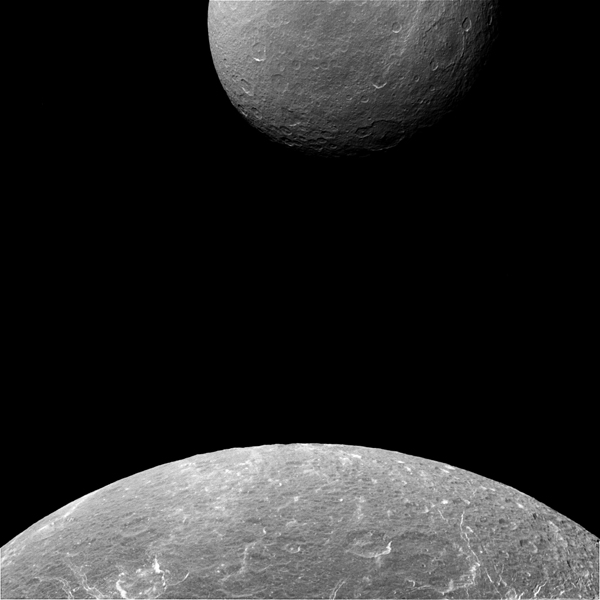
Teolis and Waite found that the density of Dione and Rhea's exospheres was related to the seasons; the gasses increased in density aound the moons' equinoxes, and lost density around the solstices, suggesting that the behaviour of the gasses is largelly determined by the amount of Sunlight different parts of the moons recieve.
They calculate that both gasses are lost from the surface of the moons as ice is warmed by direcr Sunlight on their daysides. Some of the carbon dioxide is precipitated back on the nightside of the moons, though this can be lost again as the nightside rotates back into sunlight. Around the equinoxes, when all of the moons recieve around the same amount of Sunlight each day, this is all that is happening, and the exosphere of the moons slowly becomes more dense. Hoever at the solstices, when of the poles is pointed away from the Sun and is in permanent darkness, he temperature falls low enough for both gasses to be precipitated, and as the polar regions remain in darkness for Earth years at a time (one Saturn year is euivalent to 29 Earth years) these gasses are lost from the exosphere for long enough to alter it loose density.

Schematic showing the mechanism responsible for the exospheric seasonal variability. The exosphere is cryopumped at the solstices onto the cold winter polar surface. As equinox approaches the Sun rises over the winter latitudes, warming the surface and desorbing the frost cap to produce a transient augmentation of the exosphere. Teolis & Waite (2016).
See also...
Fissure eruptions from the southern polar region of Saturn's moon Enceladus. Observations of Saturn's
moon Enceladus by the Cassini space probe have revealed a number of
sulci (linear structures) in the...Methane storms as a possible cause of Titan’s equatorial dune fields. Observations by the Cassini Space Probe have revealed vast dune fields, similar to those observed...The origin of mini-jets in Saturn's F Ring. The
F Ring is the outermost and thinest of Saturn's rings. It was
discovered by the Pioneer 11 Spacecraft in 1979, and has been studied by
NASA's Cassini...
Follow
Sciency Thoughts on Facebook.


