Showing posts with label Virgo. Show all posts

Tuesday, 28 April 2015

Determining the Habitable Zone of 70 Virginis.


70 Viriginis is a G-type Yellow Dwarf Star about 59 light years from Earth in the constellation of Virgo. It is calculated to have a mass 109% of that of the Sun, but radius 194% of the Sun’s, and a lower temperature, 5393K, compared to 5778K for the Sun, from which it is calculated to be somewhat older, approximately 7.77 billion years (compared to about 5.0 for the Sun). This star hosts one of the first discovered exoplanets, 70 Virginis b, asuperjovian planet in a short (116 days) but highly eccentric orbit discovered in 1996.

In a paper published on the arXiv database at Cornell University Library on 15 April 2015 and submitted for publication in The Astrophysical Journal, Stephen Kane of the Department of Physics & Astronomy at San Francisco State University, Tabetha Boyejian of the Departmentof Astronomy at Yale University, Gregory Henry of the Center of Excellence in Information Systems at Tennessee State University, Katherina Feng of the Departmentof Astronomy and Astrophysics and Center for Exoplanets & Habitable Worlds at Pennsylvania State University and the Department of Astronomy & Astrophysics at the University of California, Santa Cruz, Natalie Hinkal, also of the Department of Physics & Astronomy at San Francisco State University, Debra Fischer, also of the Department of Astronomy at Yale University, Kaspar von Braun of Lowell Observatory, Andrew Howard of the Institute for Astronomy at the University of Hawaii and Jason Wright, also of the Department of Astronomy and Astrophysics and Center for Exoplanets & Habitable Worlds at Pennsylvania State University, present a fresh study of the 70 Virginis system using new data from the Cente rfor High Angular Resolution Astronomy (CHARA array) at Georgia State University and the HIRES echelle spectrometer on the 10.0m Keck I telescope, which they combine with previously acquired data on the system from the Hamilton Echelle Spectrograph on the 3.0m Shane Telescope at Lick Observatory and the ELODIE spectrograph on the 1.93m telescope at Observatoirede Haute-Provence, which they use to build a model of the Habitable Zone of the system, and calculate the possibility of an Earth-sized planet remaining in a stable orbit within it.

Kane et al. derive a ‘conservative’ habitable zone for the 70 Virginis system with an inner boundary at 1.63 AU from the star (i.e. 1.63 times the average distance at which the Earth orbits the Sun) and an outer boundary at 2.92 AU from the star, and an ‘optimistic’ habitable zone with an inner boundary at 1.29 AU and an outer boundary at 3.08 AU.

A top-down view of the 70 Virginissystem showing the extent of the Habitable Zone calculated using the stellar parameters established with the CHARA, HIRES, Hamilton Echelle and ELODIE data. The conservative Habitable Zone is shown as light-gray and optimistic extension to the Habitable Zone is shown as dark-gray. The revised Keplerian orbit of the known planet is overlaid as a continuous dark line. Kane et al. (2015).

Next Kane et al. attempted to calculate the possibility of an Earth-sized planet remaining in a stable orbit within this habitable zone. In order to do this they calculated the stability of planets at the inner and outer margins of the conservative and optimistic Habitable Zones (i.e. 1.29 AU, 1.63 AU, 2.92 AU and 3.08 AU), since if these orbits are stable then intermediate orbits, fully within the Habitable Zone, ought to be available.

These calculations revealed that while it was possible for an Earth-sized planet to remain in a stable orbit within the habitable zone, the gravitational influence of the known planet, 70 Virginis b, would make it impossible for such a planet to remain in a stable orbit in the same orbital plane as the larger body. This is problematic if we consider the Solar System to be a typical planetary system, as all the planets in the Solar System orbit in approximately the same plane, and models of Solar System formation suggest that this was the way in which they formed, apparently ruling out other configurations. However other stellar systems have been discovered in which not all the planets orbit in the same plane, indicating that such an outcome is not impossible.

Kane et al. calculate that an Earth-sized planet orbiting 70 Virginis at a distance of 1.29 AU would need to have an orbit tilted at an angle of at least 24˚ to that of 70 Virginis b to remain stable. Such a planet at 1.63 AU would need to be tilted at 25˚ to remain stable, one at 2.92 at 10˚ and one at 3.08 AU at 3˚. This is roughly linear, with hypothetical planets further from 70 Virginis b able to adopt less inclined orbits due to the reduced influence of its gravity, though the planet at 1.63 was more affected than that at 1.29 AU, due to its being closer to being in a resonant orbit (planets in resonant orbits pass one-another regularly on their orbital cycle, typically with the inner planet completing two orbits for one of the outer planet or some similar arrangement; such resonant orbital arrangements are extremely stable, but orbits close to resonant arrangements are highly unstable, with the smaller body typically being either pushed into the stable arrangement or ejected from the system completely).

See also…

The Kepler Space Telescope has discovered over 4000 candidate planets, around 40% of which are in systems with multiple planets. Many of the early multiple planet systems discovered contained one or more...
 
 
The Kepler Space Telescope observed a 115 square degree of space for four years (from May 2009 till May 2013), looking for potential planets around the 150 000 stars in the magnitude range 8-16 within the field. In this time it found a total of 4233 candidate planets, of which 965 have subsequently been confirmed. The conformation of such a planet requires follow...
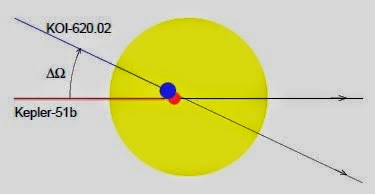
 
http://sciencythoughts.blogspot.co.uk/2014/07/conformation-of-third-planet-in-kepler.htmlConformation of the third planet in the Kepler-51 System.                                               Kepler-51 is a G-type Yellow Dwarf star 2800 light years from Earth in the constellation of Cygnus. It has a...
Follow Sciency Thoughts on Facebook.

Friday, 4 April 2014

The planet Mars passes the Earth.

The planet Mars will make its closest pass to the Earth since December 2007, coming within 92 000 000 km of us on 14 April 2014. This will make the planet a particularly bright object, visible in the night sky from anywhere on Earth in the constellation of Virgo, close to the star Spica.

The relative positions of Earth and Mars on 14 April 2014 (not to scale). Windows to the Universe.

Mars orbits the Sun at a distance of approximately 1.52 AU (i.e. 1.52 times the distance at which the Earth orbits the Sun), completing one orbit every 687 days. However this does not mean it passes the Earth every 687 days, since the Earth is also completing one orbit every 365 days, the two planets passing approximately once every 26 months. Nor are the two planets equally separate at each pass, eccentricities in their orbits (i.e. variations in the distance between the planet and the Sun) mean that these passes cyclically become closer and more distant. The next such pass will come in June 2016, when Mars will come within 75 000 000 km of the Earth.

See also...


Follow Sciency Thoughts on Facebook.

Tuesday, 25 February 2014

GJ 504b, a cold Jovian exoplanet in a wide orbit about a Sun-like star.

In the past two decades a large number of planets have been discovered orbiting other stars (exoplanets). The vast majority of these have been large planets orbiting close to their host stars, such planets being easier to detect due to the influence that their gravity has on the star. Planets further from their stars are harder to detect, as their gravity has less effect upon the star, and they have long orbital periods which will tend to mask this anyway. Such planets are more likely to be detected by direct imaging, though this will require separate observations over a long period of time to confirm the relationship with the host star.

In a paper published on the online arXiv database at the Cornell University Library on 12 August 2013 and in The Astrophysical Journal on 1 September 2013, a team of scientists led by Masayuki Kuzuhara of the Department of Earth and Planetary Science at The University of Tokyo and the National Astronomical Observatory of Japan and the Department of Earth and Planetary Sciences at the Tokyo Institute of Technology describe the detection of a superjovian planet orbiting the Sun-like star GJ 504 at a distance of 43.5 AU (i.e. 43.5 times the distance between the Earth and the Sun).

GJ 504 (or Gliese 504 or 59 Virginis) is 57 light years from Earth in the constellation of Virgo. It is a G-type Yelow Dwarf Star estimated to have 1.22 times the mass of the Sun, and to be about 160 million years old.Kuzahara et al. observed this star using the Subaru Telescope operated by the National Astronimical Observatory of Japan on Mauna Kea, Hawaii, between 26 March 2011 and 25 May 2012.

These observations enabled them to detect a smaller object close to the star, and establish that it is in fact gravitationally bound (orbiting) the larger body. The planet is named GJ 504b (Gliese 504b), making the parent body GJ 504A (when naming bodies in stellar systems other than our own, stars are indicated with an upper case letter and planets with a lower case letter.

Image of GJ 504A and GJ 504b produced by the Subaru 8.2 m telescope on Mauna Kea. Kazahara et al. (2013).

GJ 504b is thought to have a mass approximatelly four times that of Jupiter, making it the largest planet discovered by direct imaging (larger planets have previously been discovered by the influence of their gravity on their parent stars, but these have all been to close to their stars for direct imaging), and to orbit the star GJ 504A at a distance of 43.5 AU, making it amoungst the fursthest planets from its parent star yet discovered. The planet is thought to have an effective surface temperature of 510 k (237°C), making it the coolest superjovian lanet yet discovered.


Follow Sciency Thoughts on Facebook.

Friday, 30 March 2012

The atmosphere of WASP-24b.

WASP-24 is an F-type star in the constellation of Virgo, 1076 light years from Earth. It has an effective temperature of 6075 K, compared to 5778 K for our Sun, is 1.13 times as massive as the Sun and has 6.32 times the Sun's volume. In 2009 a Hot Jupiter type planet was discovered orbiting WASP-24 by the SuperWASP planetary survey. This planet, WASP-24b, orbits the star at a distance of 0.0359 AU (3.59% of the distance between the Earth and the Sun), completing one orbit every 56.2 hours and is 1.01 times as massive as Jupiter, with 11 times Jupiter's volume (it is much less dense than Jupiter because it is much hotter, due to the heat from the nearby star, and therefore occupies more volume).

WASP-24b, compared to the planets of our Solar System. The Visual Exoplanet Catalogue.

In a paper published in the online arXiv database at Cornell University Library on 27 March 2012, and accepted for publication in the journal Astronomy & Astrophysics, a team of scientists led by Alexis Smith of the Astrophysics Group at Keele University describe the results of a study of the atmosphere of WASP-24b, using the Spitzer Space Telescope and the CAHA 2.2-m telescope at Calar Alto, Spain, combined with data previously collected by the SuperWASP-N and WASPSouth telescopes, the Liverpool, Faulkes North and Faulkes South Telescopes, and the Nordic Optical Telescope.

Smith et al. analyzed data from occultations of WASP-24 by WASP-24b, that is to say times when the planet passed in front of the star, in order to determine how shining through the atmosphere of the planet altered light from the star. From this they were able to determine that the atmosphere of WASP is reasonably clear; whereas other Hot Jupiter type planets have been shown to have opaque clouds of titanium and vanadium oxides.

From this they deduct that WASP-24b lacks a thermal inversion, a cool layer above and bellow which the temperature rises. On planets such as Earth or Jupiter, where such inversions exist, gasses precipitate out as liquids (or sometimes solids) in this layer, forming clouds. On WASP-24b, however, this will never happen, liquids that evaporate here will never reach a cool layer in the atmosphere, and will not precipitate back out, either remaining as gasses in the atmosphere, or being lost into space.

Thursday, 29 December 2011

Planets in the NY Virginis system.

NY Virginis is an eclipsing binary system roughly 2000 light years from the Earth in the constellation of Virgo. The name NY Virginis implies the 258th variable star in the constellation of Virgo. The system is also known as PG1336-018, where the PG stands for 'Palomar Green'; it was discovered during the Palomar Green survey.

The system is made up of two stars referred to as M₁ and M₂. M₁ has a mass of approximately 46% of that of our sun, but is over six times as hot (33 000 K as opposed to 5578 K for our sun). It is an 'Extreme Horizontal Branch' blue-white subdwarf-star, where the 'Extreme Horizontal Branch' refers to the position on a graph where colour/temperature is plotted against temperature. Stars of this type have run out of hydrogen in their core and expanded to form Red Giant stars, in which helium is fused in the core and hydrogen in the outer layers, then lost these outer layers for some reason (probably in this case interaction with M₂), exposing the helium-fusing core.

Orbiting this at a distance of slightly under 5 million km is M₂, a Red Dwarf star with 14% of the mass of our sun and a temperature of about 3000 K. Red Dwarfs are small, cool stars which do not get particularly hot due to their low mass, but subsequently burn for much longer than larger stars.

This month a study of the system by a team lead by SB Qian of the Yunnan Observatory was published in a paper on the arXiv database at Cornell University Library. Qian et al. combined data from an earlier study of the system by the South African Astronomical Observatory with new data collected by the Jorge Sahade Telescope in Argentina and the Yunnan Observatory.

This study was able to detect irregularities in the orbit of the two stars, which they used to calculate the existence of a planet with a mass of 2.3 times that of Jupiter, orbiting at a distance of 3.3 AU, that is to say 3.3 times the distance at which the Earth orbits the Sun, or twice the distance at which Mars orbits, every 2900 days. Qian et al. refer to this planet as M₃, but it is referred to elsewhere as NY Virginis b, or NY Vir b. This is inaccurate; using conventional numbering for the system M₁ would be NY Virginis A, M₂ would be NY Virginis B and M₃ would be NY Virginis c; since all bodies in the system are lettered, stars with a capitol and planets with a lower case letter.

The inclusion of M₃ in the model still does not completely resolve the irregularities in the two stars orbits. Qian et al. therefore infer a second planet, with a mass of about 2.5 times that of Jupiter, orbiting roughly once every 15 Earth years.

An artist's impression of a binary system with two planets. By scientific illustrator Mark A. Garlick.

Qian et al. also attempt to model the history of the NY Virginis system. As noted above, M₂ orbits M₁ at a distance of only 5 million km, but it cannot have been this close throughout the history of the system. Qian et al. calculate that if M₁ had originally had a mass the same as our sun (which is an arbitrary figure, but works for modeling the evolution of the system), then it would have grown till its radius was roughly 0.5 AU - half the radius of Earth's orbit, or slightly greater than the orbit of Mercury. In this model if M₂ had originally orbited M₁ at a distance of 0.8 AU (a slightly greater distance than that at which Venus orbits the sun) then once M₁ reached a radius of 0.5 AU, then M₂ would have started to tear away the outer atmosphere of M₁. This would have slowed down M₂ in its orbit, causing it to spiral inwards towards M₁, stabilizing in its current orbit once the outer atmosphere of M₁ was used up.