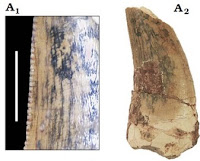
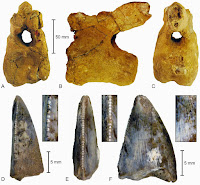
The Abelisaurids were a curious group of large Theropod Dinosaurs that diverged away from the main Theropod lineage, that went on to produce forms such as the Allosaurids, Tyranosaurids and Maniraptors, early in the group’s history. Abelisaurids tended to be short faced, with some species having horns of uncertain purpose. Many Abelisaurids followed the common Theropod evolutionary path of having forelimbs reduced in size, though some species also appeared to have had shortened hindlimbs. Despite these curiosities Abelisaurids appear to have been the dominant group of predatory Dinosaurs in the Cretaceous of South America, India and Madagascar, with occasional specimens being found in North America and Asia. The presence of Abelisaurids in Africa is less well understood, though there have been several recent discoveries of Abalisaurid specimens in North Africa, particularly Morocco.
In a paper published in the journal PLoS One on 2 April 2019, Slimane Zitouni of the Département de Géologie at the Université Cadi Ayyad, and the Muséum d’Histoire Naturelle de Marrakech, Christian Laurent of the National Oceanography Centre, and the Department of Geology at Babes-Bolyai University, Gareth Dyke, also of the Department of Geology at Babes-Bolyai University, and of the Department for Evolutionary Zoology at the University of Debrecen, and Nour-Eddine Jalil, also of the Département de Géologie at the Université Cadi Ayyad, and of the Muséum national d’Histoire naturelle, describe a partial ilium of an Abelisaurid Dinosaur from the Late Cretaceous Kem Kem Beds of Morocco.
The Kem Kem Beds of southeastern Morocco and neighbouring areas of Algeria are noted for the production of numerous Late Cretaceous Vertebrate fossils, including Fish, Crocodylomorphs, Turtles, and Dinosaurs, particularly large Theropods. These fossils appear to have come from a wide range of environments, and are poorly sorted stratigraphically (i.e. not arranged in time related order), and are generally thought to be the result of geological mixing.
Commercial fossil collecting has become a significant industry in Morocco in recent decades, with commercial collectors highly variable in the level of care they employ in retrieving fossils. Some are extremely careful in how they remove fossils from the sediment, and carefully record the strata from which the fossils were obtained. Others take a more haphazard approach, seeking to obtain as much material as quickly as possible, making few records, frequently damaging specimens, and often abandoning finds thought to have insufficient commercial value.
The specimen described by Zitouni et al., MHNM KK04, was found by a commercial fossil collector in 2007 and later sold to Gareth Dyke and Nour-Eddine Jalil, who deposited it in the collection of the Natural History Museum of Marrakech. At the time when it was found the specimen had already been excavated by an earlier, unknown collector, and was free of any matrix (surrounding rock) and fractured into several pieces.
The specimen comprises the ilium of a Theropod Dinosaur, with an incomplete iliac blade, a damaged anterior process, and further damage to the underside of the pubic peduncle, all of which damage appears to have been caused during the extraction process, with fresh surfaces exposed where the damage was caused. The absence much of the pubic peduncle, the anterior process and the anterior side of the iliac blade means that a lot of the material that would generally be used to classify a bone of this type is missing, but the fact that the iliac blade is elongate and sub-rounded, rather than truncated or tapered, the fact that the brevis fossa is deep and broadens towards the posterior, and the shape of the dorsal margin of the illium are together taken to indicate that the specimen is an Abelisaurid.

The Kem Kem Beds of southeastern Morocco and neighbouring areas of Algeria are noted for the production of numerous Late Cretaceous Vertebrate fossils, including Fish, Crocodylomorphs, Turtles, and Dinosaurs, particularly large Theropods. These fossils appear to have come from a wide range of environments, and are poorly sorted stratigraphically (i.e. not arranged in time related order), and are generally thought to be the result of geological mixing.
Commercial fossil collecting has become a significant industry in Morocco in recent decades, with commercial collectors highly variable in the level of care they employ in retrieving fossils. Some are extremely careful in how they remove fossils from the sediment, and carefully record the strata from which the fossils were obtained. Others take a more haphazard approach, seeking to obtain as much material as quickly as possible, making few records, frequently damaging specimens, and often abandoning finds thought to have insufficient commercial value.
The specimen described by Zitouni et al., MHNM KK04, was found by a commercial fossil collector in 2007 and later sold to Gareth Dyke and Nour-Eddine Jalil, who deposited it in the collection of the Natural History Museum of Marrakech. At the time when it was found the specimen had already been excavated by an earlier, unknown collector, and was free of any matrix (surrounding rock) and fractured into several pieces.
The specimen comprises the ilium of a Theropod Dinosaur, with an incomplete iliac blade, a damaged anterior process, and further damage to the underside of the pubic peduncle, all of which damage appears to have been caused during the extraction process, with fresh surfaces exposed where the damage was caused. The absence much of the pubic peduncle, the anterior process and the anterior side of the iliac blade means that a lot of the material that would generally be used to classify a bone of this type is missing, but the fact that the iliac blade is elongate and sub-rounded, rather than truncated or tapered, the fact that the brevis fossa is deep and broadens towards the posterior, and the shape of the dorsal margin of the illium are together taken to indicate that the specimen is an Abelisaurid.

Abelisaur (indeterminate), right ilium (MHNM KK 04). A lateral view; B medial view; C Anterior; D dorsal and E Posterior view. Abbreviations: Csa, supra-acetabular abutment; Pi, ischial peduncle; P.ps posterior process. Scale bar is 10 cm. Zitouni et al. (2019).
See also...