Showing posts with label Babinskaiidae. Show all posts

Sunday, 27 May 2018

Parababinskaia makarkini: A new species of Babinskaiid Lacewing from Cretaceous Burmese Amber.

The Babinskaiidae are an extinct family of Lacewings (Neuroptera) best known from the Early Cretaceous Crato Formation of Brazil, as well as from the Zaza Formation of southern Siberia and Burmese Amber deposits from Kachin State, Myanmar. They are small Lacewings, with forewings 9-12.7 mm in length, differentiated from other groups by the venation of their forewings (very few specimens have preserved hindwings). To date only nine species of Babinskaiid have been described, from the Early Cretaceous Crato Formation of Brazil and Zaza Formation of Russia, and from Middle Cretaceous Burmese Amber.

In a paper published in the journal ZooKeys on 4 April 2018, Jiahui Hu and Xiumei Lu of the Department of Entomology at the China Agricultural University, Bo Wang of the State Key Laboratory of Palaeobiology and Stratigraphy at the Nanjing Institute of Geology and Palaeontology of the Chinese Academy of Sciences, and Xingyue Liu, also of the Department of Entomology at the China Agricultural University, describe a new species of Babinskaiid Lacewing from Cretaceous Burmese Amber.

Cretaceous ‘Burmese Amber’ has been extensively worked at several sites across northern Myanmar (though mostly in Kachin State) in the last 20 years. The amber is fairly clear, and often found in large chunks, providing an exceptional window into the Middle Cretaceous Insect fauna. This amber is thought to have started out as the resin of a Coniferous Tree, possibly a Cypress or an Araucaria, growing in a moist tropical forest. This amber has been dated to between 105 and 95 million years old, based upon pollen inclusions, and to about 98.8 million years by uranium/lead dating of ash inclusions in the amber. 

The new species is placed in the genus Parababinskaia, which contains only one previously described species, from the Crato Formation of Brazil, and given the specific name makarkini, in honour of the entomologist Vladimir Makarkin, for his work on fossil Neuroptera. The new species is described from two specimens, a male and a female, in separate pieces of clear amber.

Parabinskaia makarkini, male specimen in dorsal view. Scale bar is 1.0 mm. Hu et al. (2018).

The male has a body length of 11.20 mm, and a forewing length of 11.11 mm, the female has a bodylength of 10.68 mm and a forewing length of 13.05 mm. Both have Both sexes have large, semi-globular compound eyes and two domed areas on the head. The thorax is robust, the legs long and the forewing broader than the hindwing.

Parabinskaia makarkini, female specimen in dorsal view. Scale bar is 1.0 mm. Hu et al. (2018).

See also...
http://sciencythoughts.blogspot.co.uk/2018/03/stictosisyra-pennyi-new-species-of.htmlhttp://sciencythoughts.blogspot.co.uk/2017/11/spilosmylus-spilopteryx-spilosmylus.html
http://sciencythoughts.blogspot.co.uk/2017/09/lithochrysa-borealis-new-species-of.htmlhttp://sciencythoughts.blogspot.co.uk/2017/08/cretaconiopteryx-grandis-new-species-of.html
http://sciencythoughts.blogspot.co.uk/2017/07/parababinskaia-elegans-new-species-of.htmlhttp://sciencythoughts.blogspot.co.uk/2016/11/lasiosmylus-longus-new-species-of.html
Follow Sciency Thoughts on Facebook.

Friday, 21 July 2017

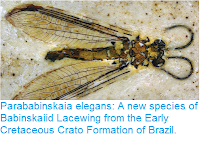
Parababinskaia elegans: A new species of Babinskaiid Lacewing from the Early Cretaceous Crato Formation of Brazil.

The Babinskaiidae are an extinct family of Lacewings (Neuroptera) best known from the Early Cretaceous Crato Formation of Brazil, as well as from the Zaza Formation of southern Siberia and Burmese Amber deposits from Kachin State, Myanmar. They are small Lacewings, with forewings 9-12.7 mm in length, differentiated from other groups by the venation of their forewings (very few specimens have preserved hindwings).

In a paper published in the journal Cretaceous Research on 15 June 2017, Vladimir Makarkin of the Federal Scientific Center of the East Asia Terrestrial Biodiversity of the Far Eastern Branch of the Russian Academy of Sciences, Sam Heads of the Illinois Natural History Survey at the University of Illinois at Urbana-Champaign, and Sonja Wedmann of the Messel Research Station of the Senckenberg Research Institute, describe a new species of Babinskaiid Lacewing from the Crato Formation, as part of a wider review of the group.

The new species is named Parababinskaia elegans, where ‘Parababinskaia’ means ‘beside-Babinskaia’ in reference to another genus which it resembles., and ‘elegans’ means ‘elegant’, in reference to the quality of the specimen from which it is described. The species is described from a single specimen from the collection of the Illinois Natural History Survey. This specimen is preserved in a slab of finely laminated limestone, and is almost complete, lacking only the legs and detail of the forewings missing (unusually the hindwings are extremely well preserved). 

Parababinskaia elegans; specimen as preserved (wetted with ethanol). Scale bar represents 2 mm. Jared Thomas in Makarkin et al. (2017).

See also...

http://sciencythoughts.blogspot.co.uk/2016/11/lasiosmylus-longus-new-species-of.htmlhttp://sciencythoughts.blogspot.co.uk/2016/08/paleosisyra-minor-new-species-of.html
http://sciencythoughts.blogspot.co.uk/2016/02/butterflies-of-jurassic-convergent.htmlhttp://sciencythoughts.blogspot.co.uk/2015/12/glenochrysa-minima-new-species-of-green.html
http://sciencythoughts.blogspot.co.uk/2014/07/a-silky-lacewing-from-eocene-of.htmlhttp://sciencythoughts.blogspot.co.uk/2014/05/a-new-species-of-osmylid-from-middle.html
Follow Sciency Thoughts on Facebook.