
Asteroid 2013 ND15 was discovered on 13 July 2013 by Natalia Primak, Alfred Schultz, Thomas Goggia and Ken Chambers working at the Pan-STARRS 1 project on Mount Haleakala, Hawaii. Its discovery was confirmed by follow-up observations by the Cerro Tololo Observatory and the 3.6 m Canada-France-Hawaii Telescope from Mauna Kea. It has an elliptical orbit which takes it from 0.28 AU from the Sun (28% of the average distance between the Earth and the Sun, considerably inside the orbit of Mercury) to 1.17 AU from the Sun (117% of the average distance at which the Earth orbits the Sun). This gives it a semi-major axis (average distance from the Sun) of 0.7235 AU, very close to that of Venus (0.7233 AU); it also has an orbital period very close to that of Venus, 224.79 days, compared to the 224.70 year of Venus (planets are considered to have years, but asteroids have orbital periods). As such the asteroid can be considered a Venus co-orbital candidate.

The calculated orbit of 2013 ND15. JPL Small Body Database Browser.
In a paper published in the Monthly Notes of the Royal Astronomical Society on 15 February 2014, and on the arXiv Database at Cornell University Library on 4 February 2014, Carlos and Raúl de la Fuente Marcos of the Universidad Complutense de Madrid, present a study of the orbit of 2013 ND15, and the three previously described Venus co-orbitals, (322756) 2001 CK32, 2002 VE68 and 2012 XE133.
Such asteroids have thought to be somewhat of a rarity, as they are subjected to the disruptive influences of the gravity of the three innermost planets (Earth, Venus, Mercury and the Sun are all closer together than Earth is to Mars). Venus co-orbitals are locked into a 1:1 resonance with Venus (i.e. they complete 1 orbit for every orbit of Venus, even it their orbital paths are somewhat different), but are also in a 9:23 resonance with Mercury and an 8:13 resonance with Earth. Resonance orbits occur when two bodies pass close to each other and exchange some orbital momentum, causing one body to slow and the other to speed up. In practice when the two bodies are a planet and an asteroid the effect on the planet is negligible, while the asteroid is sped up and slowed down with each pass until it is either trapped in a resonant orbit or ejected into a completely different orbit. Repeated close encounters with three planets is thought likely to result in extremely chaotic, unstable orbits. However the number of bodies discovered in this part of the Solar System is slowly growing.
(322756) 2001 CK32 was discovered on 13 February 2001 by the Massachusetts Institute of Technology's Lincoln Near Earth Asteroid Research Laboratory in Socorro, New Mexico. The designation 2001 CK32 indicates that it was the 811th asteroid (asteroid K32) discovered in the first half of February 2001 (period 2001 C). It has an 226 day orbital period that takes it from 0.44 AU from the Sun (44% of the distance at which the Earth orbits the Sun, slightly outside the orbit of Mercury) to 1.003 AU from the Sun (100.3% of the distance at which the Earth orbits the Sun). As such it has a Venus crossing, Earth crossing and Mercury Grazing orbit, and is classified as an Aten Family Asteroid (an asteroid with an Earth crossing orbit that is on average closer to the Sun than the Earth is), a Near Earth Asteroid and a Potentially Hazardous Asteroid.

The calculated orbit of (322756) 2001 CK32. JPL Small Body Database.
A Potentially Hazardous Asteroid is currently defined as an asteroid with an absolute magnitude of 22 or less (which corresponds roughly to a diameter of 150 m for an object with a 13% albedo) that passes within 0.05 AU of the Earth (asteroids with Earth-crossing orbits may not do this if their orbit is sufficiently inclined to the plane of the Solar System that they pass above or below the Earth), though this is likely to be changed in the future as it has been realized in the aftermath of the Chelyabinsk Bolide incident that smaller or darker objects can be quite dangerous.
(322756) 2001 CK32 is considered to be a horseshoe-quasi-satellite orbiter of Venus; that is to say an object that appears to describe a horseshoe shape when seen from another, larger object. This is caused by the smaller body moving in an orbit slightly faster than the larger object, until it catches up with that object, when it looses some inertial energy to the larger body. This causes the larger body to speed up slightly (though probably not perceptibly), and the smaller body to slow down. The smaller body then slows down relative to the larger body, until the larger body catches up with it, at which point a second exchange of inertial energy takes place, causing the smaller body to accelerate and the larger body to slow down, a state of affairs that can potentially continue indefinitely..

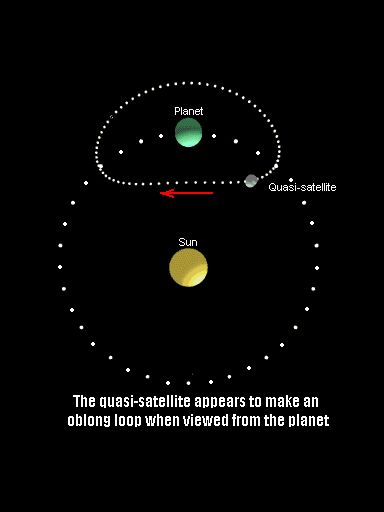
How a horseshoe-quasi-satellite orbit works; the quasi-satellite body has an elliptical orbit, but from the other body this appears horse-shoe shaped. Western University.
2002 VE68 was discovered on 11 November 2002 by the Lowell Observatory in Flagstaff, Arizona. The designation 2002 VE68 implies that it was the 1705th asteroid (asteroid E68) discovered in the first half of November 2002 (period 2002 V). It has an 225 day orbital period that takes it from 0.43 AU from the Sun (43% of the distance at which the Earth orbits the Sun, slightly outside the orbit of Mercury) to 1.02 AU from the Sun (102% of the distance at which the Earth orbits the Sun). As such it has a Venus crossing, Earth crossing and Mercury Grazing orbit, and is classified as an Aten Family Asteroid, a Near Earth Asteroid and a Potentially Hazardous Asteroid.

The calculated orbit of 2002 VE68. JPL Small Body Database Browser.
2012 XE133 was discovered on 12 December 2012 by the University of Arizona's Catalina Sky Survey, which is located in the Catalina Mountains north of Tucson. The designation 2012 XE133 implies that it was the 3330th asteroid (asteroid E133) discovered in the first half of December 2012 (period 2012 X). It has an 225 day orbital period that takes it from 0.41 AU from the Sun (41% of the distance at which the Earth orbits the Sun, slightly outside the orbit of Mercury) to 1.04 AU from the Sun (104% of the distance at which the Earth orbits the Sun). As such it has a Venus crossing, Earth crossing and Mercury Grazing orbit, and is classified as an Aten Family Asteroid (an asteroid with an Earth crossing orbit that is on average closer to the Sun than the Earth is), a Near Earth Asteroid and a Potentially Hazardous Asteroid.

The calculated orbit of 2012 XE133. JPL Small Body Database Browser.
De la Fuente Marcos and de la Fuente Marcos calculate that 2013 ND15 is a Venus-Trojan Asteroid, following a tadpole orbit around Venus’s L1 Lagrangian Point; i.e. it has an orbit which revolves around the Legrange Point, trailing further behind when it is furthest from Venus, giving the orbit a 'tadpole' shape..
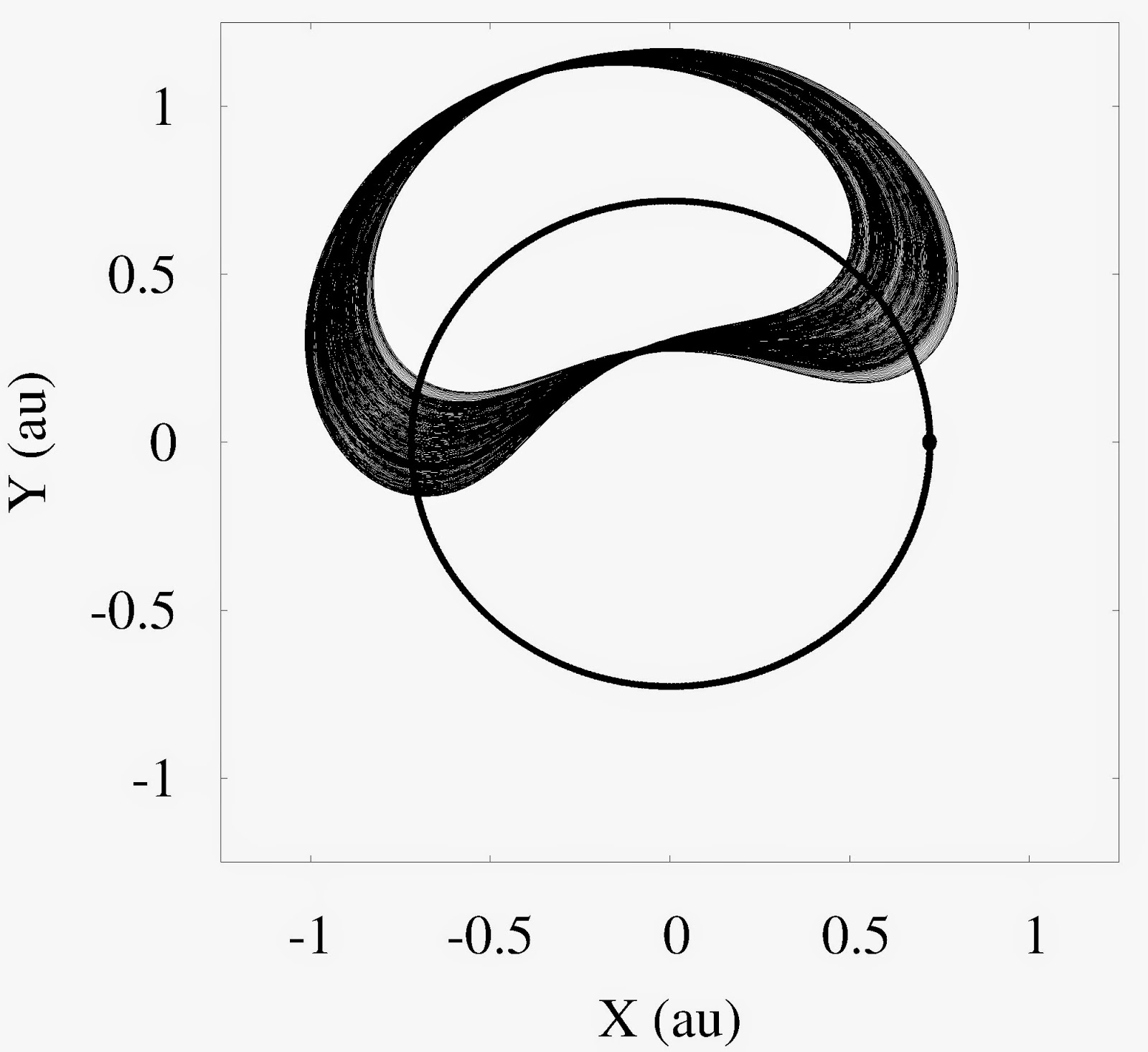
The motion of 2013 ND15 over the time range (-200, 50) years is displayed projected on to the ecliptic plane in a coordinate system rotating with Venus. The orbit and position of Venus are also indicated. De la Fuente Marcos & de la Fuente Marcos (2014).
De la Fuente Marcos and de la Fuente Marcos estimate that 2013 ND15 has been a Venus co-orbital for several thousand years, but that time it has changed the nature of its orbit several times, being variously an L1 Trojan Asteroid, an L5 Trojan Asteroid, a quasi-satellite and a horseshoe-orbiter. It is likely that its orbit will evolve further due to close encounters with the inner planets in the next 250-500 years, in particular a close encounter with Earth in about 250 years time, when it will come within 0.003 AU of Earth (448 800 km).
Because Venus co-orbital asteroids (and Aten Family Asteroids in general) are thought to be extremely rare, current searches for Near Earth Asteroids do not specifically target them, and all the bodies discovered so far have been discovered incidentally by searches looking for different types of objects. De la Fuente Marcos and de la Fuente Marcos estimate that there may be as many as 28 more large, bright objects (bigger than 150 m in diameter) in Venus co-orbital pathways, and many more smaller bodies. They further predict that the forthcoming Gaia mission will be better positioned to detect such bodies.
See also…
 Asteroid (163132) 2002 CU11 passes the Earth.
Asteroid (163132) 2002 CU11 passed by the Earth at a distance of about 5 188 000 km (13.50 times the average distance between the Earth and the Moon, or...
 Venus at perihelion.
The planet Venus will reach perihelion (the closest point on its orbit to the Sun) at 3.3p pm GMT on Friday 5 September 2014, when it will be 0.718 440 AU...
 Asteroid 2014 QD364 passes the Earth.
Asteroid 2014 QD364 passed by the Earth at a distance of 2 332 000 km (6.07 times the average distance between the Earth and the Moon, or 1.6% of the...
Follow Sciency Thoughts on Facebook.


.jpg)
+2010+KR59.jpg)
+2010+EN65.jpg)

