Showing posts with label Hangingflies. Show all posts

Thursday, 17 December 2015

Possible Wasp-mimcry in a Mexican Hangingfly.

Hangingflies, Bittacidae, are highly specialized Scorpionflies, Mecoptera, noted for their resemblance to Crane Flies (which are True Flies, Diptera, and only have a single pair of wings) and their tendency to hang upside down in wait for prey. Like other Scorpionflies they are a rellict group today, with only about 170 species known worldwide (and most of those extremely rare), but were an important part of Insect faunas in the Jurassic, before Angiosperms (Flowering Plants) and associated Insects came to dominate terrestrial ecosystems.

The genus Eremobittacus is known from two species, Eremobittacus spinulatus and Eremobittacus sodalium, both of which are known from single male specimens from Mexico. To date attempts to find further specimens of either species, particularly females and juveniles, have proved futile, despite some extensive searches in the areas from which they were first described.

In a paper published in the journal ZooKeys on 23 November 2015, Fernando Villagomez of the Laboratorio de Ecología y Sistemática de Microartrópodos at the Universidad Nacional Autónoma de México, Atilano Contreras-Ramos of the Departamento de Zoología at the Universidad Nacional Autónoma de México and Yesenia Marquez-López of the Maestría en Biología at the Universidad Autónoma Metropolitana-Iztapalapa describe a series of specimens of Eremobittacus spinulatus discovered in the collection of the National Collection of Insects of the Institute of Biology of the Universidad Nacional Autónoma de México. 

The series comprises six specimens, three male and three female, that were collected in Oaxaca State in 1998, close to the area where the species was discovered in 1997 and in an area where further specimens were being actively sought, though they were apparently not recognized at the time (this is not as surprising as it sounds; Hangingflies are rare insects that most entomologists are unlikely to be familiar with, and the original description of Eremobittacus spinulatus was published in an American journal in English, before it was possible to search journals quickly online).

Eremobittacus spinulatus (1) male and (2) female. Villagomez et al. (2015).

The specimens show marked sexual dimorphism, with enlarged upper hind legs on the males, which is very unusual in Hangingflies. In addition the species is extremely Wasp-like in appearance, which could possibly be an indicator of mimicry in the species. Although predatory themselves, Hangingflies are subject to predation by a variety of other animals, including Spiders, Damselflies, Robber Flies and Assassin Bugs, against which they have few defenses. This would make resembling a Wasp highly advantageous, as Wasps have powerful stings, strong mandibles and are generally aggressive, so that many predators tend to avoid them. However in order for such mimicry to be effective it would be necessary for the Hangingfly to exhibit Wasp-like behavior, such as actively foraging for prey, rather than hanging upside down in wait. Such behavior is known in some Hangingflies, so it is a possibility for Eremobittacus spinulatus, though observation of living specimens would be needed before this could be confirmed.

See also...

http://sciencythoughts.blogspot.co.uk/2014/12/four-new-species-of-hangingflies-from.htmlFour new species of Hangingflies from the Middle Jurassic of Inner Mongolia.       Hangingflies, Bittacidae, are large members of the Scorpionfly order, Mecoptera, which resemble the more widespread Craneflies (members of the True Fly order, Diptera) both in morphology and lifestyle, although...
Hangingflies are long legged Scorpionflies (Mecoptera), a group of insects related to the True Flies. Scorpionflies get their name from the reproductive organs of the males of some species, which resemble the tails of Scorpions. Despite this fierce appearance most species are harmless herbivores, though it is thought that fleas are highly...
Earwigflies (Meropeidae) are a small group within the Mecoptera (Scorpionflies), known only from four fossil and two modern species. Three of the fossil species are from the Triassic of Kyrgyzstan, and the fourth from the Jurassic of Siberia, while the two modern species, Merope tuber and Austromerope poultoni are from North America and Australia respectively. Little is known of the biology of these Insects, the larvae having never...


Follow Sciency Thoughts on Facebook.

Tuesday, 30 December 2014

Four new species of Hangingflies from the Middle Jurassic of Inner Mongolia.


Hangingflies, Bittacidae, are large members of the Scorpionfly order, Mecoptera, which resemble the more widespread Craneflies (members of the True Fly order, Diptera) both in morphology and lifestyle, although the two groups are easily separated, as Hangingflies have two pairs of wings and Craneflies only one. Hangingflies uncommon today, with about 270 species known worldwide, but are thought to have been far more abundant and diverse in the Jurassic, before Flowering Plants and associated Insects came to dominate terrestrial ecosystems.

In a paper published in the journal ZooKeys on 19 December 2014, Sulin Liu, Chungkun Shih and Dong Ren of the College of Life Sciences at Capital Normal University describe four new species of Hangingflies from the Middle Jurassic Jiulongshan Formation of Inner Mongolia. The Jiulongshan Formation comprises a series of grey tuffaceous sandstones and sandy mudstones which has produced a large number of extremely detailed fossils of a wide variety of insects, including Moths, Hangingflies, Wasps, True Flies, Lacewings and many extinct groups.

The first new species described is placed in the genus Mongolbittacus, which to date has been known only from a single species from the Jiulongshan Formation, and given the specific name speciosus meaning ‘showy’. This species is described from a single male specimen, preserved in lateral view as part and counterpart from within a split block. This specimen is 8.8 mm in length and preserved with all four wings held open and separated from one-another.

Mongolbittacus speciosus, photo of part. Scale bar is 3 mm. Liu et al. (2014).

The second new species is also placed in the genus Mongolbittacus, and is given the specific name oligophlebius, meaning ‘few veins’ in reference to the low number of crossveins on the the wings. This species is described from two specimens, both preserved as part and counterpart from split blocks. The first is only partially exposed, with only one forewing and the forepart of the body visible, the second is preserved with the limbs folded over the body.

Mongolbittacus oligophlebius, first specimen, photo of part. Scale bar is 3 mm. Liu et al. (2014).

The third specimen is placed in the genus Exilibittacus, which is also known to date from a single species from the Jiulongshan Formation, and given the specific name foliaceus, meaning ‘leafshaped’, in reference to the shape of the wings. This species is described from a single female specimen, 12.9 mm in length, preserved in dorsal view on a split block.

Exilibittacus foliaceus, female specimen in dorsal view. Scale bar is 3 mm. Liu et al. (2014).

The final new species is also placed in the genus Exilibittacus, and is given the specific name plagioneurus, meaning ‘oblique veined’, in reference to the oblique crossveins on its wings. The species is described from a single female specimen, preserved in dorsal view as part and counterpart from a split block.

Exilibittacus plagioneurus, dorsal view of part. Scale bar is 3 mm. Liu et al. (2014).

See also…

Hangingflies are long-legged Scorpionflies (Mecoptera), a group of insects related to the True Flies. Scorpionflies get their name from the reproductive organs of the males of some species, which resemble the tails of Scorpions. Despite this fierce appearance most species are harmless herbivores, though it is thought that fleas are highly...
Earwigflies (Meropeidae) are a small group within the Mecoptera (Scorpionflies), known only from four fossil and two modern species. Three of the fossil species are from the Triassic of Kyrgyzstan, and the fourth from the Jurassic of Siberia, while the two modern species, Merope tuber and Austromerope poultoni are from North America and Australia respectively. Little is known of the biology of these Insects, the larvae having never...
The Scorpionflies (Mecoptera) are a group of insects related to the True Flies. They get their name from the reproductive organs of the males of some species, which resemble the tails of Scorpions. Despite this fierce appearance most species are harmless...


Follow Sciency Thoughts on Facebook.

Monday, 5 May 2014

A Hangingfly from the Early Cretaceous Jehol Biota.

Hangingflies are long-legged Scorpionflies (Mecoptera), a group of insects related to the True Flies. Scorpionflies get their name from the reproductive organs of the males of some species, which resemble the tails of Scorpions. Despite this fierce appearance most species are harmless herbivores, though it is thought that fleas are highly specialised members of the group, and the True Flies, Butterflies and Moths may have evolved from the group in the Mesozoic. The group has a fossil record dating back to the Permian, and it has been suggested that the Scorpionflies were the first Insects to pollinate plants, possibly pollinating gymnospermous plants in the Jurassic before the origin of true flowering plants.

In a paper published in the journal Acta Geologica Sinica in February 2014, Wang Chen, Shih Chungkun and Ren Dong of the Key Laboratory of Insect Evolution and Environmental Changes at the College of Life Sciences at Capital Normal University describe a new species of Hangingfly from the Early Cretaceous Yixian Formation of Liutiaogou in Inner Mongolia, part of the Jehol Biota.

The new species is considered to be a member of the Cimbrophlebiidae, an extinct family of Hangingflies known from the Middle Jurassic to the the Early Eocene, but not previously described from the Jehol Biota. It is placed in the genus Cimbrophlebia and given the specific name rara, meaning rare. It is described from a single specimen preserved as part and counterpart within a split block.

Cimbrophlebia rara, part (a) and counterpart (b). Wang et al. (2014).

See also...


Follow Sciency Thoughts on Facebook.

Saturday, 28 December 2013

Leaf mimicry in a Jurassic Scorpionfly.

The Scorpionflies (Mecoptera) are a group of insects related to the True Flies. They get their name from the reproductive organs of the males of some species, which resemble the tails of Scorpions. Despite this fierce appearance most species are harmless herbivores, though it is thought that fleas are highly specialised members of the group, and the True Flies, Butterflies and Moths may have evolved from the group in the Mesozoic. The group has a fossil record dating back to the Permian, and it has been suggested that the Scorpionflies were the first Insects to pollinate plants, possibly pollinating gymnospermous plants in the Jurassic before the origin of true flowering plants.

In a paper published in the Proceedings  of the National Academy of Sciences of the United States of America on 26 November 2012, a team of scientists led by Yongjie Wang of the College of Life Sciences at Capital Normal University in Beijing describe a new species of Scorpionfly from the Middle Jurassic Jiulongshan Formation from Daohugou Village in Inner Mongolia, which they suggest may have been camouflaged to resemble the leaves of a Ginkgoalean Plant uppon which the Insect lived.

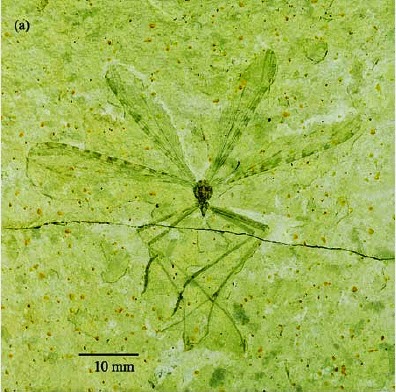
The new species is named Juracimbrophlebia ginkgofolia, where 'Juracimbrophlebia' means 'Jurassic Cimbrophlebia' (a modern genus of Scorpionfly to which Juracimbrophlebia is thought to be related) and 'ginkgofolia' means 'Ginko-leaf'. Juracimbrophlebia ginkgofolia is a ~38.5 mm Hangingfly (long-legged Scorpionfly superficially resembling a Cranefly).

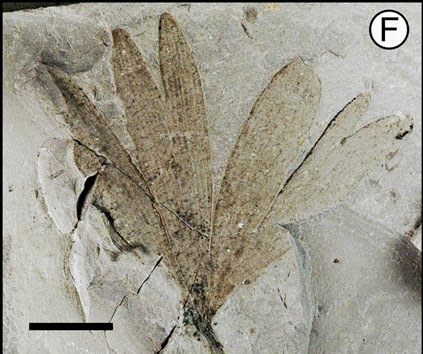
Specimens of Juracimbrophlebia ginkgofolia from the Middle Jurassic Jiulongshan Formation of Inner Mongolia. Scale bars are 10 mm. Wang et al. (2012).

The specimens were found alongside preserved leaves of the Ginkgo Yimaia capituliformis, with the Insect and Plant fossils proving confusing to separate, both in the field and the lab. Wang et al. suggest that this is a result of mimicry on behalf of the Scorpionfly, which would have been camouflaged among the leaves of the Ginkgo in life.

Leaves of Yimaia capituliformis  from the Middle Jurassic Jiulongshan Formation of Inner Mongolia. Scale bars are 10 mm. Wang et al. (2012).

 Wings of Juracimbrophlebia ginkgofolia (H&I) and leaves of Yimaia capituliformis (J&K), illustrating the similarities. Scale bars are 10 mm. Wang et al. (2012).

Reconstruction of Juracimbrophlebia ginkgofolia in life. Wang et al. (2012).


Follow Sciency Thoughts on Facebook.