Pumice is a volcanic rock, produced by the rapid cooling of gas rich lava from submarine eruptions, or high-pressure eruptions on land. The rapid cooling traps bubbles of gas within the rock, creating a very light material that will often float on water. Submarine volcanic eruptions can produce vast mats of pumice, which cover hundreds of square kilometers and persist for years, traveling vast distances across the oceans. While this is unusual on a human timescale, it is very common geologically, with 20 major events known in the last 200 years (not including the Kermadec Islands event of July/August 2012), suggesting that pumice rafts could provide a major dispersal mechanism for marine organisms.
Home Reef is a submarine volcano midway between Metis Shoal and Late Island in Tonga. It currently has a summit 10 m bellow sea-level, but sometimes rises above the waves forming ephemeral islands. In August 2006 the volcano an eruption produced a pumice raft covering over 440 km², which then drifted through the islands of Tonga and Fiji before reaching the Australian coast in March 2007, by which time it had spread out to cover about 1600 km²; roughly ⅔ of the original material is thought to have reached Australian waters.
Map showing the progress of the Home Reef pumice raft. Bryan et al. (2012).
The pumice proved to be a very good transport system for marine organisms with a short larval stage and an attached adult phase. Unlike other floating material, such as rafts of algae (Seaweed) or wood, it started out with nothing living on it, thus everything present had to reach it, but it was long-lived on the surface, due to the nature of its buoyancy, and its lack of nutritious value (biological rafts are typically broken up in the end by feeding).
The pumice was host to a wider range of organisms than found by previous studies, which had concentrated on beech-collected pumice, where typically only the remains of mineralized shells of attached organisms were found; non-mineralized organisms on stranded pumice quickly die and decay, and non-attached organisms (e.g. crabs) simply walk away. The amount of organisms growing on the pumice grew steadily as time progressed, with some organisms living long enough to spawn and produce a second generation.
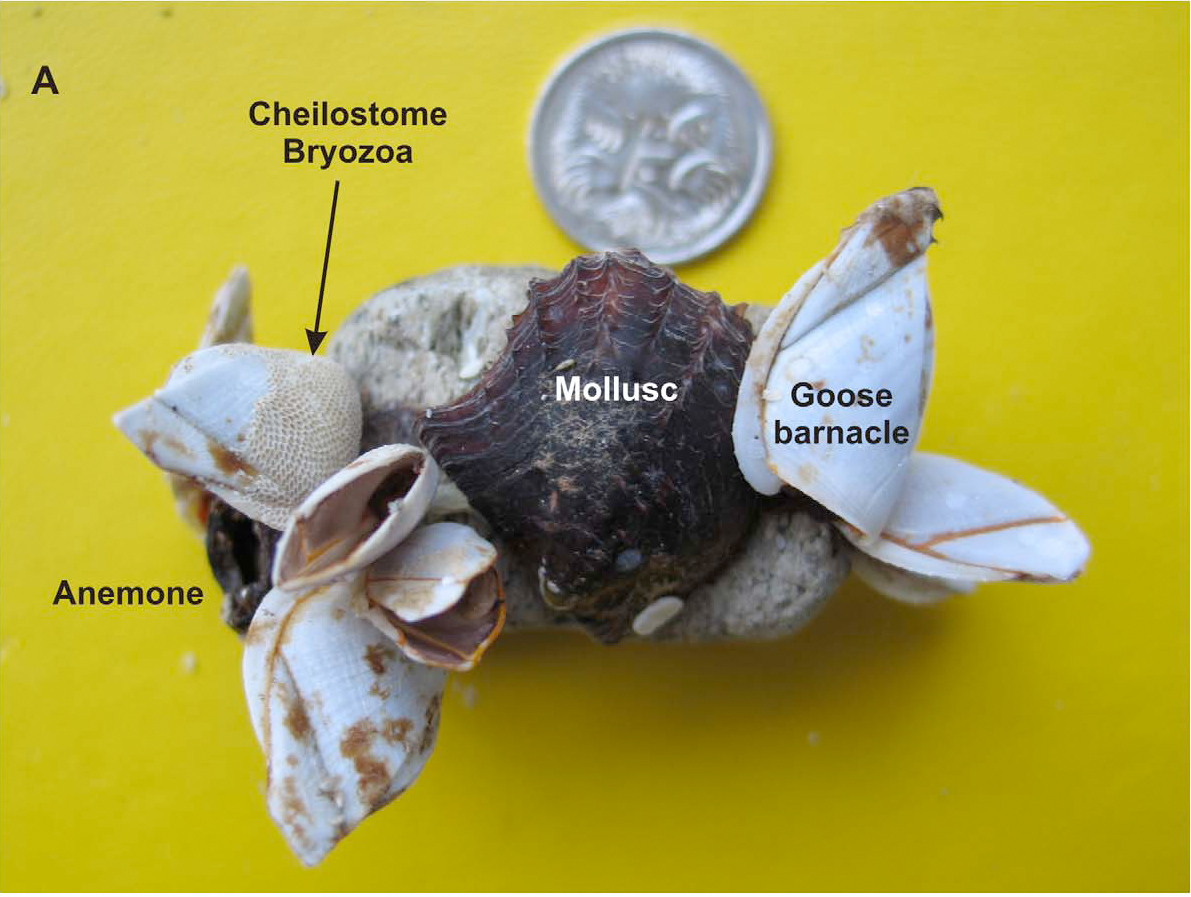
Piece of pumice collected at Marion Reef (roughly 450 km off the Queensland coast) on 30 April 2007. Based upon their size, the Goose Barnacles (Lepas anserifera; largest specimen 23 mm length) have been attached for at least 60 days and the Mollusc over 200. Coin is 2 cm in diameter. Bryan et al. (2012).
Two pieces of pumice bound together by Cyanobacteria (photosynthetic filament-forming Bacteria, principally Rivularia sp.) and Macroalgae (Seaweed, Caulerpa sp.) collected from Broadbeach in southeastern Queensland on 27 December 2007. Also present are two Cauliflower Corals (Pocillopora sp.), a Colonial Scyphozoan (Order Coronatae, the benthic larval stage of a Crown Jellyfish), Goose Barnacles (Lepas anserifera) and a Pearl Oyster (Pinctada sp.) Bryan et al. (2012).
Three pieces of pumice collected from Broadbeach in southeastern Queensland on 27 December 2007. Each has a Sea Anemone (Calliactus sp.) forming a keel, with Cheilostome Bryozoa (Jellyella sp.) along the waterline and Cyanobacteria (Rivularia spp.) occupying allof the dorsal surface. Left hand pumice stone is 5 cm in length. Bryan et al. (2012).
Piece of pumice collected at Lamberts Beach, Mackay, with dorsal surfaces almost exclusively occupied by Cyanobacteria (Rivularia sp.), and the ventral surface entirely covered by cheilostome Bryozoa (Jellyella sp.) colonies. Piece is 1.7 cm long. Bryan et al. (2012).