Micro-organisms are, unsurprisingly, typically the first organisms to colonise newly formed or exposed land surfaces, such as those exposed by a rockfall or glacial retreat, or the deposition of volcanic ash. These first colonisers typically comprise oligotrophic (able to survive on very limited nutrition) and autotrophic (able to generate their own energy through chemical reactions or photosynthesis) groups, which are able to survive in environments with very limited environments, as well as groups able to fix nitrogen and carbon obtained from the atmosphere. However, the precise nature of the earliest colonisers is not consistent, and varies from environment to environment. Thus, sediments exposed after the retreat of a glacier are typically first colonised by photosynthetic Cyanobacteria as are newly formed sand dunes, while newly laid lava-flow deposits are typically first colonised by chemolithic (able to obtain nutrients from rock) Micro-organisms.
Volcanic eruptions often create totally new land surfaces very rapidly, either by covering the existing landscape in a new layer of lava, ash, and tephra, or, less commonly, by creating totally new land-masses in the form of volcanic islands. These new volcanic islands are known as 'Surtseyan islands', in reference to the island of Surtsey, which was formed by a volcanic eruption on 14 November 1963. However, unlike Surtsey (which still exists), most such islands are very short lived, formed principally of soft volcanic ash, which is washed away by the sea within a few months, or at most one or two years. Surtseyan islands provide a completely new 'blank state' for micro-organisms to colonise, with little-or-no organic material within the new sediments, an unusually high level of heavy metals, and, frequently, intermittent exposure to toxic volcanic gasses.
Such environments are likely to be challenging to new microbial colonisers, as they are also for microbiologists hoping to study them. The extremely short-lived nature, and general instability, of most Surtseyan islands, makes it close to impossible to carry out field work upon them before they disappear. Persisting Surtseyan islands, however, present a much more interesting scenario, with the potential for biologists to study their long-term succession from a bare-volcanic environment to a developed terrestrial ecosystem. The two most recent persisting Surtseyan islands were Surtsey itself, which emerged in 1963, and Vulcão dos Capelinhos in the Azores, which emerged in 1957. Both of these were extensively studied by the biologists of the time, but in a period when the importance of Micro-organisms as environment shapers was poorly understood, an consequently little attention was paid to these organisms. The first survey of Micro-organisms on the island of Surysey did not take place until the year 2000, 37 years after the island formed. Based upon studies of other volcanic terrains and borehole evidence from the island itself (which expose evidence from early island surfaces covered up by subsequent volcanic activity) it has been suggested that the first Micro-organisms to settle on Surtsey were probably species capable of photosynthesis and lithotrophic species capable of oxidizing trace gasses, sulphur, and/or iron, and possibly some oligotrophic species capable of surviving on the very low levels of carbon and nitrogen found in volcanic sediments.
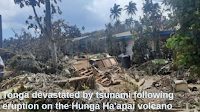
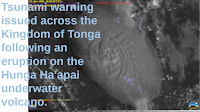
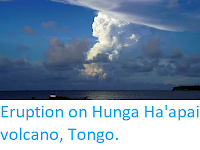
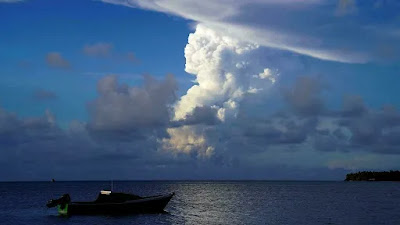
On 19 December 2014, the Hunga underwater volcano within the Kingdom of Tonga began a series of eruptions, which by 15 January had produced a new island, named Hunga Tonga Hunga Ha'apai, which connected the two older, and much smaller, islands of Hunga Tonga and Hunga Ha'apai into a single landmass. This new landmass included a cone of tephra and ash which rose to about 120 m above sealevel. Initially it was predicted that this new island would erode away within a few months, but this was not in fact the case, making the island the third such persistent Surtseyan island to have formed in the past 150 years. The new island in fact persisted until 2022, when it was destroyed by an explosive eruption of the Hunga volcano. However, the island was visited by scientists in October 2018 and again in October 2019, who collected samples of tephra from across its surface.
In a paper published in the journal mBio on 11 January 2023, Nicholas Dragone of the Department of Ecology and Evolutionary Biology at the University of Colorado Boulder, and the Cooperative Institute for Research in Environmental Science, Kerry Whittaker of the Corning School of Ocean Sciences at the Maine Maritime Academy, Olivia Lord of the Sea Education Association, Emily Burke of the School of Marine Science and Ocean Engineering at the University of New Hampshire, Helen Dufel of the Scripps Institute of Oceanography at the University of California San Diego, Emily Hite of the School of Earth Sciences and Environmental Sustainability at Northern Arizona University, Farley Miller and Gabrielle Page of the Université de Bretagne Occidentale, Dan Slayback of Science Systems & Applications, Inc., and the Biospheric Sciences Lab at NASA's Goddard Spaceflight Center, and Noah Fierer, also of the Department of Ecology and Evolutionary Biology at the University of Colorado Boulder, and the Cooperative Institute for Research in Environmental Science, present the results of a study of the Micro-organisms from these samples, which aimed to answer the questions: 'What taxa were the earliest microbial colonizers of sediments on Hunga Tonga Hunga Ha'apai?' 'From where did these microbial colonizers originate?' and 'What metabolic strategies were used by these microbes to persist in the challenging environmental conditions found on the recently formed landmass?

Dragone et al. collected 32 samples from across the new landmass, at altitudes ranging from sealevel to the summit of the cone, at roughly 120 m higher. At the time of the collecting, some Plants and Animals had begun to settle on the island, although the majority of the samples were collected at sites away from such incursions.
The samples collected from unvegetated areas of the Hunga Tonga Hunga Ha'apai tuff cone show very low levels of nutrients, and organic carbon, but high levels of heavy metals and sulphur. The concentration of organic carbon in these tuff samples ranged from 0.19 to 0.50 mg per gram (with an average of 0.32 mg per gram), which was about ten times lower than the level from vegetated samples (i.e. samples collected from around plants, at the edge of the original landmass of Hunga Tonga). The tuff samples lacked any detectable nitrogen, while sulphur levels ranged from 0.1 to 19.8 mg per gram, with an average of 2.1 mg per gram, and iron levels ranged from 74 to 86 mg per gram, with an average of 80.1. Copper, vanadium, cobalt, and other metals were also present at levels far higher than typical of natural soils, but comparable to those often seen in contaminated soils from former industrial sites.
All of the samples yielded both Bacterial and Archaean DNA, although the levels of DNA from tuff samples was typically two orders of magnitude lower than that from vegetated samples. The tuff samples were also apparently much less biodiverse, with an average of 108 variants on the 16SrRNA gene sequence (a highly conserved, but still variable, sequence found in all known Bacteria and Archaeans, as well as in the nuclei, mitochondria, and chloroplasts of Eukaryotes, which is considered extremely useful as a marker by Prokaryote taxonomists), compared to 473 in the vegetated samples.
The Microbial community represented in the tuff samples was also distinct from the community found in the vegetated samples, dominated by members of the Bacterial phylum Chloroflexi making up 24.6% of the genetic reads, followed by Actinobacteria, 18.1% of genetic reads, Firmicutes, 15.7, and Proteobacteria, 15.5%. Present at lower concentrations were members of the Bacteroidetes, 6.2% of genetic reads, Planctomycetes, 5.4%, Acidobacteria, 3.3%, Cyanobacteria, 2.8%, Gemmatimonadetes, 1.5%, and candidate phylum WPS-2 'Eremiobacteria', 1.5%. The Archaean phylum Thaumarchaeota was also present in all samples, but in all cases at levels of less than 2% of the total number of genetic reads.
The most commonly found Bacterial families were Acidiferrobacteraceae (Proteobacteria), Ktedonobacteraceae (Chloroflexi), and Sulfuricellaceae (Proteobacteria), all of which contain autotrophic chemolithotrophs capable of gaining energy by oxidizing sulphur or iron. However, many of the samples came from little known groups, so that 40% of the total genetic reads could not be classified to family level. This means that the majority of Bacteria which were colonising the new land surface belonged to taxa for which their ecological role is at best poorly understood, with only 52% belonging to families from which any member has ever been cultivated in the lab.
This Microbial community is quite distinct from that found in the initial stages of colonisation of new land surfaces in other terrestrial settings. Cyanobacteria, typically among the earliest settlers on new land surfaces in other environments, and thus widely considered to be indicative of such communities, were absent on Hunga Tonga Hunga Ha'apai. Dragone et al. suggest that this absence of Cyanobacteria may be linked to the presence of high concentrations of hydrogen sulphide, which is produced by most volcanic systems and known to be an inhibiting agent for Cyanobacteria. Members of the Phylum Chloroflexi dominated the Microbial community on Hunga Tonga Hunga Ha'apai. This dominance has not been seen elsewhere, but these Bacteria are known to be hydrogen sulphide-tollerant and are often found in volcanic settings with high hydrogen sulphide levels.
The Microbial community from Hunga Tonga Hunga Ha'apai does show some similarities to Microbial communities observed on older volcanic deposits at other sites. For example, on basaltic deposits in Iceland, the Bacterial orders Planctomycetales (Planctomycetota), Rhizobiales (Proteobacteria), Rhodospirillales (Proteobacteria), and Sphingomonadales (Proteobacteria) were apparently ubiquitous, being found in all samples, as were members of the Phylum Chloroflexi.
Theoretically, the most likely source of Microbial colonisers on a new island landmass are is the surrounding ocean, followed by gut Bacteria from Birds deposited in their feces. Neither of these seems to be a particularly likely source for the Microbes colonising Hunga Tonga Hunga Ha'apai. Another possibility is that Microbes could have migrated to the new landmass from the two original landmasses, Hunga Tonga and Hunga Ha'apai. However, while Dragone et al. did find some similarities between the Microbial community of Hunga Tonga Hunga Ha'apai and that of Hunga Tonga, this did not appear to be the main source of the new landmass's Microbiota.
As an alternative, Dragone et al. suggest that the Bacteria may have originated from nearby volcanic and/or hydrothermal vent systems. Unfortunately, not information was available on the Microbial communities at submarine or subaerial geothermal systems in Tonga prior to the 2014-15 eruption, but the Microbes observed on Hunga Tonga Hunga Ha'apai does reflect that often found in such environments. Gene sequences associated with the Planctomycetales, Rhizobiales, Rhodospirillales, and Sphingomonadales have all been recovered from volcanic environments in Alaska, Hawai'i, and New Zealand. Dragone et al. also note that many of the most abundant gene sequences from the Hunga Tonga Hunga Ha'apai deposits, including the uncultivated Chloroflexi sequences, are common in marine water samples from the deep euphotic zone, and in particular around hydrothermal vents, on organic-poor seafloor surfaces, and in organic-poor deep marine sediments. The most abundant 16S rRNA gene sequence in the Hunga Tonga Hunga Ha'apai material, Chloroflexi AD3, is identical to a sequence recovered from sediments from the Brothers Volcano Complex in the Tonga-Kermadec Arc. Other gene sequences from Hunga Tonga Hunga Ha'apai are similar to sequences recovered from hot springs in Yellowstone National Park, and hydrothermal vent fields in the Atlantic and Pacific.
The island of Hunga Tonga Hunga Ha'apai (and the original islands of Hunga Tonga and Hunga Ha'apai) was a subaerial projection of the much larger submarine Hunga Volcanic Caldara, which covers a today area of about 16 km². This is an extremely active volcanic complex, with submarine venting recorded since 1912, and significant eruptions recorded in 2009, 2014-25, and 2022. It is possible that Microbes living in sediments on submarine parts of the volcano were transported to the new land surface during the 2014-15 eruption. Something similar has been observed on Surtsey, where Micro-organisms from subsurface sediment pore waters have been shown to be transported to the surface via fumerole systems. An alternative is that the Microbes could have been blown to the island from exposed volcanic surfaces on nearby islands. Hunga is one of about 20 active volcanic systems within the Kingdom of Tonga, the closest of which is the submarine Fonuafo’ou Volcano, only 25 km from Hunga Tonga Hunga Ha'apai. The nearest volcano which reaches the surface is Tofua, about 100 km away, while Late’iki, another submarine volcano about 200 km to the north, underwent an explosive eruption in 2019, which could have aerosolised Micro-organisms. Previous work in New Zealand has suggested that Microbes could be dispersed over 850 km following a volcanic eruption. Given the presence of gene sequences associated with deep marine sediments in the Hunga Tonga Hunga Ha'apai tuff samples, Dragone et al. suggest that many of the Microbes on the island are likely to have arrived from a subsurface environment.
The taxonomic identities of the Hunga Tonga Hunga Ha'apai Microbes, combined with our current knowledge of the ecological roles of these groups, suggests that the earliest stages of settlement on the island were dominated by hemolithotrophic Bacteria and anoxygenic phototrophs. Dragone et al. found gene sequences associated with the metabolism of sulphur, the oxidation of carbon monoxide and hydrogen, and bacteriochlorophyll-mediated anoxygenic photosynthesis in tuff samples at levels two-to-five times as high as in the vegetated samples, while genes associated with other Bacteria functions were present at roughly equal levels in both sets of samples.
The high concentration of genes for sulphur metabolism in the Hunga Tonga Hunga Ha'apai tuff samples accords well with the high concentration of sulphur found in the same samples. Notably, genes associated with the metabolism of thiosulphate where far more abundant in the tuff samples than in the vegetated samples, notably thiosulphate reductase, thiosulphate sulphurtransferase, sulphur oxidation pathway, and thiosulphate dehydrogenase, were found in all samples. Thiosulphates serve as an intermediary phase in many sulphur metabolising pathways, with the effect that almost all sulphur-processing chemolithotrophic Microbes, including those from terrestrial volcanic systems and deep sea hydrothermal systems. Since the surface sediments on Hunga Tonga Hunga Ha'apai were well aerated and not likely to be lacking in oxygen, it is unlikely that the Bacteria here were engaged in the anaerobic reduction of sulphur, leading Dragone et al. to conclude that sulphur oxidation is likely to be the most important ecological strategy for these Micro-organisms.
No photosynthetic Cyanobacteria were found in any of the samples, nor were genes for oxygenic photosynthesis found. However, a number of genes associated with anoxygenic photosynthesis were found. These are known to be present in a wide range of Bacteria, including the Actinobacteria, which were a major component of the Hunga Tonga Hunga Ha'apai Microbiota, as well as more specific anoxygenic photosynthesis genes associated with the families Beijerinckiaceae (Proteobacteria) and Acetobaceraceae (Actinobacteria). This suggests that photosynthesis was occurring on Hunga Tonga Hunga Ha'apai, but that this was anoxygenic photosynthesis, in which sulphur is used as an electron doner.
Also widely present were genes associated with the oxidation of trace gasses, notably carbon monoxide and hydrogen. Many groups found within the samples, including the Ktedonobacteraceae and other members of the Chloroflexi are known to have this capability. The oxygenation of trace gasses is generally associated with Bacteria surviving in extremely resource-poor environments, such as Antarctic soils, and is also known to play an important role in more mature volcanic soils, 10-20 years after an eruption. Dragone et al. hypothesize that trace gas oxygenation may play the same role in volcanic soils as photosynthesis does in other newly colonised environments, enabling the very first Microbes to gain a foothold from which more developed communities can then develop.
Dragone et al.'s study indicates that Micro-organisms begin to settle on new volcanic islands very soon after their formation. However, unlike other new environments, the first colonisers on volcanic islands are not photosynthetic Cyanobacteria, but rather Bacteria capable of utilising the abundant sulphur resources of these environments, and oxidizing trace gasses. Furthermore, these Bacteria do not appear to have come from the neighbouring surface-marine or vegetated island environments, but rather to have originated from geothermal systems, potentially those deep beneath the sea or land surfaces. These Micro-organisms may well have reached the island as a result of volcanic activity elsewhere, which has the potential to disperse Micro-organisms over wide areas. It is quite possible that the Microbiota of the island went through a number of changes in the three years between the formation of the island, and the collection of the first samples there, and almost certain that, had the island survived, the Microbial community would have continued to evolve as the island developed from a bare rocky surface into a vegetated island. However, the complete destruction of the island by a new eruption in January 2022 made any further work impossible on that island, and scientists will have to wait for the formation of new volcanic islands elsewhere to take this field of study further foreward.
See also...


Follow Sciency Thoughts on Facebook.
Follow Sciency Thoughts on Twitter.