Showing posts with label Lanao del Norte Province. Show all posts

Sunday, 14 January 2018

Landslides kill six in the Philippines.

Six people have died in two separate landslides in the Philippines on Saturday 13 January 2017. Four people died in the city of Tacloban on Leyte Island, when a landslide pushed over a perimeter wall onto a house at abut 9.00 pm local time. The four have been identified as village secretary Inday Hernandez, her husband, one of her children, and Delia Carzon, a 67-year old woman employed by the family as a watchman. It a separate incident two people described as pensioners were killed by a second landslide in Pantar town in Lanao del Norte Province on Mindanao Island.

Rescue teams at the site of the 13 Jabuary 2017 Tacloban landslide. Cristina Gonzalez Romuldez.

The incidents occurred following heavy rains across the Philippines associated with the Northern Monsoon. Landslides are a common problem after severe weather events, as excess pore water pressure can overcome cohesion in soil and sediments, allowing them to flow like liquids. Approximately 90% of all landslides are caused by heavy rainfall. 
 
Monsoons are tropical sea breezes triggered by heating of the land during the warmer part of the year (summer). Both the land and sea are warmed by the Sun, but the land has a lower ability to absorb heat, radiating it back so that the air above landmasses becomes significantly warmer than that over the sea, causing the air above the land to rise and drawing in water from over the sea; since this has also been warmed it carries a high evaporated water content, and brings with it heavy rainfall. In the tropical dry season the situation is reversed, as the air over the land cools more rapidly with the seasons, leading to warmer air over the sea, and thus breezes moving from the shore to the sea (where air is rising more rapidly) and a drying of the climate.
 
 Diagrammatic representation of wind and rainfall patterns in a tropical monsoon climate. Geosciences/University of Arizona.
 
Southeast Asia has two distinct Monsoon Seasons, with a Northeast Monsoon driven by winds from  the South China Sea during the Southern Hemisphere Summer and a Southwest Monsoon driven by winds from the southern Indian Ocean in the Northern Hemisphere Summer. Such a double Monsoon Season is common close to the equator, where the Sun is highest overhead around the equinoxes and lowest on the horizons around the solstices, making the solstices the coolest part of the year and the equinoxes the hottest.
 
 The winds that drive the Northeast and Southwest Monsoons in Southeast Asia. Mynewshub.
 
See also...
 
http://sciencythoughts.blogspot.co.uk/2018/01/evacuations-ordered-after-eruption-on.htmlhttp://sciencythoughts.blogspot.co.uk/2017/12/flash-flood-destroys-village-on.html
http://sciencythoughts.blogspot.co.uk/2017/12/three-confirmed-dead-as-tropical-storm.htmlhttp://sciencythoughts.blogspot.co.uk/2017/12/phreatic-eruptions-on-mount-kanlaon.html
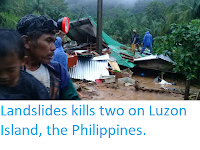
http://sciencythoughts.blogspot.co.uk/2017/11/landslides-kills-two-on-luzon-island.htmlhttp://sciencythoughts.blogspot.co.uk/2017/11/landslide-kills-man-in-camarines-sur.html
Follow Sciency Thoughts on Facebook.

Saturday, 23 December 2017

Flash flood destroys village on Mindanao Island, the Philippines.

At least 43 people have died and it is feared as many as 80 may have died after a flash flood hit the village of Dalama in Lanao del Norte Province on northern Mindanao Island, the Philippines, at about 11 am local time on Friday 22 December 2017. The flooding was caused by heavy rains associated with Tropical Storm Vinta (or Tembin), which caused the River Cabuyao to burst its banks, resulting in a flood of mud and water laden with rocks and trees destroying the majority of the 103 buildings there. Around 25 more people are thought to have died in other events associated with the storm in Lanao del Norte Province.

The site where the village of Dalama in Lanao del Norte formerly stood. Province of Lanao del Norte/Facebook.

Tropical Storm Vinta has caused widespread flooding in the Visayas, Mindanao and southern Luzon, and is currently heading towards. Palawan Island, where it is expected to make landfall within the next few hours. The storm is thought to have caused over a hundred deaths other than those in Dalama, with at least 47 dead in the province of Zamboanga del Norte on western Mindanao.

 The path and strength of Tropocal Storm Vinta. Thick line indicates the past path of the storm (till 9.00 pm GMT on Monday 11 September 2017), while the thin line indicates the predicted future path of the storm, and the dotted circles the margin of error at six and twelve hours ahead. Colour indicated the severity of the storm. Tropical Storm Risk.

Tropical storms are caused by the warming effect of the Sun over tropical seas. As the air warms it expands, causing a drop in air pressure, and rises, causing air from outside the area to rush in to replace it. If this happens over a sufficiently wide area then the inrushing winds will be affected by centrifugal forces caused by the Earth's rotation (the Coriolis effect). This means that winds will be deflected clockwise in the northern hemisphere and anti-clockwise in the southern hemisphere, eventually creating a large, rotating Tropical Storm. They have different names in different parts of the world, with those in the northwest Atlantic being referred to as hurricanes.

Flooding associated with Tropical Storm Vinta in Maranding in Lanao del Norte. ABS-CBN News.

Despite the obvious danger of winds of this speed, which can physically blow people, and other large objects, away as well as damaging buildings and uprooting trees, the real danger from these storms comes from the flooding they bring. Each drop millibar drop in air-pressure leads to an approximate 1 cm rise in sea level, with big tropical storms capable of causing a storm surge of several meters. This is always accompanied by heavy rainfall, since warm air over the ocean leads to evaporation of sea water, which is then carried with the storm. These combined often lead to catastrophic flooding in areas hit by tropical storms.

 Flooding in Lanao del Norte. Aclimah Cabugatan Disumala/Reuters.

See also...

http://sciencythoughts.blogspot.co.uk/2017/12/three-confirmed-dead-as-tropical-storm.htmlhttp://sciencythoughts.blogspot.co.uk/2017/12/phreatic-eruptions-on-mount-kanlaon.html
http://sciencythoughts.blogspot.co.uk/2017/11/landslides-kills-two-on-luzon-island.htmlhttp://sciencythoughts.blogspot.co.uk/2017/11/landslide-kills-man-in-camarines-sur.html
http://sciencythoughts.blogspot.co.uk/2017/10/magnitude-54-earthquake-in-batangas.htmlhttp://sciencythoughts.blogspot.co.uk/2017/10/landslide-kills-man-in-cebu-city.html
Follow Sciency Thoughts on Facebook.