Showing posts with label Lianas. Show all posts

Wednesday, 6 November 2024

Pothos deleonii: A new species of Arum from Mindanao Island.

Arums of the genus Pothos are hemiepiphytic vines (Plants which begin life as epiphytes growing upon other plants, but which as they grow stronger become self-supporting) found in tropical and subtropical forests in South China, Southeast Asia, Austrolasia, Oceana, and Madagascar. 

In a paper published in the journal PhytoKeys on 15 October 2024, Maria Melanie Medecilo-Guiang of the Center for Biodiversity Research and Extension in Mindanao and Plant Biology Division at Central Mindanao University, and Derek Cabactulan of Cagayan de Oro City, describe a new species of Pothos from Bukidnon Province on Mindanao Island, Philippines.

The new species was first noted as possibly significant on the basis of its remarkable inflorescence, by conservationist and eye surgeon Miguel De Leon at a Robert S. Kennedy Bird Conservancy site in Bukidnon Province during an ornithological expedition in 2019. A subsequent expedition to the same site in February 2024 collected samples of the plant, from which it has been confirmed to be a new species. This is named Pothos deleonii, in honour of the initial discoverer.

Pothos deleonii. (A) Habit with flowering branch, (B) leaf apex, (C) leaf base, (D) venation pattern, (E) inflorescence, (F( detail of spadix. Medecilo-Guiang & Cabactulan (2024).

Pothos deleonii is a root climbing, fibrous liana, with slender, slightly woody, green stems from which slender leaves arise on petioles (leaf stems) at regular intervals. Roots are found along the stem when the plants are young, but become less common as the Plant matures, and tend to be absent around inflorescence-producing termini. Inflorescences are born singularly on elongated peduncles (flower stalks) which hang 16-18 cm below the stem. These inflorescences are a dark wine red, aging to purplish black, with a spadix (spike with a large number of small flowers) up to 6.9 cm long, surrounded by a spathe (petal-like structure) up to 10 cm long and 5.5 cm wide.

Pothos deleonii was found growing at only two locations, climbing on the  base and trunks of Tree Ferns of the genus Alsophila, in an area of degraded secondary, open-canopy Dipterocarp forest, at altitudes of 1150 and 1270 m above sealevel. Once the vines reach about 4-6 m in height they become independent of their host, able to stand free, either on their own base or supported by the surrounding tree canopy. 

Both known sites are within a 5 km² area in the northern foothills of Mt. Kitanglad. This area is protected, and monitored by the Robert S. Kennedy Bird Conservancy, and not considered to be under any threat. However, on the basis of the low number of specimens discovered, and the limited area within which it is found, Medecilo-Guiang and Cabactulan recommend that Pothos deleonii is classified as Critically Endangered under the terms of the International Union for the Conservation of Nature's Red List of Threatened Species.

See also...
Friday, 5 December 2014

Two new species of Bigonia from Brazil.


Bigonias of the genus Tynanthus are lianas (woody climbers) found across the Neotropics (tropical areas of Central and South America), but reaching their maximum diversity in the wet forests of Amazonas State, and wet Atlantic forests of Brazil.

In a paper published in the journal PhytoKeys on 24 October 2014, Maria Cláudia de Medeiros and Lúcia Lohmann of the Departamento de Botânica at the Universidadede São Paulo describe two new species of Tynanthusfrom Brazil, discovered during a revision of the genus.

The first new species described is named Tynanthus densiflorus, in reference to its densely packed flowers, which are white or yellow and produced in August. The species was found growing only around Manaus in Amazonas State. While the species was found in the Reserva Florestal Adolpho Ducke, where there was a reasonable population of the plants, no plants have been found at any great distance from the rapidly expanding Manaus urban area, and as such de Medeiros and Lohmann suggest that the species should be considered to be Vulnerable under the terms of the International Union for the Conservation of Nature’s Red List of Threatened Species until additional studies have been carried out to fully determine the plant’s conservation status.

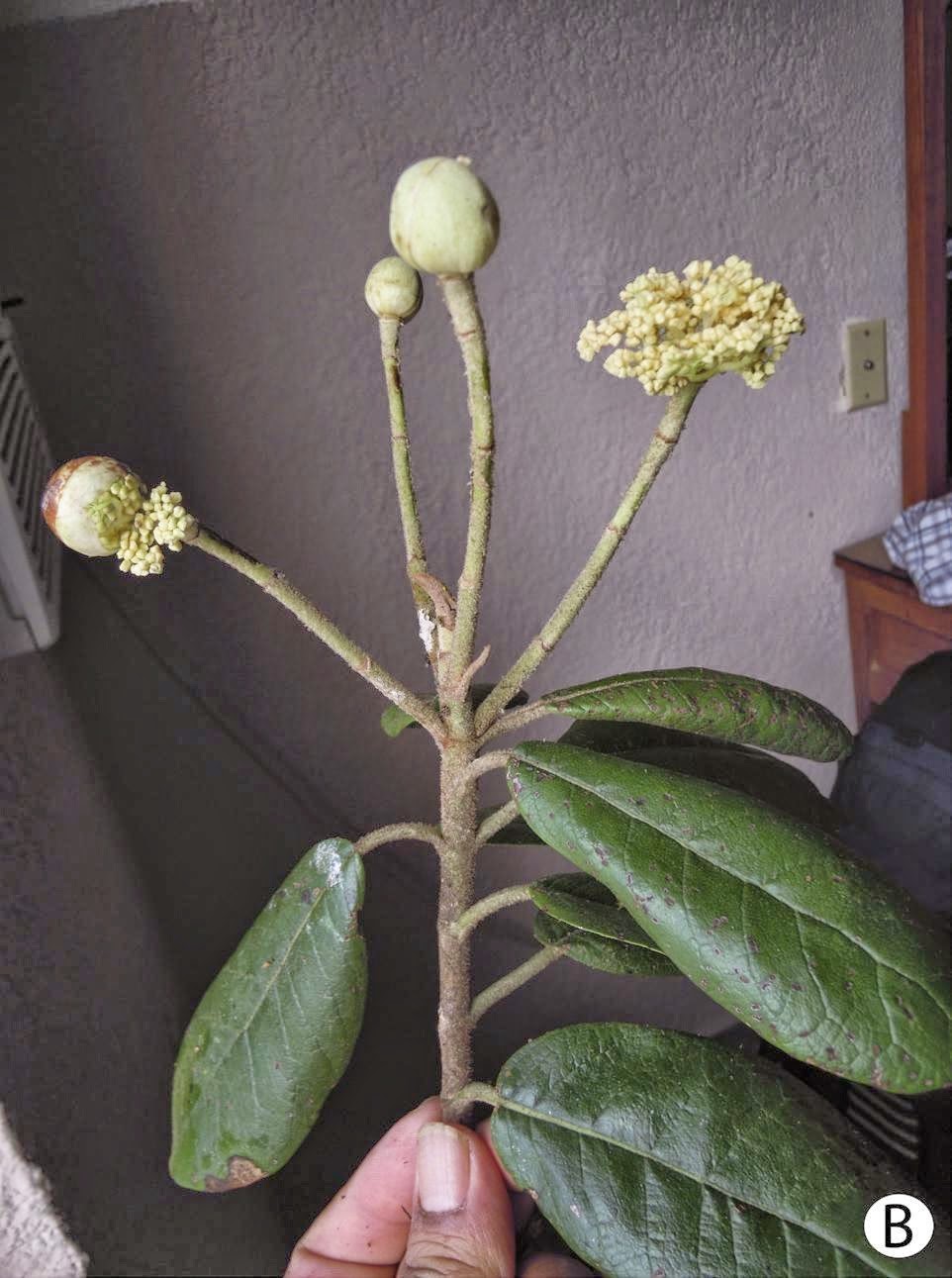
Flowering branch of Tynanthus densiflorus. Lilian Procópio in de Madeiros & Lohmann (2014).

The second new species is named Tynanthus espiritosantensis, meaning ‘from Espírito Santo’; the species was found growing in wet forests around Linhares in Espírito Santo State. This species produces white flowers from December to February, and has distinct bromeliad-like prophylls (leaflets) around its axillary buds (points at which smaller stems branch of from main stems).

Flowering branch of Tynanthus espiritosantensis. D.A. Folli in de Madeiros & Lohmann (2014).

See also…

Hydrangeas are perennial woody plants related to Dogwoods and Silkleafs. Most species form small shrubs, but some grow to tree sizes, and there are some lianas (woody vines) in the group. Hydrangeas are most abundant and diverse in eastern Asia, but they are found as far west as the Himalayas, and also throughout the Americas. Most Hydrangeas have white flowers, but some species produce pink or blue flowers in response to changes in soil pH, a trait which has made them popular with gardeners. As such they have been...

Ox-eye Beans (or Dear-eye Beans, or Hamburger Seeds) are Legumes in the genus Mucuna, found throughout the tropics. They get their common names from the three-layered structure of their seeds, which resembles the eye of a large Mammal (or a hamburger). These seeds are sea-beans; they are capable of surviving long periods of immersion in sea-water, enabling them to use ocean currents to colonize new areas; several species of Mucuna are found in both the American and African tropics. The  plants themselves form woody shrubs or...

Follow Sciency Thoughts on Facebook.

Saturday, 28 July 2012

New species of Ox-eye Bean from Costa Rica and Panama.

Ox-eye Beans (or Dear-eye Beans, or Hamburger Seeds) are Legumes in the genus Mucuna, found throughout the tropics. They get their common names from the three-layered structure of their seeds, which resembles the eye of a large Mammal (or a hamburger). These seeds are sea-beans; they are capable of surviving long periods of immersion in sea-water, enabling them to use ocean currents to colonize new areas; several species of Mucuna are found in both the American and African tropics. The  plants themselves form woody shrubs or lianas (erect woody vines that climb trees to gain access to light in tropical forest canopies). They have large, scented, colourless flowers that are typically pollenated by Bats.

Mucuna beans from a beech in Texas (where the plant is not found). John Batchelder's Beach Beans Blog.

In a paper published in the journal Phytotaxa on 17 July 2012, a team of scientists led by Tânia Moura of the Programa de Pós-graduação em Biologia Vegetal at the Instituto de Biologia at the Universidade Estadual de Campinas in Brazil describe a new species of Mucuna from the tropical forests of Costa Rica and Panama.

Map showing the distribution of sites where the new species of Mucuna was found growing. Moura et al. (2012).

The new plant is named Mucuna monticola, referring to the montane forests where it was found growing. It is a liana-forming species, distinguished from other members of the genus in that the seed-pods are not 'pinched' between the seeds.

Photographs of Mucuna monticola. (A) Inflorescence. (B) Detail of inflorescence. (C) Individual flower. (D) Seed pods. (E) Detail of seed pod. (F) Leaf. Moura et al. (2012).

Line drawings of Mucuna monticola by Ana Lucia Souza. (A) Branchlet with leaf and inflorescence. (B) Flower. (C) Standard. (D) Wings. (E) Keel. (F) Androecium. (G) Gynoecium. (H) Opened calyx. (I) Calyx, lateral view. (J) Fruit. Moura et al. (2012).


Follow Sciency Thoughts on Facebook.