Showing posts with label Solar Flares. Show all posts

Tuesday, 23 June 2015

Sunspot AR 2371 emits a major solar flair, causing disruption to shortwave radio signals over North America.

On Monday 22 June 2015 at about 6.25 pm GMT, NASA's Solar Dynamics Observatory witnessed a sunspot labeled AR 2371 (Active Region 2371) emit an M6.5 Solar Flare (flare emitting X-rays with an energy of more than 0.00065 Watts per meter squared). The X-ray and ultraviolet emissions from this flare caused a temporary blackout of short-wave radio signals over parts of North America and in the polar regions. The flare also caused the release of a coronal mass ejection (stream of plasma) that is traveling directly towards us and is predicted to  reach the Earth on Wednesday 24 June. This is likely to produce some spectacular auroras in the polar regions, and possibly at lower latitudes, but not to cause any serious harm.


Blackout map showing areas suffering disruption to shortwave radio signals caused by the 24 June 2015 solar flare. Areas coloured red suffered the worst disruption, while areas coloured black were unaffected. Space Weather.

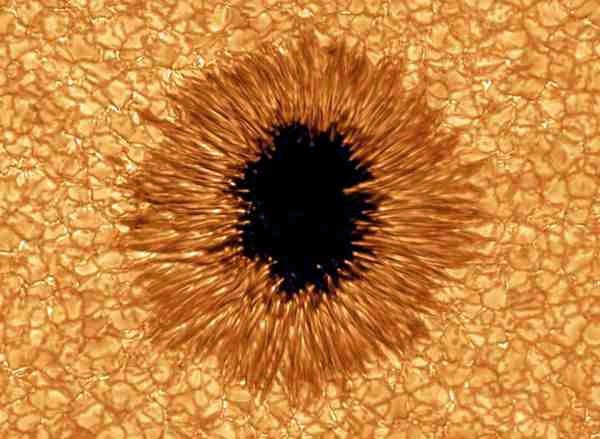
Sunspots are magnetic storms on the face of the Sun. These inhibit convection currents in the Sun's photosphere, causing localized cooling; the surface of the Sun can drop from its usual 5778 K to as low as 3000 K in a Sunspot, causing them to darken compared to the rest of the Sun (though they are in fact still pretty bright). Since Sunspots are magnetic they have magnetic poles, with positive and negative charges. These can be connected by coronal loops, streams of magnetic flux carrying plasma above the surface of the Sun. This can lead to a short circuit in which a large amount of magnetic energy is released suddenly, producing a brightening we perceive as a Solar Flare.

This in turn can lead to the release of a coronal mass ejection, a stream of charged particles, mainly electrons and protons but with some ionized atoms of heavier elements such as helium or oxygen. This travels out from the Sun, typically taking about two days to reach the Earth's orbit.


Solar Heliospheric Observatory movie of the 24 June 2015 coronal mass ejection. Space Weather.

When these streams of charged particles reach the Earth they can cause magnetic storms. These are usually harmless, with the energy being released in spectacular displays of light near the Earth's poles known as the Aurora Borealis (north) and Aurora Australis (south), but occasionally large events cause problems for electrical systems on Earth, such as the March 1989 event that knocked out electrical distribution networks in Quebec (such distribution networks are now generally better safeguarded against these events).

Aurora displays come in a variety of colours, caused by electrons from the coronal mass ejection striking different atoms in the Earth's atmosphere. This is because the energy of the atoms increases each time it is struck by an electron, but atoms can only absorb so much energy before they must release some, and each atom always releases energy as light (photons) at a specific wavelengths. In the Earth's atmosphere this is effected by altitude, thus Oxygen releases either green or red light and Nitrogen releases either blue or violet light. Typically auroras shimmer as different reactions occur, photographs do not really do them justice.


Aurora Australis (Southern Lights) display spotted over Bundanoon in New South Wales on 22 June 2015. This was caused by an earlier coronal mass ejection produced by a solar flare on 20 June 2015. David Metcalf/DJM Images.

Gasses release light at specific wavelengths in response to other stimuli besides coronal mass ejections. Thus the blue colour of the daytime sky is the colour of Nitrogen in the lower atmosphere reacting to the (steady) energy input from sunlight, whereas the red colour of sunrises and sunsets is the colour of oxygen higher in the atmosphere reacting to the same; we see this at dawn and dusk because the sun is no longer in line of sight with the lower atmosphere. Neon lights are red because Neon gas releases red light in response to electrical charge, and Sodium lights orange for the same reason. Molecules made up of more than one sort of atom, such as Carbon Dioxide (CO₂), Water (H₂O) or Methane (CH₄) release light in the infra-red part of the spectrum, which can lead to warming of the atmosphere (the Greenhouse Effect), hence the current concerns about the release of such gasses into the atmosphere by industrial processes, and the effect this might have on our climate.

See also...


Bright aurora displays in both hemispheres following coronal mass ejection on 15 March 2015.
Bright aurora displays were seen in the night skies of both hemispheres in the early morning of Tuesday 17 March 2015...


Large Solar Flair could mean spectacular aurora displays today.
On Wednesday 10 September 2014 at about 5.45 pm GMT, NASA's Solar Dynamics Observatory witnessed a sunspot labeled AR 2158 (Active Region 2158), which is currently facing towards the Earth, produce one of the largest Solar Flares so far this year. This has been classed as an X1.6-class flare (flare emitting more than 0.001 W/m² over more than 0.01% of the Earth's...


On Thursday 12 July 2012 at 4.52 pm GMT, NASA's Solar Dynamics Observatorywitnessed a sunspot labeled AR 1520 (Active Region 1520), currently facing towards the Earth, produce one of the largest Solar Flares so far this year. This has been classed as an X1.4-class flare, potentially large enough to cause disruption to communications networks...


Follow Sciency Thoughts on Facebook.

Wednesday, 18 March 2015

Bright aurora displays in both hemispheres following coronal mass ejection on 15 March 2015.

Bright aurora displays were seen in the night skies of both hemispheres in the early morning of Tuesday 17 March 2015, with reports of displays as far south as Oregon, Kansas and Virginia in the US and England, Germany and Poland in Europe, and as far north as New South Wales and Western Australia. The displays followed a coronal mass ejection (stream of charged particles, mainly electrons and protons but with some ionized atoms of heavier elements such as helium or oxygen) which was ejected from the Sun on 15 March 2015. The displays were expected, but turned out to be much more dramatic than predicted, rated as a level 4 geomagnetic storm, rather than a predicted level 1 storm.

Aurora Borealis (Northern Lights) seen from Jyväskylä in Central Finland on 17 March 2015. Juha Kinnunen/Space Weather.

Aurora displays come in a variety of colours, caused by electrons from the coronal mass ejection striking different atoms in the Earth's atmosphere. This is because the energy of the atoms increases each time it is struck by an electron, but atoms can only absorb so much energy before they must release some, and each atom always releases energy as light (photons) at a specific wavelengths. In the Earth's atmosphere this is effected by altitude, thus Oxygen releases either green or red light and Nitrogen releases either blue or violet light. Typically auroras shimmer as different reactions occur, photographs do not really do them justice.

Gasses release light at specific wavelengths in response to other stimuli besides coronal mass ejections. Thus the blue colour of the daytime sky is the colour of Nitrogen in the lower atmosphere reacting to the (steady) energy input from sunlight, whereas the red colour of sunrises and sunsets is the colour of oxygen higher in the atmosphere reacting to the same; we see this at dawn and dusk because the sun is no longer in line of sight with the lower atmosphere. Neon lights are red because Neon gas releases red light in response to electrical charge, and Sodium lights orange for the same reason. Molecules made up of more than one sort of atom, such as Carbon Dioxide (CO₂), Water (H₂O) or Methane (CH₄) release light in the infra-red part of the spectrum, which can lead to warming of the atmosphere (the Greenhouse Effect), hence the current concerns about the release of such gasses into the atmosphere by industrial processes, and the effect this might have on our climate.

Aurora Borealis (Northern Lights) seen from the Kola Peninsula in Russia on 17 March 2015. Трифонова Любовь/Space Weather.

Coronal mass ejections are a product of solar flares from sunspots. Sunspots are magnetic storms on the face of the Sun. These inhibit convection currents in the Sun's photosphere, causing localized cooling; the surface of the Sun can drop from its usual 5778 K to as low as 3000 K in a Sunspot, causing them to darken compared to the rest of the Sun (though they are in fact still pretty bright). Since Sunspots are magnetic they have magnetic poles, with positive and negative charges. These can be connected by coronal loops, streams of magnetic flux carrying plasma above the surface of the Sun. This can lead to a short circuit in which a large amount of magnetic energy is released suddenly, producing a brightening we perceive as a Solar Flare. This in turn can lead to the release of a coronal mass ejection, a stream of charged particles which takes an average of two days to reach the Earth.

Solar Heliospheric Observatory movie of the 15 March 2015 coronal mass ejection. Space Weather.

See also...

Large Solar Flair could mean spectacular aurora displays today.
On Wednesday 10 September 2014 at about 5.45 pm GMT, NASA's Solar Dynamics Observatory witnessed a sunspot labeled AR 2158 (Active Region 2158), which is currently facing towards the Earth, produce one of the largest Solar Flares so far this year. This has been classed as an X1.6-class flare (flare emitting more than 0.001 W/m² over more than 0.01% of the Earth's...

Sunspot AR 11598 releases a huge flair.
On Monday  22 October 2012 NASA's Solar Dynamics Observatory detected a major flare erupting from Sunspot AR 11598, peaking at 3.22 am GMT on Tuesday 23 October. The event has been classified as an X1.8 type flare, which implies an energy discharge of between 0.001 and 0.01 Whatts per square meter, enough to cause disruption to radio signals of the flare was directed towards the Earth. This is the...


Sunspot AR 1520 releases a powerful Solar Flare.
On Thursday 12 July 2012 at 4.52 pm GMT, NASA's Solar Dynamics Observatory witnessed a sunspot labeled AR 1520 (Active Region 1520), currently facing towards the Earth, produce one of the largest Solar Flares so far this year. This has been classed as an X1.4-class flare, potentially large enough to cause disruption to communications networks and...


Follow Sciency Thoughts on Facebook.

Friday, 12 September 2014

Large Solar Flair could mean spectacular aurora displays today.

On Wednesday 10 September 2014 at about 5.45 pm GMT, NASA's Solar Dynamics Observatory witnessed a sunspot labeled AR 2158 (Active Region 2158), which is currently facing towards the Earth, produce one of the largest Solar Flares so far this year. This has been classed as an X1.6-class flare (flare emitting more than 0.001 W/m² over more than 0.01% of the Earth's surface), potentially large enough to cause disruption to communications networks and electricity supplies on Earth. The flare caused the release of a coronal mass ejection (stream of plasma) that is traveling towards us at 1100 km per second, and will reach the Earth on Friday 12 September. This is likely to produce some spectacular auroras in the polar regions, and possibly at lower latitudes, but not to cause any serious harm.

An X1.6 solar flare flashes in the middle of the sun on 10 September 2014. NASA/Solar Dynamic Observatory.

Sunspots are magnetic storms on the face of the Sun. These inhibit convection currents in the Sun's photosphere, causing localized cooling; the surface of the Sun can drop from its usual 5778 K to as low as 3000 K in a Sunspot, causing them to darken compared to the rest of the Sun (though they are in fact still pretty bright). Since Sunspots are magnetic they have magnetic poles, with positive and negative charges. These can be connected by coronal loops, streams of magnetic flux carrying plasma above the surface of the Sun. This can lead to a short circuit in which a large amount of magnetic energy is released suddenly, producing a brightening we perceive as a Solar Flare.


This in turn can lead to the release of a coronal mass ejection, a stream of charged particles, mainly electrons and protons but with some ionized atoms of heavier elements such as helium or oxygen. This travels out from the Sun, typically taking about two days to reach the Earth's orbit.

When these streams of charged particles reach the Earth they can cause magnetic storms. These are usually harmless, with the energy being released in spectacular displays of light near the Earth's poles known as the Aurora Borealis (north) and Aurora Australis (south), but occasionally large events cause problems for electrical systems on Earth, such as the March 1989 event that knocked out electrical distribution networks in Quebec (such distribution networks are now generally better safeguarded against these events).

A coronal mass ejection imaged on 31 August 2012. NASA/STEREO-B/Goddard Space Flight Center.

Aurora displays come in a variety of colours, caused by electrons from the coronal mass ejection striking different atoms in the Earth's atmosphere. This is because the energy of the atoms increases each time it is struck by an electron, but atoms can only absorb so much energy before they must release some, and each atom always releases energy as light (photons) at a specific wavelengths. In the Earth's atmosphere this is effected by altitude, thus Oxygen releases either green or red light and Nitrogen releases either blue or violet light. Typically auroras shimmer as different reactions occur, photographs do not really do them justice.

An Aurora Borealis display over Chena Lake, Alaska in September 2009. Bud Kuenzli.

Gasses release light at specific wavelengths in response to other stimuli besides coronal mass ejections. Thus the blue colour of the daytime sky is the colour of Nitrogen in the lower atmosphere reacting to the (steady) energy input from sunlight, whereas the red colour of sunrises and sunsets is the colour of oxygen higher in the atmosphere reacting to the same; we see this at dawn and dusk because the sun is no longer in line of sight with the lower atmosphere. Neon lights are red because Neon gas releases red light in response to electrical charge, and Sodium lights orange for the same reason. Molecules made up of more than one sort of atom, such as Carbon Dioxide (CO₂), Water (H₂O) or Methane (CH₄) release light in the infra-red part of the spectrum, which can lead to warming of the atmosphere (the Greenhouse Effect), hence the current concerns about the release of such gasses into the atmosphere by industrial processes, and the effect this might have on our climate.

See also...


On Thursday 12 July 2012 at 4.52 pm GMT, NASA's Solar Dynamics Observatory witnessed a sunspot labeled AR 1520 (Active Region 1520), currently facing towards the Earth, produce one of the largest Solar Flares so far this year. This has been classed as an X1.4-class flare, potentially large enough to cause disruption to communications networks and electricity supplies on Earth, though...


At midnight on Tuesday 6/Wednesday 7 March 2012, GMT, the Sun emitted the largest solar flare since 9 August 2011; the second largest since its current last solar minimum in 2007 (solar activity increases and drops in an eleven years cycle). The flare was classified as an...


At about 4.00 am GMT on Monday 23 January 2012 a massive solar flare was observed on the sun, pointing more-or-less directly our way. An hour later radiation from the flare, a stream electrons, followed by a wave of protons (hydrogen ions) moving at 41.6...


Follow Sciency Thoughts on Facebook.

Wednesday, 24 October 2012

Sunspot AR 11598 releases a huge flair.

On Monday  22 October 2012 NASA's Solar Dynamics Observatory detected a major flare erupting from Sunspot AR 11598, peaking at 3.22 am GMT on Tuesday 23 October. The event has been classified as an X1.8 type flare, which implies an energy discharge of between 0.001 and 0.01 Whatts per square meter, enough to cause disruption to radio signals of the flare was directed towards the Earth. This is the third significant flare since the sunspot came into view on 20 October, and it has been followed by about a dozen smaller events, suggesting it has a high probability of sending a large flare in our direction.

The location of AR 11598 on the Sun's surface. Solar Monitor.

Solar flares are major energy discharges from the Sun's surface; these are immediately disruptive to life on Earth themselves, but are almost invariably accompanied by coronal mass ejections, streams of charged particles (ions and electrons) which can be disruptive to radio signals and power supplies when they reach the Earth (although modern power networks tend to be better insulated against their effects than was the case in the past), as well as triggering Aurora Borrealis and Aurora Australis events.

Auroras are triggered by the interaction of charged particles in coronal mass ejections with the Earth's magnetic field. They tend to be concentrated at the poles, where the magnetic field crosses, rather than running parallel to, the atmosphere, and produce light by exciting atoms in the upper atmosphere, provoking them to produce light.

See also Sunspot AR 1520 releases a powerful Solar Flare, The Earth reaches its aphelionSolar flare may hit Earth on 4 July 2012NASA's Solar Dynamic Observatory observes the transit of Venus, and Comet C/2011 W3 (Lovejoy) survives a close encounter with the sun.

Follow Sciency Thoughts on Facebook.

Friday, 13 July 2012

Sunspot AR 1520 releases a powerful Solar Flare.

On Thursday 12 July 2012 at 4.52 pm GMT, NASA's Solar Dynamics Observatory witnessed a sunspot labeled AR 1520 (Active Region 1520), currently facing towards the Earth, produce one of the largest Solar Flares so far this year. This has been classed as an X1.4-class flare, potentially large enough to cause disruption to communications networks and electricity supplies on Earth, though in this case highly unlikely to do so. The flare caused the release of a coronal mass ejection (stream of plasma) that is traveling towards us at 1400 km per second, and will reach the Earth on Saturday 14 July, at about 5.00 am, GMT. This is likely to produce some spectacular auroras in the polar regions, but not to cause any serious harm.

An X1.4 class flare erupted from the center of the sun, peaking on 12 July 2012 at 4.52 GMT. It erupted from Active Region 1520 which rotated into view on July 6. NASA/Solar Dynamics Observatory/Atmospheric Imaging Assembly.

Sunspots are magnetic storms on the face of the Sun. These inhibit convection currents in the Sun's photosphere, causing localized cooling; the surface of the Sun can drop from its usual 5778 K to as low as 3000 K in a Sunspot, causing them to darken compared to the rest of the Sun (though they are in fact still pretty bright). Since Sunspots are magnetic they have magnetic poles, with positive and negative charges. These can be connected by coronal loops, streams of magnetic flux carrying plasma above the surface of the Sun. This can lead to a short circuit in which a large amount of magnetic energy is released suddenly, producing a brightening we perceive as a Solar Flare.

Image of coronal loops over the eastern limb of the Sun, taken on 29 June 1999 around 2.00 am, GMT. NASA/Transition Region and Coronal Explorer.

This in turn can lead to the release of a coronal mass ejection, a stream of charged particles, mainly electrons and protons but with some ionized atoms of heavier elements such as helium or oxygen. This travels out from the Sun, typically taking about two days to reach the Earth's orbit.

A coronal mass ejection breaking away from the Sun. Universe Today/JAXA/Hinode.

When these streams of charged particles reach the Earth they can cause magnetic storms. These are usually harmless, with the energy being released in spectacular displays of light near the Earth's poles known as the Aurora Borealis (north) and Aurora Australis (south), but occasionally large events cause problems for electrical systems on Earth, such as the March 1989 event that knocked out electrical distribution networks in Quebec (such distribution networks are now generally better safeguarded against these events).

An Aurora Borealis display over Sommarøya in Norway in January 2011. Thilo Bubek/National Geographic.

Aurora displays come in a variety of colours, caused by electrons from the coronal mass ejection striking different atoms in the Earth's atmosphere. This is because the energy of the atoms increases each time it is struck by an electron, but atoms can only absorb so much energy before they must release some, and each atom always releases energy as light (photons) at a specific wavelengths. In the Earth's atmosphere this is effected by altitude, thus Oxygen releases either green or red light and Nitrogen releases either blue or violet light. Typically auroras shimmer as different reactions occur, photographs do not really do them justice.

Gasses release light at specific wavelengths in response to other stimuli besides coronal mass ejections. Thus the blue colour of the daytime sky is the colour of Nitrogen in the lower atmosphere reacting to the (steady) energy input from sunlight, whereas the red colour of sunrises and sunsets is the colour of oxygen higher in the atmosphere reacting to the same; we see this at dawn and dusk because the sun is no longer in line of sight with the lower atmosphere. Neon lights are red because Neon gas releases red light in response to electrical charge, and Sodium lights orange for the same reason. Molecules made up of more than one sort of atom, such as Carbon Dioxide (CO₂), Water (H₂O) or Methane (CH₄) release light in the infra-red part of the spectrum, which can lead to warming of the atmosphere (the Greenhouse Effect), hence the current concerns about the release of such gasses into the atmosphere by industrial processes, and the effect this might have on our climate.

The colours of a sunset are caused by our being able to see the upper atmosphere, once the Sun is out of line of sight with the lower atmosphere. Joe Bauwens.

See also The Earth reaches its aphelionSolar flare may hit Earth on 4 July 2012NASA's Solar Dynamic Observatory observes the transit of VenusComet C/2011 W3 (Lovejoy) survives a close encounter with the sun and Two solar flares coming our way.

Follow Sciency Thoughts on Facebook.

Tuesday, 3 July 2012

Solar flare may hit Earth on 4 July 2012.

On Monday 2 July 2012 NASA's Solar Dynamics Observatory witnessed a large Solar Flare issuing from the AR1515 Sunspot, in the direction of Earth. It is thought likely that this will reach us on 4 July 2012. The flare is currently classed as a Class M Flare, likely to cause Aurora Borealis and Aurora Australis displays (Northern and Southern Lights), but unlikely to cause significant disruption to communication or electricity distribution networks.

Solar Dynamics Observatory footage of the AR1515 Solar Flare. NASA.

Sunspots are the result of intense magnetic storms on the surface of the Sun, which inhibit the convection currents in the photosphere, causing a localized cooling. This can lead to mass ejections of charged particles (i.e. Solar Flares) from the Sun's corona. These streams of charged particles interact with the magnetic fields of any planets in their path, releasing energy as photons (light) and producing spectacular displays near the magnetic poles (auroras). Particularly large Solar Flares can cause damage to electronic systems on satellites, and occasionally even on the ground. 


Follow Sciency Thoughts on Facebook

Thursday, 8 March 2012

Two solar flares coming our way.

At midnight on Tuesday 6/Wednesday 7 March 2012, GMT, the Sun emitted the largest solar flare since 9 August 2011; the second largest since its current last solar minimum in 2007 (solar activity increases and drops in an eleven years cycle). The flare was classified as an X4 type flare, the most severe form of flare, which translated means that during the flare the sun was emitting more than 0.001 Watts per meter squared (W/m²) over more than o.06% of its surface area.

This was followed at 1.14 am GMT by a second flare from the same part of the sun, which registered as an X1.3 class flare (emitting more than 0.001 W/m² over more than 0.01% of the Earth's surface), according to NASA's Solar Terrestrial Relations Observatory and Solar Heliospheric Observatory.


Short video showing the solar flare at two different wavelengths. NASA/Goddard Space Flight Center.

Both these flares are likely to hit the Earth (and Mars, which is currently in alignment with Earth). The larger flare is traveling at slightly over 2000 km/s², and is expected to reach the Earth on 8 March at about 6.25 pm, the second at slightly under 1800 km/s². These will be followed by two (related) coronal mass ejections, moving towards the Earth at slightly under 1000 km/s².

The flares consist of clouds of electrons, atoms and charged ions flooding outwards from the sun (generally electrons first). These can interact with particles in the ionosphere to cause auroras (Borealis in the northern hemisphere, Australis in the south). This happens as atoms or molecules in the upper atmosphere gain energy from the flare. An atom or molecule can only gain so much energy above its ground state then it has to release some. This happens in bursts of energy at specific wave-lengths specific to each atom and/or molecule. Nitrogen (N₂) and oxygen (O₂) both emit energy in the blue part of the spectrum, giving us a blue sky. Water (H₂O), methane (CH₄) and carbon dioxide (CO₂) all emit light in the infra-red part of the spectrum, which is why too much of these gasses in the atmosphere can cause global warming. Hydrogen (H₂) and helium (He) emit light in the red and green parts of the spectrum, respectively giving us the colours of the Northern and Southern Lights.

The Aurora Australis seen from above. A stream of charged helium ions (He+) from a coronal mass ejection interacting with the Earth's ionosphere in May 2010, as seen from the International Space Station. NASA/Earth Observatory.

There is also a danger that solar flares might interfere with energy distribution networks, though these are increasingly protected against such effects, and/or damage satellites. As well as numerous commercial satellites, some high profile NASA missions could potentially be effected by these flares, including Messenger, Spitzer, and STEREO-B.

Tuesday, 24 January 2012

Solar storm baths Earth in protons.

At about 4.00 am GMT on Monday 23 January 2012 a massive solar flare was observed on the sun, pointing more-or-less directly our way. An hour later radiation from the flare, a stream electrons, followed by a wave of protons (hydrogen ions) moving at 41.6 million meters per second washed over the Earth, a stream that we will remain in till Wednesday 25 January. This is a long way from being the worst solar storm ever recorded, but is the worst for several years, and may cause problems for satellite communications systems and astronauts on the International Space Station. On the bright side, it may lead to some spectacular Aurora Borealis displays, which may come south further than usual (the flare is angled slightly to the north of the Earth, so increased Aurora Australis displays are unlikely).


Space Weather prediction animation from the US National Atmospheric and Oceanic Administration.

Solar flares occur when energy builds up in the Sun's magnetic field, then is transfered to charged particles in the form of kinetic energy, though exactly how this happens remains a mystery. The result is a wave of charged particles that hits the Earth, these charged particles then interact with atoms in our upper atmosphere, causing a release of photons (light), which we see as auroras. Nitrogen atoms emit green or blue light when they interact with charged particles, oxygen atoms green or red light; thus green is the most common colour in aurora displays on Earth. The displays tend to happen at the poles as the Earth's magnetic field channels the charged particles their; the Earth is effectively a huge bar magnet and the charged particles act like iron filings, seeking out the poles. In times of high solar activity the number of charged particles goes up, and the auroras spread away from the poles.

The Aurora Borealis seen from Ineshowen in County Donegal on Sunday 22 January 2012 (before the solar flare). Image from Adam Porter of the Buncrana Camera Club.

In extreme instances solar flares can interfere with electrical and communications networks. In 1989 a solar storm caused a blackout in Quebec that lasted 9 hours. The rocks of the Canadian Shield (on which Quebec sits) are poor conductors of electricity, so a build up of static electricity caused by the storm tried to earth itself through the power grid, burning out sections of the network and tripping circuit breakers across the state. Since then Hydro-Québec have introduced special measures to deal with solar storms, as have some other power networks in North America and Europe. The storm also caused problems for communications satellites and the Space Shuttle Discovery, which was in orbit at the time. On that occasion the Aurora Borealis was seen as far south as Texas.