Showing posts with label Tiaojishan Formation. Show all posts

Sunday, 12 August 2018

Caihong juji: A new species of Deinonychosaur from the Middle-to-Late Jurassic Yanliao Biota of Hebei Province, China.

The Yanliao Biota of northeastern China outcrops across much of  western Liaoning, northern Hebei, and southeastern Inner Mongolia provinces, providing a series of deposits with exceptional preservation laid down over a period of about 10 million years in terrestrial settings. These deposits include the Daohugou phase (about 168–164 million years ago) and the Oxfordian Linglongta phase (164–159 million years ago). These fossils provide a valuable insight into a variety of emerging taxa in across the boundary between the Middle and Late Jurassic, including Insects, Mammals and Paravian Dinosaurs, the group which includes Dromaeosaurs, Troodontids and Birds.

In a paper published in the journal Nature Communications on 15 January 2018, Dongyu Hu of the Paleontological Museum of Liaoning at Shenyang Normal University, Julia Clarke of the Department of Geological Sciences and Integrated Bioscience at the University of Texas at Austin, Chad Eliason, also of the Department of Geological Sciences and Integrated Bioscience at the University of Texas at Austin, and of the Integrative Research Center at the Field Museum of Natural History, Rui Qiu, also of the Paleontological Museum of Liaoning at Shenyang Normal University, Quanguo Li of the State Key Laboratory of Biogeology and Environmental Geology at the China University of Geosciences, Matthew Shawkey of the Evolution and Optics of Nanostructures Group at the University of Ghent, Cuilin Zhao, again of the Paleontological Museum of Liaoning at Shenyang Normal University, Liliana D’Alba also of the Evolution and Optics of Nanostructures Group at the University of Ghent, Jinkai Jiang, once again of the Paleontological Museum of Liaoning at Shenyang Normal University, and Xing Xu of the Key Laboratory of Vertebrate Evolution and Human Origins at the Institute of Vertebrate Paleontology and Paleoanthropology of the Chinese Academy of Sciences, describe a new species of Paravian Dinosaur from the Late Jurassic Tiaojishan Formation of northern Hebei.

The new species is named Caihong juji, where 'Caihong' means 'rainbow' and 'juji' means 'big crest'. It is described from a single, almost complete skeleton and associated plumage preserved as part and counterpart on a split slab. The specimen is estimated to have been about 400 mm in length, and to have weighed about 475 g when it was alive, and is thought to have been an adult. It had a pair of prominent crests on its lacrimal bones (the bone that joins the nose to the eye-socket in Humans, and the hind-part of the snout in Theropod Dinosaurs), something very unusual in Paravians. Caihong juji is assessed to have been a Deinonychosaur on the basis of its anatomy (i.e. the sub-group of Paravians that includes Dromaeosaurs ans Troodontids, but not Birds.

Caihong juji. Photographs of the slab (a) and counter slab (b) and line drawing (c) of the specimen based on both slabs. Photograph (d) and line drawing (e) of a composite of the rostrum of the skull and mandible exposed on the counter slab and the post-rostrum cranium exposed on the slab. Arrows indicate lacrimal crests. Question mark indicates uncertain identification. Scale bars: 10 cm in (a)–(c), 1 cm in (d) and (e). Abreviations aof, antorbital fenestra; cav, caudal vertebra; cev, cervical vertebra; dr, dorsal rib; dv, dorsal vertebra; ect, ectopterygoid; emf, external mandibular fenestra; en, external naris; f, feather; fu, furcula; ga, gastralia; hy, hyoid; il, ilium; is, ischium; la, left angular; lar, left articular; lc, left coracoid; lcr, lacrimal crest; ld, left dentary; lf, left frontal; lfe, left femur; lh, left humerus; lj, left jugal; ll, left lacrimal; lma, left maxilla; lm, left manus; ln, left nasal; lp, left pes; lpa, left palatine; lpo, left postorbital; lq, left quadrate; lqj, left quadratojugal; lr, left radius; ls, left scapula; lsp, left splenial; lsa, left surangular; lsq, left squamosal; lt, left tibiotarsus; lu, left ulna; ma, mandible; mf, maxillary fenestra; o, orbit; p, parietal; pm, premaxilla; pt, pterygoid; pu, pubis; rar, right articular; rc, right coracoid; rd, right dentary; rfe, right femur; rh, right humerus; rm, right manus; rp, right pes; rpra, right prearticular; rq, right quadrate; rr, right radius; rs, right scapula; rt, right tibiotarsus; ru, right ulna; scl, sclerotic bones; sk, skull; sy, synsacrum. Hu et al. (2018).

Much of the plumage of Caihong juji is exceptionally well preserved, retaining the microstructure of the melanosomes (pigment cells). Comparison of these cells to those of modern Birds leads Hu et al. to conclude that this Jurassic Dinosaur had brightly coloured iridescent plumage.

Platelet-like nanostructures in Caihong juji and melanosomes in iridescent extant feathers. (a)–(d) Fossilized nanostructures from Caihong feathers preserved as molds in a neck feather (a) and three-dimensional preservation in a neck feather, with SEM stage rotated 45° to show 3D platelet morphology; (b) a back feather with SEM stage at 0° (c) and a neck feather showing nanostructure packing; (d), (e) Anna’s Hummingbird, Calypte anna, showing overlapping melanosomes within a feather barbule; (f) White-tailed Starfrontlet, Coeligena phalerata, showing stacking and interior morphology (air bubbles) of melanosomes in a feather barbule; (g) Black-tailed Trainbearer, Lesbia victoriae, showing exterior surface and morphology of isolated melanosomes in a feather barb; (h) Moustached Treeswift, Hemiprocne mystacea, showing densely packed melanosomes in the barbule of a crown feather. Inset in (d) illustrates 3D stacking of platelet-shaped nanostructures. All scale bars are 1000 nm. Hu et al. (2018).

See also...

https://sciencythoughts.blogspot.com/2018/02/almas-ukhaa-new-species-of-troodontid.htmlhttps://sciencythoughts.blogspot.com/2017/12/ostromia-crassipes-second-species-of.html
https://sciencythoughts.blogspot.com/2016/02/boreonykus-certekorum-new-species-of.htmlhttps://sciencythoughts.blogspot.com/2015/12/partial-dromaeosaur-remains-from-early.html
https://sciencythoughts.blogspot.com/2015/10/dakotaraptor-steini-giant-feathered.htmlhttps://sciencythoughts.blogspot.com/2015/07/zhenyuanlong-suni-large-feathered.html
Follow Sciency Thoughts on Facebook.

Saturday, 20 January 2018

Caihong juji: A new species of Paravian Dinosaur from the Middle-Late Jurassic Tiaojishan Formation of Hebei Province, China.

The Paravians are a group of Maniraptoran Theropod Dinosaurs which includes the Birds, plus their closest relatives the Dromaeosaurs, Troodontids, Anchionithids, and Scansorioptererygids. Most of species of these Dinosaurs are known from the Late Jurssic and Cretaceous (later in the case of Birds) and can be confidently assigned to one of the derived groups that make up the Paraves, however the Middle-Late Jurassic Tiaojishan Formation of Hebei Province in China has produced a number of early Paravian Dinosaurs that appear to date from around the time that these groups diverged and which cannot always be confidently assigned to one group, including some specimens which may be the earliest known Birds (the Tiaojishan Formation is thought to be slightly older than the Solnhofen Limestone which produced the generally accepted first known fossil Bird, Archaeopteryx lithographica.

In a paper published in the journal Nature Communications on 15 January 2017, Dongyu Hu of the Paleontological Museum of Liaoning and Key Laboratory for Evolution of Past Life in Northeast Asia at Shenyang Normal University, Julia Clarke of the Department of Geological Sciences and Integrated Bioscience at the University of Texas at Austin, Chad Eliason, also of the Department of Geological Sciences and Integrated Bioscience at the University of Texas at Austin, and of the Integrative Research Center at the Field Museum of Natural History, Rui Qiu, also of the Paleontological Museum of Liaoning and Key Laboratory for Evolution of Past Life in Northeast Asia at Shenyang Normal University, Quanguo Li of the State Key Laboratory of Biogeology and Environmental Geology at the China University of Geosciences, Matthew Shawkey of the Evolution and Optics of Nanostructures Group at the University of Ghent, Cuilin Zhao, again of the Paleontological Museum of Liaoning and Key Laboratory for Evolution of Past Life in Northeast Asia at Shenyang Normal University, Liliana D’Alba, also of the Evolution and Optics of Nanostructures Group at the University of Ghent, Jinkai Jiang once again of the Paleontological Museum of Liaoning and Key Laboratory for Evolution of Past Life in Northeast Asia at Shenyang Normal University, and Xing Xu of the Key Laboratory of Vertebrate Evolution and Human Origins at the Institute of Vertebrate Paleontology and Paleoanthropology of the Chinese Academy of Sciences, describe a new speciecs of Paravian Dinosaur from the Middle-Late Jurassic Tiaojishan Formation of Hebei Province, China.

The new species is named Caihong juji, where 'Caihong' means 'rainbow' in reference to the insights into the colour of Paravians that the high preservation of this specimens provides, and 'juji' means 'big crest' in reference to the large crests the specimen has on its lacriminal bones (the hind part of its snout). The species is described from a single almost complete specimen preserved on a slab and counter-slab from a layer interpreted as being 171 million years old. Besides the crests the species is distinguished by a robust dentary (jawbone) short ilium (part of the hip).

Caihong juji. Photographs of the slab (a) and counter slab (b) and line drawing (c) of the specimen based on both slabs. Photograph (d) and line drawing (e) of a composite of the rostrum of the skull and mandible exposed on the counter slab and the post-rostrum cranium exposed on the slab. Arrows indicate lacrimal crests. Question mark indicates uncertain identification. Scale bars: 10 cm a–c, 1 cm d and e. aof antorbital fenestra, cav caudal vertebra, cev cervical vertebra, dr dorsal rib, dv dorsal vertebra, ect ectopterygoid, emf external mandibular fenestra, en external naris, f feather, fu furcula, ga gastralia, hy hyoid, il ilium, is ischium, la left angular, lar left articular, lc left coracoid, lcr lacrimal crest, ld left dentary, lf left, frontal, lfe left femur, lh left humerus, lj left jugal, ll left lacrimal, lma left maxilla, lm left manus, ln left nasal, lp left pes, lpa left palatine, lpo left postorbital, lq left quadrate, lqj left quadratojugal, lr left radius, ls left scapula, lsp left splenial, lsa left surangular, lsq left squamosal, lt left tibiotarsus, lu left ulna, ma mandible, mf maxillary fenestra, o orbit, p parietal, pm premaxilla, pt pterygoid, pu pubis, rar right articular, rc right coracoid, rd right dentary, rfe right femur, rh right humerus, rm right manus, rp right pes, rpra right prearticular, rq right quadrate, rr right radius, rs right scapula, rt right tibiotarsus, ru right ulna, scl sclerotic bones, sk skull, sy synsacrum. Hu et al. (2018).

A phlylogenetic analysis suggests that the new species is a member of the Deinonychosaurs (Dromaeosaurids and Troodontids) rather than directly ancestral to the Birds though it does provide insight into a close relative of the first Birds. The specimen has a well preserved feather covering, including what appear to be densely packed melanosomes (colour cells). These would normally be indicative of a dark colour (in the absence of other colour cells, as appears to be the case, black), however those of Caihong juji resemble closely those of iridescent Birds, such as Hummingbirds, which appear to shimmer different colours when seen an angle, suggesting that this Jurassic species may have been similarly iridescent.

See also...

http://sciencythoughts.blogspot.co.uk/2017/12/ostromia-crassipes-second-species-of.htmlhttp://sciencythoughts.blogspot.co.uk/2017/06/an-enantiornithine-bird-hatchling.html
http://sciencythoughts.blogspot.co.uk/2017/01/tingmiatornis-arctica-ornithurine-bird.htmlhttp://sciencythoughts.blogspot.co.uk/2017/02/a-hesperornithiform-bird-from-late.html
http://sciencythoughts.blogspot.co.uk/2016/12/preserved-plumage-in-immature.htmlhttp://sciencythoughts.blogspot.co.uk/2016/12/tongtianlong-limosus-new-species-of.html
Follow Sciency Thoughts on Facebook.

Saturday, 30 December 2017

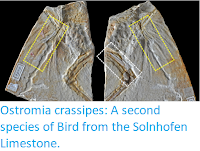
Ostromia crassipes: A second species of Bird from the Solnhofen Limestone.

The first known fossil Bird, Archaeopteryx lithographica, was described from the Late Jurassic Solnhofen Limestone of Bavaria in 1861, only two years after the publication of Darwin's On the origin of species by means of natural selection, and, showing a clear connection between modern Birds and the Theropod Dinosaurs, provided the first strong evidence in support of Darwin's theories after the publication of the book. Since that time many fossil Bird species have been described, but until the 2012, when Birds were described from the Tiaojishan Formation of eastern China, Archaeopteryx lithographica was the only Bird species known from the Jurassic, and remains to this day the only described Jurassic Bird species from outside of China.

In a paper published in the journal BMC Evolutionary Biology on 2 December 2017, Christian Foth of the Department of Geosciences at the Université de Fribourg, and the Staatliches Museum für Naturkunde Stuttgart, and Oliver Rauhut of the Bayerische Staatssammlung für Paläontologie und Geologie at Ludwig-Maximilians-University Munich, describe a second species of Bird from the Solnhofen Limestone.

The new species is described from a specimen first described as a Pterodactyl in 1857 under the name Pterodactylus crassipes. This specimen was identified as a Bird in 1970, and assigned to the species Archaeopteryx lithographica, and has since then been known as the 'Haarlem specimen', as it is kept in Teylers Museum in Haarlem, the Netherlands.

Overview of the 'Haarlem specimen'. Foth & Rauhut (2017).

The Haarlen specimen is not a complete Bird, like the more famous Berlin and London specimens, but rather a partial specimen comprising portions of a wing and hindlimb, which has prevented direct comparison to other specimens assigned to the species. Foth and Rauhut carried out a morphometric analysis of the bones that were preserved intact in order to compare the Haarlem specimen to better preserved examples of the species.

Morphometric analysis is a tool used by palaeontologists, archaeologists, anthropologists and forensic pathologists to analyse and compare specimens. It relies on taking numerous measurements of an object such as a bone or shell, and comparing both these measurements and ratios between measurements to those obtained from other specimens in order to establish relationships between them.

Using this methodology Foth and Rauhut found that almost all of the proportions of the Haarlem specimen fell outside those of other Archaeopteryx lithographica, specimens, strongly suggesting that it is a member of a new species. In order to test this further, they carried out a cladistic analysis (computerised analysis of relationships within the group based entirely upon shared common features rather than assumed relationships) including the Haarlem specimen, Archaeopteryx lithographica, and a selection of other early Birds and Maniraptoran Dinosaurs (the group of Therapods that includes Birds). This strongly suggested that the Haarlem specimen is more closely related to the Tiaojishan Birds Pedopenna, Eosinopteryx, and Anchiornis, than it is to Archaeopteryx

On this basis Foth and Rauhut conclude that the Haarlem specimen represents a second species of Bird from the Solnhofen Limestone, and formally describe that species as Ostromia crassipes, where 'Ostromia' honours John Ostrom, who first recognised the specimen was a Bird rather than a Pterodactyl, and 'crassipes' is the original species name assigned to the specimen in 1857.

See also...

http://sciencythoughts.blogspot.co.uk/2017/06/an-enantiornithine-bird-hatchling.htmlhttp://sciencythoughts.blogspot.co.uk/2017/02/a-hesperornithiform-bird-from-late.html
http://sciencythoughts.blogspot.co.uk/2017/01/tingmiatornis-arctica-ornithurine-bird.htmlhttp://sciencythoughts.blogspot.co.uk/2016/12/preserved-plumage-in-immature.html
http://sciencythoughts.blogspot.co.uk/2016/04/chongmingia-zhengi-new-species-of-bird.htmlhttp://sciencythoughts.blogspot.co.uk/2015/11/fumicollis-hoffmani-new-species-of.html
Follow Sciency Thoughts on Facebook.

Sunday, 8 November 2015

Preserved eggs within the body of a Late Jurassic Pterosaur.

The Pterosaurs were a group of flying animals that appeared in the Late Triassic and persisted till the end of the Cretaceous. They were Diapsids, members of the group that also includes Squamates (Lizards and Snakes), Archosaurs (Crocodiles and Dinosaurs) and Chelonians (Turtles and Tortoises), with most experts in the field considering them to be Archosaurs more closely related to Dinosaurs than Birds. While in many ways Pterosaurs were quite Bird-like, in others they were very different and often quite puzzling. For example their reproductive strategy is thought to have been quite different from that of Birds, with the animals taking several years to reach maturity and having been able to fly and probably reproduce before reaching full size, unlike Birds which reach their maximum size in the first year of life, before leaving the nest. Unfortunately no Pterosaur nest has ever been recovered, and very few eggs are known either, so that most of what we know about very young Pterosaurs is inferred from examining the skeletons of older specimens.

In 2011 a team of palaeontologists led by Lû Junchang of the Institute of Geology of the Chinese Academy of Geological Sciences described the fossil of a female Wukongopterid Pterosaur from the Late Jurassic Tiaojishan Formation of Liaoning Province, China, preserved with an egg adjacent to the pelvis in a paper in the journal Science. This was interpreted as being a parchment egg (egg with an uncalcified shell) that had been expelled from the body post-mortem rather than laid. This was of particular interest as previous Pterosaur eggs discovered had all had calcarous shells, though the egg was preserved as an impression only, preventing detailed study of the specimen.

In a paper published in the Anais da Academia Brasileira de Ciências on 3 July 2015, Xiaolin Wang of the Institute of Vertebrate Paleontology and Paleoanthropology of the Chinese Academy of Sciences, Alexander Kellner of the Laboratory of Systematics and Taphonomy of Fossil Vertebrates at the Department of Geology and Paleontology at the Universidade Federal do Rio de Janeiro, Xin Cheng of the Institute of Vertebrate Paleontology and Paleoanthropology of the Chinese Academy of Sciences and the Laboratory of Systematics and Taphonomy of Fossil Vertebrates at the Universidade Federal do Rio de Janeiro, Shunxing Jiang and Qiang Wang, also of the Institute of Vertebrate Paleontology and Paleoanthropology of the Chinese Academy of Sciences, Juliana Sayào of the Centro Acadêmico de Vitória at the Universidade Federal de Pernambuco, Taissa Rodrigues of the Departamento de Biologia at the Universidade Federal do Espírito Santo, Fabiana Costa of the Department of Biological Sciences at the Universidade Federal de São Paulo, Ning Li of the Institute of Vertebrate Paleontology and Paleoanthropology of the Chinese Academy of Sciences and the University of Chinese Academy of Sciences and Xi Meng and Zonghe Zhou, again of the Institute of Vertebrate Paleontology and Paleoanthropology of the Chinese Academy of Sciences, describe the recently discovered counterpart to the slab on which the fossil described by Lû et al. in 2011, which reveals a second egg within the body of the Pterosaur as well as details of the structure of the eggs.

The specimen is a subadult Wukongopterid Pterosaur which Lû et al. assigned to the genus Darwinopterus but which Wang et al reassign to the genus Kunpengopterus, as the new material is more complete and shows additional details of the skeleton, and our understanding of the anatomy and diversity of Wukongopterid Pterosaurs has improved considerably in the last four years. There are two eggs preserved on the slab, one to the left of the skeleton and immediately to the posterior of the pelvis, the other within the body cavity behind the pelvis and associated with the gastrula and ribs.

Gravid pterosaur of Kunpengopterus sp. with two eggs, one inside the body cavity and a second posterior to the pelvic region. (a) Counter slab. (b) Composite drawing of slab and counter slab indicating the position of the eggs and the bones (in grey) preserved in the counter slab. The arrow indicates the part of the femur removed for histological sections. Scale bar is 100 mm. Wang et al. (2015).

The eggs are flattened, and whitish in colour, they show concentric folding around the edges, but not crazing or cracking which would be associated with a crushed calcified egg. Wang et al. attempted to detect traces of calcium in the shells of the eggs using Energy Dispersive Spectroscopy under a Scanning Electron Microscope, but were unable to do so, from which they conclude that the eggs were either never calcified or have lost all their calcium, either by re-absorbtion by the female prior to death or during the preservation process.

The eggs measure 27.8 by 19.8 mm and 27.9 by 18.2 mm respectively. Following attempts to reconstruct these flattened dimensions with hatched, waterlogged snake eggs leads Wang et al. to conclude the original eggs were between 3.19 g and 4.50 g in mass (considerably smaller than Lû et al.'s estimates), and would have produced hatchlings in the range 2.75 g to 3.75 g.

The presence of two eggs within and closely associated with the specimen strongly suggests that the female was capable of carrying two eggs at the same time, which in turn strongly suggests that the Pterosaur had two functioning ovaries (no living animal is capable of producing two large eggs from a single ovary in this way). This is different to the situation in modern Birds, where one ovary has been lost, presumably as part of the general trend to lose weight and improve flight performance in Birds.

Wang et al. also examined the femur bone of the specimen for traces of a medullary bone layer. This is a tissue produced in female Birds which stores calcium, allowing this to be rapidly deposited into developing eggs and foetuses, and which has also been found in some Dinosaurs. Were medullary bone to be produced in Pterosaurs then is would be expected to be found in a gravid female. However no trace of medullary bone could be found, suggesting that this tissue arose after the split between Dinosaurs and Pterosaurs.

Unfortunately the early life history if Pterosaurs is largely unknown. A number of Pterosaur eggs have previously been recovered, but no nests or hatchlings, and it is unclear to what extent young Pterosaurs relied upon parental care. It is known that Pterosaurs took several years to reach maturity, and that they were capable of flying and even breeding before reaching maturity. The new specimen cannot shed any direct light upon the early life of Pterosaurs, in other Diapsids small parchment shelled eggs tend to be associated with large clutch sizes, suggesting a reproductive strategy closer to Crocodiles or Turtles rather than Birds.

See also...

http://sciencythoughts.blogspot.co.uk/2015/04/azhdarchid-pterosaur-cervical-vertebra.htmlAzhdarchid Pterosaur cervical vertebra from the Late Cretaceous of the Haţeg Basin in Transylvania.                                                            Azhdarchids were long-necked, toothless Pterosaurs, which came to dominate Pterosaur assemblages in...

The Loma del Pterodaustro lake deposits of Central Argentina have produced large numbers of the Pterosaur Pterodaustro guinazui...


http://sciencythoughts.blogspot.co.uk/2014/06/preserved-ovarian-follicles-in-mesozoic.htmlPreserved ovarian follicles in Mesozoic Birds.                                                            The two surviving groups of Archosaurs, Crocodilians and Birds, show very different reproductive strategies. Crocodilians have paired ovaries and produce... 


Follow Sciency Thoughts on Facebook.