Wednesday, 7 February 2018

Asteroid 2018 CT passes the Earth.

Asteroid 2018 CT passed by the Earth at a distance of about 650 000 km (1.69 times the average distance between the Earth and the Moon, or 0.43% of the distance between the Earth and the Sun), slightly before 10.30 am GMT on Saturday 3 February 2018. There was no danger of the asteroid hitting us, though were it to do so it would not have presented a significant threat. 2018 CT has an estimated equivalent diameter of 13-41 m (i.e. it is estimated that a spherical object with the same volume would be 13-41 m in diameter), and an object of this size would be expected to explode in an airburst (an explosion caused by superheating from friction with the Earth's atmosphere, which is greater than that caused by simply falling, due to the orbital momentum of the asteroid) in the atmosphere between 30 and 10 km above the ground, with only fragmentary material reaching the Earth's surface.

The calculated orbit of 2018 CT. Minor Planet Center.

2018 CT was discovered on 4 February 2018 (the day after its closest approach to the Earth) by the University of Arizona's Catalina Sky Survey, which is located in the Catalina Mountains north of Tucson. The designation 2018 CT implies that it was the 19th asteroid (asteroid T) discovered in the first half of February 2018 (period 2018 C).
 
2018 CT has a 521 day orbital period and an eccentric orbit tilted at an angle of 33.9° to the plane of the Solar System, which takes it from 0.94 AU from the Sun (i.e. 94% of he average distance at which the Earth orbits the Sun) to 1.59 AU from the Sun (i.e. 159% of the average distance at which the Earth orbits the Sun, and further from the Sun than the planet Mars). It is therefore classed as an Apollo Group Asteroid (an asteroid that is on average further from the Sun than the Earth, but which does get closer). This means that 2018 has occasional close encounters with the Earth, with the last having happened in August 2017, and the next predicted for August 2027.
 
See also...
 
http://sciencythoughts.blogspot.co.uk/2018/02/asteroid-2018-bt6-passes-earth.htmlhttp://sciencythoughts.blogspot.co.uk/2018/01/asteroid-2018-bn6-passes-earth.html
http://sciencythoughts.blogspot.co.uk/2018/01/comet-c2016-t3-panstarrs-makes-its.htmlhttp://sciencythoughts.blogspot.co.uk/2018/01/comet-74psmirnova-chernykh-reaches.html
http://sciencythoughts.blogspot.co.uk/2018/01/asteroid-2018-ag4-passes-earth.htmlhttp://sciencythoughts.blogspot.co.uk/2018/01/asteroid-2018-au2-passes-earth.html
Follow Sciency Thoughts on Facebook.

British tourist attacked by Shark while snorkeling in the Galapagos Islands.

A British tourist has suffered severe damage to his right leg after being bitten by a Shark while snorkeling in the Galapagos Islands. London-based businessman Andrew Phipps Newman, 45, originally from South Africa, suffered a broken bone and several severed ligaments after the Shark seized him by one foot off Santa Fe Island. The animal broke off its attack after being punched repeatedly on the nose, allowing Mr Phipps Newman to be pulled from the water into a boat, where he was treated by a doctor, Kathryn Gilbert, 27, also on holiday from the UK, during a three hour trip to the nearest hospital.

British tourist Andrew Phipps Newman recovering after being bitten by a Shark in the Galapagos Islands. Andrew Newman.

The attack is thought to have been carried out by a Galapagos Shark, Carcharhinus galapagensis, a large species of Requiem Shark, Carcharhinidae, which, despite its name, is found around tropical island and reefs in all the world's oceans. Galapagos Sharks typically feed on small Fish and Cephalopods (Squid and Octopus), but larger members of the species can be more adventurous, and will attack other Sharks and Marine Mammals. Shark attacks on Humans are extremely rare, with only eight such events recorded in Ecuadorian waters since records began in 1952.

A Galapagos Shark, Carcharhinus galapagensis, in the northwest Hawaiian Islands. Dwayne Meadows/NOAA.

See also...

http://sciencythoughts.blogspot.co.uk/2018/01/cretalamna-bryanti-new-species-of.htmlhttp://sciencythoughts.blogspot.co.uk/2017/12/shark-remains-from-early-cretaceous-of.html
http://sciencythoughts.blogspot.co.uk/2017/12/american-tourist-killed-by-shark-in.htmlhttp://sciencythoughts.blogspot.co.uk/2017/12/californian-student-recovering-after.html
http://sciencythoughts.blogspot.co.uk/2016/09/megachasma-alisonae-megamouth-shark.htmlhttp://sciencythoughts.blogspot.co.uk/2016/01/mollisquama-sp-pocket-shark-from-gulf.html
Follow Sciency Thoughts on Facebook.

Magnitude 6.4 Earthquake kills at least four in Taiwan.

The Taiwan Central Weather Bureau reported a Magnitude 6.4 Earthquake at a depth of 10.6 km on the coast of Hualian County in eastern Taiwan at about 11.50 pm local time (about 3.50 pm GMT) on Tuesday 6 February 2017. Four people have now been confirmed dead following this event, with at least 140 more missing and 255 people known to have been injured, many of them critically. The majority of those affected lived in four large apartment blocks in Hualian that have partially collapsed following the event. Several thousand more people have been left without water and electricity following the event, and schools and other public services are expected to remain closed in Hualian County on Wednesday 7 February. People have reported feeling the event across Taiwan and on parts of the Chinese mainland.

Apartment building in Hualian County, Taiwan, which is listing heavily after collapsing on one side following an Earthquake in Taiwan on 6 February 2018. Tian Jun-hsiung/AP.

Taiwan has a complex tectonic setting, lying on the boundary between the Eurasian and Philippine Plates, with the Eurasian Plate being subducted beneath the Philippine Plate in the South and the Philippine Plate being subducted beneath the Eurasian in the East. Subduction is not a smooth process even in simple settings, with plates typically sticking together as pressure from tectonic expansion elsewhere builds up, then suddenly breaking apart and shifting abruptly, causing Earthquakes.

The motion of the tectonic plates beneath Taiwan. The University of Memphis.

Witness accounts of Earthquakes can help geologists to understand these events, and the structures that cause them. The international non-profit organisation Earthquake Report is interested in hearing from people who may have felt this event; if you felt this quake then you can report it to Earthquake Report here.

The approximate location of the 6 February 2018 Hualian Earthquake. USGS.

See also...

http://sciencythoughts.blogspot.co.uk/2017/11/magnitude-55-earthquake-in-chiayi.htmlhttp://sciencythoughts.blogspot.co.uk/2017/02/magnitude-56-earthquake-beneath.html
http://sciencythoughts.blogspot.co.uk/2016/10/magnitude-57-earthquake-off-southeast.htmlhttp://sciencythoughts.blogspot.co.uk/2016/02/twenty-four-confirmed-deaths-following.html
http://sciencythoughts.blogspot.co.uk/2014/08/at-least-25-dead-following-series-of.htmlhttp://sciencythoughts.blogspot.co.uk/2014/07/airplane-crash-linked-to-typhoon-matmo.html
Follow Sciency Thoughts on Facebook.

Tuesday, 6 February 2018

Accident kills mineworker in West Virginia.

A mineworker has died in an accident at the Arch Coal Mining operated Wolf Run Sentinel Mine in Barbour County, West Virginia, on Tuesday 6 February 2018. Leonard Griffith, 52, of Valley Bend in Randolph County, an electrician employed at the mine for slightly over  three years, was working on a machine when he was caught in a partial collapse, at about 3.55 am local time.

The approximate location of the Wolf Run Sentinel Mine. Google Maps.

The incident has been described as a rib roll, a partial collapse around a pillar. Pillars are left as supporting structures as miners clear galleries. However as the mine grows, the load on each pillar can become to much, leading to collapses around the pillars as sections of the pillar known as ribs crack and come away, a process known in the industry as rib-rolling.

See also...

http://sciencythoughts.blogspot.co.uk/2017/12/mineworker-killed-in-accident-in-west.htmlhttp://sciencythoughts.blogspot.co.uk/2016/06/flooding-kills-26-in-west-virginia.html
http://sciencythoughts.blogspot.co.uk/2015/03/one-dead-and-two-injured-following-roof.htmlhttp://sciencythoughts.blogspot.co.uk/2014/05/two-fatalites-following-roof-collapse.html
http://sciencythoughts.blogspot.co.uk/2014/01/around-300-000-still-without-water.htmlhttp://sciencythoughts.blogspot.co.uk/2013/10/worker-killed-at-west-virginia-coal-mine.html
Follow Sciency Thoughts on Facebook.

Flooding and landslides kill at least two in West Java.

Two people are known to have died and eight more are missing following a series of flooding and landslide events in West Java Province, Indonesia, this week. Both of the fatalities are reported to have occurred in the city of Bogor about 50 km to the south of Jakata. Only one of the dead has been identified, Dianti Dyah Ayu Putri, one of two women who were buried by a landslide in their car in the early hours of Tuesday 6 February 2018, who died of her injuries in hospital. Her companion Mukhmainah, who was trapped in the vehicle for several hours, is still being treated.

The scene of a landslide that buried two women in their car in Bogor, West Java, on 2 February 2018. Andika Panduwinata/Warta Kota.

Landslides are a common problem in Java, particularly during the Northeast Monsoon, which lasts from November to February, with peak rainfall in January and February, and can result in an annual rainfall in excess of 4000 mm in parts of West Java. This problem has been made worse as expanding populations has led to people farming higher on hillslopes, in an area where soils tend to be volcanic in action and poorly consolidated (i.e. lack much cohesion), making them more prone to landslides.

Monsoons are tropical sea breezes triggered by heating of the land during the warmer part of the year (summer). Both the land and sea are warmed by the Sun, but the land has a lower ability to absorb heat, radiating it back so that the air above landmasses becomes significantly warmer than that over the sea, causing the air above the land to rise and drawing in water from over the sea; since this has also been warmed it carries a high evaporated water content, and brings with it heavy rainfall. In the tropical dry season the situation is reversed, as the air over the land cools more rapidly with the seasons, leading to warmer air over the sea, and thus breezes moving from the shore to the sea (where air is rising more rapidly) and a drying of the climate.

 Diagrammatic representation of wind and rainfall patterns in a tropical monsoon climate. Geosciences/University of Arizona.

Java has two distinct Monsoon Seasons, with a Northeast Monsoon driven by winds from  the South China Sea that lasts from November to February and a Southwest Monsoon driven by winds from the southern Indian Ocean from March to October. Such a double Monsoon Season is common close to the equator, where the Sun is highest overhead around the equinoxes and lowest on the horizons around the solstices, making the solstices the coolest part of the year and the equinoxes the hottest. 

 The winds that drive the Northeast and Southwest Monsoons in Southeast Asia. Mynewshub.

See also...

http://sciencythoughts.blogspot.co.uk/2017/12/magnitude-65-earthquake-beneath-west.htmlhttp://sciencythoughts.blogspot.co.uk/2017/10/landslide-kills-four-in-west-java.html
http://sciencythoughts.blogspot.co.uk/2015/11/landslide-believed-to-have-killed-one.htmlhttp://sciencythoughts.blogspot.co.uk/2015/05/landslide-triggers-explosion-at.html
http://sciencythoughts.blogspot.co.uk/2014/08/three-dead-following-west-java-pipeline.htmlhttp://sciencythoughts.blogspot.co.uk/2015/03/twelve-confirmed-deaths-in-javanese.html
Follow Sciency Thoughts on Facebook.


Monday, 5 February 2018

Amplectister tenax: A new species of Clown Beetle from Cretaceous Burmese Amber.

Clown (of Hister) Beetles, Histeridae, are a diverse group of carnivorous Beetles found across the globe. They are easy to distinguish, the elytra (wing cases) that do not cover the ends of their abdomens and club-like tips to their antennae. They occupy a wide range of ecological niches, with most species feeding on other Arthropods and small invertebrates, though other specialise in the carrion of larger animals (and in some cases are used by forensic entomologists to help determine how long bodies have been dead). The group has a reasonable fossil record, with numerous fossils, predominantly in amber, from the Oligocene onwards, and two previously described specimens from Cretaceous Burmese Amber, though these are not for the most part well studied and the origins of the group are obscure.

In a paper published in the journal ZooKeys on 1 February 2018, Michael Caterino of the Department of Plant & Environmental Sciences at Clemson University and David Maddison of the Department of Integrative Biology at Oregon State University, describe a third species of Clown Beetle from Burmese Amber.

Cretaceous ‘Burmese Amber’ has been extensively worked at several sites across northern Myanmar (though mostly in Kachin State) in the last 20 years. The amber is fairly clear, and often found in large chunks, providing an exceptional window into the Middle Cretaceous Insect fauna. This amber is thought to have started out as the resin of a Coniferous Tree, possibly a Cypress or an Araucaria, growing in a moist tropical forest. This amber has been dated to between 105 and 95 million years old, based upon pollen inclusions, and to about 98.8 million years by uranium/lead dating of ash inclusions in the amber. 

The new species is named Amplectister tenax, where 'Amplectister' means 'Hugging Hister' and 'tenax' means 'tenacious'. The species is described from a single specimen of indeterminate sex, 1.41 mm in length and 1.02 mm in width, with an elongate, flattened body. This appears to have a granular texture, and has trapped a layer of either some granular substance or small air bubbles on its surface.

Photographs of Amplectister tenax. (2) Ventral view. (3) Dorsal view. (4) Lateral view. (5) Frontal view. Caterino & Maddison (2018).

See also...

http://sciencythoughts.blogspot.co.uk/2017/12/elonus-gruberi-new-species-of-ant-like.html
http://sciencythoughts.blogspot.co.uk/2017/11/spinotoma-ruicheni-new-species-of-wedge.htmlhttp://sciencythoughts.blogspot.co.uk/2017/10/eurypeza-aurora-new-species-of-scarab.html
http://sciencythoughts.blogspot.co.uk/2017/10/lamellothyrea-isimangalis-new-species.htmlhttp://sciencythoughts.blogspot.co.uk/2017/10/kuskaella-macroptera-new-species-of.html
Follow Sciency Thoughts on Facebook.

Sunday, 4 February 2018

Almas ukhaa: A new species of Troodontid Dinosaur from the Late Cretaceous of Mongolia.

The Troodontids were a group of small-to-medium sized Maniraptoran Theropod Dinosaurs known from the Cretaceous of Asia and North America. They were closely related to the Birds and Dromeosaurs, with the three groups being classified together as the Paraves. They had large brains and large forward pointing eyes, traits that would generally be associated with predatory behaviour, but their dentition implies a more complex story, with several species having small serrated teeth that would be on their own be taken as indicative of a browsing herbivorous diet, with the two together probably indicating some measure of omnivory.

In a paper published in the American Museum Novitates on 15 December 2017, Rui Pei of the Department of Earth Sciences at the University of Hong Kong, and the Division of Paleontology at the American Museum of Natural History, Mark Norell, also of the Division of Paleontology at the American Museum of Natural History, Daniel Barta of the Richard Gilder Graduate School and Division of Paleontology at the American Museum of Natural History, Gabriel Bever, again of the Division of Paleontology at the American Museum of Natural History, and of the Center for Functional Anatomy & Evolution at the Johns Hopkins University School of Medicine, Michael Pittman of the Vertebrate Palaeontology Laboratory at the University of Hong Kong, and Xing Xu of the Institute of Vertebrate Paleontology and Paleoanthropology of the Chinese Academy of Sciences, describe a new species of Troodontid Dinosaur from the Late Cretaceous Djadokhta Formation of Ukhaa Tolgod in the Ömnögovi Province of southern Mongolia.

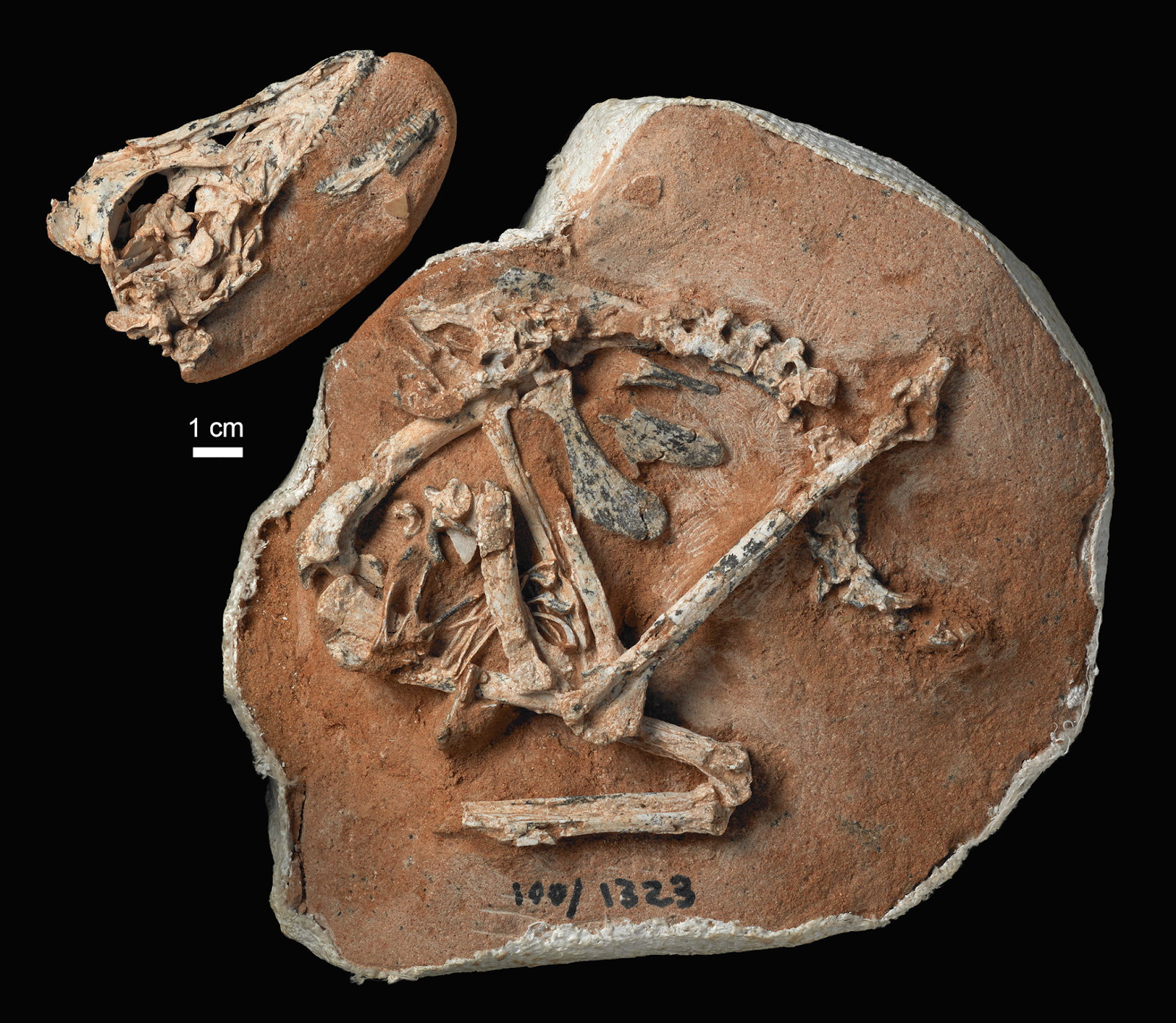
The new species is named Almas ukhaa, where 'Almas' refers to a Yeti-like creature from Mongolian folklore and 'ukhaa' to the locality where the specimen was found. The species is described from a single specimen comprising a nearly complete skull and partial post-cranial skeleton, probably that of an almost mature sub-adult. The skull is about 82 mm in length, with four premaxilary (upper front) a teeth, a row of 16 maxilary teeth, smaller at the front and lacking serrations, and 23 dentary (lower) teeth, closer packed at the front.

The specimen of Almas ukhaa. Pei et al. (2017).

The specimen was found associated with a number of eggshell fragments, which almost certainly came from a non-Avian Dinosaur, and quite possibly a Troodontid, though it is impossible to say what the actual relationship of these to the specimen is.

See also...

http://sciencythoughts.blogspot.co.uk/2018/01/caihong-juji-new-species-of-paravian.htmlhttp://sciencythoughts.blogspot.co.uk/2017/12/ostromia-crassipes-second-species-of.html
http://sciencythoughts.blogspot.co.uk/2017/06/an-enantiornithine-bird-hatchling.htmlhttp://sciencythoughts.blogspot.co.uk/2016/12/tongtianlong-limosus-new-species-of.html
http://sciencythoughts.blogspot.co.uk/2016/03/fukuivenator-paradoxus-maniraptoran.htmlhttp://sciencythoughts.blogspot.co.uk/2016/02/boreonykus-certekorum-new-species-of.html
Follow Sciency Thoughts on Facebook.