Showing posts with label Acfer 086 Meteorite. Show all posts

Monday, 27 April 2020

First protein of extraterrestrial origin found within the Acfer 086 Meteorite.

Although individual amino acids have been found in abundance in carbonaceous meteorites there have been only two reports of polymers of amino acids The first of these was di-glycine, from the Murchison Meteorite, a carbonaceous chondrite which fell in Victoria, Australia in 1969, and the Yamato-791198, a second carbonaceous chondrite collected from Antarctica in 1979. More recently a range of large polymers of mainly glycine was reported in the Allende Meteorite, a 17.3 kg carbonaceous chondrite which fell in Mexico in February 1969.

In a paper published on the arXiv Database at Cornell University on 22 February 2020, Malcolm McGeogh of the PLEX Corporation, Sergei Dikler of Bruker Scientific, and Julie McGeogh of the Department of Molecular and Cellular Biology at Harvard University, present the discovery of the first known protein of extraterrestrial origin, found within the Acfer 086 Meteorite, a 17.5 kg carbonaceous chondrite found in Algeria in 1989.

In follow-on work to the discovery of large polymers in the Allende Meteorite high molecular mass organic molecules were discovered in the Allende and Acfer 086 meteorites, with extra-terrestrial isotope enhancement that confirmed that these unexpected molecules were not artifacts due to terrestrial contamination.

Studying molecules from the Acfer 086 Meteorite with a state-of-the-art mass spectrometer generated much-improved signal-to-noise ratios that allowed McGeogh et al. to discover via the iron⁵⁴ isotope satellite (isotope satellites are small peaks that can be seen shouldering the main peaks in an Nuclear Magnetic Resonance spectrum) that iron was also present and bonded to the glycine and hydroxy-glycine, in specific arrangements. Also, via its lithium⁶ satellite, lithium was found to be a standard component.  When the prior observations are also taken into account, the most probable core molecule has a molecular mass of 2320, containing two glycine strands each of length 16 residues, but variants with 15 and 17 residues also appear to be present. This molecule is given the name 2320 hemolithin, derived from its molecular weight and iron and lithium contents.

Model of the 2320 hemolithin molecule after Merck Molecular Force Field energy minimisation. Top: in space-filling mode; Centre: ball and stick; Bottom: enlarged view of iron, oxygen and lithium termination. White, hydrogen; orange, lithium; grey, carbon; blue, nitrogen; red, oxygen; and green, iron. Hydrogen bonds are shown by dotted lines. McGeogh et al. (2020).

This is the first report of a protein from any extra-terrestrial source. Room temperature extracts from micron-sized meteorite particles contain polymers of amino acids with a definite chain length centered at 16 residues. Analysis via iron and lithium isotope satellites in mass spectrometry reveals a novel protein motif with iron atoms closing out the ends of anti-parallel peptide chains composed of glycine.

In a review of the known binding geometries for iron within proteins such as hemoglobin or hemerythrin, this new motif was not found. Its overwhelming simplicity and the new association with beta sheet proteins make its future study very important.

The molecule was found to be highly enriched in deuterium (hydrogen²) compared to terrestrial hydrogen sources. Such high deuterium enhancements are well documented in molecular clouds where low temperature isotopic selection has operated for timespans of more than 10 million years. McGeogh et al. estimate that simple amino acids should be able to slowly polymerise in the conditions of 'warm dense molecular clouds', without necessarily requiring surfaces for the reaction. Furthermore, the elements hydrogen, lithium, carbon, nitrogen, oxygen, and iron, comprising this molecule were initially the most abundant when the first massive stars released them about 13 billion years ago.

Deuterium is also enriched in molecules of proto-planetary discs. A previous study applied complete molecular cloud chemistry models to the disc and one of the predictions from this relates to the amount of deuterium/hydrogen enrichment expected at 30AU radius (i.e 30 timse as far from the Sun as the Earth), which is the likely region for the origin of comets, which was again consistent with the level of enhancement found in the hemolithin molecule. Interestingly, the Acfer 086 Meteorite has also been shown to be enriched in the nitrogen isotope nitrogen¹⁵ to an extent consistent with cometary values. However, both Acfer 086 and the Allende Meteorite are considered to be CV3 chondritic meteorites, thought to derive from a parent body in the asteroid belt that is only between 2.2 and 3.3AU from the Sun.

It appears that three common variants of Hemolithin with chain lengths 15, 16 and 17 may co-exist. If this molecular type grows spontaneously when its glycine, iron, oxygen, lithium and hydrogen components are present together in a particular environment then it is difficult to imagine such a tight length distribution being the result. A function yet to be identified could determine the length and maintain such a tight distribution. If successful in that function, energy could be harvested, which is a thermodynamic requirement, to aid in the creation of molecular copies of identical length.

One-step room temperature solvent extraction from micron scale particles of the Acfer 086 Meteorite, a CV3 chondrite, yielded a relatively simple spectrum that is dominated by a single protein type. This is composed of anti-parallel beta strands of glycine, each of 15 to 17 -residue length, with about 20% oxidation to hydroxy-glycine, and termination at each end with an iron atom directly bonded to carbon and nitrogen terminals of the peptide strands. There are additional tri-oxygen/iron groups at each end, and lithium adducts. The principal indicator of extra-terrestrial origin is an extreme raised deuterium/hydrogen ratio that is revealed by close quantitative fitting of isotopic satellite peaks. The average molecular deuterium excess above terrestrial is comparable to cometary levels, interstellar levels and also equal to the highest prior report in micro-meteorites. The iron oxide grouping at the tips of the molecule is of a type studied in other contexts for the photo-splitting of water.

See also...

http://sciencythoughts.blogspot.com/2020/04/understanding-earths-archean-atmosphere.htmlhttp://sciencythoughts.blogspot.com/2020/04/identifying-worlds-oldest-impact.html
http://sciencythoughts.blogspot.com/2020/04/calculating-possibility-of-phosphorus.htmlhttp://sciencythoughts.blogspot.com/2020/04/estimating-potential-for-life-to-have.html
https://sciencythoughts.blogspot.com/2020/01/understanding-influence-of-large-bolide.htmlhttps://sciencythoughts.blogspot.com/2019/03/looking-for-source-of-heavy-nitrogen-in.html
Follow Sciency Thoughts on Facebook.

Tuesday, 5 March 2019

Looking for the source of heavy nitrogen in the Allende and Acfer 086 meteorites.

Meteorites, particularly carbonaceous chondrites, have been known to frequently be enriched in heavy nitrogen (nitrogen with an atomic weight of 15, rather than 14, due to the presence of an additional neutron in the nucleus) since the 1970s, with notable examples being the Renazzo Meteorite, which fell in Italy in 1924, has a heavy nitrogen enrichment relative to that of atmospheric nitrogen of 170 ‰ (170 parts per thousand, indicating that for every 1000 atoms of heavy nitrogen in a sample of atmospheric nitrogen, an equivalent sample of nitrogen from the Renazzo Meteorite will contain 1170 atoms of heavy nitrogen), the Bencubbin Meteorite, which was found in Western Australia in 1930, with a heavy nitrogen enrichment of 973 ‰, the Bells Meteorite with a heavy nitrogen enrichment of 335 ‰, and ALH 850585, which was found in the Allen Hills of Antarctica in 1985, with a heavy nitrogen enrichment of 858 ‰. However, this enrichment in heavy nitrogen does not appear to be found throughout the meteorites, but to be coming from specific compounds within them. The Allende Meteorite, a 17.3 kg carbonaceous chondrite which fell in Mexico in February 1969, has a heavy nitrogen enrichment of -18.6 ‰ (i.e. it less heavy nitrogen than atmospheric nitrogen), yet when heated to 600°C has been shown to give off much higher levels of heavy nitrogen.

Work carried out on the Murchison Meteorite, which fell in Victoria, Australia in 1969, during the 1980s and 1990s suggested that the heavy nitrogen found in that meteorite might be bound up in organic molecules, with differing molecules having different proportions of heavy nitrogen. This is interesting because the most likely way in which atoms of the same element can become sorted by isotopic weight within different molecules is for these molecules to form in an aqueous environment (liquid water) where the protomolecules are sorted in some way over a long period of time.

In a paper published on the arXiv Database at Cornell University on 15 November 2018, Malcolm McGeogh of the PLEX Corporation, Tomáš Šamořil of TESCAN ORSAY HOLDING, David Zapotok of TESCAN USA Inc., and Julie McGeogh of the Department of Molecular and Cellular Biology at Harvard University, present the results of a study of the Allende Meteorite, as well as Acfer 086, a 17.5 kg carbonaceous chondrite found in Algeria in 1989, which sought to find the source of heavy nitrogen in these meteorites.

Samples were obtained by drilling 6 mm into the meteorites with diamond burrs in a clean room. These samples were then cleaned ultrasonically in deionised water, and dried, then split into samples for analysis by Time of Flight Secondary Ion Mass Spectrometry on a XEIA3 TESCAN Scanning Electron Microscope equipped with a Focused Ion Beam that used high resolution orthogonal scanning, looking in particular for ions with molecular masses of 24, 25, 26, and 27, which correspond to C₂⁻ (two carbon atoms), C₂H⁻ (two carbon atoms and one hydrogen atom), ¹²C¹⁴N⁻ (one carbon atom and one nitrogen atom), and ¹²C¹⁵N⁻ (one carbon atom and one heavy nitrogen atom).

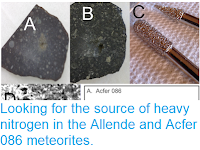
Acfer 086 (A), Allende (B) meteorite samples milled via diamond burrs (C) to produce micron scale fragments (D). McGeogh et al. (2019). 

McGeogh et al. note that the molecular mass of ¹²C¹⁵N (one carbon atom and one heavy nitrogen atom) is the same as that of ¹³C¹⁴N (one heavy carbon atom and one nitrogen atom), which could potentially be a problem. However, the ratio of heavy carbon to carbon in the Allende Meteorite has previously been determined, enabling this to be removed from the calculations. The proportion of heavy carbon to carbon in Acfer 086 is unknown, but McGeogh et al. felt able to assume that it is the same as in the Allende Meteorite, due to the similar composition (and therefore presumed origin) of these bodies.

Using this methodology McGeogh et al. found that nitrogen bound to carbon in the Allende Meteorite was enhanced in the heavier isotope by about 410 ‰ relative to terrestrial nitrogen, and that nitrogen bound to carbon in Acfer 086 was enhanced in the heavier isotope by about 1015 ‰ relative to terrestrial nitrogen.

Both the meteorites produced exactly twice as much CN⁻ as C₂⁻, and this ratio was consistent across all the samples, suggesting that all the ions were coming from a common source. The most likely source of this would be polymer amides with a backbone of covalently bonded carbon and nitrogen, which if broken into random chunks should produce CN⁻:C₂⁻ in the ratio 2:1. When C₂H⁻ ions are included in the analysis the ratio of carbon to nitrogen is 2.8 to 1 in the Acfer 086 Meteorite, and 2.64 to 1 in the Allende Meteorite. This is consistent with the presence of fragments of mixed amino acids in the sample, with common amino acids having carbon to nitrogen ratios of 2 to 1 (glycine, asparagine, and histidine), 2.5 to 1 (glutamine), and 3 to 1 (alanine, serine, cysteine, and lysine). Both meteorites have previously yielded poly-glycine amide chains, with occasional alpha carbon hydroxylations and methylations, making such a compound a likely source of the heavy nitrogen in the samples.

See also...

https://sciencythoughts.blogspot.com/2019/02/meteorites-fall-on-cuban-town-after.htmlhttps://sciencythoughts.blogspot.com/2018/11/preserved-magnetic-field-in-mineral.html
https://sciencythoughts.blogspot.com/2018/10/unusual-inickel-iron-meteorite.htmlhttps://sciencythoughts.blogspot.com/2018/09/using-mineral-inclusions-from-almahata.html
https://sciencythoughts.blogspot.com/2018/07/fragment-of-asteroid-2018-la-found-in.htmlhttps://sciencythoughts.blogspot.com/2018/06/meteorites-found-in-yunnan-province.html
Follow Sciency Thoughts on Facebook.