Showing posts with label Cherries. Show all posts

Wednesday, 9 April 2025

Prunus luxurians: A new species of Cherry from southwestern Ecuador.

The genus Prunus has a worldwide distribution and contains several important food crops (including Cherries, Almonds, and Plums), ornametal species (Blossom Cherries), timber souces (e.g. Black Cherry) and medicinal Plants (e.g. African Cherry). There are thought to be about 450 valid species in the genus, but the situation is complicated with about 1230 species described within the genus, and over 2000 more in other genera that have since been synonymised with it (i.e. genera which have had all their putative members moved into Prunus. 

Historically, it has been thought that the majority of Prunus species are found in the northern temperate belt, with a smaller number of species found at high altitudes in tropical and subtropical zones. However, recent research has discovered that the genus is much more widespread in lowland tropical forests than previously realised, particularly in the Americas, raising the possibility that the genus is more diverse in these regions than in the temperate zone.

In a paper published in the journal PhytoKeys on 4 April 2025, Álvaro Pérez of the Herbario QCA at the Pontificia Universidad Católica del Ecuador, Jorge Andrés Pérez-Zabala of the Herbario Gabriel Gutiérrez Villegas at the Universidad Nacional de Colombia, Katya Romoleroux, also of the Herbario QCA at the Pontificia Universidad Católica del Ecuador, David Espinel-Ortiz, again of the Herbario QCA at the Pontificia Universidad Católica del Ecuador, and of the Bonn Institute of Organismic Biodiversity at the University of Bonn, and Chaquira Romoleroux and Natasha Albán-Vallejo, once again of the Herbario QCA at the Pontificia Universidad Católica del Ecuador, describe a new species of Prunus from southwestern Ecuador.

The new species is described from a small population of trees discovered in a cloud forest remnant in the Sambotambo Birón area of the Jocotoco Foundation-managed Reserve Buenaventura in El Oro Province, on the western flank of the Andes, between 1300 and 1400 m above sealevel. The new species is named Prunus luxurians, in reference to its 'profuse blooming and outstanding beauty', which makes it a conspicuous part of the lower and mid-strata of the forest.

Prunus luxurians: (A) Habit, (B branch with leaves and floriferous shoots, (C) flowers. Álvaro Pérez in Pérez et al. (2025).

Prunus luxurians forms trees up to 11 m high, with grooved dark brown bark with lighter lenticles (raised pores). Leaves are oblong-to-lance-shaped, waxy, and grow on alternating sides of leaf stems, they are 10–13.65 cm long and 3.5–4.65 cm wide. Flowers are white with light green centres, and born on floriferous shoots, which can have 14–27 individual flowers, clusetered together in groups of 3-4.

Only five living trees were found, in a fragment of montane evergreen forest, with high levels of bith diversity and endemism. The remaining forest fragments in this region are considered to be threatened by mining and farming activities, for which reason Pérez et al. recomend that Prunus luxurians be classified as Critically Endangered under the terms of the International Union for the Conservation of Nature's Red List of Threatened Species.

See also...

Friday, 29 April 2016

Understanding the role of Bears in enabling a Cherry tree to migrate up mountains.

The Earth's climate is known to fluctuate over time, requiring animals and plants to move in order to find suitable habitats. For animals this is a fairly easy task, since most animals constantly move in search of the optimum environments during their lives, however for plants this is much more problematic, as they live the majority of their lives rooted to a single spot, with dispersal only occuring during the seed stage. One way to track optimum conditions in a changing climate without traveling vast distances is to move up and down slopes, since on average a 100 m rise in altitude coresponds to a -0.65 °C drop in temperature. However, while a seed can easily move downslope throgh gravity or water dispersal, seeds cannot fall upslope, requiring the plant to find more creative ways to move seeds uphill.

In a paper published in the journal Current Biology on 25 April 2016 a team of scientists led by Shoji Naoe of the Forestry and Forest Products Research Institute examine the dispersal of the seeds of the Hill Cherry, Prunus verecunda, in Central Japan via two animal vectors, the Asiatic Black Bear, Ursus thibetanus and the Japanese Marten, Martes melampus.

Oxygen isotope ratios in plant tissue can be closely related to altetude, enabling Naoe et al. to estimate the altitude at which the trees that produced Cherry stones found in Bear and Marten droppings had been growing. Surprisingly they found that both species preferentially moved the seeds upwards, with Bears moving them an average of 749.5 m upslope and Martens 460.5 m, close to the maximum distance a foraging member of each species would be expected to travel between eating the fruit and excreting their stones.

The Hill Cherry produces fruit in spring-to-summer, with trees lower on the slope producing flowers, fruit and leaves earlier in the season. Bears, which were responsible for moving 80.3% of the Cherry seeds, have previously been shown to move upslope over the season enabling them to access fruit throughout the season. Naoe et al. suggest that the preferential movement of Bears and Martend uphill between consuming Cherries and defacating may reflect a daily feeding cycle, with the animals feeding first on the fruit, then moving upslope to forrage on herbs and young vegetation that cannot be accessed beneath the canopy of fruiting trees.


Vertical seed dispersal toward the mountain tops by mammals that are following the springto summer plant phenology. The spring-to-summer plant phenology proceeds from the foot to the top of mountains. Cherry fruits and young vegetation are no longer available in low altitudes, ripe fruits are available but young vegetation is no longer available in middle altitudes, and ripe fruits are unavailable but young vegetation is available in high altitudes. Naoe et al. (2016).

See also...

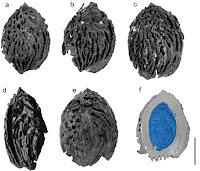
http://sciencythoughts.blogspot.co.uk/2015/12/prunus-kunmingensis-peaches-from-late.htmlPrunus kunmingensis: Peaches from the Late Pliocene of Yunnan Province.                 Peaches, Prunus persica, are widely grown and consumed fruit around the world today, with a total annual production of about 20 million tons. They have a long historical association with humans, particularly in East Asia, with the oldest known...


http://sciencythoughts.blogspot.co.uk/2015/03/changes-in-diet-of-brown-bears-on.htmlChanges in the diet of Brown Bears on Hokkaido.                                                           Expanding Human populations have been the major factor affecting almost all of the Earth’s ecosystems since the end of the last glaciation. Human activity has altered food...
http://sciencythoughts.blogspot.co.uk/2014/05/worker-killed-by-bear-at-alberta-oil.htmlWorker killed by Bear at Alberta oil sands site.                                                                   A worker was killed in an attack by a Bear at an oil sands excavation site operated by Suncor Oil, about 25 km north of Fort McMurray in Alberta Province, Canada, around mid-afternoon on Wednesday 7...


Follow Sciency Thoughts on Facebook.