Showing posts with label Chewing Lice. Show all posts

Sunday, 27 December 2015

Bobdalgleishia stephanophallus: a new species of Philopterid Chewing Louse from Pará State, Brazil.

Chewing Lice, Ischnocera, are considered to be primitive members of the Lice order, Phthiraptera, which lack specialist adaptations for sucking blood or other bodily fluids. Like other Lice they are ectoparasites living externally on the bodies of warm blooded hosts, usually Birds though one group targets Lemurs, feeding on the feathers and skin of the host. The Philopterid Chewing Lice target a wide range of Birds around the world, including Passarines, Kingfishers, Parrots, Trogons and Woodpeckers.

In a paper published in the journal ZooKeys on 1 December 2015, Michel Valim of the Museu de Zoologia at the Universidade de São Paulo and Armando Cicchino of the Laboratorio de Artrópodos at the Universidad Nacional de Mar del Plata describe a new species of Chewing Louse from a Great Jacamar, Jacamerops aureus ridgwayi, from Pará State in Brazil.

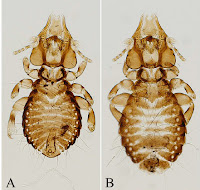
The new species is given the specific name Bobdalgleishia stephanophallus, where 'Bobdalgleishia' honours the late entomologist Robert Dalgleish for his 'special disposition to listen and learn from those who disagree with him on taxonomic issues', and 'stephanophallus' means 'crowned penis' in reference to the male reproductive structure. The species is described from two male and one female specimens found on the preserved skin of a Great Jacamar from the Museu de Zoologia da Universidade de São Paulo obtained in 1943. Valim and Cicchino are aware of the hazards of describing ectoparasites from museum specimens, with a number of documented cases of species being described erroneously based upon poorly preserved parasites that had been transferred to animals other than their hosts post mortem, and to this end examined a large number of further Great Jacamar specimens looking for further examples of Bobdalgleishia stephanophallus without success. In the end it was decided that with well preserved specimens of both sexes it was possible to describe the species, particularly as the specimens show a number of distinctive features not seen in any other documented species, most notably long occular settae (hairs on the eyes), which should make it possible to re-identify this species if it is subsequently found on a different host.

Bobdalgleishia stephanophallus, habitus in dorsal view: (A) male (B) female. Abbreviations: mts, marginal temporal setae 1 and 2; os, ocular seta. Valim & Cicchino (2015).

See also...

http://sciencythoughts.blogspot.co.uk/2013/12/seven-new-species-of-chewing-lice-from.htmlSeven new species of Chewing Lice from Costa Rica.                                               Chewing Lice are parasites living in the feathers of Birds (or occasionally the fur of Mammals). They are considered to be more primitive relatives of the...
http://sciencythoughts.blogspot.co.uk/2012/09/three-new-species-of-chewing-lice-from.htmlThree new species of Chewing Lice from Limpopo Province, South Africa.            Chewing Lice are parasites living in the feathers of Birds (or occasionally the fur of Mammals). They are considered to be more primitive relatives of the...
http://sciencythoughts.blogspot.co.uk/2012/07/three-new-species-of-chewing-lice-from.htmlThree new species of Chewing Lice from Bulbuls in northern Vietnam.                   Chewing Lice (Amblycera and Ischnocera) are specialized parasites on birds and sometimes mammals. They are considered primitive members of the Louse Order Phthiraptera, since they lack the specialized mouthparts that other lice use to drain blood from their hosts, instead either eating dead skin...
Follow Sciency Thoughts on Facebook.
  

Monday, 23 December 2013

Seven new species of Chewing Lice from Costa Rica.

Chewing Lice are parasites living in the feathers of Birds (or occasionally the fur of Mammals). They are considered to be more primitive relatives of the more advanced blood-sucking lice; lacking the apparatus for sucking blood they either chew through the skin and lap blood from the resulting wound or simply eat the skin. The biodiversity of the group is not well studied, as the group has not been sampled in many parts of the world, and in many other places only studied on commercially important birds. Since it is likely that most Birds (and many Mammals) play host to unique Chewing Lice there are probably many more species than currently described.

In a paper published in the journal Zootaxa on 6 March 2013, Filip Kounek and Oldrich Sychra of the Department of Biology and Wildlife Diseases at the Faculty of Veterinary Hygiene and Ecology at the University of Veterinary and Pharmaceutical Sciences in Brno, Miroslav Kapek of the Institute of Vertebrate Biology at the Academy of Sciences of the Czech Republic, and Ivan Literak, also of the Department of Biology and Wildlife Diseases, describe seven new species of Chewing Lice from Thrushes in Costa Rica. All are placed in the genus Myrsidea, which is well known from tropical American Thrushes.

The first new species is named Myrsidea assimilis, where the specific name is derived from the host Bird, Turdus assimilis, the White-throated Thrush. The species is described from three female and four male specimens collected at La Amistad Lodge in the Zona Protectora Las Tablas in Costa Rica in 2010.

(Top) Myrsidea assimilis, female. (Bottom) Myrsidea assimilis, male. Kounek et al. (2013).

The White-throated Thrush, Turdus assimilis. Salvadora Morale/The Internet Bird Collection.

The second new species described is named Myrsidea cerrodelamuertensis, where the specific name derives from the locality where it was discovered, Cerro de la Muerte (Death Mountain). The species is described from three females and three males, found living on the Black-billed Nightingale-Thrush, Catharus gracilirostris. 

(Top) Myrsidea cerrodelamuertensis female. (Bottom) Myrsidea cerrodelamuertensis male. Kounek et al. (2013).

The Black-billed Nightingale-Thrush, Catharus gracilirostris. Wikipedia.

The third new species described is named Myrsidea hrabaki, where the specific name honours the entomologist Rudolf Hrabak, who passed away recently. The species is described from seven female and five male specimens collected from Black-faced Solitaires, Myadestes melanops, in the Tapanti and Braulio Carrillo National Parks.

(Top) Myrsidea hrabaki female. (Bottom) Myrsidea hrabaki male. Kounek et al. (2013).

The Black-faced Solitaire, Myadestes melanops. Lee Hunter/The Internet Bird Collection.

The fourth new species is named Myrsidea obsoleti, where the specific name derives from that of the host, Turdus obsoletus, the Pale-vented Thrush. The species is described from three females and two males collected at Hitoy Cerere in Limón Province.

(Top) Myrsidea obsoleti female. (Bottom) Myrsidea obsoleti male. Kounek et al. (2013).

The Pale-vented Thrush, Turdus obsoletus. Nick Athanas/Antpitta.

The fifth new species described is named Myrsidea quinchoi, in honour of Joaquin Cortes Carrera, whose nickname is Quincho. The species is named from one female and one male specimen, collected from a Ruddy-capped Nightingale-Thrush, Catharus frantzii, in the Tapanti National Park.

(Top) Myrsidea quinchoi female. (Bottom) Myrsidea quinchoi male. Kounek et al. (2013).

The Ruddy-capped Nightingale-Thrush, Catharus frantzii. Lynn Barber/Carolina Nature.

The sixth new species described is named Myrsidea tapanti, where the specific name derives from the locality where it was discovered, in the Tapanti National Park. The species is described from four female and four male specimens, collected from Slaty-backed Nightingale-Thrushes, Catharus fuscater.

(Top) Myrsidea tapanti female. (Bottom) Myrsidea tapanti male. Kounek et al. (2013).

The Slaty-backed Nightingale-Thrush, Catharus fuscater. Jacques Erard/
The Internet Bird Collection.

The final new species described is named Myrsidea tapetapersi, in honour of Oldrich Sychra Sr, father of one of the authors, who is known by the nickname TapeTapers. The species is named from two female and four male specimens, collected from Sooty Thrushes, Turdus nigrescens, in the Tapanti National Park.

(Top) Myrsidea tapetapersi female. (Bottom) Myrsidea tapetapersi male. Kounek et al. (2013).

The Sooty Thrush, Turdus nigrescens. Robin Lietz/
The Internet Bird Collection.


Follow Sciency Thoughts on Facebook.

Sunday, 2 September 2012

Three new species of Chewing Lice from Limpopo Province, South Africa.

Chewing Lice are parasites living in the feathers of Birds (or occasionally the fur of Mammals). They are considered to be more primitive relatives of the more advanced blood-sucking lice; lacking the apparatus for sucking blood they either chew through the skin and lap blood from the resulting wound or simply eat the skin. The biodiversity of the group is not well studied, as the group has not been sampled in many parts of the world, and in many other places only studied on commercially important birds. Since it is likely that most Birds (and many Mammals) play host to unique Chewing Lice there are probably many more species than currently described.

In a paper published in the journal Zootaxa on 28 August 2012, Ali Halajian of the Department of Biodiversity (Zoology) at the University of Limpopo and the Department of Parasitology at the Faculty of Specialised Veterinary Sciences at the Science and Research Branch of the Islamic Azad University, and Oldrich Sychra of the Department of Biology and Wildlife Diseases at the Faculty of Veterinary Hygiene and Ecology at the University of Veterinary and Pharmaceutical Sciences in Brno in the Czech Republic, and Wilmien Luus-Powel and Derek Engelbrecht, also of the Department of Biodiversity (Zoology) at the University of Limpopo, describe three new species of Chewing Lice from Limpopo Province, South Africa, discovered by mist netting Pasarines (songbirds), then examining them carefully for Lice. All three new species are placed in the pre-existing genus Myrsidea.

The first new species is named Myrsidea aynazae, in honour of Ali Halajian's daughter Aynaz. The species is described from 13 individual Lice, found living on Yellow-streaked Greenbuls (Phyllastrephus flavostriatus) in the Woodbush Forest Reserve (roughly 300 km northeast of Pretoria).

The Yellow-streaked Greenbul (Phyllastrephus flavostriatus). Biodiversity Explorer/Izico Museums of Cape Town.
Myrsidea aynazae. (Top) Female. (Bottom) Male. Halajian et al. (2012).

The second new species is named Myrsidea eslamii, in honour of Ali Eslami, a veterinary parasitologist at the University of Tehran. The species is described from 15 individuals all collected from Orange Ground-Thrushes (Zoothera gurneyi) in the Woodbush Forest Reserve.

The Orange Ground-Thrush (Zoothera gurneyi). The Internet Bird Collection/Dubi Shapiro.
Myrsidea eslamii. (Top) Female. (Bottom) Male. Halajian et al. (2012).

The third new species of Chewing Louse is named Myrsidea mariquensis, after the Mariqua Flycatcher (Bradornis mariquensis), the Bird on which it was found. The species is named from three individuals found on Flycatchers in the Woodbush Forest Reserve.

The Mariqua Flycatcher (Bradornis mariquensis). The Internet Bird Collection/Robert Erasmus.
Myrsidea mariquensis. (Top) Female. (Bottom) Male. Halajian et al. (2012).


Follow Sciency Thoughts on Facebook.

Thursday, 5 July 2012

Three new species of Chewing Lice from Bulbuls in northern Vietnam.

Chewing Lice (Amblycera and Ischnocera) are specialized parasites on birds and sometimes mammals. They are considered primitive members of the Louse Order Phthiraptera, since they lack the specialized mouthparts that other lice use to drain blood from their hosts, instead either eating dead skin and feathers or simply chewing through the skin and lapping up the blood.  They roam freely over the bodies of their hosts, rather than remaining in one place like some parasites. Some species of chewing louse have been shown to spread diseases, making them important to understand for both medical and economic reasons, however they are little understood in many parts of the world.

Vietnam is home to at least 446 species of Passerine Birds (Songbirds or Perching Birds). 151 species of these Birds have had their parasites, revealing (amongst other things) 194 species of Chewing Lice. However most of these studies have been carried out in neighboring countries; only three species of Chewing Lice have been recorded in Vietnam, despite the more-or-less ubiquitous nature of these parasites in Bird populations.

In a paper published in the journal Zootaxa on 26 June 2012, a team of scientists led by Tomáš Najer of the Department of Biology and Wildlife Diseases at the Faculty of Veterinary Hygiene and Ecology at the University of Veterinary and Pharmaceutical Sciences in Brno, describe the results of a study of Chewing Lice infesting Bulbuls (medium sized Passarine Birds from tropical Africa and Asia) in the Cuc Phuong National Park in northern Vietnam.

The team recovered seven species of Chewing Louse from five species of Bulbul, three of which were new to science.

The first of these was placed in the existing genus Philopteroides and given the specific name flavala, which is derived from the Latin specific name of the bird on which it was first discoverd, the Ashy Bulbul, Hemixos flavala. It was also found on the Chestnut Bulbul, Hemixos castanonotus. 


Top: Philopteroides flavala. (A) Male. (B) Female. Najer et al. (2012). Bottom: The Ashy Bulbul, Hemixos flavala. Raj Kamal Phukan/Oriental Bird Club. 

The second new species is placed in the genus Brueelia, and also given the specific name flavala, after the Ashy Bulbul, Hemixos flavala, as this species was also first found on this bird. It will be interesting to see if this name sticks, as while it is not unusual for two species in different genera to share the same name, these two genera are fairly closely related which may lead to this name being challenged. Like Philopteroides flavala, this species was also found on the Chestnut Bulbul, Hemixos castanonotus. 

Top: Brueelia flavala. (C) Male. (D) Female. Najer et al. (2012). Bottom: The Chestnut Bulbul, Hemixos castanonotus. Michelle and Peter Wong/Oriental Bird Club. 

The third new species is also placed in the genus Brueelia, and is given the specific name cucphuongensis, which derives from Cuc Phuong, the name of the National Park in which the specimens were gathered. It was initially found on the Stripe-throated Bulbul, Pycnonotus finlaysoni, and was also found on the Black-crested Bulbul, Pycnonotus flaviventris, and the Grey-eyed Bulbul, Iole propinqua. 

Top: Brueelia cucphuongensis. (E) Male. (F) Female. Najer et al. (2012). Bottom: The Stripe-throated Bulbul, Pycnonotus finlaysoni. Kamal Muda/Malayan Paradise. 


Follow Sciency Thoughts on Facebook.