Showing posts with label Dinocephalians. Show all posts

Saturday, 12 August 2017

Moschops capensis: Synchrotron scanning sheds light on the behaviour of a Middle Permian Dinocephalian Therapsid.

The Dinocephalian were a group of large-bodied Therapsids (the wider group which also includes the Cynodonts, the group that gave rise to, and includes the Mammals) known from the Middle Permian of Russia, China, Brazil, South Africa, Zimbabwe, and Tanzania. They had exceptionally thick skulls, with the braincase often entirely enclosed by other elements of the skull. The purpose of this bone is unclear; it may have been used in intra-specific head-butting contests, as in modern ungulates, but ungulates have a thick keratinous (horn) boss that absorbs impact, rather than greatly thickened bone, so the biomechanics of conflict in the two groups would not be the same. This thick layer of dense bone makes it hard for palaeontologists to examine the structure of the skull without recourse to destructive methods, further hampering efforts to understand the biology of these animals.

In a paper published in the journal PeerJ on 10 August 2017, Julien Benoit of the Evolutionary Institute and School of Anatomical Sciences at the University of the Witwatersrand, Paul Manger, also of the School of Anatomical Sciences at the University of the Witwatersrand, Luke Norton, also of the Evolutionary Institute at the University of the Witwatersrand, Vincent Fernandez of the European Synchrotron Radiation Facility, and Bruce Rubidge, again of the Evolutionary Institute at the University of the Witwatersrand, describe the results of a study in which a specimen of the Dinocephalian Moschops capensis was scanned at the European Synchrotron Radiation Facility in Grenoble, France, providing information on the internal anatomy of the skull of this species that had not previously been available.

The specimen, AM4950, was discovered at The Grant 39 site, to the north of Grahamstown in Eastern Cape Province, and is housed in the Albany Museum in Grahamstown. The specimen is estimated to be 265 million years old, and is a subadult, weathered on the left side, but well preserved on the right. It is slightly over 34 cm in length, with the largest adult skulls reaching about 38 cm.

The skull of Moschops capensis AM4950 in lateral view. (A) Photograph of the skull. (B) Reconstruction of the skull (right side, bone transparent) to reveal the neural structures discussed in this paper. (C) Reconstruction of the skull (left side, bone transparent) showing the endocast, bony labyrinth and the angle between the plane of the lateral semicircular canal and the main axis of the skull. Numbers indicate the position of the cross sections in the subsequent figures. EmV, emissary veins; End, endocranial cast; Hyp, hypophyseal fossa; Lab, bony labyrinths; Pin, pineal tube. Luke Norton in Benoit et al. (2017).

Benoit et al. estimate that AM4950 would have had a total body length of about 187 cm and would have weighed about 327 kg. It's braincase has a volume of 61 cm³ (though this will be considerably larger than the actual brain volume as the brain is surrounded by layers of soft tissue and fluid) giving it a braincase-volume to total mass ratio (encephalization quotient) similar to the lowest values found among living animals. The skull above the brain is about 6 cm thick, with the outer 2 cm being dense, osteosclerotic, bone and the lower 4 cm being less dense cancellous bone.

Previous reconstructions of Moschops capensis have suggested that its snout was carried before it, like that of a modern Mammal such as a Horse or Dog, and it has even been suggested that these animals may have been semi-aquatic, but the position of the labyrinth, the organ in the inner ear which is used to tell which way up the head is (and therefore enable us to balance), in AM4950 makes this highly unlikely. Benoit et al. reconstruct Moschops capensis with its head held at an angle of 60 -65° to the horizontal.
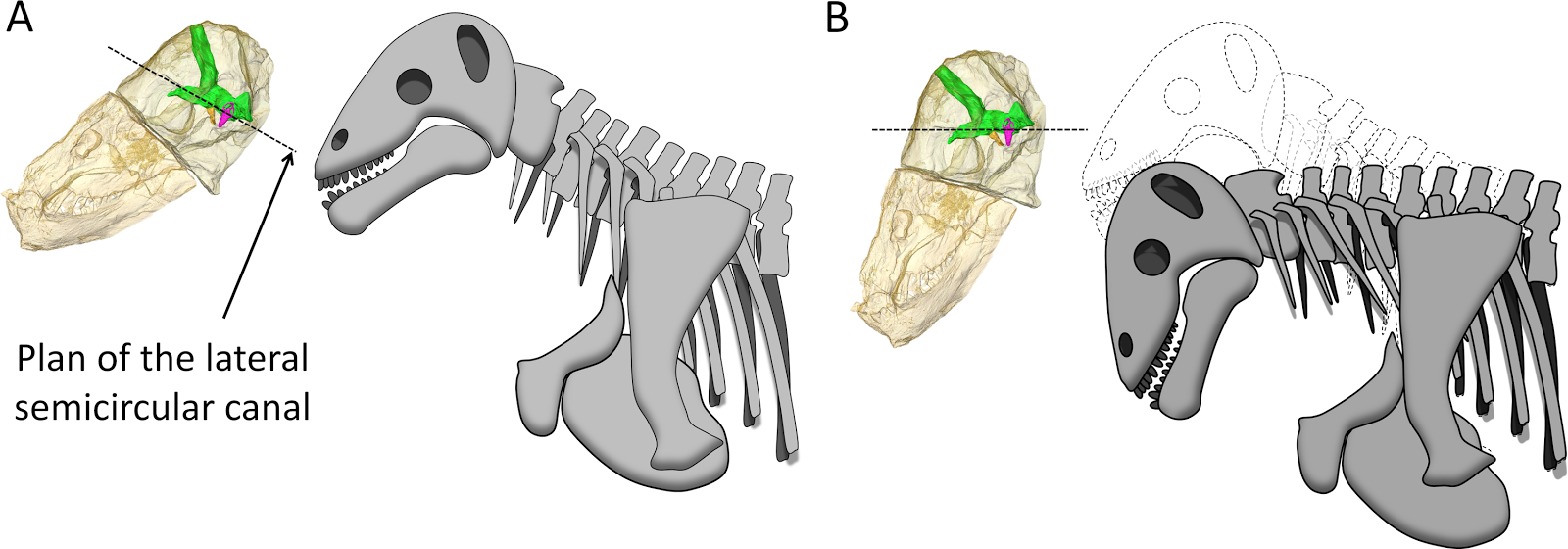
Hypothesized reconstructions of the natural head posture in Moschops capensis. (A) Redrawn after the mounted skeleton at the American Museum of Natural History. (B) Based on the position of the plane of the lateral (horizontal) canal. Julien Benoit in Benoit et al. (2017).

In this position the thickened bone above the braincase would be pointed directly forward, and also directly in line with the straightened spine, an ideal position for fighting by head-butting, strongly supporting the idea that these animals exhibited this behaviour. While to us head-butting does seem a particularly advanced behaviour, it actually implies a degree of social behaviour not generally attributed to early Therapsids In modern species that exhibit such behaviour it is usually associated either with ritualized display fights, observed by females who in turn engage in a degree of mate choice, or with the establishment of territories, which requires a degree of spatial awareness and the ability to understand a simple set of social rules.
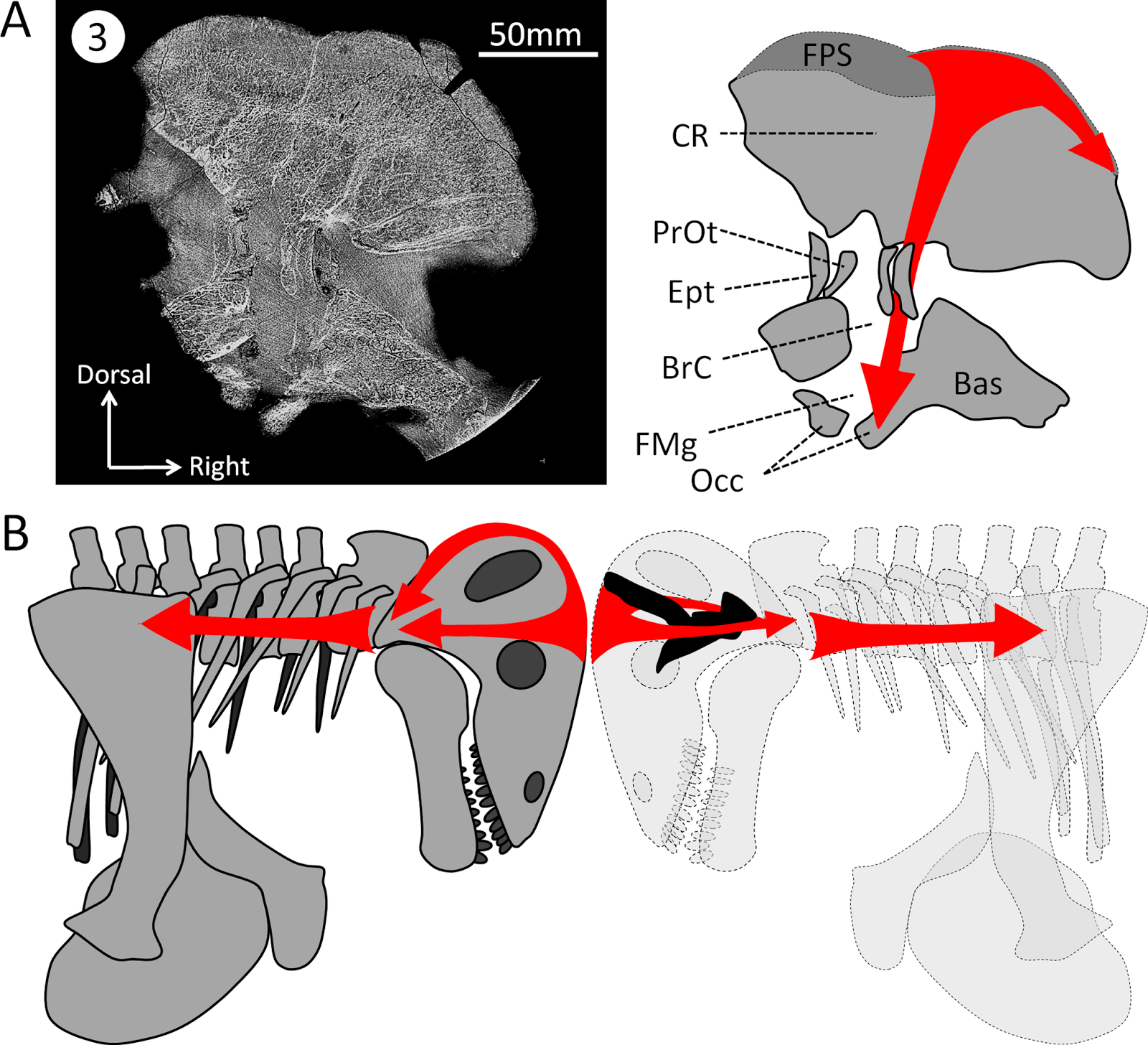
Hypothesized dissipation of the energy during head butting in the skull of Moschops capensis. Arrows indicate the direction of energy transfer. (A) CT section of the skull of Moschops capensis AM4950. (B) The proposed route of the dissipation of energy through the dermatocranium (left) and the braincase (right) in two fighting Moschops. Abbreviations: Bas, basicranium; BrC, braincase; CR, cranial roof; Ept, epipterygoid; FMg, foramen magnum; FPS, frontoparietal shield; Occ, occipital condyles; PrOt; prootic. Julien Benoit in Benoit et al. (2017).

See also...

http://sciencythoughts.blogspot.co.uk/2016/09/unidentified-burnetiamorph-specimens.htmlhttp://sciencythoughts.blogspot.co.uk/2015/03/dinocephalian-therapsids-from-middle.html
http://sciencythoughts.blogspot.co.uk/2015/03/kannemeyeriiforme-dicynodonts-from.htmlhttp://sciencythoughts.blogspot.co.uk/2014/04/scavenging-on-body-of-dicynodont.html
http://sciencythoughts.blogspot.co.uk/2014/04/a-caseid-synapsid-from-late.htmlhttp://sciencythoughts.blogspot.co.uk/2013/07/strange-bedfellows-in-early-triassic.html
Follow Sciency Thoughts on Facebook.

Tuesday, 31 March 2015

Dinocephalian Therapsids from the Middle Permian of the Karoo Basin, South Africa.


The Dinocephalians were a group of mostly large, herbivorous Therapsids (the group that also includes Dicnodonts and Mammals) known from the Middle Permian of Russia, Central Asia, China, Brazil, Tanzania, Zambia, Zimbabwe and South Africa, that briefly formed a dominant part of terrestrial faunas before becoming abruptly extinct. Their sudden rise to dominance and equally sudden disappearance has led to them being used to help define the fossil biozones (stratigraphic time periods defined from fossil assemblages – these are generally defined using pollen in later terrestrial settings, but no pollen was present in the Permian) used to date terrestrial sediments from South Africa, and since these South African rocks have a number of volcanic horizons used to obtain isotopic dates for these biozones, they in turn are considered a global reference point for dating events in early Tetrapod evolution. Dinocephalian Therapsids first appear in the Eodicynodon Biozone, then rise to become a diverse and dominant part of the fauna in the Tapinocephalus Biozone, but are absent from the overlying Pristerognathus Biozone; there disappearance is therefore one of the factors used to define the boundary between the Tapinocephalus and Pristerognathus Biozones.

In a paper published in the South African Journal of Science on 27 March 2015, Michael Day, Saniye Güven, Fernando Abdala, Sifelani Jirah and Bruce Rubidge of the Evolutionary Studies Institute at the School of Geosciences at the University of the Witwatersrand and John Almond of Natura Viva in Cape Town describe two new Dinocephalian specimens from the lower Poortjie Member of the Teekloof Formation in the Beaufort West District of Western Cape Province, South Africa.

Both of the new specimens comprise the rear portions of skulls, and both are assigned to the genus Criocephalosaurus, of which two species have previously been described. However since both of these species were described from cranial roofs only, with Criocephalosaurus vanderbyli described from a single weathered cranial roof and Criocephalosaurus gunyankaensis described from four cranial roofs, all of which are currently missing, the new specimens are not assigned to species level. They are notably smaller and more slender than other specimens assigned to the genus, but it is unclear based upon the available material whether they are members of a new species or juveniles of one of the previously described species.

Photos of the specimens (a–d) SAM-PK-K10888 and (e–g) BP/1/7214 showing (a,e) dorsal view, (b,f) left lateral view, (c,g) right lateral view and (d) occipital view. (h) View of sagittal plane on right posterior part of the skull of SAM-PK-K10888, showing the pineal canal orientated parallel to the occipital plane. (i, j) Idealised skull of Criocephalosaurus showing the portions preserved in (i) BP/1/7214 and (j) SAM-PK-K10888. Day et al. (2015).

The boundary between the Tapinocephalus and Pristerognathus Biozones has previously been placed in the upper part of the Abrahamskraal Formation, with the boundary between the Abrahamskraal and Teekloof Formations within the Pristerognathus Biozone. The discovery of specimens of Criocephalosaurus within the lower Poortjie Member of the Teekloof Formation suggests that this scenario is wrong, and that either the boundary between the Abrahamskraal and Teekloof Formations lies within the Tapinocephalus Biozone or Criocephalosaurus extends into the Pristerognathus Biozone. This adds to a growing problem defining the boundary betweem the two biozones, with specimens of the two fossil groups considered diagnostic of the Pristerognathus Biozone, Diictodon and Pristerognathus, having recently been discovered within the Tapinocephalus Biozone, and Day et al. suggest that these biostratigraphical units need reviewing in the near future.

(a) Extension of the Tapinocephalus Assemblage Zone (AZ) into the lower Teekloof Formation. Arrows indicate the extension of Tapinocephalus AZ into the Teekloof Formation. (b) Stratigraphic section measured at Beaufort West between the level of the SAM-PK-K10888 locality and the lower Hoedemaker Member. (c) Stratigraphic section on the farm Putfontein. Day et al. (2015).

See also…

Triassic deposits are widespread in Northern China, but Tetrapod fossil producing locations are very rare. Those that are known are restricted to the Heshanggou, Ermaying and Tongchuan...


Therapsids were a group of Synapsid Amniotes (the group of terrestrial vertebrates that include the...


Synapsids, the group which gave rise to and includes the modern Mammals (and which are sometimes misleadingly known as ‘Mammal-like Reptiles’) diverged from the other early Amniotes (fully terrestrial Vertebrates) about 315 million years ago in the Late Carboniferous, and went on to become the dominant large vertebrates in Permian ecosystems, though they suffered badly in the end-Permian extinction, and... 


Follow Sciency Thoughts on Facebook.