Showing posts with label Extremadura. Show all posts

Saturday, 29 July 2023

Elaborate Roman mosaic uncovered at Mérida in the Extremadura Region of western Spain.

Students from the Escuela Profesional Barraeca II del Ayuntamiento have uncovered a large and elaborate Roman mural while carrying out excavation work at the Huerta de Otero archaeological site in the city of Mérida in the Extremadura Region of western Spain, according to a press release issued by the Mérida Ayuntamento on 26 July 2023.

Partial view of a Roman mosaic uncovered by students from the Escuela Profesional Barraeca II del Ayuntamiento at Mérida in the Extremadura Region of western Spain. Mérida Ayuntamento.

The multi-coloured mosaic covers an area of about 30 m², and has a central motif depicting the head of Medusa within an octagonal medallion, surrounded by four Peacocks, within a wider square with a variety of images of Fish, Birds, Jellyfish, masks, and geometric shapes. The mosaic is thought to have been associated with a sixth century AD bathhouse.

The central Medusa motif of the Huerta de Otero mosaic. Mérida Ayuntamento.

The Huerto de Otero site was discovered in 1976, when some preliminary exploration work was carried out, but full scale excavations did not begin until 2019, when a joint project by the Mérida Ayuntamento and the Consorcio y el Instituto de Arqueología de Mérida was set up to manage the site. Fifteen students from the Escuela Profesional Barraeca II del Ayuntamiento began working on the project in September 2022, as part of a work-placements scheme which is credited with gaining 85% of the school's students a job in their chosen field.

One of the Peacocks surrounding the central Medusa motif of the Huerta de Otero mosaic. Mérida Ayuntamento.

See also...

Follow Sciency Thoughts on Facebook.

Follow Sciency Thoughts on Twitter.


Tuesday, 30 August 2022

Fishing observed in a Red Fox for the first time.

Red Foxes, Vulpes vulpes, are small mesocarnivorous  found across Eurasia and North America, and introduced to Australia. They are extremely flexible hunters, able to adapt their behaviour to a wide range of prey species. Fish remains have occasionally been found associated with Foxes, but they have never been observed fishing, despite living in close proximity to Humans in many parts of the world, which has led to speculation that they are scavenging Fish rather than actively hunting them.

In a paper published in the journal Ecology on 18 August 2022, Jorge Tobajas of the Departamento de Botánica, Ecología y Fisiología Vegetal at the Universidad de Córdoba, the Instituto de Investigación en Recursos Cinegéticos, and the Biodiversity Research Institute at the University of Oviedo, and Francisco Díaz-Ruiz of the Biogeography, Diversity, and Conservation Research Team at the Universidad de Málaga, describe witnessing a male Red Fox hunting Fish.

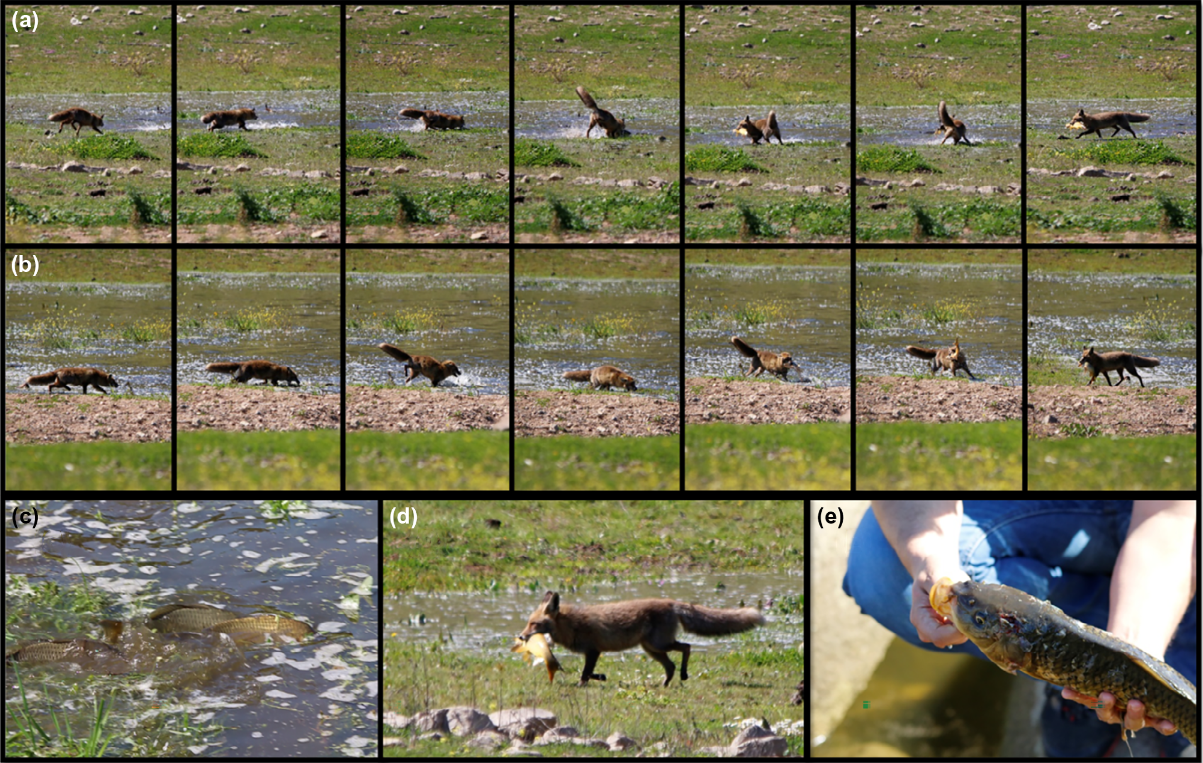
The observation was made while Tobajas and Díaz-Ruiz were carrying out fieldwork near the Valuengo reservoir in southern Extremadura, on 24 March 2016. Here, a male Red Fox was observed capturing European Carp, Cyprinus carpio, while they were mating close to the water's edge.

Male Red Fox, Vulpes vulpes, capturing a European Carp, Cyprinus carpio, at the Valuengo reservoir in southern Extremadura, in March 2016. Tobajas & Díaz-Ruiz (2022).

The Fox was observed catching Carp between 1.18 and 2.51 pm, at which point it noticed it was being observed and fled. During this time it made 12 hunting attempts, capturing 10 Fish with an estimated average mass of about 1 kg. This represents a capture success rate of 83%. The Fox was hunting while the Carp were in a reproductive frenzy, and paying little head to the danger present. Fish were captured by simply jumping into the water and grabbing them. After each successful hunt the Fish was carried to a site 20-30 m from the water's edge and buried, hidden, or simply left, presumably for later consumption. The Fox was never observed to eat any substantial part of the Fish, although small parts (possibly eggs?) were consumed on several occasions. At one point a female Fox was observed removing one of the Carp that the male had captured. The male Fox did not challenge this behaviour, suggesting that she was his mate, and that the male was capturing the Fish for the benefit of the female and a litter of pups (unobserved).

Female Red Fox recovering a Fish previously hunted by the male. Tobajas & Díaz-Ruiz (2022).

This observation adds significantly to our understanding of the ecology of the Red Fox, a familiar species generally thought to be well understood, and about which new discoveries would not be expected. It clearly demonstrates that Foxes are highly able hunters of Fish; such a high success rate is unlikely to represent an opportunistic action by a single animal, but is more likely to represent hunting by a Fox with an instinct for such behaviour, which has been further honed through experience.

(a), (b) Two sequences showing the Red Fox, Vulpes vulpes, hunting European Carp, Cyprinus carpio, on the shore of the Valuengo reservoir (southern Extremadura; Spain) during the Carp spawning period, March 2016. (c) European Carp spawning eggs and distracted by the frenzy of reproduction in the shallow reservoir shore. (d) Red Fox carrying a large European Carp far to the shore.(e) European Carp hunted by the Red Fox with the fatal incisions on the head. Tobajas & Díaz-Ruiz (2022).

At first site this observation appeared to represent an incident of 'overkill' by the Fox, i.e. a case of a Fox being presented with an overabundance of easy prey and killing more than it needs to consume out of some sort of misfiring instinct (an explanation often used to justify the hunting of Foxes). However, an animal killing prey which are then consumed by other members of its social unit (such as, in this case, its mate and presumed young) is far from maladaptive. Instead, this appears to be a good use of a seasonally available food resource which coincides with the Fox's own breeding cycle. Similar behaviour has been observed among Arctic Foxes, Vulpes lagopus, which cache large numbers of Bird's eggs in order to feed their young.

See also...

Follow Sciency Thoughts on Facebook.

Follow Sciency Thoughts on Twitter.


Wednesday, 25 July 2018

Iberia's oldest cave art can be confidently assigned to Neanderthal artists.

Neanderthals were an archaic Human group that first appeared in Europe between 430 000 and 250 000 years ago. They were for a long time seen as more primitive than modern Humans, with a lower capacity for technology, little art or symbolism, and probably a much less sophisticated grasp of language, though this view has changed in recent decades, as they have been shown to have used more sophisticated tools than previously understood, as well as dyes for body art and even musical instruments, though cave painting has never been confidently added to this list of achievements.

In a paper published in the journal Science on 23 February 2018, a group of scientists led by Dirk Hoffmann of the Department of Human Evolution at the Max Planck Institute for Evolutionary Anthropology, describe the results of a study of cave art in Spain, which used uranium-thorium dating of flowstone deposits overlaying parts of the artwork to provide minimum dates for the paintings, which suggests that they are to old to be attributed to Modern Humans.

Flowstone is formed by the deposition of calcium carbonate onto surfaces by evaporating water; typically water that has flowed through limestone deposits then run out onto a surface such as a cave wall or cliff face before evaporating. The most obvious examples of this are stalagmites and stalactites, though many caves have an interior surfaces covered by flowstone. Where these flowstone deposits occur in caves with paintings they will often overlay the artwork, which means that if the flowstone can be dated, then a minimum age for the art can be established (as the art cannot be younger than the flowstone that overlays it).

Red scalariform sign, panel 78 in hall XI of La Pasiega gallery C. This panel features the La Trampa pictorial group. (Inset) Crust sampled and analysed for a minimum age, which constrains the age of the red line. Hoffmann et al. (2018).

Uranium-thorium dating works because uranium decays to thorium at a known rate, so that the ratio  of the two elements in minerals that naturally incorporate uranium but not thorium can be used to establish a date for the minerals. Neither uranium nor thorium are typically found in carbonate deposits, but uranium can be absorbed into these minerals as they form, whereas thorium cannot.

Hoffmann et al. sampled flowstone overlaying paintings in three caves, the La Pasiega Cave in the Monte Castillo Cave Art Complex World Heritage Site in Cantabria in the north of the country, the Maltravieso Cave in Extremadura in the west of the country, and Doña Trinidad Cave in Andalucia, in the south of the country.

Hand stencil GS3b in Maltravieso Cave. (Top) Original photo. The inset shows where the overlying carbonate was sampled. (Bottom) Same picture after application of the DStretch software (correlation LRE 15%, auto contrast) to enhance colour contrast. Hoffman et al. (2018).

The La Pasiega Cave is known to have been occupied for the much of the past 100 000 years, which it was occupied by first Neanderthals, who were present in the region until about 39 000 years ago, and then by Modern Humans, who first appeared in the region about 45 000 years ago. This means that any art younger than 39 000 years old must have been made by Modern Humans, while any art older than 45 000 years old must have been made by Neanderthals, with a period of about 6000 years in the middle where art could have been produced by either group.

The site contains a variety of paintings, predominantly in red and black, and including groups of animals, linear signs, claviform signs, dots, and possible anthropomorphs. Hoffmann et al. obtained samples of limestone from a flowstone deposit overlaying a ladder-like red symbol. This contained three distinct layers of material, with the innermost layer yielding an age of 64 800 years, roughly 20 000 years too old to have been produced by Modern Humans.

Speleothem curtain 8 in section II-A-3 in Ardales Cave with red pigment. (Left) Series of curtains with red paint on top, partially covered with later speleothem growth.The white rectangle outlines the area shown at right. (Right) Detail of curtain 8.The black square indicates where carbonate, overlying the red paint, was sampled. Hoffman et al. (2018).

The Maltravieso Cave is thought to have been occupied intermittently from about 160 000 years ago onwards, which again implies that it was occupied sequentially by first Neanderthals and then Modern Humans. This cave contains about sixty hand stencils, as well as geometric shapes and Human figures. Hoffmann et al. obtained a series of samples from carbonate deposits overlaying a red hand stencil, with the oldest yielding a minimum age of 66 700 years, again too old for the painting to have been produced by Modern Humans.

The Doña Trinidad Cave has not previously been dated, but has produced artifacts associated with the Middle and Late Palaeolithic, technologies associated with both Modern Humans and Neanderthals. The cave has numerous paintings, including hand stencils, geometric shapes and animal figures. Hoffmann et al. obtained samples from a flowstone curtain overlaying an area of cave wall that had been painted red, yielding ages of between 32 100 and 63 700 years, again implying that painting on the cave wall began long before modern Humans arrived in Iberia.

See also...

https://sciencythoughts.blogspot.com/2017/11/determining-origin-of-yabroud.htmlhttps://sciencythoughts.blogspot.com/2016/07/evidence-of-cannibalism-in-neanderthal.html
https://sciencythoughts.blogspot.com/2016/04/mitochondrial-genomes-of-pleistocene.htmlhttps://sciencythoughts.blogspot.com/2016/03/middle-palaeolithic-stone-tools-from.html
https://sciencythoughts.blogspot.com/2014/10/acheulian-and-levallois-technologies.htmlhttps://sciencythoughts.blogspot.com/2014/10/human-remains-from-middle-pleistocene.html
Follow Sciency Thoughts on Facebook.