Showing posts with label Gastropods. Show all posts

Sunday, 5 January 2025

Provanna dongshaensis: A new species of fossil Gastropod from hydrate-bearing sediments in the South China Sea.

The Abyssochrysoidea are a large group of Caenogastropods found in deep-sea environments. The genus Provanna is the largest within this group, currently containing 29 extant species from  hydrothermal vents, hydrocarbon seeps, and organic falls (such as sunken wood and Whale falls) in the Pacific Ocean, the Caribbean, the Southern Ocean, and off the west coast of Africa, as well as nine species from preserved seep deposits and organic falls in Japan, New Zealand, the United States, and Peru, the oldest of which date back to the Cretaceous. These Snails are grazers and detritivores form part of biological communities which are dependent on the chemosynthetic activities of Bacteria and Archaeans for their survival.

In a paper published in the journal Zoosystematics and Evolution on 2 January 2024, Cong Wu and Fang Chen of the National Engineering Research Center of Gas Hydrate Exploration and Development, the Key Laboratory of Marine Mineral Resources of the Ministry of Land and Resources, and the Guangzhou Marine Geological Survey, Ying Tian of the Key Laboratory of Mariculture and Stock Enhancement in North China Sea at Dalian Ocean University, and the Dalian Shell Museum, Kazutaka Amano of the Department of Geology and Paleontology at the Japanese National Museum of Nature and Science, and Xin Su of the School of Ocean Sciences from the China University of Geosciences, describe a new species of Provanna from specimens recovered from two drill cores sunk into cold seeps in the South China Sea.

The new species is described from two specimens, and three other shell fragments, recovered from two separate drill cores (GMGS2-09B and GMGS2-07B) sunk into the seafloor of the northern South China Sea. The shells were obtained from carbonate layers with carbon isotope signatures which strongly indicate that they were laid down at ancient methane seeps. The new species is named Provanna dongshaensis, where 'dongshaensis' means 'from Dongsha' in reference to the island known as 'Dongsha' in Chinese, which lends its name to the area where the fossils were found. This island is currently administered by Taiwan under the name 'Tungsha', and is known as 'Pratas Island' in English.

Global distribution of genus Provanna displayed as type locations of known species and location of the study (GMGS2-07B and GMGS2-09B). orange circle: active hydrothermal vents, hydrocarbon seeps where extant Provanna species are discovered; blue circle: seep deposits or organic falls that yield fossil Provanna. Wu et al. (2025).

The larger of the two specimens of Provanna dongshaensis is 10.89 mm high and has a final whorl width of 7.13 mm; the smaller has a height of 7.80 mm and a final whorl width of 5.02 mm. It is not possible to tell the length of the original shells as both are slightly damaged and lack their tips. This means that the protoconch (the shell that a marine Gastropod uses during its larval, planktonic stage), an important diagnostic tool for Gastropods is missing. Nor is the radula (tongue), another key diagnostic feature, present in any specimens, nor any genetic organic material from which DNA could be extracted. Previous studies, however, have established that the shell microstructure of the genus Provanna, is distinctive, so Wu et al. are confident in their assignment of the shells.

Provanna dongshaensis, from a late Pleistocene seep site in the northern South China Sea. (A)–(C) Holotype, GMGS2-09B-C15-2, specimen from core 09B-4, shell height: 7.8mm; (D)–(F) Paratype, GMGS2-07B-A1, specimen from core 07B-2H-2A with the protoconch almost lost, shell height: 10.89mm; (G)–(I) Incomplete specimen GMGS2-09B-C15-1 from core 09B-2M-1A; (J)–(L) Incomplete specimen GMGS2-09B-C14 from core 09B-4. (M)-(O) Incomplete specimen GMGS2-09B-C13 from core 09B-2M-1A. Scale bar is 5 mm. Wu et al. (2025).

The largest of the specimens in the collection has been dated to 91 693 yeats before the present, though all others are significantly younger, with dates of 16 230±50 years before the present and 15120±50 years before the present. This places all specimens within the final Pleistocene glaciation, although their chronological distribution is probably more closely linked to the life cycle of the cold methane seep where they lived than to the climate on the surface. Wu et al. note that a number of other Gastropod shells are present in the cores from which Provanna dongshaensis was derived, suggesting that the site might be significant for our understanding of ancient cold seeps in the South China Sea.

See also...

Sunday, 7 August 2022

Provanna exquisita: A new species of Provannid Snail from a submarine volcano in the Mariana Island Arc.

Hydrothermal vent systems are unique deepwater environments with diverse ecosystems driven by chemosythetic micro-organisms able to derive energy using hydrogen sulphide and other compounds, rather than being dependent on photosynthesis. Since their first discovery on the Galápagos Rift in 1977, hydrothermal systems have been found on ocean ridges, volcanic arcs, and back-arc basins across the world's oceans. 

Northwest Eifuku is a submarine volcano on the Mariana Volcanic Arc, which hosts a hydrothermal vent ecosystem discharging both hot hydrogen sulphide-rich volcanic vents, and liquid carbon dioxide from cold vents (carbon dioxide is able to form a liquid in the deep ocean due to the high pressure there, but cannot do this at the surface), making the water unusually acidic, with a pH as low as 5.36. This site is covered by dense colonies of marine organisms, dominated by the deepwater Mussel, Bathymodiolus septemdierum.

In a paper published in the journal ZooKeys on 14 July 2022, Chong Chen and Hiromi Kayama Watanabe of the  Japan Agency for Marine-Earth Science and Technology, describe a new species of Provannid Snail from the Northwest Eifuku volcano.

The Provannidae are a group of highly specialised Gastropods found only on hydrothermal vent ecosystems. Together with the Abyssochrysidae (also restricted to deep-sea ecosystems) they form the Superfamily Abyssochrysoidea. The Family Provannidae currently comprises the genera Alviniconcha and Ifremeria, which live on hydrothermal vents and are hosts to endosymbiotic chemosynthetic Bacteria, and  Provanna and Desbruyeresia, which live on hydrothermal vents but live a conventional Gastropod grazing lifestyle. The Abyssochrysidae comprises two genera, Abyssochrysos, which is found on the deep ocean floor away from hydrothermal vents, and Cordesia, which is found on organic falls (the bodies of large organisms such as Whales that have sunk to the deep ocean floor). A seventh genus, Rubyspira, is also found on organic falls, but has not been assigned to either family. However, this taxonomic system has recently been challenged by studies that have applied genetic analysis to the systematics of the group, which have suggested that the Provannidae is in fact polyphyletic, with both genera assigned to the Abyssochrysidae nested within it.

The new species is assigned to the genus Provanna, and given the specific name exquisita, meaning 'exquisite'. The species is described from four specimens collected by the remote operated vehicles JASON II and Roger Revelle in 2014. The specimens were collected from the Golden Lips site, about 40 m away from the volcano's Champagne Vent, at a depth of 1606 m.

Provanna exquisita is a large Provannid Snail with a teleoconch (adult shell) reaching over 13 mm in length (over 15 mm if the spire is intact, but this is rare). The shell is thin, translucent, and fragile, but strengthened by three sharply raised, flange-like keels (one of these keels is missing in some individuals, but at least two are always present). The whorls of the shell are convex, and highly inflated, with axial ribs, weaker than the ridges, running suture to suture. The shells have an oval operculum (lid), and are  covered by a golden-brown periostracum (skin). 

Provanna exquisita, type specimens. (A)–(D) Holotype (MNHN-IM-2000-37945), shell height 10.4 mm. (E)–(H) Paratype #1 (NSMT-Mo 79360), shell height 11.6 mm. (I), (J) Paratype #2 (MNHNIM-2000-37946), shell height 13.1 mm. (K), (L) paratype #3 (NSMT-Mo 79361), shell height 9.4 mm. Scale bar is 1 cm. Chen & Watanabe (2022).

A genetic analysis carried out by Chen and Watanabe found that Provanna exquisita grouped with other members of the genus Provanna, confirming their analysis, but again that the two genera assigned to the Abyssochrysidae, while maintaining a sister-group relationship with one-another, appear to lie within the Provannidae, challenging the validity of that group as currently interpreted.

Bayesian phylogenetic reconstruction of Abyssochrysoidea using a 530-bp alignment of partial COI sequences. Node values are Bayesian posterior probabilities, those less than 0.6 not shown. Scale bar indicates substitutions per site. Chen & Watanabe (2022).

See also...

Follow Sciency Thoughts on Facebook.

Follow Sciency Thoughts on Twitter.


Tuesday, 26 July 2022

Barkeriella museensis: A new species of Systellommatophoran Slug from the tropical Afromontane greenhouse of the Science Museum of Trento, northern Italy.

Botanical gardens, Plant nurseries, and similar facilities are well known reserves of xenodiversity (diversity based upon introduced, non-local species). Such environments have been a route through which a wide range of Invertebrates, Micro-organisms, Fungi, and Plants are known to have spread from such centres into new environments, leading many countries to have introduced tight legislation around the importing of Plants and soil. In recent years taxonomists have described a number of new species from botanical gardens, including Fungi, Wasps, Gastrotrichs (four of the 800 species described within this group, or 0.5% of their total diversity), Arachnids, Insects, and Molluscs.

In a paper published in the Zoological Journal of the Linnean Society on 26 July 2022, Giuseppe Manganelli of the Dipartimento di Scienze Fisiche, della Terra e dell’Ambiente at the Università di Siena, Andrzej Lesicki of the Department of Cell Biology at the Adam Mickiewicz University in Poznan, Andrea Benocci of the Museo di Storia Naturale dell’Accademia dei Fisiocritici, Debora Barbato, also of the Dipartimento di Scienze Fisiche, della Terra e dell’Ambiente at the Università di Siena, Dannio Miserocchi of Ravenna, Joanna Pieńkowska, aslo of the Department of Cell Biology at the Adam Mickiewicz University in Poznan, and Folco Giusti, again of the Dipartimento di Scienze Fisiche, della Terra e dell’Ambiente at the Università di Siena, describe a new species of Slug from the tropical Afromontane greenhouse of the Science Museum of Trento, northern Italy.

The new species is described from a population found living in the greenhouse in January and May 2019, but which could not be refound in February 2022. During the intervening time the part of the greenhouse where the Slugs were found was restructured, and the entire greenhouse suffered an infestation with burrowing Suriname Cockroaches, Pycnoscelus surinamensis, and it is believed the population is now extinct. 

An initial examination of the Slugs quickly revealed that they had transverse ridges on the foot, indicating that they did not belong to the Order Stylommatophora, the most numerous and diverse group of Pulmonate Gastropods, but rather the less numerous Order Systellommatophora. Members of the Systellommatophora are all Slug-like forms lacking shells, and are exclusively hermaphroditic. They are considered to be a sister group to the Stylommatophora, with the two groups together forming the clade Geophila. 

The Order Systellommatophora comprises three families. The Onchidiidae are large, oval-to-round, predominantly semi-marine Slugs, with a single pair of tentacles, found throughout the coastal zones of the temperate, subtropical, and tropical oceans, but most diverse and abundant in the eastern Indian Ocean and tropical western Pacific. The Veronicellidae are medium-to-large sized, dorsoventrally flattened, elongate Slugs, with leathery backs and two pairs of tentacles, found throughout the tropics and subtropics, although favouring moist climates and most abundant and diverse in primary and secondary rainforests. The Rathouisiidae are small, slender, typically keeled, carnivorous Slugs, with two pairs of tentacles, found in Southeast Asia and Australasia. 

The new Slug is a small, slender species with four pairs of tentacles, which shares many features associated with the Rathouisiidae. However, the species also has a number of unique features which prevent it being placed into any currently described Rathouisiid genus, most notably the structure of the reproductive system, considered important in the classification of Gastropods, prompting Manganelli et al. to place it in a new genus.

The new species is named Barkeriella museensis, where 'Barkeriella' honours New Zealand Gary Barker for his work on  terrestrial Gastropods, and 'museensis' means 'coming from MUSE', where MUSE is an abbreviation commonly used for the Science Museum of Trento.

Live specimen of Barkeriella museensis from the tropical greenhouse of the Science Museum of Trento, Italy. Debora Barbato in Manganelli et al. (2022).

Barkeriella museensis is a small Slug, at most 20 mm in length and no more than 3 mm in width. It has a rounded body, whitish in colour with a grey band on each side, separated by a white line marking the trace of a keel. There are two pairs of tentacles, with the upper being longer and tending to have a pinkish hue. The foot is elongate.

The origin of Barkeriella museensis is unclear. The given the known range of the Rathouisiidae, it is unlikely that the species originates in the montane forests of Africa. However, the Afromontane greenhouse of the Science Museum of Trento is known to contain species of non-African origin, chosen for their close resemblance to African species which were not available, and the majority of Plants in the greenhouse were sourced from other collections or commercial dealers in Italy anyway.

There are currently four known genera of Rathouisiids (excluding Barkeriella), each with its own distribution. The genus Rathouisia, which gives its name to the group as a whole, is known from southeastern China, and possibly South Korea. The genus  Atopos is known from Southeast Asia, Indonesia, New Guinea, and northern Australia. The genus Granulilimax contains a single species from Japan, with another genus known, but never formally named or described, from the Ryukyu Islands.

Theoretically, if the relationship between Barkeriella and these other genera could be established, then it might be possible to estimate its point of origin. Unfortunately the GenBank database, an open access database of gene sequences containing data from more than 500 000 species of species of Animals and Plants, contains only a limited number of sequences from the genera Atopos and Granulilimax, and none from Rathouisia, despite this being the largest genus in the family. In order to remedy this Manganelli et al. uploaded sequences from key parts of the genomes of both Barkeriella museensis and Rathouisia sinensis. Unfortunately none of the sequences available were close enough to Barkeriella museensis to shed any light on its point of origin.

See also...

Follow Sciency Thoughts on Facebook.

Follow Sciency Thoughts on Twitter. 


Tuesday, 8 March 2022

Five new species of Staircase Snails from Borneo.

Staircase Snails, Diplommatinidae, are small terrestrial Gastropods with operculi, which get their common name from the strong ribbing on their shells, which can resemble a spiral staircase. They are members of the Cyclophoroidea, a group of Caenogastropods which have lost their combed gills and developed an internal lung independently of the Pulmonata.

In a paper published in the journal Folia Malacologia, Jaap Vermeulen of JK Art and Science and Mohd Zacaery Khalik of the Faculty of Resource Science and Technology at Universiti Malaysia Sarawak, describe five new species of Staircase Snails from Borneo.

The first new species described is placed in the genus Arinia, and given the specific name bathyodon, meaning 'deep-tooth'. The species is described from a collection of shells gathered on a limestone plateau in a primary rainforest Sangkulirang Peninsula in the Indonesian province of Kalimantan. These shells are 1.2-1.6 mm high, 0.75-0.90 mm wide, and ellipsoid-cylindrical to almost cylindrical in shape, with the last two whorls widest in frontal view. The whorls are convex, and there is a constriction of the shell before the aperture, which lacks teeth. The radial ribs are single-crested, and there are 8-12 per 0.5 mm. 

 
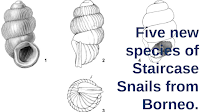
Arinia bathyodon: (1) Holotype, frontal view, shell height 1.6 mm; (2) same shell, right lateral view; (3) same shell, umbilical view; (4) paratype, right lateral view with part of the shell wall removed to show internal tooth. Vermeulen & Khalik (2022).

The second new species is also placed within the genus Arinia, and given the specific name congener, meaning 'of the same kind', in reference to the fact that it closely resembles the previously described Arinia similis, which is found in the same area. The species is described from a series of shells collected in the Gunung Mulu National Park in Sarawak Province, Borneo, on the path between Clearwater Cave and Moonmilk Cave. These shells are 1.0-1.2 mm in height, 0.75-0.80 mm in width, and shortly ellipsoid-cylindrical in shape, with the body whorl or last two whorls widest in frontal view. There is a constriction before the aperture, which lacks teeth. The earlier parts of the shell have 12-17 ribs per 0.5 mm, which drops to 5-7 ribs per 0.5 mm after the second half of penultimate whorl.

 
Arinia congener: (5) holotype, frontal view, shell height 1.2 mm; (6) same shell, right lateral view; (7) same shell, umbilical view. Vermeulen & Khalik (2022).

The third new species is again placed in the genus Arinia, and given the specific name semiconica, meaning 'half-cone-shaped', in reference to the shape of the shells. The species is described from a series of specimens collected at Kampong Air Putih near Samarinda, and at Gua Ambulabung in the Baay river valley on the Sangkulirang peninsula, with both localities being in Kalimantan. These shells are 1.7-2.3 mm high, 1.45-1.70 mm wide, and conical with almost flat sides, with the body whorl widest in frontal view. The whorls are convex, with the body whorl often slightly more narrowly rounded at the periphery. A constriction is present before the aperture, which lacks teeth. The ribs are single-crested with 3-6 ribs per 0.5 mm.

 
Arinia semiconica:(8) Holotype, frontal view, shell height 1.8 mm; (9) same shell, right lateral view; (10) same shell, umbilical view. Arrows indicate the position of the constrictions. Vermeulen & Khalik (2022).

The fourth new species is placed in the genus Notharinia, and given the specific name xenos, meaning 'foreigner', in reference to the fact that the genus Notharinia has previously only been identified from Laos and Cambodia, locations significantly distant from Borneo. Vermeulen and Khalik note that the genus Notharinia is similar to the genus Arinia, differing mainly in the constriction of the shell before the aperture of adult shells of Arinia, which is absent in Notharinia; something which could potentially have been lost separately in Notharinia xenos, thereby making the genus paraphyletic, but in the absence of genetic data they choose to base their diagnosis upon the available morphological data.

Notharinia xenos is described from six shells collected from limestone scarps in the upper Tatau river valley of Sarawak State Malaysia. These are 1.9-2.4 mm high and 0.85-0.90 mm wide, with cylindrical shells, slightly widened towards the base. The whorls are moderately convex, the ribs single crested and there are 8-15 ribs per 0.5 mm.

 
Notharinia xenos: (11) Holotype, frontal view, shell height 1.9 mm; (12) same shell, right lateral view; (13) same shell, umbilical view. Vermeulen & Khalik (2022).

The final new species is placed in the genus Opisthostoma, and given the specific name hemituba, meaning 'half-trumpet' in reference to the shortened shells of this species. The species is described from a series of shells collected at Gua Mardua near Kampong Pengadan on the Sangkulirang Peninsula of Kalimantan Province, Indonesia. These range from 1.6 mm to 1.7 mm in height and from 1.60 mm to 1.75 mm in width, and are shortly cylindrical to depressed conical, with the body whorl widest in frontal view. The apex of the shell is oblique and truncated. The whorls are moderately convex, and rounded, the  body whorl is rather narrowly rounded at the base, towards a constriction before the aperture. The ribs are low and thin, being widely spaced; on the spire there are 3-5 ribs per 0.5 mm, on the body whorl this drops to 2-3 ribs per 0.5 mm.

 
Opisthostoma hemituba. (14) Holotype, frontal view, shell height 1.6 mm; (15) same shell, right lateral view; (16) same shell, umbilical view. Arrows indicate the position of the constrictions. Vermeulen & Khalik (2022).

See also...


Follow Sciency Thoughts on Facebook.

Follow Sciency Thoughts on Twitter.


Thursday, 3 February 2022

Erhaia norbui: A new species of freshwater Snail from Bhutan.

Gastropods of the genus Erhaia are small aquatic Snails with ovoid shells less than 5 mm high, single gills and opercula, found in clear freshwater environments across a broad area of northern India, Nepal, Bhutan, and eastern China, with a total east-west distribution range of about 3500 km. These Snails are usually found in springs and brooklets, and show a high rate of endemism, with many species only known from a limited area or even single location. To date, three members of this genus have been described from Bhutan, two of which are found at single locations in Latipur and Kavre districts, with the third found at both of these locations, plus a further four localities.

In a paper published in the journal ZooKeys on 2 February 2022, Edmund Gittenberger of the Naturalis Biodiversity Center, and GiMaRIS, Choki Gyeltshen of the National Biodiversity Centre of Bhutan, and Björn Stelbrink of the Department of Animal Ecology & Systematics at Justus Liebig University Giessen, describe a new species of Erhaia from Haa District in Bhutan.

The new species is named Erhaia norbui in honour of Sangay Norbu, who discovered the population from which the species is described. The description is based upon six shells, collected from a spring at an altitude of 2700 m above sealevel, close to the village of Naychu. 

 
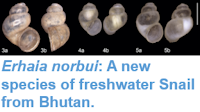
Erhaia norbui from the type locality, district Haa, Uesu, Naychu, roughly 2700 m above sealevel. (3) Holotype, NBCB 1239 (height 2.3 mm) and paratypes used for DNA analyses (4 UGSB 25956,height 1.5 mm 5 UGSB 25957, height 1.8 mm). Scale bar is 1 mm. Gittenberger et al. (2022).

Erhaia norbui has a ovoid to elongate ovoid or conical shell, smooth or with spiral microsculpture on the proto- and/or teleoconch (the protoconch is the embryonic shell of a Snail, which remains attached to the later shell, or teleoconch, and is often quite different in structure, making it a useful taxonomic tool). The apex of the shell is conspicuously and obliquely flattened. The aperture of the shell varies from ovoid-elliptical to circular; its palatal side is curved and gradually passes into the basal side. The peristome (layer of skin covering the shell is continuous, attached at the parietal side or slightly protruding. The umbilicus (gap inside the spirals of some Snail shells) is minute or closed. The parietal part of the aperture is smooth or with a lamella; columella smooth or with 2 spiral lamellae.

 
Habitat of Erhaia norbui at the type locality. Sangay Norbu in Gittenberger et al. (2022).

A DNA analysis based upon mitochondrial markers, plus the gened which code for the cytochrome c oxidase I protein and 16S rRNA, established that Erhaia norbui is a separate species, genetically differentiated from all other Erhaia species, but also that the three Erhaia species which are found in Bhutan and which were included in the study, form a distinct clade, all being more closely related to one another than any of them is to any species found outside the kingdom.

 
Maximum likelihood tree reconstructed with RAxML BlackBox (GTR+G substitution model for each partition and 100 bootstrap replicates), with new data in red. Numbers on branches denote bootstrap values of more than 50. Gittenberger et al. (2022).

See also...


Follow Sciency Thoughts on Facebook.

Follow Sciency Thoughts on Twitter.


Thursday, 13 January 2022

Angustopila coprologos & Angustopila psammion: Two new species of cave-dwelling Snails from Laos and Vietnam, and the smallest terrestrial Snails described to date.

Miniaturisation presents both new opportunities and novel challenges to Animal species, in so far as a small size often enables species to access resources and ecological niches unavailable to similar but larger species. The smallest parasitic Wasps specialise in targeting the eggs of other small Insect species, and can have adult sizes as small as 0.3 mm, enabling them to utilise a food source unavailable to larger species. Tiny Mites and Feather-wing Beetles are able to live in soil where the only food particles are to small to sustain larger species, and hide in cracks and crevices also beyond the reach of bigger Arthropods. The size of the space between soil particles probably also controls the lowest possible size for Snails living in these environments; with the accessibility of a space given by the ability of the Snail to pull its shell through gaps, since this is the only rigid part of its body. The past few years have seen the description of several new Snail species, each of which has replaced the one before as the smallest known terrestrial Snail.

In a paper published in the journal Contributions to Zoology on 5 January 2022, Barna Páll-Gergely of the Plant Protection Institute at the Centre for Agricultural Research, Adrienne Jochum of the Naturhistorisches Museum der Burgergemeinde Bern, the Institute of Ecology and Evolution at the University of Bern, and the Senckenberg Forschungsinstitut und Naturmuseum, Jaap Vermeulen and Katja Anker of JK Art and Science, András Hunyadi of Budapest, Aydin Örstan of the Section of Mollusks at the Carnegie Museum of Natural History, and Ábel Szabó of the Lithosphere Fluid Research Laboratory at Eötvös University, describe two new species of Land Snail from Laos and Vietnam, both of which are smaller than any previously described species, making the smaller of the two the new official smallest known species.

Both new species belong to the genus Angustopila, a genus which also contains two other species that have held the title of 'Smallest Land Snail' since 2015.

The first of these new species is named Angustopila coprologos, meaning 'dung-gatherer' in Greek, in reference to the mud granules, assumed by Páll-Gergely et al. to be faeces, which the species places upon its shells. This species is known only from 19 empty shells, which were found in a limestone gorge in Bolikhamsai Province, Laos, following a season of heavy rain, and are thought to have been washed down from crevices in the limestone cliffs above.

 
Angustopila coprologos (holotype). Páll-Gergely et al. (2022).

Angustopila coprologos has a strongly depressed-globular shell with a wide umbilicus, and strong spiral sculpture consisting of a series of coarse elevations (flat-topped beads) in a chain-like pattern and four well-developed teeth around the aperture to its shell. The specimens found were 0.66–0.76 mm high and 0.49–0.58 wide.

The habit of placing granules of mud or other debris on their shells is quite common in terrestrial Snails, with many distantly related species doing this. It is generally thought that the Snails do this for camouflage purposes, enabling them to blend in better with their environment. However, Angustopila coprologos is thought to live in crevices in limestone cliffs, possibly around the root systems of cliff-dwelling Plants, where it is difficult to see how such camouflage would be useful. The grains on the shell of Angustopila coprologos tend to accumulate in the umbilicus of the shell, suggesting that they are placed spirally and are overgrown as the shell grows, Páll-Gergely et al. suggest that these particles might be the faeces of the Snail, essentially mud that has been passes through the gut of the Snail to extract micro-organisms and other food, then bound together with mucus to make a pellet which is attached to the shell, and that this might be a means of signalling to other members of the species in some way, or possibly help the Snails conserve water in what can be a dry environment.

 
Granules on the shell surface of Angustopila coprologos shells. (A)–(B) shows a shell with brown ‘mud’, whereas (C)–(D) shows a shell with white (calcareous) granules. Páll-Gergely et al. (2022).

The second new species described is named Angustopila psammion, where 'psammion' means a grain of sand in Greek. The species is described from 416 empty shells collected in small sediment deposits along the walls of a dry cave (Cap La Cave in Quang Ninh Province, Vietnam), in complete darkness. Páll-Gergely et al. assume that the sediment had fallen in through crevices in the rock, because it contains a species-rich assemblage of bleached, opaque shells of surface-dwelling terrestrial Gastropods, although the shells of Angustopila psammion appear fresh and are probably local to the environment where they were found rather than washed in from elsewhere.

 
Angustopila psammion. (A) Paratype, (B)–(I) holotype. Páll-Gergely et al. (2022).

The shells of Angustopila psammion are depressed-globular shell with dome-shaped spires, thick spiral striae, and kidney-shaped apertures with a single parietal denticle not reaching the parietal callus. The shells range from 0.6 to 0.68 mm in height and from 0.46 to 0.57 mm in width, making it the smallest yet reported species of terrestrial Gastropod.

In 2015 a team led by Barna Páll-Gergely reported the discovery of Angustopila dominikae from southern China, which had a maximum shell height of 0.86 mm, making it the smallest known terrestrial Gastropod at that time. However, only two months later another team, led by Jaap Vermeulen, reported an even smaller Snail, Acmella nana, from Sabah Province on Malaysian Borneo, with a shell height of 0.60–0.79 mm, and a  shell width of 0.50–0.60 mm. In 2016, Mohammad Effendi Marzuki and Jun Kitt foom described an even smaller species, Arinia micro, from Perak State in Peninsular Malaysia, with a shell height of 0.80–0.90 mm, and a shell width og 0.34–0.35 mm. Most recently, a team led by Pongrat Dumrongojwattama reported the discovery of Angustopila pallgergelyi, with a shell width of 0.76–0.85 mm and a shell height of 0.59–0.71 mm, from eastern Thailand.

 
Size comparisons of the former record holders, Angustopila pallgergelyi,, Acmella nana, Notharinia micro, the smallest marine snail, Ammonicera minortalis, and the two new species described by Páll-Gergely et al. Páll-Gergely et al. (2022).

Páll-Gergely et al. note, however, that while Angustopila psammion is the smallest Snail in terms of height, Arinia micro is considerably narrower, and could potentially fit through smaller gaps. This suggests that height might not, alone, be a suitable measure of the smallest species, and a slightly more analytical method might be needed. To do this they found the smallest clearly adult specimen of each species (the aperture teeth do not develop in these Snails until the Animal is fully grown), and took the average of the height and width of these specimens as a measure of smallness. This produced a result of 54.5 mm for Angustopila psammion, making it the smallest species, and 59.5 for Acmella nana, the second smallest species.

See also...


Follow Sciency Thoughts on Facebook.

Follow Sciency Thoughts on Twitter.