Showing posts with label Honshu. Show all posts

Tuesday, 14 July 2020

Fragments of meteorite believed to have come from the July Fireball found in Narashino, Japan.

A fireball meteor (a meteor brighter than Venus is considered to be a fireball) was witnessed by many people over the Kanto Region of Japan on Thursday 2 July 2020. Following this event a resident of a condominium in the city of Narashino in Chiba Prefecture, was awoken by a loud crash, discovered a fragment of rock on the communal landing outside her home, which she collected in the belief that it might be a meteorite. Noting that the handrail outside her home had been damaged, she later found a second fragment in the courtyard below, and took both to the National Museum of Nature and Science in Tokyo. On Monday 13 July 2020 scientists at the museum announced that they had been able to confirm the extra-terrestrial nature of the rock, by the detection of isotopes of aluminium, sodium, and manganese, which have extremely short half-lives, but which are constantly formed on the surface if asteroids by the actions of cosmic rays.

Two fragments of meteorite found in Narashino, Japan, following a fireball meteor over the Kanto Region on 2 July 2020. National Museum of Nature and Science/Kyodo News.

The two fragments of meteorite weigh 63 and 70 g, with the specimen which was found second having a brownish colour, believed to be caused by exposure to rain, which caused iron on its surface to oxidise (rust). The two meteorites appear to fit together, and are thought to have been part of the same object that broke upon impact, possibly with the damaged handrail.

A close fit between the two pieces of the Narashino Meteorite suggests they were part of the same object. National Museum of Nature and Science/Kyodo News.

Objects of this size probably enter the Earth's atmosphere several times a year, though unless they do so over populated areas they are unlikely to be noticed. They are officially described as fireballs if they produce a light brighter than the planet Venus. The brightness of a meteor is caused by friction with the Earth's atmosphere, which is typically far greater than that caused by simple falling, due to the initial trajectory of the object. Such objects typically eventually explode in an airburst called by the friction, causing them to vanish as an luminous object. However this is not the end of the story as such explosions result in the production of a number of smaller objects, which fall to the ground under the influence of gravity (which does not cause the luminescence associated with friction-induced heating).

These 'dark objects' do not continue along the path of the original bolide, but neither do they fall directly to the ground, but rather follow a course determined by the atmospheric currents (winds) through which the objects pass. Scientists are able to calculate potential trajectories for hypothetical dark objects derived from meteors using data from weather monitoring services.
 
See also...
 
 
https://sciencythoughts.blogspot.com/2020/06/water-in-indian-meteor-crater-changes.html
https://sciencythoughts.blogspot.com/2020/07/fireball-meteor-over-kanto-region-of.html
 
http://sciencythoughts.blogspot.com/2020/04/identifying-worlds-oldest-impact.html
https://sciencythoughts.blogspot.com/2020/04/first-protein-of-extraterrestrial.html
https://sciencythoughts.blogspot.com/2020/01/understanding-influence-of-large-bolide.html
https://sciencythoughts.blogspot.com/2020/01/looking-for-source-of-australasian.html

Follow Sciency Thoughts on Facebook.

Thursday, 2 July 2020

Fireball meteor over the Kanto Region of Japan.

Witnesses across the Kanto Region of Japan have reported observing a bright fireball at about 2.30 am local time on Thursday 2 July 2020 (about 5.30 pm on Wednesday 1 July, GMT). The fireball is described as having moved from east to west, and as having been brighter than the Full Moon, as well as having made an audible boom which caused windows to rattle. A fireball is defined as a meteor (shooting star) brighter than the planet Venus. These are typically caused by pieces of rock burning up in the atmosphere, but can be the result of man-made space-junk burning up on re-entry.

Series of still images from a video of a fireball meteor observed from Tokyo on 2 July 2020. Kyodo News.

Objects of this size probably enter the Earth's atmosphere several times a year, though unless they do so over populated areas they are unlikely to be noticed. They are officially described as fireballs if they produce a light brighter than the planet Venus. The brightness of a meteor is caused by friction with the Earth's atmosphere, which is typically far greater than that caused by simple falling, due to the initial trajectory of the object. Such objects typically eventually explode in an airburst called by the friction, causing them to vanish as an luminous object. However this is not the end of the story as such explosions result in the production of a number of smaller objects, which fall to the ground under the influence of gravity (which does not cause the luminescence associated with friction-induced heating).
 
These 'dark objects' do not continue along the path of the original bolide, but neither do they fall directly to the ground, but rather follow a course determined by the atmospheric currents (winds) through which the objects pass. Scientists are able to calculate potential trajectories for hypothetical dark objects derived from meteors using data from weather monitoring services.
 
See also...
 
https://sciencythoughts.blogspot.com/2020/06/the-june-bootid-meteor-shower.htmlhttps://sciencythoughts.blogspot.com/2020/06/fireball-meteor-over-western-australia.html
https://sciencythoughts.blogspot.com/2020/06/water-in-indian-meteor-crater-changes.htmlhttps://sciencythoughts.blogspot.com/2020/06/fireball-meteor-over-southern-ohio.html
https://sciencythoughts.blogspot.com/2020/05/fireball-meteor-over-puget-sound.htmlhttps://sciencythoughts.blogspot.com/2020/05/the-eta-aquarid-meteor-shower.html
Follow Sciency Thoughts on Facebook. 

Wednesday, 6 May 2020

Magnitude 5.5 Earthquake beneath the Chiba Peninsula, Japan.

The Japan Meteorological Agency recorded a Magnitude 5.5 Earthquake at a depth of about 50 km, beneath the city of Sōsa in Chiba Prefecture, Honshū Island, slightly after 10.05 pm Japan Standard Time (slightly after 1.05 pm GMT) on Sunday on Monday 4 May 2020. The event was felt across much of southeastern Honshū Island, though there are no reports of any damage or casualties. This is roughly what would be expected from an Earthquake of this size at this depth; the quake is big enough to be felt over a wide area, but most of its energy has dissipated before the shock-waves reach the surface.


The approximate location of the 4 May 2020 Sōsa Earthquake. Google Maps,

Japan has a complex tectonic situation, with parts of the country on four different tectonic plates. Eastern Honshū area lies on the boundary between the Pacific, Eurasian and Philippine Plates, where the Pacific Plate is passing beneath the Eurasian and Philippine Plates as it is subducted into the Earth. This is not a smooth process; the rocks of the two plates constantly stick together, only to break apart again as the pressure builds up, causing Earthquakes in the process. 

The movement of the Pacific and Philippine Plates beneath eastern Honshū. Laurent Jolivet/Institut des Sciences de la Terre d'Orléans/Sciences de la Terre et de l'Environnement.

Witness accounts of Earthquakes can help geologists to understand these events, and the structures that cause them. The international non-profit organisation Earthquake Report is interested in hearing from people who may have felt this event; if you felt this quake then you can report it to Earthquake Report here.

See also...

https://sciencythoughts.blogspot.com/2019/11/spectacular-eruption-on-mount.htmlhttps://sciencythoughts.blogspot.com/2019/11/eruption-on-iojima-island-japan.html
https://sciencythoughts.blogspot.com/2019/10/four-dead-as-landslides-and-flooding.htmlhttps://sciencythoughts.blogspot.com/2019/10/typhoon-hagibis-kills-at-least-73.html
https://sciencythoughts.blogspot.com/2019/09/sakurajima-volcano-erupts.htmlhttps://sciencythoughts.blogspot.com/2019/08/three-dead-as-tropical-storm-krosa.html
Follow Sciency Thoughts on Facebook.

Friday, 25 October 2019

Four dead as landslides and flooding linked to Typhoon Bualoi hit Japan.

Four people have died and another one is missing in Chibu Prefecture, Japan, in a series of events linked to Typhoon Bualoi on Friday 25 October 2019. The typhoon has not made landfall in Japan, but instead has been moving northward of the country's east coast, bringing widespread rains and flooding. A woman in her sixties is dead and another in her forties is missing after a landslide struck two houses. Landslides are a common problem after severe weather events, as excess pore water pressure can overcome cohesion in soil and sediments, allowing them to flow like liquids. Approximately 90% of all landslides are caused by heavy rainfall. A separate landslide is reported to have claimed the life of a man, while two elderly men are reported to have drowned in separate incidents, one of them in his car. Flood warnings are in place across a broad swath of eastern and central Japan, with over 395 000 people in low lying areas advised to evacuate their homes.

Typhoon Bualoi off the coast of Japan. Joint Typhoon Warning Center.

Tropical storms are caused by solar energy heating the air above the oceans, which causes the air to rise leading to an inrush of air. If this happens over a large enough area the in rushing air will start to circulate, as the rotation of the Earth causes the winds closer to the equator to move eastwards compared to those further away (the Coriolis Effect). This leads to tropical storms rotating clockwise in the southern hemisphere and anticlockwise in the northern hemisphere.These storms tend to grow in strength as they move across the ocean and lose it as they pass over land (this is not completely true: many tropical storms peter out without reaching land due to wider atmospheric patterns), since the land tends to absorb solar energy while the sea reflects it. Such storms have different names in different parts of the world, with those in the western Pacific and Indian Ocean being known as Typhoons.

 The path and strength of Typhoon Bualoi. Thick line indicates the past path of the storm (till 6.00 pm GMT on Friday 25 October 2019), while the thin line indicates the predicted future path of the storm, and the dotted circles the margin of error at twelce and twenty four hours ahead. Colour indicated the severity of the storm. Tropical Storm Risk.

Despite the obvious danger of winds of this speed, which can physically blow people, and other large objects, away as well as damaging buildings and uprooting trees, the real danger from these storms comes from the flooding they bring. Each drop millibar drop in air-pressure leads to an approximate 1 cm rise in sea level, with big tropical storms capable of causing a storm surge of several meters. This is always accompanied by heavy rainfall, since warm air over the ocean leads to evaporation of sea water, which is then carried with the storm. These combined often lead to catastrophic flooding in areas hit by tropical storms. 

See also...

https://sciencythoughts.blogspot.com/2019/10/typhoon-hagibis-kills-at-least-73.htmlhttps://sciencythoughts.blogspot.com/2019/09/sakurajima-volcano-erupts.html
https://sciencythoughts.blogspot.com/2019/08/three-dead-as-tropical-storm-krosa.htmlhttps://sciencythoughts.blogspot.com/2019/07/magnitude-65-earthquake-off-south-coast.html
https://sciencythoughts.blogspot.com/2019/05/magnitude-63-earthquake-off-coast-of.htmlhttps://sciencythoughts.blogspot.com/2019/01/eruption-on-mount-shindake-kuchinoerabu.html
Follow Sciency Thoughts on Facebook.

Bualoi

Friday, 16 August 2019

Three dead as Tropical Storm Krosa makes landfall in Japan.

Three people have died and more than fifty more have been injured after Tropical Storm Krosa made landfall on Honshū Islands, Japan, close to Kure City in Hiroshima Prefecture, at about 3.00 pm local time on Thursday 15 August 2019. Neneko Mori, 11, died after being swept out to sea with her sister near Shimoda City; her body was later recovered at Shizuoka on the other side of Suruga Bay, her sister was able to swim back to shore alive. In Hyogo Prefecture fisherman Noriyuki Kumabuchi, 71, died after being swept into a river, and in in Onomichi in Hiroshima Prefecture an 82-year-old man died after being swept into the sea while tyong up a boat.

Large waves associated with Tropical Storm Krosa at Shirahama in Wakayama Prefecture. Tatsuya Onishi/Mainichi.
Wakayama Prefecture
Shirahama
Shirahama

The storm brought with it very high rainfall, with 869.5 mm of rain recorded in three hours at Yanase in Kochi Prefecture. This triggered a number of landslides, which are not thought to have caused any injuries but which have blocked roads in some areas. Landslides are a common problem after severe weather events, as excess pore water pressure can overcome cohesion in soil and sediments, allowing them to flow like liquids. Approximately 90% of all landslides are caused by heavy rainfall. Other transport networks have also been disrupted, with numerous flights and rail services cancelled due to the storm.


Waves associated with Tropical Storm Krosa in Miyazaki Prefecture. Kyodo News/Reuters.

Tropical storms are caused by the warming effect of the Sun over tropical seas. As the air warms it expands, causing a drop in air pressure, and rises, causing air from outside the area to rush in to replace it. If this happens over a sufficiently wide area then the inrushing winds will be affected by centrifugal forces caused by the Earth's rotation (the Coriolis effect). This means that winds will be deflected clockwise in the northern hemisphere and anti-clockwise in the southern hemisphere, eventually creating a large, rotating Tropical Storm. They have different names in different parts of the world, with those in the northwest Pacific being referred to as typhoons.

 A tree uprooted by Tropical Storm Kroda in Hiroshima. Kyodo News.

Despite the obvious danger of winds of this speed, which can physically blow people, and other large objects, away as well as damaging buildings and uprooting trees, the real danger from these storms comes from the flooding they bring. Each drop millibar drop in air-pressure leads to an approximate 1 cm rise in sea level, with big tropical storms capable of causing a storm surge of several meters. This is always accompanied by heavy rainfall, since warm air over the ocean leads to evaporation of sea water, which is then carried with the storm. These combined often lead to catastrophic flooding in areas hit by tropical storms.

See also...
https://sciencythoughts.blogspot.com/2019/07/magnitude-65-earthquake-off-south-coast.htmlhttps://sciencythoughts.blogspot.com/2019/05/magnitude-63-earthquake-off-coast-of.html
https://sciencythoughts.blogspot.com/2019/01/eruption-on-mount-shindake-kuchinoerabu.htmlhttps://sciencythoughts.blogspot.com/2018/09/typhoon-jebi-leaves-at-least-ten-dead.html
https://sciencythoughts.blogspot.com/2018/08/immature-blue-whale-washes-up-dead-on.htmlhttps://sciencythoughts.blogspot.com/2018/07/volcanic-activity-on-asamayama-japan.html
Follow Sciency Thoughts on Facebook.
 

Sunday, 28 July 2019

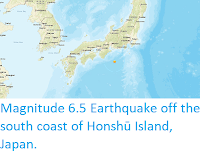
Magnitude 6.5 Earthquake off the south coast of Honshū Island, Japan.

The Japan Meteorological Agency recorded a Magnitude 6.5 Earthquake at a depth of about 420 km, off the south coast of the Honshū Island, slightly after 3.30 am Japan Standard Time on Sunday 28 July 2019 (slightly after 6.30 pm on Saturday 27 July GMT). The event was felt across much of Honshū Island, though there are no reports of any damage or casualties. This is roughly what would be expected from an Earthquake of this size at this depth; the quake is big enough to be felt over a wide area, but most of its energy has dissipated before the shock-waves reach the surface.

The approximate location of the 28 July 2019 Honshū Earthquake. USGS.

Japan has a complex tectonic situation, with parts of the country on four different tectonic plates. Eastern Honshū area lies on the boundary between the Pacific, Eurasian and Philippine Plates, where the Pacific Plate is passing beneath the Eurasian and Philippine Plates as it is subducted into the Earth. This is not a smooth process; the rocks of the two plates constantly stick together, only to break apart again as the pressure builds up, causing Earthquakes in the process. 
 
 The movement of the Pacific and Philippine Plates beneath eastern Honshū. Laurent Jolivet/Institut des Sciences de la Terre d'Orléans/Sciences de la Terre et de l'Environnement.
 
Witness accounts of Earthquakes can help geologists to understand these events, and the structures that cause them. The international non-profit organisation Earthquake Report is interested in hearing from people who may have felt this event; if you felt this quake then you can report it to Earthquake Report here.
 
See also...
 
https://sciencythoughts.blogspot.com/2018/09/typhoon-jebi-leaves-at-least-ten-dead.htmlhttps://sciencythoughts.blogspot.com/2018/07/volcanic-activity-on-asamayama-japan.html
https://sciencythoughts.blogspot.com/2018/07/fifteen-known-deaths-as-floods-and.htmlhttps://sciencythoughts.blogspot.com/2018/06/magnitude-59-earthquake-in-osaka.html
https://sciencythoughts.blogspot.com/2018/05/magnitude-53-earthquake-beneath-chiba.htmlhttps://sciencythoughts.blogspot.com/2018/04/magnitude-58-earthquake-in-shimane.html
Follow Sciency Thoughts on Facebook.

Wednesday, 5 September 2018

Typhoon Jebi leaves at least ten dead in Japan.

At least ten people have been killed and more than 200 have been injured after Typhoon Jebi made landfall on the south coast of Honshu Island, Japan, on Tuesday 4 September 2018, bringing with it winds of up to 216 kilometres per hour. The storm led to over a million people being advised to evacuate their homes, and tens of thousands of homes and businesses being left without power. Over 700 flights to and from Japanese airports were cancelled, and road, rail, and shipping routes were all severely disrupted. 

Damage to buildings in Osaka caused by Typhoon Jebi. EPA.

Tropical storms (called Typhoons in the West Pacific Ocean) are caused by solar energy heating the air above the oceans, which causes the air to rise leading to an inrush of air. If this happens over a large enough area the in rushing air will start to circulate, as the rotation of the Earth causes the winds closer to the equator to move eastwards compared to those further away (the Coriolis Effect). This leads to tropical storms rotating clockwise in the southern hemisphere and anticlockwise in the northern hemisphere.These storms tend to grow in strength as they move across the ocean and lose it as they pass over land (this is not completely true: many tropical storms peter out without reaching land due to wider atmospheric patterns), since the land tends to absorb solar energy while the sea reflects it.

Damage to a bridge in Osaka Bay that was hit by a tanker during Typhoon Jebi. Reuters.

The low pressure above tropical storms causes water to rise there by ~1 cm for every millibar drop in pressure, leading to a storm surge that can overwhelm low-lying coastal areas, while at the same time the heat leads to high levels of evaporation from the sea - and subsequently high levels of rainfall. This can cause additional flooding on land, as well as landslides, which are are a common problem after severe weather events, as excess pore water pressure can overcome cohesion in soil and sediments, allowing them to flow like liquids. Approximately 90% of all landslides are caused by heavy rainfall.

Vehicles swept into a pile by Typhoon Jebi in Kobe. Sky News.

See also...
https://sciencythoughts.blogspot.com/2018/08/immature-blue-whale-washes-up-dead-on.htmlhttps://sciencythoughts.blogspot.com/2018/07/volcanic-activity-on-asamayama-japan.html
https://sciencythoughts.blogspot.com/2018/07/magnitude-60-earthquake-rattles-tokyo.htmlhttps://sciencythoughts.blogspot.com/2018/07/fifteen-known-deaths-as-floods-and.html
https://sciencythoughts.blogspot.com/2018/06/shinmoedake-volcano-eruption-on-friday.htmlhttps://sciencythoughts.blogspot.com/2018/06/magnitude-59-earthquake-in-osaka.html
Follow Sciency Thoughts on Facebook.