Showing posts with label Kinorhynches. Show all posts

Thursday, 27 February 2025

Echinoderes semprucciae: A new species of Kinorhynch from a macerating Neptune Grass environment in the eastern Mediterranean.

Kinorhynchs are tiny (generally less than 1 mm) worm like Animals largely found in marine sediments, for which reason they are sometimes known as 'Mud Dragons'. They appear to be ubiquitous members of the interstitial meiofauna (Animals that live between sediment grains) in shallow marine habitats, but have been studied in relatively few locations. However, not all Kinorhynchs are sediment-dwellers, with members of the group having been found living on a wide range of Algae, marine Plants, and Animals.

In a paper published in The Eutopean Zoological Journal on 3 February 2024, Adele Cocozza di Montanara of the Department of Science and Technology at the Parthenope University of Naples, Alberto González-Casurrubios of the Department of Biodiversity, Ecology and Evolution at the Complutense University of Madrid, and Diego Cepeda of the Centre for Research on Biodiversity and Global Change at the Autonomous University of Madrid, and the Department of Life Sciences at Alcalá University, describe a new species of Kinorhynch from a macerating Neptune Grass environment off the coast of Ischia Island in the western Mediterranean Sea.

Neptune Grass, Posidonia oceanica, is a form of Seagrass endemic to the Mediterranean, where it forms vast meadows in the photic parts of the sea (i.e. those areas where sufficient sunlight penetrates to allow photosynthesis). Seagrasses are important habitat-forming organisms, and a wide range of Animals, including Kinorhynchs are adapted to life in these meadows. However, as well as meadows, Seagrasses also form areas called 'macerating Seagrass detrital bottoms', where large volumes of decomposing leaves and rhizomes accumulate, typically below the photic zone, forming an important marine carbon sink. Whilst these environments have been known since the 1950s, very little attention has been paid to them or the fauna which live there, to which end Cocozza di Montanara et al. have begun a project to study the fauna of the macerating Seagrass detrital bottom environment of the Regno di Nettuno Marine Protected Area, along the coast of Ischia Island off the western coast of Italy.

Study area at 65–80 m depth along the northwestern area of Ischia Island (western Mediterranean Sea). Cocozza di Montanara et al. (2025).

The new species is placed in the genus Echinoderes, and given the specific name semprucciae, in honour of Federica Semprucci of the University of Urbino Carlo Bo, for acting as co-supervisor for Adele Cocozza di Montanara's PhD and supporting and guiding her research on meiofauna. The species is described from two specimens, both collected on 19 June 2020 near Ischia Island, an adult female, collected at a depth of 80 m, and an adult male collected at a depth of 70 m.

Line art illustrations of Echinoderes semprucciae. (a) Ventral view of a female based on holotype (NHMD-1177723). (b) Dorsal view of a female based on holotype (NHMD-1177723). (c) Dorsal view of segments 10–11 of a male based on paratype (NHMD-1177722). Abbreviations: ac, acicular spine; gcoI, type 1 glandular cell outlet; LA, lateral accessory; LD, laterodorsal; ltas, lateral terminal accessory spine; lts, lateral terminal spine; LV, lateroventral; MD, middorsal; ML. midlateral; ne, nephridiopore; pa. papilla; PD. paradorsal; ps, penile spines; SD, subdorsal; ss, sensory spot; t, tube; Vl, ventrolateral; VM, ventromedial; number in abbreviations indicates the corresponding segment. Cocozza di Montanara et al. (2025).

The two known specimens of Echinoderes semprucciae are 202 μm (female) and 193 μm (male) in length, with a retractable mouth cone surrounded by oral styles. This retractable mouth is mounted on an organ called the introvert, which has six concentric rings of scalids and 10 longitudinal sectors defined by the arrangement of primary spinoscalids. Behind the head is a neck section, then a trunk comprising eleven segments, with spines on segments four, six, eight, nine, and eleven; the two spines on segment eleven being elongated to form a pair of tail-like structures.

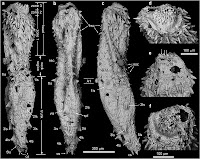
Light micrographs of female holotype (NHMD-1177723) (a)-(d), (g) and male paratype (NHMD-1177722) (e), (f) of Echinoderes semprucciae. (a) Ventral overview. (b) Head, dorsal view. (c) Head, ventral view. (d) Ventral view of segments 5–6. (e) Lateral view of segments 5–8. (f) Detail of penile spines. (g) Ventral view of segment 11. ltas, lateral terminal accessory spine; lts, lateral terminal spine; lvs, lateroventral spine; lvt, lateroventral tube; pa, papillae; ps, penile spines; te, tergal extension, number after abbreviation indicates the corresponding segment, sensory spots are marked with dashed circles and type 1 glandular cell outlets with closed circle. Cocozza di Montanara et al. (2025).

See also...

Thursday, 21 April 2016

Three new species of Kinorhynchs from Singapore.

Kinorhynchs are tiny (generally less than 1 mm) worm like animals found in marine sediments. They appear to be ubiquitous members of the interstitial meiofuana (animals that live between sediment grains) in shallow marine habitats, but have been studied in relatively few locations. Kinorhynchs are thought to be related to Pripulid Worms (large unsegmented Worms with evertable pharyxes and Loriciferas (small unsegmented animals with cup-shaped rigid bodies and evertable pharynxes), and like these groups have evertable pharynxes, which is used not just in feeding, but in locomotion, being pushed ahead of the animal then anchored and used to pull it forwards.

In a paper published in the Raffles Bulletin of Zoology on 29 January 2016, Martin Sørensen, Ludwik Gąsiorowski and Phillip Randsø of the Section for GeoGenetics at the Natural History Museum of Denmark, Nuria Sánchez of the Department of Zoology and Anthropology at the Universidad Complutense de Madrid and Ricardo Neves of the Biozentrum of the University of Basel, describe three new species of Kinorhynches from Singapore, as part of a study of this group around the island; Kinorhynches have previously been recorded but not identified from the Malaysian Peninsula, while elsewhere in Asia the specimens have been identified from Borneo, Indian territories around the Bay of Bengal and Anderman Sea, and the coasts of Japan, Korea, China and the Russian Far East.

The first new species is placed in the genus Centroderes, which has previously been described from the Black Sea, the Mediterranean, the Caribean and the Atlantic Coast of North America, and given the specific name 'impurus' meaning 'unclean' or 'covered with dirt' in reference to the sediment which covered the specimens and which made examination of them very difficult.

 Light micrographs showing lateral overviews of Centroderes impurus. (A) Adult male stage-2. (B) Putative J6 or adult stage-1 specimen of unknown gender. Sørensen et al. (2016).

The species is described from two stage 2 adult males and four specimens of indeterminate sex that are either stage 6 juveniles or stage 1 adults (Kinorhynches have eight growth stages, the first six considered to be juvenile stages and the final two adult, though sexual characteristics are only manifest in the final stage), collected at a depth of nine meters between Bedok Jetty and Sungei Bedok in the southeast part of Singapore Island.

 Line art illustration of Centroderes impurus, male stage-2, lateral view. Abbreviations: ij, intersegmentary joint line; lass, lateral accessory sensory spot; ldss, laterodorsal sensory spot; ltas, lateral terminal accessory spine; lts, lateral terminal spine; lv, lateroventral spine; mdp, middorsal placid; mds, middorsal spine; mls, midlateral spine; mlss, midlateral sensory spot; mts, midterminal spine; mvp, midventral process; pdss, paradorsal sensory spot; pf, pectinate fringe; sdss, subdorsal sensory spot; sf, secondary fringe; vms, ventromedial spine; vmss, ventromedial sensory spot. Digits following labels refer to segment numbers. Sørensen et al. (2016).

The second species described is placed in the genus Echinoderes, and given the specific name annae, after Anna, the girlfriend of Phillip Randsø. The species is described from two males, two females and a juvenile collected from muddy Seagrass aggregations on the intertidal zone on Saringat Island, a small Singapore terretory to the south of the main island.

 Light micrographs showing overviews and details of neck and trunk morphology in female  and male specimes of Echinoderes annae. (A) Lateroventral overview. (B) Neck and segments 1–2, lateroventral view. (C) Neck and segments 1–2, laterodorsal view. (D) Segments 3–7, lateroventral view. (E) Segment 4, middorsal. F, segments 8–10, lateroventral view. (G) Segments 6–8, dorsal view. (H) Segments 10–11, dorsal view, showing male morphology. (I) Segment 11, ventral view, showing female morphology. (J) Segments 9, laterodorsal view. Abbreviations: gco1/2, glandular cell outlet type 1 or 2; ldt, laterodorsal tube; ltas, lateral terminal accessory spine; lts, lateral terminal spine; lvt, lateroventral tube; mds, middorsal spine; mlt, midlateral tube; mvp, midventral placid; pe1–3, penile spines; si, sieve plate; te, tergal extensions; trp, trichoscalid plate. Dashed circles mark glandular cell outlet type 1. Sørensen et al. (2016).

The final species described is placed in the genus Leiocanthus. and given the specific name nagini, which is the female version of Nāgá, a Sanskrit word implying a devine Serpent or Dragon, as well as being the name of Voldemort's Snake in JK Rowling's Harry Potter novels. The species is described from a single male collected from a depth of 52 m to the southeast of Singapore island, and a female collected at a depth of nine meters between Bedok Jetty and Sungei Bedok in the southeast part of Singapore Island.

 Scanning electron micrographs of female Leiocanthus nagini in (A) ventrolateral overview, and (B) ventral overview. Sørensen et al. (2016).

In addition to the new species described, Sørensen et al. also record several previously described species from Singaporean waters for the first time, notably Condyloderes paradoxus, a species previously recorded from the Bay if Bengal, Echinoderes tchefouensis, a species widespread in East Asia, and two unidentified species of Echinoderes.

See also...

http://sciencythoughts.blogspot.co.uk/2016/01/scathascolex-minor-palaeoscolecid-worm.htmlScathascolex minor: A Palaeoscolecid Worm from the Middle Cambrian Burgess Shale of British Colombia.                            Palaeoscolecids are a group of vermiform animals (worms) known from Cambrian to Silurian deposits. They had rings similar to...
http://sciencythoughts.blogspot.co.uk/2015/12/eokinorhynchus-rarus-kinorhynch-from.htmlEokinorhynchus rarus: A Kinorhynch from the Early Cambrian of Sichuan Province, China.                                                 Kinorhynches are tiny (at most 3 mm) worm like animals found in marine sediments, with segmented tube- or barrel-shaped bodies, separate head and neck regions and evertable pharynxes. They are related...
http://sciencythoughts.blogspot.co.uk/2015/05/priapulid-worms-from-middle-cambrian-of.htmlPriapulid Worms from the Middle Cambrian of Canada.                                                Priapulid Worms are a form of marine worms with denticle-covered pharynxes which can be everted to form proboscises. They are a minor element of..

 
Follow Sciency Thoughts on Facebook.

Tuesday, 1 December 2015

Eokinorhynchus rarus: A Kinorhynch from the Early Cambrian of Sichuan Province, China.

Kinorhynches are tiny (at most 3 mm) worm like animals found in marine sediments, with segmented tube- or barrel-shaped bodies, separate head and neck regions and evertable pharynxes. They are relcated to Pripulid Worms (large unsegmented Worms with evertable pharyxes and Loriciferas (small unsegmented animals with cup-shaped rigid bodies and evertable pharynxes), the three groups being grouped together as the Scalidophora. Molecular clock estimates have suggested that the three groups diverged during the Eidacaran, but while Priapulids are well documented from the Cambrian onwards, and a large, Loricifera-like animal (Sirilorica) is also known from the Cambrian, to date no Kinorhynches have been found in the fossil record from any period.


In a paper published in the journal Nature:Scientific Reports on 26 November 2015, a team of scientists led by Huaqiao Zhang of the Key Laboratory of Economic Stratigraphy and Palaeogeography of the Chinese Academy of Sciences, at the NanjingInstitute of Geology and Palaeontology, describe a series of Kinorhynch fossils from the Early Cambrian Xinli Member of the Dengying Formation in Nanjiang County in Sichuan Province, deposits that form part of the Small Shelly Fauna at the beginning of the Cambrian (the Small Shelly Fauna marks the beginning of the Cambrian in deposits around the world; in these beds numerous small shells and shell-elements are found, but not larger mineralized shells) and are dated to about 535 million years ago.


Several of the best preserved specimens are described together as Eokinorhynchus rarus, where 'Eokinorhynchus' means 'dawn-Kinorhynch' and 'rarus' means 'rare', though Zhang et al. record the presence of fragmentary specimens that apparently belong to other species. Eokinorhynchus rarus is essentially similar to modern Kinorhynches, with a segmented tubulaer trunk, a neck region and head with an evertable pharyx, but while modern Kinorhynches invariably have 11 segments, Eokinorhynchus rarus appears to have a minimum of 20.


SEM images of Eokinorhynchus rarus. (a–c) Dorsal, ventral, and left lateral views, respectively. (d–f) Close-up views of zones 2 and 3 to show the arrangement pattern of pharyngeal teeth (numbered in the two basal circlets), with white arrows denoting the 3rd and black arrows denoting the 4th circlet of pharyngeal teeth. Abbreviations: A1–A20, 1st to 20th trunk annulus; an, anus; cs, caudal spine; hsc, head scalid; ls, large sclerite; 1ls–5ls, 1st to 5th pair of large sclerites; mg, midgut; nsc, neck scalid; spl, small plate; ss, small spine; vls, ventral large sclerite. Scale bar beneath (c) applies to (a–c), and scale bar beneath (d) applies to (d–e). Zhang et al. (2015).


The presence of Eokinorhynchus rarus in deposits dating to the earliest Cambrian supports the idea that the Scalidophoran groups diverged in the Ediacaran, but does not explain the absence of Kinorhynch fossils from other deposits, particularly notable Cambrian drposits such as the Burgess Shale, which preserve numerous non-mineralized taxa. Zhang et al. suggest that the microscopic size and interstitial lifestyle of Kinorhynches makes them unsuitable for Burgess Shale type preservation, but suitable for preservation as phosphatic microfossils; a type of preservation that has only been discovered and studied in recent years, as computerized scanning and modeling methods have enabled palaeontologists to study fossils that would either have been destroyed or overlooked using traditional techniques.


Reconstruction of Eokinorhynchus rarus. (a–c) Dorsal, ventral, and right lateral views, respectively. Dinghua Yang in Zhang et al. (2015).


See also...

http://sciencythoughts.blogspot.co.uk/2015/05/yuganotheca-elegans-early-cambrian.htmlYuganotheca elegans: An Early Cambrian Lophophorate Animal with affinities to Brachiopods and Phoronids.                   Lophophorates are animals which feed using a filter called a...
http://sciencythoughts.blogspot.co.uk/2015/05/priapulid-worms-from-middle-cambrian-of.htmlPriapulid Worms from the Middle Cambrian of Canada.                                                                      Priapulid Worms are a form of marine worms with denticle-covered pharynxes which can be everted to form proboscises. They are a minor element of modern marine faunas, largely restricted to deep marine...
http://sciencythoughts.blogspot.co.uk/2014/11/a-new-species-of-vetulicolian-from.htmlA new species of Vetulicolian from the Early Cambrian of Kangaroo Island, South Australia.                                                                    Vetulicolians are an enigmatic group of Cambrian fossils known from the Chengjiang and Guanshan biotas of South China, Sirius Passet in...

Follow Sciency Thoughts on Facebook.