Showing posts with label Las Hoyas. Show all posts

Tuesday, 2 April 2019

Laser-Stimulated Fluorescence reveals previously unseen plumage in a hatchling Enantiornithine Bird from the Las Hoyas Deposits of Spain.

Specimen MPCM-LH-26189 is a hatchling Enantiornithine Bird described from the Early Cretaceous Las Hoyas Deposits of Spain, first described in 2018. Like other Enantiornithine Birds preserved in the Las Hoyas Deposits, specimen MPCM-LH-26189 is preserved in an articulated state, with some soft tissue preservation. However the specimen has no apparent plumage (feathers), which led the scientists describing it to conclude that, like many modern Birds, MPCM-LH-26189 was featherless when it hatched, implying that it was also likely to be altricial (completely dependent on its parents for food and shelter), rather than precocious (able to fend for itself with minimal parental supervision) in nature.

In a paper published in the journal Scientific Reports on 21 March 2019, Thomas Kaye of the Foundation for Scientific Advancement, Michael Pittman of the Vertebrate Palaeontology Laboratory at the University of Hong Kong, and Jesús Marugán-Lobón, Hugo Martín-Abad, José Luis Sanz, and Angela Buscalioni of the Facultad de Ciencias at the Universidad Autónoma de Madrid, re-examine specimen MPCM-LH-26189 using Laser-Stimulated Fluorescence imaging.

Kaye et al. used a 405 nm laser diode to cause the specimen to fluoresce, then imaged it with a Nikon D810 DSLR camera and a 425 nm laser blocking filter, then processed the pictures in Photoshop CS6, using a technique in which the equalisation, saturation and colour balance was adjusted across the entirety of the image, in order to prevent inadvertently manufacturing features.

Specimen MPCM-LH-26189 is surrounded by yellowish stains in several places, which when subjected to Laser-Stimulated Fluorescence imaging revealed filamentous structures, which Kaye et al. interpret as feathers. They further reason that if the hatchling Bird did in fact have feathers, then it is less likely to have been completely altricial at the time of hatching, as in modern Birds species which hatch with feathers are far more likely to be precocious.

Spanish Enantiornithine hatchling MPCM-LH-26189. (A) White light image of the counterslab. (B) Laser-Stimulated Fluorescence image of the slab and counterslab combined (composite image) reveals brown patches around the specimen. These comprise of clumps of elongate feathers associated with the neck and wings (upper arrows) as well as a single long pennaceous feather associated with the left wing (lower arrow). (C) White light image of the slab. Scale bar is 5 mm. Kaye et al. (2019).

Feathers are present in patches across the body, with the best preservation seen on the left side of the neck and on the left wing. The feathers of the left side of the neck are elongate, with bands of darker and lighter colour, with a generally bushy appearance. On the right wing feathers can be seen associated with the radius and ulna, with those on the ulna seeming obliquely in multiple thin filaments. The best preserved feather is associated with the left wing, and is about 3 cm in length, with barbs deriving from the rachis at an angle of about 30°.

Preserved feathering of Spanish Enantiornithine hatchling MPCM-LH-26189 under LSF and white light. Elongate feathers preserving bushy dorsal tips are found near the neck and appear to be cover feathers: (A) under Laser-Stimulated Fluorescence, (B) under white light. Scale bar is 1 mm. Suspected feather clumps are associated with the right wing (C) under Laser-Stimulated Fluorescence, (D) under white light. Scale bar is 3 mm. A long pennaceous feather associated with the left wing is very similar to an Enantiornithine embryo specimen from China (E) under Laser-Stimulated Fluorescence, (F) under white light. Scale bar is 4 mm. Kaye et al. (2019).

The presence of feathers in very young Birds has been seen in other Enantiornithines, and the newly discovered plumage of MPCM-LH-26189 shows that the specimen conforms to this wider pattern. Interestingly the presence of bushy feathers on the neck of the hatchling shows that it possessed cover, as well as flight, feathers, something which has not previously been demonstrated in an Enantiornithine Bird, and the discovery of which adds to our understanding of the biology of the group.
See also...

https://sciencythoughts.blogspot.com/2018/12/an-enantiornithine-bird-chick-from.htmlhttps://sciencythoughts.blogspot.com/2017/06/an-enantiornithine-bird-hatchling.html
https://sciencythoughts.blogspot.com/2015/06/preserved-feathers-in-enantiornithine.htmlhttps://sciencythoughts.blogspot.com/2015/01/bird-eggs-from-late-cretaceous-colonial.html
https://sciencythoughts.blogspot.com/2014/07/two-new-species-on-enantiornithine.htmlhttps://sciencythoughts.blogspot.com/2014/06/a-subadult-enantiornithine-bird-from.html
Follow Sciency Thoughts on Facebook.

Friday, 28 December 2018

An Enantiornithine Bird Chick from the Early Cretaceous Las Hoyas Lagerstätte of eastern Spain.

Understanding the way in which animals develop is key to understanding the way in which they evolve, as changes in adult morphology are inevitably the result of changes in the way in which the young animal develops. This is well studied in modern animals, but much harder to study in extinct animals, as juveniles are often less readily available. This is particularly true for groups like Birds, where even the adults have rather fragile skeletons, making intact specimens very rare in the fossil record. 

In a paper published in the journal Nature Communications on 5 March 2018, a group of scientists led by Fabien Knoll of the Fundación Conjunto Paleontológico de Teruel-Dinopolis and the School of Earth and Environmental Sciences at the University of Manchester, describe an Enantiornithine Bird Chick from the Early Cretaceous Las Hoyas Lagerstätte of eastern Spain.

The Las Hoyas is a Konservat-Lagerstätten (deposit producing numerous excellently preserved fossils) of Barremian age (125-130 million years old) formed in a stagnant, microbe rich lake. It is noted for its excellently preserved vertebrate fossils, including Fish, Crocodiles, Dinosaurs and Birds.

Birds derived from small Theropod Dinosaur ancestors in the Middle Jurassic, and appear to have reached similar levels of diversity in the Cretaceous to that seen today. However the dominant group of Birds in the Cretaceous were the Enantiornithines, a group of mostly toothed Birds, related to but not ancestral to modern Birds (Ornithuromorpha), which died out in the end Cretaceous extinction event.

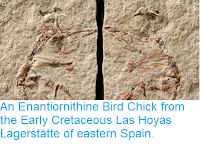
The specimen, MPCM-LH-26189, is not described as a new species, which can be problematic with juvenile animals, as it is hard to ascertain whether they belong to the same species as adults found separately. The specimen is preserved as part and counterpart on a split slab, and comprises a nearly complete and largely articulated skeleton, missing only the tips of the tail and limbs.

Overview photographs of the slab and counterslab of MPCM-LH-26189. Slab (a) is on the left, slab (b), on the right. The two red boxes indicate the localisation of the areas analysed histologically. Abbreviations: An: angular, Ar: articular, CaV: caudal vertebrae, CeV: cervical vertebrae, Co: coracoid, De: dentary, DoV: dorsal vertebrae, Fe: femur, Fr: frontal, Ga: gastralium, Hu: humerus, Hy: hyoid, Is: ischium, Ju: jugal, MiMC: minor metacarpal, Pu: pubis, Qu: quadrate, Ra: radius, Ri: rib, Sa: surangular, Sp: splenial, SaV: sacral vertebrae, SR: sclerotic ring, St: sternum, Ti: tibia, Ul: ulna. Knoll et al. (2018).

One of the distinctive structures of Enantiornithine Birds is their sternal complexes, which are made up of four-to-six ossified elements, and are different from those of both modern Birds and non-Avian Dinosaurs. In modern Birds, bones from the tail are recruited into the sternal complex as the individual grows, an ongoing process hard to spot in the fossil record. However, no known adult Enantiornithine Bird has more than eight free tailbones, whereas MPCM-LH-26189 has ten, strongly suggesting that more would have been recruited into the sternal complex as it grew.

Hypothetical fleshed-out reconstruction of MPCM-LH-26189. The fact that MPCM-LH-26189 is so well preserved and conserves some soft tissue associated chemistry, while showing no feathers or chemical evidence for plumage suggest that the baby bird might have been largely featherless when it died. However, this cannot be confirmed, and so the individual was reconstructed with juvenile plumage hypothesised for perinate Enantiornithines. The silhouettes inset are those of the juvenile Bird and an unspecified sympatric Cockroach to give a sense of scale. Raúl Martín in Knoll et al. (2018).

See also...

https://sciencythoughts.blogspot.com/2017/06/an-enantiornithine-bird-hatchling.htmlhttps://sciencythoughts.blogspot.com/2015/06/preserved-feathers-in-enantiornithine.html
https://sciencythoughts.blogspot.com/2015/01/bird-eggs-from-late-cretaceous-colonial.htmlhttps://sciencythoughts.blogspot.com/2014/07/two-new-species-on-enantiornithine.html
https://sciencythoughts.blogspot.com/2014/06/a-subadult-enantiornithine-bird-from.htmlhttps://sciencythoughts.blogspot.com/2014/06/preserved-ovarian-follicles-in-mesozoic.html


Follow Sciency Thoughts on Facebook.

Thursday, 5 July 2012

A new species of Tapejarid Pterodactyl from the Early Cretaceous Las Hoyas Lagerstätte of eastern Spain.

The Tapejarid Pterodactyls are a group of bizarre, toothless Pterosaurs known from the Early Cretaceous (Aptian–Albian stages, 125–99 million years ago) of Brazil and China, with a single possible Late Cretaceous specimen from Morocco. The Tapejarids sported large, distinctive crests that varied a great deal between species. The lifestyle and diet of the Tapejarids is unclear, but it has been noted that a number of groups of Pterosaurs independently evolved toothless forms in the Early Cretaceous, implying that a new ecological niche had become available. It has further been suggested that this coincided with the expansion of the Angiosperms (flowering plants), and that this might be connected, possibly implying that these toothless Pterosaurs may have been among the first frugivores. However there is at this time no actual evidence to confirm or contradict this theory, and it is unlikely that it could be resolved without finding Pterosaurs with preserved stomach contents, which is quite a hard requirement.

In a paper published in the journal PLoS One on 3 July 2012, a team of scientists led by Romain Vullo of the Laboratoire Géosciences Rennes at the Université de Rennes 1 and the Unidad de Paleontología at the Departamento de Biología at the Universidad Autónoma de Madrid describe a new species of Tapejarid Pterodactyl from the Early Cretaceous Las Hoyas Lagerstätte of eastern Spain.

The Las Hoyas is a Konservat-Lagerstätten (deposit producing numerous excellently preserved fossils) of Barremian age (125-130 million years old) formed in a stagnant, microbe rich lake. It is noted for its excellently preserved vertebrate fossils, including Fish, Crocodiles, Dinosaurs and Birds.

The new species is named from a single, incomplete, skull and lower jaw from the Las Hoyas deposits. It is named as Europejara olcadesorum, where Europejara is a combination of Europe and Tapejara, the first described genus of Tapejarid Pterodactyls, and olcadesorum derives from the Olcades, a Celtic tribe who inhabited the region in ancient times. It is not well enough preserved to resolve its exact taxonomic position within the group, though it clearly is a Tapejarid, and being Barremian in age it is the earliest known member of the group, and indeed the earliest known toothless Pterosaur from any group, suggesting that whatever ecological niche these Pterosaurs filled had arisen by this time.

Skull of Europejara olcadesorum. (A) Close-up of the crushed left post-orbital region of the skull (acid-prepared counterslab) in lateral view showing the narrowness of the lower temporal fenestra (ltf), the mandibular condyle of the quadrate (cq) and the distal extremities of the hyoid apparatus (hy). (B) Close-up of the posterior area of the palate (main slab under ultraviolet light) in dorsal view showing the thin, elongated vomer (v) septum separating the two choanae (ch). Note the medial surface of the left dentary (ld) and the hyoid apparatus (hy), adjacent to the ventral margin of the mandible. (C) Detail of the posterior area of the palate (acid-prepared counterslab) in dorsal view showing the pterygoid (pt), the ectopterygoid (ec), and the right maxilla (rm). Note the robustness of right mandibular ramus (in lateral view) and its thin, edentulous dorsal edge (arrow). ch, choanae; cq, mandibular condyle of the quadrate; ec, ectopterygoid; hy, hyoid apparatus; j, jugal; lbd, lingual bulge of the dentary; ld, left dentary; lft, lower temporal fenestra; po, postorbital; pt, pterygoid; q, quadrate; rd, right dentary; rm, right maxilla; sq, squamosal; v, vomer. Scale bars: 10 mm. Vullo et al. (2012).

Lower jaw of Europejara olcadesorum. (A) Close-up of the symphyseal area (acid-prepared counterslab) in right lateral view showing the typical step-like dorsal margin of the dentary in tapejarines (arrow). Note the strong lateral compression of the mandible and the trabecular structure of the sagittal crest of the dentary (scd). (B) Close-up of the best preserved margin of the dentary crest (main slab). Note the concave posterior border (arrow) giving the peculiar recurved aspect of the dentary crest of Europejara. scd, sagittal crest of the dentary. Scale bars: 10 mm. Vullo et al. (2012).

Reconstructions of Europejara olcadesorum. (A) Interpretative line drawing of the skull as observed on the acid-prepared counterslab. (B) Reconstruction of the skull (based in part on Tapejara) showing preserved parts in red. Life restoration of the head of Europejara in lateral (C) and frontal (D) views. apj, anterior process of the jugal; aprj, anterior process of the right jugal; d, dentary; ec, ectopterygoid; hy, hyoids; j, jugal; l, lacrimal; ld, left dentary; lj, left jugal; lm, left maxilla; lpo, left postorbital; lq, left quadrate; lsa, left surangular; lsq, left squamosal; ltf, lower temporal fenestra; m, maxilla; naof, nasoantorbital fenestra; o, orbit; pf, postfrontal; po, postorbital; pt, pterygoid; q, quadrate; rap, retroarticular process; rd, right dentary; rm, right maxilla; scd, sagittal crest of the dentary; scp, scleral plates; sq, squamosal. Scale bar: 50 mm. Vullo et al. (2012).


Follow Sciency Thoughts on Facebook.

Thursday, 7 June 2012

An Eucryptodiran Turtle from the Early Cretaceous of Spain

The Eucryptodiran Turtles are capable of retracting their heads completely into their shells; all modern Turtles and Tortoises fall into this group, with the exception of the Side-Necked Turtles (Pleurodira). The group originated In Europe during the Jurassic, and expanded into Asia in the Early Cretaceous, eventually spreading across the globe.

In a paper published in the journal Acta Palaeontologica Polonica on 11 May 2012, Adán Pérez−García of the Departamento de Paleontología at the Facultad de Ciencias Geológicas at the Universidad Complutense de Madrid, Marcelo de la Fuente of the Departamento de Paleontología at the Museo de Historia Natural de San Rafael, and Francisco Ortega of the Grupo de Biología at the Facultad de Ciencias at the Universidad Nacional de Educación a Distancia, describe a new, basal (i.e. from before the modern groups separated from one another) Eucryptodiran Turtle from the Early Cretaceous (Barremian) Las Hoyas Limestone of Cuenca, Spain.

Map showing the location where the new Turtle was discovered (star). Pérez−García et al. (2012).

The new turtle is named as Hoyasemys jimenezi, Jiménez's Hoya-Turtle, after Emiliano Jiménez Fuentes, an expert on Spanish fossil Turtles. In is a small (~80 mm) turtle preserved on two slabs; it is more-or-less complete, lacking only the upper portion of the skull. The deposits it comes from are interpreted as finely laminated freshwater limestones; suggesting a low energy, freshwater environment, such as a lake.

Hoyasemys jimenezi in ventral view. (A) Photograph. (B) Interpretive drawing. Pérez−García et al. (2012).

Hoyasemys jimenezi detail of skull in ventral view. (A) Photograph. (B) Interpretive drawing. Pérez−García et al. (2012).

Hoyasemys jimenezi in ventral view. (A) Photograph. (B) Interpretive drawing. Pérez−García et al. (2012).


Follow Sciency Thoughts on Facebook.