Showing posts with label Skinks. Show all posts

Wednesday, 15 October 2014

Two new species of Skink from the Cape York Peninsula in northeast Australia.

Tropical Rainforests in Australia are found in a 430 km lowland strip between Townsville and Cooktown in Queensland, known as the ‘Wet Tropics’, and in smaller patches on the mountainous Cape York Peninsula. While the more accessible Wet Tropics have been extensively studied and surveyed for biodiversity, the patchy forests of the Cape York Peninsula are less well known, with most of the research that has occurred having concentrated on larger forest patches.

In a paper published in the journal Zootaxa on 29 September 2014, Conrad Hoskin of the Centre for Tropical Biodiversity & Climate Change at James Cook University and Patrick Couper of the Natural Environments Program at the Queensland Museum, describe two new species of Skink (Scincidae) from the Cape York Peninsula. Both new species are placed in the genus Glaphyromorphus, which is found in Australia and New Guinea.

The first new species described is named Glaphyromorphus othelarrni, which means ‘he-listens’ a name given to Bob Flinders who was born around Cape Melville and who passed knowledge of, and responsibility for the country onto the current generation of Traditional Owners; the name was chosen by the bubu gudjin, who are the Traditional Owners of the area where the species lives.

Glaphyromorphus othelarrni in life. Conrad Hoskin in Hoskin & Couper (2014).

Glaphyromorphus othelarrni is a smooth brown Skink with wavy lines of dark spots. Adults reach 215.4-236.9 mm in length. The species was found living at three sites around the Melville Range at Cape Melvile, on the western uplands of the mountains, around the highest peak and on the lowlands to the south of the range. It was round living in thick leaf litter around the base of or in between boulders within rocky areas within rainforests.

Habitat of Glaphyromorphus othelarrni in the Melville Range: (A) shows rainforest and boulder-field in the uplands; (B) showsboulder-strewn rainforest. Conrad Hoskin in Hoskin & Couper (2014).

The second new species described is named Glaphyromorphus nyanchupinta, meaning ‘covered in dead leaves or mulch’, a name chosen by the Elders of the Kaantju clan, traditional owners of the area where the species was discovered.

Glaphyromorphus nyanchupinta in life. Stephen Williams in Hoskin & Couper (2014).

Glaphyromorphus nyanchupinta is an elongate, tube-shaped Skink, brown in colour with darker brown or grey wavy bars. It was found living under logs in upland rainforest around the headwaters of Peach Creek in the McIlwraith Range on the Cape York Peninsula.

Habitat of Glaphyromorphus nyanchupintain the McIlwraith Range: (A) shows the rainforest uplands; (B) shows rainforest inthe vicinity of the headwaters of Peach Creek. (A) Adam Creed/QPWS in Hoskin & Couper (2014); (B) Patrick Couper in Hoskin & Couper (2014).

See also…

Skinks of the genus Carliaare found in northeast Australia, New Guinea and the Wallacea biogeographical province between Australia and...

Skinks are smallish lizards with elongate bodies and reduced legs and necks. They are an ancient and successful group, found throughout the tropical, subtropical and warm temperate regions of the world...

Skinks are smallish lizards with elongate bodies and reduced legs and necks. They are an ancient...

Follow Sciency Thoughts on Facebook.

Wednesday, 8 October 2014

A new species of Skink from Cape Melville in northeast Australia.


Skinks of the genus Carlia are found in northeast Australia, New Guinea and the Wallacea biogeographical province between Australia and Southeast Asia. There are currently 42 described species, 23 of which are found in Australia, all but one of these being restricted to the continent (one species is found in Australia and New Guinea). Of these Australian species, the majority occupy open forests in northeastern and coastal Queensland, with only two known species, Carlia rubrigularis and Carliar homboidalis, that can accurately be described as two rainforest species, both being found in the ‘Wet Tropics’ between Townsville and Cooktown.

In a paper published in the journal Zootaxa on 1 October 2014, Conrad Hoskin of the Centre for Tropical Biodiversity & Climate Change at James Cook University describes a new species of Carlia from the upland rainforests of Cape Melville.

The new species is named Carlia wundalthini, in honour of Charlie Monaghan, a Traditional Owner from the Cape Melville area who passed on knowledge and responsibility to the current generation of Traditional Owners; it was chosen by the bubu gudjin of Cape Melville, the Traditional Owners with responsibility for the area where the species was discovered.

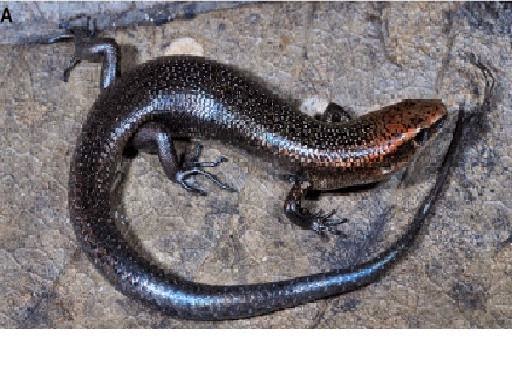
Carlia wundalthini male specimen in life. Hoskin (2014).

Carlia wundalthini is a brown Skink with scattered black and white flecks, a rainbow tinge when seen from certain angles and a coppery head. Males have an orange flush on their necks and flanks in the breeding season (around December). Females have brown flanks, darker on the upper surface, a paler line along the top of the back and pale spots on the flanks.

Carliawundalthini (A) male and (B) female.Hoskin (2014).

The species was found living in upland rainforest on Cape Melville. The Skinks were active during the daytime, foraging in leaf-litter or basking in the sun. When disturbed they hid beneath the leaf litter or in rock crevices.

Habitat of Carlia wundalthini, in the Melville Range: (A) shows the edge of the rainforest plateau and the extensive boulder-fields that characterise Cape Melville, (B) shows the rainforest at the locality where the first specimens were found. Hoskin (2014).

See also…

http://sciencythoughts.blogspot.co.uk/2014/01/a-new-species-of-skink-from-southern.htmlA new species of Skink from southern New Caledonia.                                                 Skinks are smallish lizards with elongate bodies and reduced legs and necks. They are an ancient and successful group, found throughout the tropical, subtropical and warm temperate regions of the world, though...
http://sciencythoughts.blogspot.co.uk/2012/03/new-species-of-skink-from-northwest-new.html New species of Skink from northwest New Caledonia.                                                 Skinks are smallish lizards with elongate bodies and reduced legs and necks. They are an ancient and successful group, found throughout the...

Follow Sciency Thoughts on Facebook.

Tuesday, 14 January 2014

A new species of Skink from southern New Caledonia.

Skinks are smallish lizards with elongate bodies and reduced legs and necks. They are an ancient and successful group, found throughout the tropical, subtropical and warm temperate regions of the world, though individual species (of which there are over 12 000) may be threatened. Skinks can either lay eggs or bear live young (depending on species) and can be divided into tree-dwelling and ground-dwelling species, though this is an ecological rather than a taxonomic distinction; ground-dwelling species tend to have much more reduced limbs than tree-dwelling species, often being quite snake-like. Most skinks are insectivorous, but some will eat vegetable matter, or small rodents.

In a paper published in the journal Zootaxa on 8 August 2013, a team of scientists led by Ross Sadler of the Section of Herpetology at the Australian Museum in Sydney describe a new species of Skink from the southern Highlands of New Caledonia.

The new species is placed in the genus Caledoniscincus, which is native to New Caledonia and already contains 13 species, and given the specific name notialis, meaning 'southern'. Caledoniscincus notialis is a cryptic species (one that cannot be distinguished on morphological traits alone, but which has been shown to be distinct genetically) discovered as a result of a genetic study into the systematics of the genus. It closely resembles the widespread Caledoniscincus atropunctatus, and the populations referred to the new species were formerly classified as belonging to this species. The adult males, on close inspection, have pale marking on their dorsal scales not seen in Caledoniscincus atropunctatus, but the juveniles and females could only be differentiated by genetic analysis.

Caledoniscincus notialis. Top and bottom, males, center, female. Sadler et al. (2013).

Caledoniscincus notialis is only known from scattered locations on the Goro Plateau and Grand Terre in far southern New Caledonia. It lives in humid forests and tall maquis (shrubland) on ultramafic soils (soils derived from low silica volcanic rocks, which tend to be low in calcium and phosphorus but high in metal content). Due to its limited range and subsequent low population, Sadler et al. recommend that Caledoniscincus notialis be classified as Vulnerable on the ICUN's Red List of Threatened Species.

Humid forest (a) and maquis preforest (b) on ultramafic surfaces of the Goro Plateau, typical habitat for Caledoniscincus notialis. Sadler et al. (2013).


Follow Sciency Thoughts on Facebook.

Monday, 12 March 2012

New species of Skink from northwest New Caledonia.

Skinks are smallish lizards with elongate bodies and reduced legs and necks. They are an ancient and successful group, found throughout the tropical, subtropical and warm temperate regions of the world, though individual species (of which there are over 12 000) may be threatened. Skinks can either lay eggs or bear live young (depending on species) and can be divided into tree-dwelling and ground-dwelling species, though this is an ecological rather than a taxonomic distinction; ground-dwelling species tend to have much more reduced limbs than tree-dwelling species, often being quite snake-like. Most skinks are insectivorous, but some will eat vegetable matter, or small rodents.

On 9 March 2012, in a paper in the journal Zootaxa, a team of biologists led by Ross Sadlier of the Section of Herpetology at the Australian Museum, describe the discovery of a new species of skink from the woodlands of northwest New Caladonia.

The species is described as Caledoniscincus constellatus, the Star-studded Caledonian Skink. It is a brown skink with a yellow underside and a white lateral stripe (stripe along its side), the adults of which are 46-57 mm in length. It is a tree-dwelling species found in Acacia Scrub and Mediterranean Woodland. Reproductive and feeding behavior were not recorded.

Male Star-studded Caledonian Skink, Caledoniscincus constellatus. From Sadlier et al. (2012).

There are two other species of Caladonian Skink with white lateral stripes, both of which share at least part of their range with C. constellatus. C. haplorhinus and C. austrocaledonicus. In C. constellatus the lateral stripe is broad and solid when it reaches the ear opening, but in C. haplorhinus, it is narrow and starting to break up. C. austrocaledonicus does not always have a lateral stripe, and where it does this does not reach the ear. Genetic studies have confirmed these are three separate species.

The heads of (A) C. constellatus, (B) C. haplorhinus, and (C) C. austrocaledonicus, showing the position of the lateral stripe at the head. From Sadlier et al. (2012).

C. constellatus is known only from two sites in the northwest of New Caledonia. These are threatened by deforestation by expanding agriculture and ranching, which fragments the landscape and makes it vulnerable to forrest fires, habitat loss due to nickel mining at the Koniambo Mine, and the harmful effects of the invasive Little Red Fire Ant (Wasmannia auropunctata). If these turn out to be the only places where it lives, then C. constellatus would meet the criteria for inclusion in the Critically Endangered category on the IUCN Red List.

Map of northern New Caledonia, showing the two locations where C. constellatus was found. From Sadlier et al. (2012).

The localities where C. constellatuswas found. (A) Acacia scrubland at Pointe de Vavouto. (B) Mediterranean Forrest on Massif Ouazangou. From Sadlier et al. (2012).