The city of Djenné lies in the Niger Inland Delta of central Mali, and is thought to have been inhabited since about 250 BC, forming a part of the trans-Saharan trade network connecting West Africa to the Mediterranean. It is a UNESCO World Herritage Site, one of four in Mali, along with Timbuktu, the Tomb of Askia, and the Dogon communities living on the Cliff of Bandiagara. From the thirteenth century onwards Djenné became a major trading centre for commodities such as rice and corn, and a centre for arts, learning and religion. The city's most famous feature is the Great Mosque, which was built in 1220 AD, and substantially rebuilt in 1907.
Declared in 1988, the Old Towns of Djenné World Herritage Site includes the city of Djenné, the Great Mosque, the archaeology of Djenné-Jeno and the surrounding old towns of Hambarketolo, Tonomba, and Kaniana. This has prompted a series of restoration projects in the city, funded by cultural agencies, non-profit organisations and foreign government aid organisations, and starting with the restoration of the Great Mosque in 2008. These projects have provoked debate about the role of conservation in Mali, and to what extent is serves the needs of local people or imposes external ideas on what aspects of the country's heritage should be preserved and how.
In a paper published in the journal Built Heritage on 30 December 2021, Oussouby Sacko of the Graduate School of Architecture at Kyoto Seika University, discusses the relationship between cultural conservation and cultural heritage preservation, based upon observation of restoration projects in Djenné, made during field surveys carried out between 2010 and 2017.
Map of the Republic of Mali. Sacko (2021).
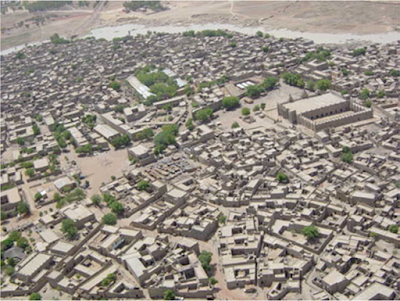
The city of Djenné currently has a population of about 20 000 people, up from about 12 000 in1987, The majority of these speak Djenné Chiini, a local dialect of Songhay, but several other languages are spoken, including Bozo, Fulani, and Bambara. The city is arranged into several different quarters, each occupied by a different ethnic/professional group (people's professions tend to be closely linked to their ethnic background), with the Great Mosque and market square at the centre. Each of the ethnic groups living in the city tends to follow its own trade or trades, with the Bozo being fishermen and builders, the Fulani cattle raisers, the Bambara specialising in farming, the Sarakolé being merchants, and the Songhai being Quran teachers, religious and traditional leaders.
An areal view of the ciry if Djenné. Sacko (2021).
There are three dominant building styles found in Djenné, Moroccan, Tukulor and Plain, which differ principally in the arrangement of their fasçades. The three styles of building tend to reflect the both the history and socioeconomic standing of the house and its residents. Houses are typically two story, with a flat roof terrace, and allow for a separation of the sexes. Houses have a vestibule which connects the inner courtyard to the street, and which is typically used as both an entrance and a place of business. Thus, it can be used as a Qur’anic school space if the occupant is a marabout (religious teacher), a workshop for a craftsman, etc..
House Plan of Djenné. Sacko (2021). The basic material used for construction in Djenné is banco, a mixture of mud and other ingredients, used both to make bricks and as a mortar and plaster covering. Bricks come in two forms, the traditional Djenné ferey, which are roughly cylindrical, and toubabou ferey (roughly 'foreign bricks'), which are rectangular bricks introduced in the 1930s, shaped like a traditional European brick. Banco is prepared in pits by the river during the dry season. This begins as a mixture of earth and rice husks, then has other ingredients added, such as Baobab fruit powder, shea butter, and gum arabic. This mixture is then allowed to ferment for 2-3 weeks before use.
(Top left) Old style mud bricks in Djenné (Djenné ferey), and (top right) new type of bricks (toubabou ferey). August 2009. (Bottom left and right) Mortar preparation in for house and buildings covering, March 2009. Sacko (2021).
Becoming a house-builder in Djenné is not a simple process. All builders (called Barey in the local tongue) belong to a professional body, the barey-ton. In order to become a Barey a boy must be born into a family where this is a trade, and choose to take up the craft very young (this is not automatic). He will then begin an apprenticeship with a relative, usually his father, at the age of about seven, learning a series of skills before qualifying as a Barey in his own right sometime in his mid-twenties; despite this apprenticeship beginning under his father, an apprentice will often serve several different masters before graduating, although these will generally come from his extended family. Relationships between the Bareys and their clients is usually a very long-term affair, with the care of a home and the family who live in it generally being passed down from father to son. If a client wishes to change Barey for some reason, then he will need the permission of the Barey-ton to do so.

Different types of House Façade in Djenné, February 2010. Sacko (2021).
Since Djenné gained World Heritage status in 1988, a number of conservation and restoration projects have been launched in the city, although few of these have involved consultation with local communities, or the Barey-ton. This has created a situation in which local people sometimes feel excluded from the management of their own heritage. Even where projects are deemed necessary and useful by the local population, they have often been carried out in ways that are sound from a scientific and theoretical point of view, but which do not take into account the views and cultural knowledge of the people of Djenné.
Djenné’s Townscape, August 2011. Sacko (2021).
In 1995/6 a short-term project with financial backing from the Netherlands began carrying out rehabilitation of 168 monumental houses thought to represent the cultural identity well, carying out activities from minor repairs to total reconstruction, based upon either documentation of the prior state of the houses or people's memories.
From 2004, a major project funded by the Aga Khan Trust for Culture began restoration work on the Great Mosques of Djenné and Mopti and the Djingereyber Mosque in Timbuktu as well as public spaces around them, which also included installation of new water and sanitation systems, street paving, early childhood education, training, health care and economic development. This has become the most high-profile restoration project in Djenné, and has relied heavily on the knowledge of traditional builders and craftsmen.
Mosque restoration site by Djenné’s inhabitants, May 2001.Sacko (2021).
In 2010 a report by the government of Mali noted that many houses in the area had been modified or repaired in ways inappropriate to their cultural heritage, often using modern building materials to make modifications that accommodate larger families or modern life-style choices. This report noted that one of the drivers of this was the high cost of traditional building materials. Following this the Mali Ministry of Culture, along with the Cultural Mission of Djenné and the World Heritage Earthen Architecture Programme, have begun looking into ways to develop town planning and construction regulations adapted to earthen architecture. The World Heritage Centre has noted that the absence of such regulations has led to a rise in new, inappropriate construction projects and poor property rehabilitation, and that, regardless of the good intentions of local players, these are likely to lead to a loss of the coherence of the urban fabric of Djenné without the implementation of regulations.

Traditional architecture in Djenné, August 2011. Sacko (2021).
In 2008 the Mali Ministry of Culture drew up an action plan for Djenné, with the objectives of improving sanitation management in the city, redefining the boundaries of registered sites within the communities, strengthening legal protections of sites within the new limits, improving the state of conservation of the city of Djenné and the archaeological sites, ensuring better promotion of the sites for visiting audiences, and promoting the intangible cultural heritage of the city.
Since this time the city has undergone a population boom and subsequent exponential urbanisation, creating a demand for territorial spaces for housing and other urban living amenities. This led to the creation of a new, reformed conservation plan in 2018, which aimed to review and update the urban planning diagram and establish sectoral urban planning for the city, strengthen the legal protection of the site in the context of decentralisation and regionalisation, undertake an emergency rescue programme for monumental architecture on threatened earth within the ancient fabric, and preserve and promote earthen architecture, strengthen the protection of archaeological sites, improve their state of conservation and fight against loss and illicit trafficking, carry out a wide-ranging awareness and information campaign in local communities on current cultural heritage and urban development issues, safeguard elements of intangible cultural heritage.

The Great Mosque and market of Djenné, March 2004. Sacko (2021).
The World Heritage Centre has recognised that the earthen architecture of Djenné and its neighbouring towns and cities is one of the most powerful expressions of the human ability to create built environments from local resources. However, this unique urban environment has been threatened by natural disasters, social conflicts, industrialisation, the urban explosion and the globalisation of models and standards for the design and construction of housing are factors contributing to the disappearance of traditional knowledge and sociocultural practices linked to the construction and maintenance of earthen architecture, leading to the placement of the city on the List of World Heritage in Danger. As a consequence of this, a number of preservation projects have been initiated, but most of these are led by foreign agencies and experts, with local people largely becoming spectators rather than participants.
The restoration of the Great Mosque of Djenné was widely hailed as a successful project which had saved both Djenné’s architecture and the national identity, as well as promoting the area's tourism industry. However, for local people the project often highlighted the gap between traditional and modern techniques or approaches to construction. This appears to have raised the awareness of the local population's responsibility for their own cultural heritage conservation, and led to a much more unified approach to these issues.
Mosque conservation by Aga Khan Trust, before and after images, March 2011. Sacko (2021).
The area at the entrance to the city is outside of the conservation area, and has recently seen the construction of many new buildings using concrete, cement blocks, and fired clay as building materials, largely by successful emigrees from the city to Bamako, building second homes in Djenné. This area includes about 700 houses and four municipal buildings. Concerns about this have been raised by Djenné Patrimoine, a local conservation group, who feel that more culturally appropriate construction styles should be encouraged.
New construction in Djenné, March 2015. Sacko (2021).
Modern Djenné derives its income from rice farming, fishing, and livestock farming on the surrounding floodplains, though all of these have been impacted adversely by a series of severe droughts. When many of the conservation projects in Djenné were conceived, the city was beginning to develop a tourism industry around its cultural heritage. However, since 2012 a rebellion has broken out in the northern part of Mali (one of a series of conflicts which has bedevilled the Sahel region since the collapse of the Gadaffi regime in Libya in 2011), with several different groups fighting against one-another and the central government. During this conflict a number of foreign tourists have been taken hostage and either held for ransom or killed, effectively ending any hopes of developing a viable tourist industry in the country. This has resulted in the closure of many businesses that formerly relied on tourists for their income, as well as a very high rate of unemployment among (mostly young) former workers in the sector, many of whom have left to find work, either in Bamako or in other countries. This presents new challenges for the conservation of Djenné's traditional architecture, with preserving these buildings providing extra costs for their residents, while at the same time there has been a loss of the tangible benefits (in the form of extra income derived from tourism) associated with them. The preservation of Djenné's cultural herritage is now apparently being done solely for the people of the city, but often according to the designs of outside agencies.

Tourist Facilities in ruins, March 2015. Sacko (2021).
The traditional architecture of Djenné requires regular maintenance and restoration work to prevent it from slowly collapsing. This is an expensive process, and the typical residents of the city are far from wealthy. A flourishing tourist industry would increase both the willingness of the people of Djenné to finance this work and their motivation for doing so. This raises the question of exactly whom Djenné is being preserved for, the international community, or the people of the city itself.
The architecture of Djenné and its neighbouring cities is made and maintained by a unique group of traditional craftsmen, the Barey, who undergo a strict apprenticeship process, forming a closed artisan union and community, and the Barey of Djenné are particularly renowned for their skills within the region. As well as their construction and craft skills, the Barey also use complex magical rituals in the building process, which secrets passed on by a master only to his most trusted apprentice(s), and which may be taken to the grave if no suitable candidate is available.
The Chief Barey of Djenné, May 2004. Sacko (2021).
The conservation of Djenné's architecture in any meaningful sense must inevitably involve the Barey, a group whom Oussouby Sacko has been studying for over 25 years, and about whom he has published numerous studies, covering the structure and uses of the houses they build, the origins of the group and the Barey-tom (their professional association), their place in the city's social structure, and their spiritual role, which mixes elements of Islam with elements of older local beliefs. During the time that Sacko has studies the Barey have undergone somewhat of a crisis, with their skills being under used for a time, due to both economic pressures and a changing culture that placed more emphasis on modernity, which resulted in fewer young people looking to join the trade. Following the Mosque restoration project, a greater sense of cultural identity has emerged in the city, making a career as a Barey more desirable, but this left a severe age gap within the Barey-ton, with master builders often much older than their apprentices. This has potentially significant consequences, due to the strict way in which information is passed on, with skills and secrets only passes to apprentices (never sideways to other Barey-masters), and only when the apprentices are deemed ready to be taught.
As part of this study Sacko carried out structured interviews with three of Djenné's most senior Barey, Béré Yonou, who is currently the oldest Barey in Djenné at 84, Nouhoum Toure, an educated Songhai Barey (most Barey, including the other two interviewees, come from the Bozo ethnic group), and Mafoune (Sésé) Dienepo, who has been an active participant in recent conservation projects, and is the lead Barey of the Maison de Djenné Patrimoine.
Béré Yonou, March 2017. Sacko (2021).
Béré Yonou is a descendant of Ousmane Yonou and Soumaila Yonou, two famous historical Barey from Djenné, and is currently the last master Barey of the family. He studied under his father from the age of six, then, after his father died when he was fifteen became a disciple (senior apprentice) to his father's younger brother. He has been an independent Barey since 1979, and has been responsible for the building of numerous properties using the traditional Djenné ferey. Yonou reports that before beginning a building project, it is necessary to measure out the site by foot, then listen to the sound the ground makes when tapped, and performing any ceremonies deemed necessary before construction can be started. The first bricks are then placed at the corners of the property, and further rituals performed, before building commences, working from the corners towards the centre. When learning the trade an apprentice must learn a number of skills in order: how to carry earthen mortar, how to pass bricks, how to make foundations, how to stack bricks, how to assemble roofs, and how to paint walls. The trade also has a number of secrets, which can only be taught to the most trusted disciples, and which it is forbidden to disclose to others, including other master Barey. If no suitable disciple can be found, then these secrets die with the master.

Nouhoum Toure, March 2017. Sacko (2021).
Nouhoum Toure was born at Douanza, in the Dogon Mountains to the northeast of Mopti. His father came from Djenné, and was one of the master Barey involved in the early twentieth century restoration of the Great Mosque, but following a dispute, was forced to leave Djenné, along with the six other master Barey who worked on the project. His father was the only one of these Barey to return to Djenné, dying their in 1961. Unlike most Barey, his father kept a Tariq (written record) of his trade, including the Mosque restoration project) from which Nouhoum Toure has learned many skills and secrets. Nouhoum Toure is a descendent of Moussa Toure, an important figure in the history of Djenné, but his family have left and returned to the area several times. His great-grandfather, Ibrahima Toure, was a noted scholar who migrated to Djenné from Goundam, in the north to the west of Timbuktu, and his grandfather, Issa Toure, was a slave merchant as well as a Barey. Nouhoum Toure learned his skills principally from his father, but when he was an apprentice, also studied under his father's brothers and cousins. He became an independent Barey in 1972. He notes that there are rivalries among the Barey, which outsiders do not often percieve, and that thse can seriously hamper or undermine building projects. He believes the most important aspect of the Barey's trade is the correct preparation of the Banco (clay mixture) used in construction, of which there are seven types (confusingly known as Labou: Labou bibi (black), Labou chiri (red), Labou Korendi, Labou couscous, Djamaye Labou (banco for pottery), Labou Kora (yellow), and Labou do (banco which contains sand). A number of other materials are also used in the laying of foundations, including rice, two types of grain, charcoal, cotton seeds, and treasure shells. He further states that to become a master Barey, an apprentice must learn a number of rituals, including Tinyeda (soil fortune-telling), learning how to determine the start date for any project, and the correct rituals to be performed on the 2nd, 12th, 17th, 22nd and 27th of every lunar month. Ideally a Barey should not work on the 27th and the last Wednesday of each lunar month. These secrets can only be passed on the most trusted apprentices, chosen by careful observation of their skills and character.

Mafoune (Sésé) Dienepo, March 2017. Sacko (2021).
Mafoune (Sésé) Dienepo is a descendent of Tassey Nassire, a Barey who moved to Djenné from Dandy in northern Mali, with a Maiga family (a religious Songhai clan) that came to Djenné to open a religious school. Tassey Nassire had twin sons, who became the most renowned Djenné Barey of their generation, one of whom, Saoudatou Nassire, was Mafoune (Sésé) Dienepo's maternal grandfather. Tassey Nassire's wife (and Saoudatou Nassire's mother), was also a Barey, called Saby Dienepo. Her brother was another Barey, and Mafoune (Sésé) Dienepo's paternal grandfather. His father Mahamane Dienepo was also a Barey, although Mafoune (Sésé) Dienepo, one of 13 children, was originally apprenticed to a distant cousin, before becoming his father's disciple. After becoming an independent Barey he moved to Mopti for a while, to broaden his skill base, before returning to Djenné. He believes that rituals are an important part of the construction process; a Sheep should be sacrificed before construction begins, and its blood sprinkled on the site, and a number of materials, including grain, cotton and kola nuts, placed within the foundations. If a Djinn is present at the site, it can be removed in a special earthenware pot called a Dagua. Other rituals must be performed if anyone falls sick during the construction process. Construction should always start with the laying of three bricks at each of the corners of the property, and, if the site has been used before, then permission to build there must be obtained from the Barey who previously built there. The secrets of the trade can generally only be passed on to an disciple whom the master has carefully observed for some time, although sometimes a dream will tell a master to pass on certain secrets to certain apprentices.

Ingredients used for mortar and offerings for site preparation, March 2011, Mopti, Djenné. Sacko (2021).
All three of the Barey interviewed reiterated that rituals are an important part of the construction process in Djenné, and the process of becoming a Barey is a complex one, and not simply dependent on hereditary. A master Barey must be a skilled in construction and ritual magic, as well as in good religious standing. This creates problems for the recruitment and training of new Barey, as apprenticeships who master the construction skills may not master the magical skills. In recent years a division has developed between older, classically trained Barey, and younger Barey who often combine the traditional skills with skills learned at school or college.
Maison du Patrimoine de Djenné, September 2015. Sacko (2021).
If the architecture of Djenné is being preserved purely for the benefits of its people, to protect their cultural identity and heritage, then the potential exists to adapt this work to better match the desired of those people, and to have homes better suited to modern living. Those people who have had their homes restored by the conservation projects have clearly benefitted from this process, although there has been some friction, as residents have typically seen the projects as an opportunity to improve and modernise their homes, rather than restore them to some historic ideal which is often seen as cramped and impractical. Many local residents have also come to see the adoption of clay roofing tiles as being a practical way to protect their homes against seasonal rains, something which UNESCO does not support, on aesthetic grounds. This has created a dichotomy between UNESCO's vision of the city as a place of important historical significance which should be preserved for all mankind, and the local population's desire to have a modern living space.
Sacko notes that the imposition of rules on the maintrnance of buildings in Djenné by UNESCO can potentially interfere with the United Nations' stated goals of enabling all people to have shelter and freedom from constant anxiety about it. Over a hundred of Djenné's traditional houses have now been restored, and, on the whole, their residents have stated that they are happy with the process, and have developed a better understanding of the importance of the architecture as a result. When the city had a growing tourism industry, historical accuracy in the preservation of buildings seemed to be an important goal, but now that that has evaporated, it is not unreasonable that more account of the material needs of the people of Djenné should be taken into account during future projects. To this end Sacko recommends that the local community is more heavily involved in setting out goals for future preservation work, as they are the best placed people to determine the ballance between the need to preserve the city's architecture, and the need to accommodate the needs of those living in the city.
See also...
Follow Sciency Thoughts on Facebook.
Follow Sciency Thoughts on Twitter.


.png)