Showing posts with label Blattida. Show all posts

Wednesday, 16 May 2018

Poeciloderrhis spp.: Six new species of Giant Cockroaches from Brazil.

Giant Cockroaches, Blaberidae, are generally large Cockroaches, reaching between 10 and 60 mm, with spines on their middle and rear legs. There are about 660 known species from across the globe, many of which give birth to live young.

In a paper published in the jounrnal Zoologia on 22 March 2018, Leonardo de Oliveira Cardoso da Silva and Sonia Maria Lopes of the Department of Entomology at the Museu Nacional of the Universidade Federal do Rio de Janeiro, describe six new species of Giant Cockroaches from Brazil, all of which are placed in the genus Poeciloderrhis.

The first new species described is named Poeciloderrhis aureolatus, in reference to their yellow-brown colour. The species is described from nineteen male and ten female specimens, collected in Rio de Janeiro and Minas Gerais states. The females are on average larger than the males, though the largest specimens of both sexes are about the same size, with females reaching 45.4-45.7 mm in length, compared to 41.6-45.7 mm in the males. These Cockroaches have triangular heads with black eyes and robust spines on all legs.

Poeciloderrhis aureolatus, male (top) and female (bottom). Scale bars 5.6 mm (top) and 6.0 mm (bottom). Silva & Lopes (2018).

The second new species is named Poeciloderrhis mediansclerostylatus, meaning 'stylus shaped median sclerite' in reference to a detail of the male genitalia. This species is described from a single male specimen collected in Rio de Janeiro State. This is 30 mm in length and shiny brown in colour, with a triangular head, dark brown eyes and strong spines on all legs.

Poeciloderrhis mediansclerostylatus, male specimen. Scale bar is 5.6 mm. Silva & Lopes (2018).

The third new species is named Poeciloderrhis diamantinensis, in reference to the municipality of Diamantino in Mato Grosso State, where this species was first discovered. The species is described from twelve male specimens from Mato Grosso, Rondônia and Goiás states. These range from 22.1 to 24.5 mm in length and are a shiny light brown colour with triangular heads, dark brown eyes, and strong spines on all legs.

Poeciloderrhis diamantinensis, male specimen. Scale bar is 3.4 mm. Silva & Lopes (2018).

The fourth new species is named Poeciloderrhis itatiaiensis, in reference to the Parque Nacional de Itatiaia, in Rio de Janeiro State, where the species was discovered. The species is described from a single male specimen, light brown in colour and 48.9 mm in length, with black eyes, a triangular head and spines on all legs.

Poeciloderrhis itatiaiensis, male specimen. Scale bar is 6.7 mm. Silva & Lopes (2018).

The fifth new species described is named Poeciloderrhis vanzolinii, in honour of herpetologist Paulo Emilio Vanzolini, who collected the specimen from which the species is described, a male from São Paulo State. This specimen is 27.5 mm in length, and shiny light brown in colour with dark brown eyes, a triangular head and strong spines on all legs.

Poeciloderrhis vanzolinii, male specimen. Scale bar is 3.5 mm. Silva & Lopes (2018).

The final new species described is named Poeciloderrhis penduloides, meaning 'pendulum shaped; in reference to the male genetalia. This species is described from a single male specimen collected in Rio de Janeiro State. This specimen is 26.9 mm in length and shiny light brown in colour, with brown eyes, a triangular head and spines on all limbs.

Poeciloderrhis penduloides, male specimen. Scale bar is 4.7 mm. Silva & Lopes (2018).

See also...

http://sciencythoughts.blogspot.co.uk/2017/10/santanmantis-axelrodi-new-specimen-of.htmlhttp://sciencythoughts.blogspot.co.uk/2015/04/latiblattella-avita-fossil-cockroach.html
http://sciencythoughts.blogspot.co.uk/2014/10/interpreting-relationship-between-ants.htmlhttp://sciencythoughts.blogspot.co.uk/2014/05/a-new-species-of-praying-mantis-from.html
http://sciencythoughts.blogspot.co.uk/2014/01/a-fossil-cockroach-from-earliest-late.htmlhttp://sciencythoughts.blogspot.co.uk/2013/09/a-fossil-cockroach-from-early.html
Follow Sciency Thoughts on Facebook.

Friday, 24 April 2015

Latiblattella avita; a fossil Cockroach from the Middle Eocene of northwestern Montana.


Despite being considered ubiquitous urban pests in many parts of the world, Cockroaches, Blattaria, are one of the smallest groups of extant Insects, with only about 5000 described living species. On the other hand the group have a long fossil record, dating back to the Palaeozoic, and modern Cockroaches are an extremely diverse group, with eusocial, jumping, aquatic, pollinating, troglobitic (cave dwelling) and bioluminescent species all known, suggesting modern Cockroaches may be relicts of a much more diverse group.

In a paper published in the journal Palaeontologica Electronica in April 2015, Dale Greenwalt of the Department of Paleobiology at the National Museum of Natural History and Ľubomír Vidlička of the Instituteof Zoology at the Slovak Academy of Sciences and the Department of Zoology at ComeniusUniversity describe a new species of fossil Cockroach from the Middle Eocene Kishenehn Formation of northwestern Montana.

The new species is placed in the modern genus Latiblattella and given the specific name avita, meaning ancient or ancestral. The specimen comprises a forewing and leg preserved on a piece of oil-shale recovered from the Dakin Site on the Middle Fork of the Flathead Rivernear Pinnacle, Montana. The forewing is 15.1 mm in length, and as with many Insect groups Cockroaches are typically classified by the venation of their wings, so Greenwalt and Vidlička are confident with the assignment of the fossil.

Latiblattella avita.Tegmen (forewing) attached (?) to an intact middle leg. Scale bar equals 5 mm. Greenwalt & Vidlička (2015).

Modern members of the genus Latiblattella are extremely diverse, with species known that dwell in cracks in the bark of Pine trees, in Spanish Moss and regular Bromeliads, in the flowers of Yuccas and along the banks of rivers. The single known specimen of Latiblattella avita was discovered in a lake deposit, and appears to be the result of a predation event (i.e. it was dropped by a Bird or other predator consuming the body of the animal). This makes it impossible to determine the environment occupied by the living animal, though the diverse range of habitats in which modern members of the genus are found does imply that the common ancestor of all its members did live a long time ago, so an Eocene specimen is not a surprise. Modern members of the genus are known from Central America, Cuba, Mexico, the Bahamas, Florida and Arizona, all considerably to the south of Montana, and suggesting that the group requires a warmer climate than is found in Montana today, which is consistent with the warmer climates known to have existed in the Eocene.

Only one modern Cockroach genus has fossils known from the Cretaceous, but many have now been found in Eocene deposits, suggesting that the group underwent a significant expansion in the aftermath of the End Cretaceous Extinction. Interestingly many of these genera show the same pattern as Latiblattella, with fossil specimens from what are now temperate areas of North America and living members restricted to the American tropics, suggesting that the modern distributions of many Cockroaches have been determined by cooling climates in the Quaternary.

See also…

http://sciencythoughts.blogspot.co.uk/2014/01/a-fossil-cockroach-from-earliest-late.htmlA fossil Cockroach from the earliest Late Carboniferous of the Ningxia Hui Autonomous Region of northwestern China. Cockroaches (Blattodea or Blattida) are highly successful non-metamorphic Insects (i.e. their young resemble the adults, there is no distinctive larval stage with a separate morphology) related to Termites and Mantises. Cockroaches are found across the globe, but...

http://sciencythoughts.blogspot.co.uk/2013/09/a-fossil-cockroach-from-early.htmlA fossil Cockroach from the Early Cretaceous Yixian Formation of Liaoning Province, China.                                                 Cockroaches (Blattida) are an ancient group of Insects which first appeared in the Carboniferous. They are closely related to Mantises (Mantodea) and...

Follow Sciency Thoughts on Facebook.

Monday, 13 January 2014

A fossil Cockroach from the earliest Late Carboniferous of the Ningxia Hui Autonomous Region of northwestern China.

Cockroaches (Blattodea or Blattida) are highly successful non-metamorphic Insects (i.e. their young resemble the adults, there is no distinctive larval stage with a separate morphology) related to Termites and Mantises. Cockroaches are found across the globe, but are most numerous and diverse in the tropics. They are large Insects, with few species reaching sexual maturity while less than a centimeter in length, and some large tropical species reaching around 10 cm in length. The forewings of Cockroaches are modified to provide a protective covering for their hindwings and bodies. The earliest Cockroaches appear in the fossil in the Late Carboniferous, becoming abundant by the end of the period. 

In a paper published in the Journal of Systematic Palaeontology on 11 December 2012, Zhijun Zhang of the Department of Palaeontology at the Geological Museum of ChinaJoerg Schneider of the Department of Palaeontology at the Technische Universität Bergakademie Freiberg and Youchong Hong of the Beijing Museum of Natural History describe a new species of fossil Cockroach from the earliest Late Carboniferous of the Ningxia Hui Autonomous Region of northwestern China.

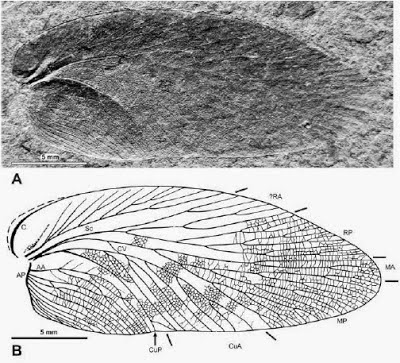
The new species is named Qilianiblatta namurensis, where 'Qilianiblatta' means Cockroach from the Qilianshan Mountains and 'namurensis' means 'from the Namurian' the earliest Stage of the Late Carboniferous (overlapping the latest Mississippian and earliest Pennsylvanian in American reckoning). The species is described from one whole and one partial right forewing, the intact specimen being about 25 mm in length. Wings, particularly forewings, are typically considered to be enough for taxonomic assignment in palaeoentomology, as wing venation is highly distinctive in Insects. 

Qilianiblatta namurensis, right forewing. Photograph (A) and line drawing (B). Zhang et al. (2012).

The specimens come from the Xiaheyan Village Insect Site, in Zhongwei County in the Qilianshan Mountains, close to the Great Wall of China. This site has produced over 3000 Insect specimens from seven different orders, and is one of the oldest significant Insect producing fossil sites known.

The approximate location of the Xiaheyan Village Insect Site.  Zhang et al. (2012).


Follow Sciency Thoughts on Facebook.

Friday, 20 September 2013

A fossil Cockroach from the Early Cretaceous Yixian Formation of Liaoning Province, China.

Cockroaches (Blattida) are an ancient group of Insects which first appeared in the Carboniferous. They are closely related to Mantises (Mantodea) and Termites (Isoptera), with the latter group now generally being accepted to be specialized Cockroaches. Cockroaches are predominantly omnivorous detritivores. They breed rapidly, form large swarms and leave trails of pheromone-infused feces as a means of communication, which makes them unpopular visitors in human residences, where they can serve as vectors for diseases. Cockroaches undergo hemimetabolous development; the larval forms resemble the adults, and never pupate or undergo a radical metamorphosis during their development. 

In a paper published in the journal ZooKeys on 23 July 2013, Chongda Wang and Dong Ren of the College of Life Sciences at Capital Normal University in Beijing describe a new species of Cockroach from the Jehol Biota of the Early Cretaceous Yixian Formation Liaoning Province, China.

The new species is placed in the genus Nuurcala, and given the specific name obesa, meaning fat. Nuurcala obesa is described from a partially preserved specimen with both fore- and hind-wings and a body, plus three isolated forewings. The preserved body is 23.8 mm in length, and it is estimated that the living animal would have been 25.2 mm long (the tip of the abdomen is not preserved).

Nuurcala obesa, line drawing (top) and photograph (bottom). Wang & Ren (2013).

Nuurcala obesa is placed in the extinct Family Caloblattinidae, the dominant group of Cockroaches in many Mesozoic faunas, but somewhat rare in the Jehol Biota, where the Family Blattulidae are the most abundant Cockroaches.


Follow Sciency Thoughts on Facebook.