Showing posts with label Dolphin. Show all posts

Friday, 3 January 2020

Dolphin found dead on beach in Dorset, southern England.

The Lulworth Coastgaurd has reported a Dolphin stranding at Durdle Door on the coast of Dorset, southern England. The animal was reported on the morning of Friday 2 January 2020, causing the Coastgaurd to investigate, as Cetacean strandings fall within their remit. Upon arrival they found the animal was a Short-beaked Common Dolphin, Delphinus delphis, a species common in waters around the UK, which had died before being discovered. The death is not regarded as suspicious, Common Dolphins are quite commonly found on beaches in Europe and other areas, simply because they are abundant. The Coastgaurds took measurements and photographed the Dolphin, data that will be shared with the Natural History Museum and the UK Cetacean Strandings Investigation Programme, who both maintain databases of Cetacean strandings around the UK.

A Short-beaked Common Dolphin found on the beach at Durdle Door in Dorset, England, on 3 January 2020. Lulworth Coastguard.

Short-beaked Common Dolphins are abundant in temperate and warm temperate waters around the world, and to some extent in the tropics. They are not considered to be endangered globally, though some populations are protected as they are considered locally vulnerable, notably those in the the North Sea, Baltic Sea, Mediterranean, Black Sea and eastern tropical Pacific, which are all protected under the terms of the Convention on the Conservation of Migratory Species of Wild Animals.

See also...

https://sciencythoughts.blogspot.com/2019/09/grampus-griseus-rissos-dolphins-in.htmlhttps://sciencythoughts.blogspot.com/2019/09/phocoena-sinus-vaquita-porpoise-in.html
https://sciencythoughts.blogspot.com/2015/09/isthminia-panamensis-south-american.htmlhttps://sciencythoughts.blogspot.com/2015/01/a-fossil-porpoise-from-early-pliocene.html
https://sciencythoughts.blogspot.com/2014/10/a-fossil-dolphin-from-late-miocene-of.htmlhttps://sciencythoughts.blogspot.com/2014/10/a-new-species-of-dolphin-from-early.html
Follow Sciency Thoughts on Facebook.

Thursday, 26 September 2019

Grampus griseus: Risso’s Dolphins in a proposed Marine Protected Area off east Lewis, Scotland.

Risso's Dolphins, Grampus griseus, are a globally distributed species found in almost all marine waters except those of the Arctic and Antarctic, favouring coastal waters at mid-temporate latitudes. The species is considered to be present in British waters year round, but is distinctly uncommon in the North Sea and eastern English Channel, being more regularly seen in coastal waters around the Shetland Islands, the Outer Hebrides, the Irish and Celtic Seas, and the western portion of the English Channel. There is thought to be a notable concentration of these Dolphins off the coast of Scotland around the eastern coast of the islands within the Minch, the Little Minch and the Sea of Hebrides, and in particular along the east and north coasts of the Isle of Lewis around the Eye Peninsula and Butt of Lewis, areas that fall within the proposed North-east Lewis Marine Protected Area.

In a paper published in the Journal of the Marine Biological Association of the United Kingdom on 18 February 2019, Carloine Weir of Whale and Dolphin Conservation and Ketos Ecology, and Nicola Hodgekins, Sarah Dolman, and Alice Walters, all also of Whale and Dolphin Conservation, publish the results of a series of surveys of the waters off the east coast of the Isle of Lewis for Risso's Dolphins made between 2010 and 2017

.A Risso's Dolphins, Grampus griseus, off the coast of Scotland. Nicola Hodgekins/Scottish Natural Heritage.

The first survey of Risso's Dolphins in the waters off the coast of Lewis were carried out around the Eye Peninsula during the summers of 1995 and 1996, identifying Branahuie Bay, Tiumpan Head and Kebock Head as favoured locations. Photo identification determined that there were at least 142 individual Dolphins present in the area at some time during the surveys, with 52 Dolphins identified in both years. This led to the the waters along the north-east coast of the Isle of Lewis from the Butt of Lewis to Loch Erisort were identified as areas that should be included in the proposed  North-east Lewis Marine Protected Area.

Weir et al. colated data from surveys carried out by Whale and Dolphin Conservation between 2010 and 2017 in the waters along the east coast of Lewis, extending from Tolsta Head in the north to the Shiant Isles in the south, an area overlapped with the southern portion of the proposed Marine Protected Area. Dedicated boat-based dolphin surveys were carried out using a variety of small motor boats, giving observers an average eye level of 2 m above the sea. In addition a larger (20 m) vessel was used in 2017, which gave an average eye level of 6 m above the sea.The surveys departed from various harbours including Bayble and Portnaguran on the Eye Peninsula, Keose in Loch Erisort, and Stornoway. The route usually followed a similar outward and return track to the Eye Peninsula although a small number of trips surveyed a large loop that included inshore and offshore legs. A total of 72 boat surveys were carried out over the course of the study, almost all in August and September.

Map of the study area, shown also in a box in relation to the wider region of north-west Scotland. Bathymetry is 50 m (dot) and 100 m (dash). Weir et al. (2019).

Shore-based surveys were also carried out from Tiumpan Head between 2011 and 2017. This was done only on days when visibility was good, and the species could be identified with confidence. Photo identification was again used to try to track individual Dolphins, targeting the the dorsal fin and the region of flank located immediately forward of, behind and below the dorsal fin, an area which is visible during breaching and upon which many (but not all) Risso's Dolphins have distinctive markings.

During the boat surveys the team registered 32 primary sightings and eight re-sightings of dolphin groups, with all of these sightings happening in August and September. The sighting locations were predominantly distributed all around the south and east coasts of the Eye Peninsula, with one sighting
1.8 km off Tolsta Head at the northern limit of the study area, and one 3 km from the coast to the north-east of Loch Erisort. No Risso’s dolphins were recorded in the southern portion of the study area between Loch Erisort and the Shiant Isles. Group sizes of between one and fifty Dolphins were recorded, though most Dolphin groups comprised less than fifteen individuals. Group sizes were on average larger when calves were present, with twelve of the 52 sightings being of groups with calves. The Dolphins were most commonly sighted in waters between 20 and 40 m deep, within a kilometre of the shore.

Risso's Dolphins were spotted from the Tiumpan Head 271 times between September 2011 and December 2017. The Dolphins were spotted at every time of year, but were more commonly seen at certain times; in the Tiumpan A field (to the north) they were seen the most between May and August, while in the Tiumpan B field (to the south) they were seen the most between May and October. Sightings were rare from December to April. Calves were only recorded between April and October, with peaks during July (both areas), August (Tiumpan B) and October (both areas).

Risso's Dolphins off the coast of Gwynedd, Wales. BBC.

A total of 131 dolphins was catalogued photographically between 2010 and 2017. Most of these were seen only in a single year, though 26 were seen in more than one year, and two were seen during six different years. Four of the Dolphins spotted in 2010 were also seen in 2017. It was also noted that the Dolphin's spotted the highest number of times were also those with the most distinctive markings; this casts some doubt on the use of photographic identification with Risso's Dolphins, though the presence of the recognisable Dolphins over multiple years does suggest that they are permanent residents of the area.

The Dolphins observed by the survey were primarily distributed in nearshore (within 5 km of the coast) waters along the south and east coasts of the Eye Peninsula during the late summer. This area falls within the proposed  North-east Lewis Marine Protected Area. Only one sighting was made outside this area during the survey, a group of Dolphins that started out within the confines of the proposed protected area but moved across its southern boundary while being observed. However the 1995-96 surveys also detected Dolphins within Branahuie Bay, which is not part of the proposed protected area, and the 2010-17 survey spotted Dolphins within tens of metres of the cliffs around the southern Eye Peninsula on several occasions, potentially a vulnerable area as the proposed boundaries do not extend up to the shoreline. Weir et al. recommend that the boundaries of the proposed protected area be adjusted to include these areas.

See also...

https://sciencythoughts.blogspot.com/2019/09/phocoena-sinus-vaquita-porpoise-in.htmlhttps://sciencythoughts.blogspot.com/2015/09/isthminia-panamensis-south-american.html
https://sciencythoughts.blogspot.com/2015/01/a-fossil-porpoise-from-early-pliocene.htmlhttps://sciencythoughts.blogspot.com/2014/10/a-fossil-dolphin-from-late-miocene-of.html
https://sciencythoughts.blogspot.com/2014/10/a-new-species-of-dolphin-from-early.htmlhttps://sciencythoughts.blogspot.com/2013/09/a-fossil-porpoise-from-early-pliocene.html
Follow Sciency Thoughts on Facebook.

Saturday, 19 September 2015

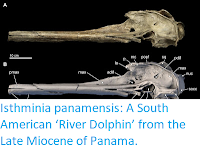
Isthminia panamensis: A South American ‘River Dolphin’ from the Late Miocene of Panama.


There are four species of River Dolphins known today; Inia geoffrensis and Pontoporia blainvillei from South America, Platanista gangetica from South Asia and the probably extinct Lipotes vexillifer from China (Lipotes vexillifer, the Yangtze River Dolphin, is considered Critically Endangered under the terms of the International Union for the Conservation of Nature's Red List of Threatened Species, as there were less than 50 adult individuals surviving when the species was last assessed in 2003, all living within a few hundred kilometers of one-another on a single river). These were formerly thought to comprise a single group, but are now thought to represent three distinct lineages that separately invaded freshwater environments from the sea. The fossil record of the Asian River Dolphins is poor, but the South American River Dolphins, Inioidea, have a fairly good fossil record, with freshwater fossils known from a number of sites in South America, and older marine specimens from South America, North America and Europe.

In a paper published in the journal Peer J on 1 September 2015, Nicholas Pyenson of the Department of Paleobiology at the National Museum of Natural History and the Departments of Mammalogy and Paleontology at the Burke Museum of Natural History and Culture, Jorge Vélez-Juarbe of the Department of Mammalogy at the Natural History Museum of Los Angeles County and the Florida Museum of Natural History at the University of Florida, Carolina Gutstein of the Department of Paleobiology at the National Museum of Natural History and the Comisión de Patrimonio Natural at the Consejo de Monumentos Nacionales, Holly Little, also of the Department of Paleobiology at the National Museum of Natural History, and Dioselina Vigil and Aaron O’Dea of the Smithsonian Tropical Research Institute, describe a new species of South American ‘River Dolphin’ from the Late Miocene Chagres Formation on the Caribbean coast of Panama.

The new species is named Isthminia panamensis, where ‘Isthminia’ means ‘isthmus-Inia’ a reference to the similarity between the fossil, which was found on the Isthmus of Panama, and the living Inia geoffrensis and ‘panamensis’ means ‘from Panama’. It is described from an almost complete skull, a complete set of mandibles (lower jaws) and an incomplete right scapula and two carpals. The specimen is estimated to be between 5.8 and 6.1 million years old.

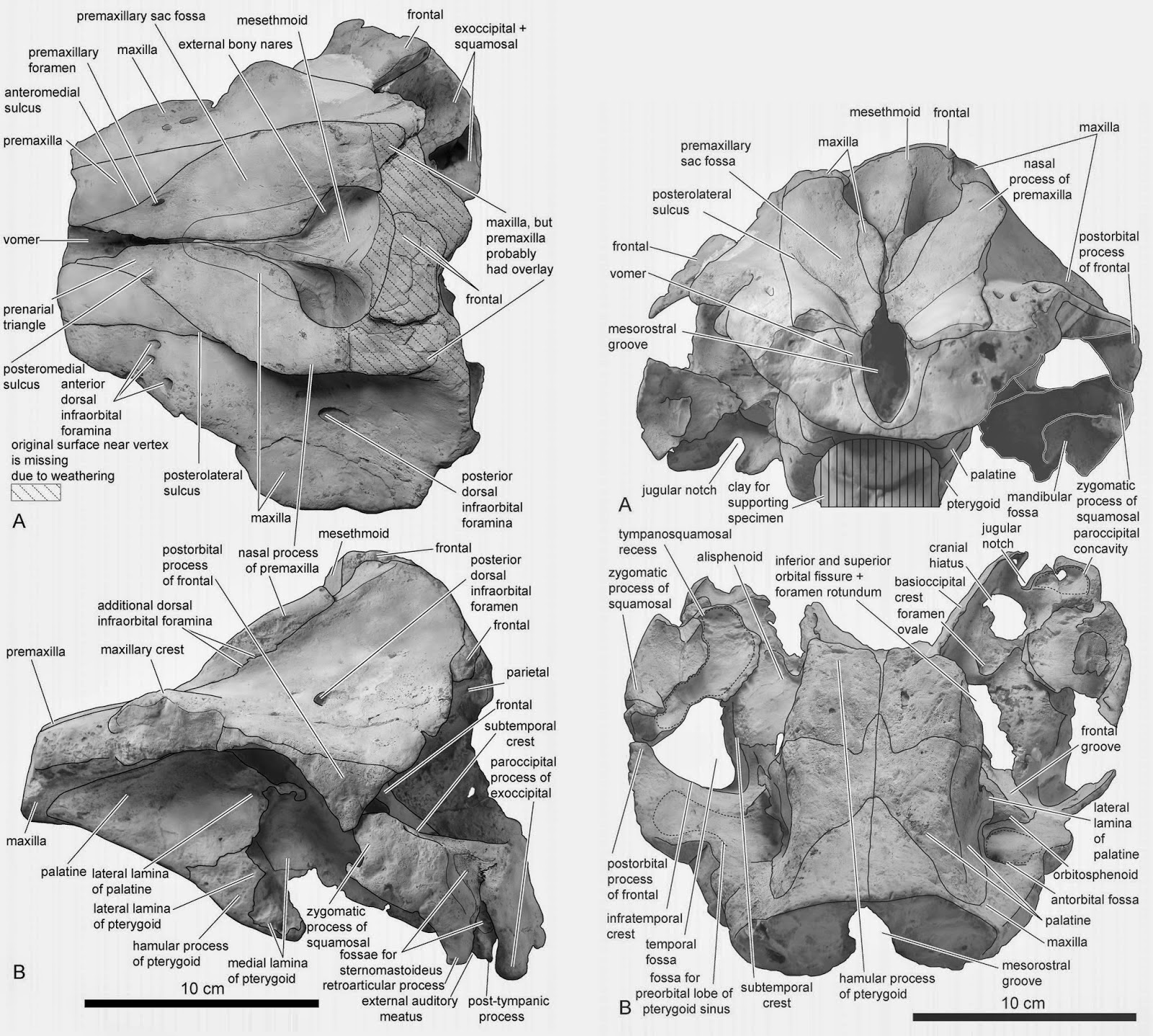
Skull in dorsal, anterior, and posterior views. Dorsal views of the skull of Isthminia panamensis from (A) photographs and (B) orthogonal digital three-dimensional polygon model prepared from CT data, with lighting and colour modifications using the Smithsonian X 3D browser. (C) Anterior and (D) posterior views of the skull of Isthminia panamensis from orthogonal digital three-dimensional polygon model prepared from CT data. Anatomical Abbreviations: adif, anterior dorsal infraorbital foramen; alis, alisphenoid; fr, frontal; gf, glenoid fossa of squamosal; ju, jugal; la, lacrimal; max, maxilla; mc, maxillary crest; me, mesethmoid; na, nasal; nar, bony narial opening or naris; nuc, nuchal crest; pa, parietal; pdif, posterior dorsal infraorbital foramen; pmax, premaxilla; popf, postorbital process of the frontal; socc, supraoccipital; sopf, supraorbital process of frontal; smf, suprameatal fossa; sq, squamosal; zpsq, zygomatic process of squamosal. Pyenson et al. (2015).

Isthminia panamensis is estimated to have been about 285 cm long in life, making it large for a Inioid, though not the largest species known. It has an extremely long snout compared to the skull, though this is typical for an Inioid, being one of the more obvious distinguishing features of the group. It had 15 teeth on each side of its upper jaw and 18 teeth on each side of its lower jaw; most of these teeth are straight and lack wear facets, though the canines and premolars curve backwards slightly, and some of these do show wear.

Mandibles in ventral and lateral views. Ventral views of the mandibles of Isthminia panamensis from (A) photographs and (B) orthogonal digital three-dimensional polygon model prepared from CT data, with lighting and colour modifications using the Smithsonian X 3D browser. (C) Left lateral and (D) right lateral views of the mandibles of Isthminia panamensis from orthogonal digital three-dimensional polygon model prepared from CT data. Anatomical Abbreviations: ap, angular process of mandible; cp, coronoid process of mandible; mef, mental foramen or foramina; ms, mandibular symphysis. Pyenson et al. (2015).

Isthminia panamensis shows a number of morphological traits more consistent with a fully marine lifestyle than a freshwater one, and the Chagres Formation is interpreted as having been an open water marine environment not close to any estuary or riverine environment. This is interesting as, while marine Inioids are well known in the fossil record, the majority of these are thought to have lived before the group invaded freshwater environments, or at to have descended from members of this group that diverged from the true ‘River Dolphins’ before this invasion. Isthminia panamensis appears to have been more closely related to the living River Dolphin Inia geoffrensis than the other South American River Dolphin species, Pontoporia blainvillei. This has implications for the history of the Inioids as a group, as it implies that either the ancestors of Inia geoffrensis and Pontoporia blainvillei invaded freshwater environments separately, or that the ancestors of Isthminia panamensis moved from a marine environment to a freshwater environment and back again. Either of which scenarios undermines the simple view of a single transition from one habitat to another by a group which gave rise to all later River Dolphins in South America, and suggests a more complex history for the group.

Reconstruction of Isthminia. Life reconstruction of Isthminia panamensis, feeding on a Flatfish, which would have been abundant in the neritic zone of the late Miocene equatorial seas of Panama. Julia Molnar in Pyenson et al. (2015).

See also…

A fossil Porpoise from the Early Pliocene of Antwerp Harbour.
Porpoises, Phocoenidae, are small Dolphins, Delphinida, found today across most of the world’s oceans, but with a fossil record restricted almost entirely to the North Pacific. Only a single fossil species from outside the Pacific Basin has been described,Septemtriocetus bosselaersi from Pliocene sediments at Verrebroek Dock in Antwerp...


A fossil Dolphin from the Late Miocene of Hokkaido, Japan, which may be the oldest True Dolphin.
Dolphins, Delphinidae, are the most diverse group of Whales (or indeed any form of Marine Mammals) alive today, with 36 described species including charismatic animals such as Bottlenose Dolphins and Killer Whales. Historically a large number of fossils have also been...


A new species of Dolphin from the Early Miocene of Peru.
The Squalodelphinidae are a small group of small to medium-sized Toothed Whales known from the Miocene of Europe and North...


Follow Sciency Thoughts on Facebook.

Wednesday, 28 January 2015

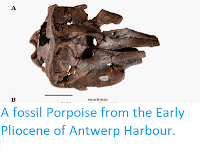
A fossil Porpoise from the Early Pliocene of Antwerp Harbour.


Porpoises, Phocoenidae, are small Dolphins, Delphinida, found today across most of the world’s oceans, but with a fossil record restricted almost entirely to the North Pacific. Only a single fossil species from outside the Pacific Basin has been described, Septemtriocetus bosselaersi from Pliocene sediments at Verrebroek Dock in Antwerp Harbour, Belgium, with a few isolated bones tentatively assigned to the group from the Miocene of Malta and the Pliocene of Italy.

In a forthcoming paper in the journal Acta Palaeontologica Polonica available online from 14 December 2014, Wouter Colpaert of the Research UnitPalaeontology at the Universiteit Gent and Mark Bosselaers and Olivier Lambert of the Department of Terre et Histoire de la Vie at the Institut royal desSciences naturelles de Belgique, describe a second species of fossil Porpoise from Antwerp Harbour, collected from the slightly earlier Kattendijk Formation on the left bank of the River Scheldt at the entrance of the Beveren Tunnel.

The specimen was collected in several fragments by Robert Marquet, a volunteer palaeontologist at the Institut Royal des Sciences Naturelles de Belgique. It is named Brabocetus gigasei, where ‘Brabocetus’ means ‘Brabo’s Whale’, in reference to SilviusBrabo, the mythical hero who liberated the city of Antwerp from the giant Antigoon, and ‘gigasei’ honours Paul and Pierre Gigase, a father and son fossil collecting team who have for many years collected marine Mammal remains from the Antwerp area, and who donated the specimen to the Institut royal des Sciences naturelles de Belgique.

The specimen comprises a partial skull in three parts, lacking the tip of the snout as well as the the nasals, the pterygoids, and some elements of the cerebral cavity and basicranium as well as part of the left supraorbital process. The snout appears to have been more elongate than any extant Porpoise but similar to that seen in Septemtriocetus bosselaersi as well as in some other extinct Porpoises (Lomacetus, Piscolithax and probably Salumiphocaena), however unlike in these species (which are not all closely related) the snout in the two Belgian species is shorter than the cranium. However Colpaert et al. note that this analysis is based upon a reconstruction of the missing parts of the skull, and cannot be considered reliable without additional material being found.

Skull of Brabocetus gigasei,from the Pliocene of northern Belgium, in dorsal view.Photo (A) and corresponding line drawing (B). Dotted lines indicate reconstructed parts and poorly visible structures. Dark grey surfaces indicate fracture surfaces. Light grey surface indicates the original position of the lost right nasal. Scale bar is 50 mm. Colpaert et al. (2014).

A phylogenetic reconstruction of known members of the Phocoenidae suggests that while Brabocetus gigaseiis closely related to Septemtriocetus bosselaersi, both being members of an extinct group of Porpoises which also includes several Pacific species, it is not the closest relative of that species, which is more closely related to five North Pacific species than it is to the new member of the group. It is not closely related to the modern Harbour Porpoise, Phocoena phocoena, the only modern Porpoise found in the North Sea.

Consensus tree of the 27 most parsimonious trees, showing the phylogenetic relationships of Brabocetus gigasei with other extinct and extant Phocoenids. † indicates extinct taxon. IO, Indian Ocean; NA, North Atlantic; NP, North Pacific; NS, North Sea; SA, South Atlantic; SO, southern oceans; SP, South Pacific; 1, 1', and 1'' correspond to a first trans-Arctic migration scenario with three successive dispersals to the North Sea. 2, 2', and 2'' correspond to a second scenario with two dispersals to the North Sea (2, 2'') and a dispersal back to the North Pacific (2'). Colpaert et al. (2014).

This leads to two possible evolutionary scenarios, each of which are considered equally likely. Either Brabocetus gigasei and Septemtriocetus bosselaersi (or close ancestors of these species) migrated from the North Pacific to the North Sea via the Arctic Ocean separately, or the common ancestor of these two species made a similar migration, with the common ancestor of the more derived members of the group subsequently migrating back to the North Pacific.

The modern Phocoena phocoena is thought to have reached the North Sea much later, part of a recent global expansion which saw members of the group migrate from the North Pacific across the world’s oceans, and which coincides with a similar global expansion of other Dolphin groups.

See also…

http://sciencythoughts.blogspot.co.uk/2014/10/a-fossil-dolphin-from-late-miocene-of.htmlA fossil Dolphin from the Late Miocene of Hokkaido, Japan, which may be the oldest True Dolphin.                                                              Dolphins, Delphinidae, are the most diverse group of Whales (or indeed any form of Marine Mammals) alive today, with 36 described species including charismatic animals such as Bottlenose Dolphins and Killer Whales. Historically a large number of fossils have also been...

The Squalodelphinidae are a small group of small to medium-sized Toothed Whales known from the Miocene of Europe and North and South America. They are thought to be related to the modern Asian River Dolphin, Platanista gangetica, which lacks any close living relatives. The group is not well understood, with most described specimens being fragmentary in nature.
Porpoises (Phocoenidae) are small Whales, related to Dolphins (Delphinidae). They tend to have shorter snouts than Dolphins, with flattened, spade-shaped teeth, as opposed to the conical, pointed teeth of Dolphins. They are among the smallest and shortest lived Whales, ranging from 1.2 to 2.3 m in length and typically reaching sexual maturity at about eight...


Follow Sciency Thoughts on Facebook.

Tuesday, 21 October 2014

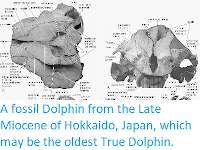
A fossil Dolphin from the Late Miocene of Hokkaido, Japan, which may be the oldest True Dolphin.


Dolphins, Delphinidae, are the most diverse group of Whales (or indeed any form of Marine Mammals) alive today, with 36 described species including charismatic animals such as Bottlenose Dolphins and Killer Whales. Historically a large number of fossils have also been assigned to this group, but the vast majority of these are no longer considered to be True Dolphins. Twelve fossil Dolphin species are currently widely accepted, all from the Pliocene or later and the majority from Italy. The oldest known True Dolphin is thought to be an undescribed specimen from the Late Miocene of California (LACM 52147), though this specimen lacks a head so its precise classification is hard to determine.

In 1977 palaeonotologist Hideo Horikawa described a fossil Dolphin from the Late Miocene Mashike Formation of Hokkaido Island, Japan, however this description was published in Japanese, and has received little attention outside Japan. Horikawa placed the specimen in the extant genus Stenella, giving it the specific name kabatensis. However the original description apparently contains a number of inaccuracies, and the genus Stenella has recently been shown to be polyphyletic (i.e. the five living species placed within the genus are not one-another’s closest relatives) by a genetic analysis, which is likely to lead to the reassignment of a number of Dolphin species in the near future.

In a paper published in the Journal of Vertebrate Palaeontology on 6 May 2014, Mizuki Marakami of the Graduate School of Creative Science & Engineering at Waseda University, Chieko Shimada of the Mineral Industry Museum at Akita University and the Geological Survey of Japan, Yoshinori Hikida of the Nakagawa Museum of Natural History, Yuhji Soeda of the Historical Museum of Hokkaido and Hiromichi Hirano of the Department of Earth Science at Waseda University redescribe Stenella kabatensisas Eodelphis kabatensis (Eodelphis meaning ‘Dawn-Dolphin’).

The specimen comprises a partial skull lacking the rostrum (snout) but having both mandibles and a number of teeth. Marakami et al. feel confident assigning this specimen to the Delphinidae, making it the oldest known member of the group. The specimen is at least 7.6 million years old, and probably between 8.5 and 13 million years old, though Marakami et al. suggest dates older than 9 million years are less likely.

The skull of Eodelphis kabatensis. Photograph of the skull whitened with ammonium chloride. (Top left) Dorsal view, (bottom left) left lateral view, (top right) anterior view, (bottom right) antereoventral view. Marakami et al. (2014).

A phylogenetic analysis suggested that Eodelphis kabatensisis more closely related to the living Orcinas orca (Killer Whale) than any other extant Dolphin, rather than being close to the common ancestor of all Dolphins. This supports previous molecular studies, which suggests that the group diversified earlier in the Miocene.

See also…

The Squalodelphinidae are a small group of small to medium-sized Toothed Whales known from the Miocene of Europe and North and South America. They are thought to be related to the modern Asian River Dolphin, Platanista gangetica, which lacks any close living relatives. The group is not well understood, with most described specimens being fragmentary in nature.


Porpoises (Phocoenidae) are small Whales, related to Dolphins (Delphinidae). They tend to have shorter snouts than Dolphins, with flattened, spade-shaped teeth, as opposed to the conical, pointed teeth of Dolphins. They are among the smallest and shortest lived Whales, ranging from 1.2 to 2.3 m in length and typically reaching sexual maturity at about eight...

Bottlenose Dolphins (Tursiops truncatus) are predatory Ceteceans, which primarily hunt small Fish. They are intelligent, social animals...


Follow Sciency Thoughts on Facebook.

Tuesday, 7 October 2014

A new species of Dolphin from the Early Miocene of Peru.


The Squalodelphinidae are a small group of small to medium-sized Toothed Whales known from the Miocene of Europe and North and South America. They are thought to be related to the modern Asian River Dolphin, Platanista gangetica, which lacks any close living relatives. The group is not well understood, with most described specimens being fragmentary in nature.

In a paper published in the Journal of Vertebrate Paleontology on 9 September 2014, Oliver Lambert of the Institut royal des Sciences naturelles deBelgique, Giovanni Bianucci of the Dipartimentodi Scienzedella Terra at the Università di Pisa and Mario Urbina of the Departamentode Paleontología de Vertebrados at the Museode Historia Natural in Lima, describe a new species of Squalodelphinid from three skulls and some fragmentary post-cranial material from the Chilcatay Formation in the Pisco-Ica Basin in southwest Peru.

The new species is named Huaridelphis raimondii, where ‘Hauri’ refers to the ancient Hauri people of the south-central Andes and coastal Peru, ‘delphis’ is Latin for Dolphin and ‘raimondii’ honours Antonio Raimondi (1826–1890), who first described fossil Whale remains in Peru.

Huaridelphis raimondii, skull in ventral (A, B), posterior (C), anterior (D), and right lateral (E, F) views. Diagonal solid lines indicate major breaks. Lambert et al. (2014).

See also…

http://sciencythoughts.blogspot.co.uk/2013/09/a-fossil-porpoise-from-early-pliocene.html A fossil Porpoise from the early Pliocene of northern Hokkaido Island, Japan.            Porpoises (Phocoenidae) are small Whales, related to Dolphins (Delphinidae). They tend to have shorter snouts than Dolphins, with flattened, spade-shaped teeth, as opposed to the conical, pointed teeth of Dolphins. They are among the smallest and shortest lived Whales, ranging from 1.2 to 2.3 m in length and typically reaching sexual maturity at about eight...

http://sciencythoughts.blogspot.co.uk/2013/08/a-fossil-neobalaenine-whale-from-late.html A fossil Neobalaenine Whale from the Late Miocene of Argentina.                                         The Pygmy Right Whale (Caperea marginata) is not considered to be closely related to other Baleen Whales, though it's precise affinities have alluded taxonomists for some time. It has been suggested that it is related to true Right Whales (Balaenidae), Rorquals and Grey Whales (Balaenopteroidea) and the extinct Cetotheres. At the moment it is generally place in its own family, the Neobalaenidae.

Follow Sciency Thoughts on Facebook.

Thursday, 19 September 2013

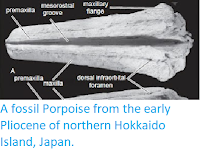
A fossil Porpoise from the early Pliocene of northern Hokkaido Island, Japan.

Porpoises (Phocoenidae) are small Whales, related to Dolphins (Delphinidae). They tend to have shorter snouts than Dolphins, with flattened, spade-shaped teeth, as opposed to the conical, pointed teeth of Dolphins. They are among the smallest and shortest lived Whales, ranging from 1.2 to 2.3 m in length and typically reaching sexual maturity at about eight years, with some species doing this as young as six. The group has a fairly good fossil record and appear to have divulged from Dolphins in the early Miocene, around 15 million years ago.

In a forthcoming paper in the journal Acta Palaeontologica Polonica, available online since 16 August 2013, Mizuki Murakami of the Graduate School of Creative Science & Engineering at Waseda University, Chieko Shimada of the Mineral Industry Museum at Akita University, Yoshinori Hikida of the Nakagawa Museum of Natural History and Hiromichi Hirano of the Department of Earth Sciences at the Faculty of Education and Integrated Arts and Sciences at Waseda University, describe a fossil Porpoise from the Lower Pliocene Koetoi Formation of Tempoku Basin of northern Hokkaido.

The specimen is described from a premaxilla, maxilla, the anteriormost portions of the palatines, a partial mandible, two isolated teeth, seven cervical vertebrae, eight thoracic vertebrae, three lumbar vertebrae and at least eight ribs. It is not assigned to a species because of its fragmentary nature, but shows some interesting traits.

The rostrum of the new Porpoise in (A) dorsal, (B) lateral, (C) ventral and (D) anterior views, and the mandible in (E) lateral and (F) dorsal views. Murakami et al. (2013).

Most notably the specimen is considered to be a sexually mature animal aged about four years. This is younger than maturity is reached in any modern Porpoise, suggesting that the evolutionary history of Porpoises has been more complex than simply Whales getting smaller and maturing earlier.

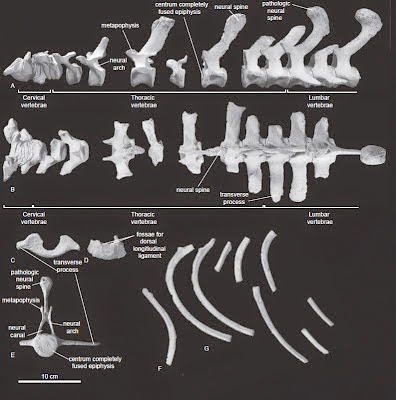
Vertebrae (A-E) and ribs (F, G) of the porpoise. Murakami et al. (2013).

See also A fossil Neobalaenine Whale from the Late Miocene of ArgentinaA Baleen Whale from the Late Miocene of southern UkraineChoking on Fish is a significant cause of death for Dolphins in Indian River Lagoon, FloridaGenetic diversity in Grey Whales and Bowhead Whales in the Northwest Passage.

Follow Sciency Thoughts on Facebook.

Saturday, 29 June 2013

Choking on Fish is a significant cause of death for Dolphins in Indian River Lagoon, Florida.


Bottlenose Dolphins (Tursiops truncatus) are predatory Ceteceans, which primarily hunt small Fish. They are intelligent, social animals, which hunt in packs and are capable of developing new hunting methods to deal with novel prey items.

In a study published in a paper in the journal PLoS One on 19 June 2013, a group of scientists led by Megan Stolen of the Hubbs-SeaWorld Research Institute looked at causes of death among stranded Dolphins in the Indian River Lagoon and adjacent areas of the Atlantic Ocean over a 14 year period from 1997 to 2011. During this period they found that 14 of 350 Dolphin deaths in the lagoon were a direct result of choking on fish (4% of the total), while none of the 186 dead Dolphins recovered from the open ocean had died in this way. Dolphins that have died in this way have been found before, but this is extremely rare; of 19 recorded cases of Dolphins choking on Fish known globally, 14 are from this location and discussed in this study. 

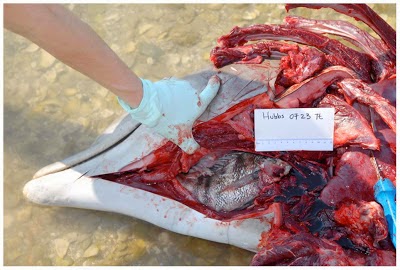
The body of a Bottlenose Dolphin with a Fish lodged in its esophagus. In this case the Fish is a Sheepshead (Archosargus probatocephalus). Stolen et al. (2013).

In all cases the Fish were lodged in the esophagus of the Dolphins, compressing or displacing the larynx, and preventing the Dolphins from breathing. In five cases the Fish were found with their tales still protruding from the Dolphin's mouth. In seven cases the Fish were held in place close to the larynx by strong dorsal spines. Eight of the Dolphins were male, two Female and one to badly decomposed to be identified. Twelve of the Dolphins were adults, two juveniles.

In five of the cases the Fish were associated with fishing tackle; two of the Fish had lures attached, and one Fish had a line attached with hooks that had become embedded in the Dolphin's esophagus. In the remaining two cases lines and lures were present, but not attached to the fish, making it hard to say with confidence that they had come from this Fish which had killed the Dolphin.

All the fish were between 19 and 40 cm in length; well within the normal range of Fish consumed by Bottlenose Dolphins. Eight of the fish could be identified to specific level; six Sheepshead (Archosargus probatocephalus), one Black Chin Tilapia (Sarotherodon melanotheron) and one striped mojarra (Diapterus plumieri). Two other fish were tentatively identified as Tilapia (Cichlidae) and one as a Jack (Carangidae).

Sheepshead are a common Fish on the southern Atlantic and Gulf coasts of the US, but are not normally considered an important prey item for Dolphins. They are spiny members of the Perch order (Perciformes) and have a deeper body profile than the Fish usually favored by Dolphins, suggesting that they are a rather risky prey item, which Dolphins would normally avoid. Why the Dolphins of Indian River Lagoon are targeting this Fish is unclear.

The Sheepshead (Archosargus probatocephalus), a deep-bodied, spiny, Perciform Fish. Wikimedia Commons/Bulletin of the United States Fish Commission.

Tilapia (which are also Perciformes) are not native to Florida, but have been introduced via Fish farms and are becoming increasingly common in the lagoons. They are similar in shape to familiar prey Fish, but again have prominent spines which may facilitate them becoming lodged in the throats of Dolphins.

The Black Chin Tilapia (Sarotherodon melanotheron), a spiny non-native Fish. Jacques Panfili/Fishbase.

The precise reason for the high number of choking mortalities among Dolphins in Indian River Lagoon cannot be stated with confidence. One case could clearly be attributed to fishing tackle associated with the Fish, and in four other cases tackle was present but could not be established as the cause of death. Three Dolphins died as a result of consuming an unfamiliar, introduced fish, but far more died after consuming native Fish that Dolphins usually avoid; the reason for this change in feeding behavior is not clear.


Follow Sciency Thoughts on Facebook.