Showing posts with label Epiphytes. Show all posts

Tuesday, 12 August 2025

Didymoglossum radiatum: A new species of creeping Fern from Thailand.

The genus Didymoglossum comprises about 30 species of small, generally tropical Ferns growing as epiphytes (i.e. on other Plants) or epiliths (on rocks). Roughly half of the described species come from the Old World, with eight species from tropical Asia. Five species of Didymoglossum are known from India, five from China, one from Vietnam, four from the Solomon Islands, and six from Malesia (Malaysia, Brunei, the Philippines, and western Indonesia). These Ferns, and possibly other, undescribed species, are likely to also be found in the nations between these documented areas, though as yet few, if any, studies have been carried out in these countries.

In a paper published in the journal PhytoKeys on 6 August 2025, Siwakorn Chokrassameehirun of the Department of Horticulture at Kasetsart University, Ekaphan Kraichak of the Department of Botany and Biodiversity Center at Kasetsart University, and Tassanai Jaruwattanaphan, also of the Department of Horticulture and Biodiversity Center at Kasetsart University, present a study of the genus Didymoglossum in which they describe a new species, as well as documenting other species in the country for the first time.

The new species is described from specimens collected in Hala–Bala Wildlife Sanctuary in Waeng District in the far south of Peninsula Thailand, close to the border with Malaysia. The species is named Didymoglossum radiatum, in reference to the false veinlets on the fronds of the Fern, which form a radiating pattern. 

Didymoglossum radiatum. (A) Habit; (B) Raised sori of fertile Plants; (C) Adaxial surface of sterile fronds; (D) Abaxial surface of sterile fronds; (E) False veinlet construction; (F) Sori. Siwakorn Chokrassameehirun in Chokrassameehirun et al. (2025).

Didymoglossum radiatum can be epiphytic or epilithic in nature, with a long, creeping rhizome 0.2-0.3 mm in diameter firmly anchored to the surface over which it grows by numerous dark brown hairs. It produces plate-like fronds 1.0-1.5 mm in diameter, with dense brown hairs around the rims. Each frond typically bears a single sori (spore-producing body).

Illustration of Didymoglossum radiatum. (A) Fertile frond; (B) Sterile fronds; (C) False veinlet construction; (D)–(E) Sori with tubular involucres; (D) Sori with filiform receptacle; (E) Sori borne at the notch of the frond. Siwakorn Chokrassameehirun in Chokrassameehirun et al. (2025).

Chokrassameehirun et al. also record the presence of two species of Didymoglossum in Thailand for the first time. 

The first of these is Didymoglossum henzaianum, a species which grows on rocks close to streams, which was first described from Myanmar in 2014, and which has subsequently been reported in India, Vietnam, and Peninsula Malaysia. Chokrassameehirun et al. found specimens of this species in Phu Ruea District in Loei Province, in the north of the Country.

Didymoglossum henzaianum. (A) Habit; (B) Fertile plants; (C) False veinlets on lamina segment; (D) Sori with obconic–tubular involucres. Siwakorn Chokrassameehirun in Chokrassameehirun et al. (2025).

The second new report is of Didymoglossum mindorense, a species described in the Philippines in 2006, and subsequently reported from Borneo, New Guinea, the Solomon Islands, and Queensland. Didymoglossum mindorense is found at low elevations, and typically close to streams. It is usually found growing around the bases of trees, but will sometimes colonise rocks. Chokrassameehirun et al. reporr specimens of this species in Hala–Bala Wildlife Sanctuary and the area around it.

Didymoglossum mindorense. (A) Habit; (B) Fertile fronds; (C) Lobe of sterile frond; (D) Fertile frond. Siwakorn Chokrassameehirun in Chokrassameehirun et al. (2025).

See also...

Wednesday, 21 December 2022

Deamia funis: A new species of epiphytic Cactus from Nicaragua.

The genus Deamia currently contains three species of climbing and epiphytic Cacti from Central America and Mexico. These Cacti show determinate growth (i.e. flowers are produced on the tips of the main stems), have stems covered by a thick, waxy coating, and produce spines on their flowers. Their fruit are red with a white pulp.

In a paper published in the journal Phytotaxa on 20 December 2022, Barry Hammel of the Missouri Botanical Garden and Salvador Arias of the Jardín Botánico at the Universidad Nacional Autónoma de México, describe a new species of Deamia from the Atlantic dry forests of Nicaragua.

The new species is named Deamia funis, in reference to the long, dangling, rope-like stems common in this species when found  growing on horizontal branches of trees ('funis' is Latin for 'rope'). It is a root-climbing or trailing epiphyte, with strait, cylindrical, usually pendulous (dangling) stems up to 10 m long and 0.6-1.1 cm in diameter.

Deamia funis, vegetative characters. (A)–(C) Habitat and habit. (D) Close-up of stem showing cracks in epidermal wax. Olga Martha Montiel in Hammel & Arias (2022).

The flowers of Deamia funis are produced in the local dry season (January to April). These are funnel shaped structures at the tips of the stem, 8-10 cm long, with at green outer pericarpel with numerous areoles (spine clusters) producing hair-like spines. The flowers open at night, revealing a white interior. Curiously, the stigma (pollen-receptive part of the female sex organs) of Deamia funis project beyond the anthers (pollen producing male organs), an unusual state in Cacti.

Deamia funis, reproductive characters (A) Side-view of flower on specimen. (B) Side-view of flower in life. (C) Front-view of flower in life (arrow at stigma). (D) Close-up of base of flower in life. (E) Submature fruit, in life. Barry Hammel, Olga Martha Montiel, & Claudia Lucía Chamorro in Hammel & Arias (2022).

Deamia funis has only been observed growing at elevations of between 322 and 423 m above sealevel in the fog-zones of dry, seasonal forests on the Atlantic watershed of central Nicaragua, although Hammel and Arias note that this ecosystem extends into neighbouring Honduras, and the species could potentially live there also. All three areas where the species has been seen growing are outside of protected zones, and the total distribution of the species probably covers less than 5000 km². Furthermore, all of this habitat is considered to be at risk from the expansion of Cattle ranching in the area, for which reasons Hammel and Arias consider that Deamia funis should be considered to be Endangered under the terms of the International Union for the Conservation of Nature's Red List of Threatened Species.

See also...

Follow Sciency Thoughts on Facebook.

Follow Sciency Thoughts on Twitter.


Saturday, 12 February 2022

Bulbophyllum mamasaense: A new species of Epidendroid Orchid from Sulawesi.

Epidendroid Orchids, Epidendroideae, are the largest subfamily of Orchids, with over 15 000 described species, more than all other Orchid groups combined. The majority of these species are epiphytic (live on other plants, typically in the canopy of rainforest trees), though terrestrial forms are known. The group is found across the globe, with the exception of the polar regions, the deserts of Africa, Arabia and Australia, and the southern part of South America. The genus Bulbophyllum contains around 2200 described species from tropical regions around the world, including about 1600 species from Asia, and is thought likely to contain many more undescribed species. Members of the genus can be very difficult to tell apart when they are not in flower, as their vegetative parts tend to be much reduced, often with only a single leaf emerging from a pseudobulb (a pseudobulb, like a bulb, is an enlarged stem base used as a food store by a plant during dormant periods, but unlike a bulb is not found in the soil).

In a paper published in the journal Taiwania on 10 January 2022, Aninda Retno Utami Wibowo of the Bali Botanic Garden of the Indonesian National Research and Innovation Agency, Jeffrey Champion of the Herbarium Bogoriense of the Indonesian National Research and Innovation Agency, and Lina Susanti Juswara of Candikuning, Bali, describe a new species of Bulbophyllum from Sulawesi.

The new species is named Bulbophyllum mamasaense, where 'mamasaense' means 'from Mamasa' in reference to the Mamasa Regency of West Sulawesi Province, where the species was discovered. Only a single wild population of the species has been discovered, in Mesawa District of Mamasa Regency, but the species appears to do well in cultivation, and has been traded commercially for some years.

 
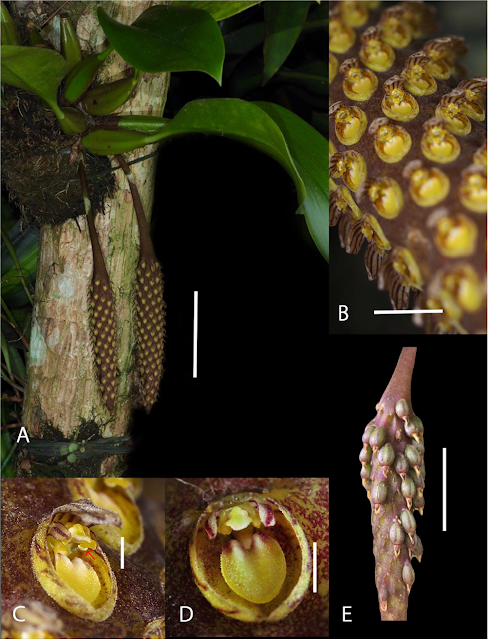
Photographs of Bulbophyllum mamasaense. (A) Habit, (B) flowers on rachis, (C) flower, oblique view, stelidia indicated with the red arrow, (D) flower, top view after median sepal removal, (E) fruits. Scale bars: (A) 10 cm; (B) 5 mm; (C) and (D) are 1 mm; (E) is 5 mm. Jeffrey Champion and Aninda Retno Utami Wibowo in Wibowo et al. (2022).

Bulbophyllum mamasaense produces three distinct, closely arranged, ovate–oblong pseudobulbs (storage organs derived from a thickening of the part of a stem between leaf nodes) from a creeping rhizome, with smooth, wiry roots spreading below the pseudobulbs, and oblong leaves, 16-16.5 cm long and 5.3-5.5 cm wide above. Flowers are born on pendulous inflorescences arising from the base side of the pseudobulb. Each inflorescence can bear up to 165 flowers, densely packed in eight rows, which open similtaneously.

 
Illustration of Bulbophyllum mamasaense. (A) Habit, (B) leaf, (C) inflorescence, (D) flower, oblique view, (E) flower, top view after median sepal removed, (F) column and lip, (G) flower bract, (H) dorsal sepal, (I) lateral sepals, (J) petal, (K) lip, (L) lip, flattened, (M) lip, oblique view showing canal, (N) column, ventral view, (O) anther cap, ventral view, (P) Pollinia in pairs. Scale bars: (A) 5 cm; (B) 5 cm; (C) 2 cm; (D), (E), (F) 5 mm; (G) 1 mm; (H) 2 mm; (I) 5 mm; (J), (K), (L), (M), (N) 2 mm; (O) 1 mm; (P) 0.2 mm. Aninda Retno Utami Wibowo in Wibowo et al. (2022).

See also...


Follow Sciency Thoughts on Facebook.

Follow Sciency Thoughts on Twitter.


Wednesday, 2 February 2022

Grammitis azorica: New records of a Critically Endangeres Fern from the Azores.

Ferns of the genus Grammitis are typically small epiphytes (Plants that grow on other Plants) with wide, tropical distributions. However, one species, Grammitis azorica, is an island endemic, with a very limited distribution within the subtropical Azores Islands. The species was first described in 2001, when 22 specimens were found growing on the trunks of Azores Juniper Trees, Juniperus brevifolia, in a montane forest on the island of Flores. Despite extensive searches, no further specimens were found in over a decade, and in 2017 the species was listed as Critically Endangered under the terms of the International Union for the Conservation of Nature’s Red List of Threatened Species. 

In a paper published in the Biodiversity Data Journal on 28 January 2022, Rui Bento Elias and Fernando Pereira of the Azorean Biodiversity Group of the Centre for Ecology, Evolution and Environmental Changes, and the Faculdade de Ciências Agrárias e do Ambiente at the Universidade dos Açores report the presence of Grammitis azorica on two further islands within the Azores.

Grammitis azorica is a very small species, with fronds reaching about 60 mm in length, which mainly grows on the trunks of Juniper trees. Its fronds are oval, without partitions, and have a black margin and large, globose sori (spore-producing bodies) on their undersides. 

 
Fertile frond of Grammitis azorica with large sori. Rui Bento Elias in Elias & Pereira (2022).

Although Grammitis azorica has only been recorded on the island of Flores, in 1987 botanist Alfred Hanson described a small, epiphytic Fern with black margins to its fronds on Pico Island. Hansen provisionally assigned these Ferns to Grammitis ebenina, a species otherwise restricted to Central Africa and Atlantic islands close to the equator. This diagnosis now seems unlikely, making it possible that this represents another population of Grammitis azorica.

In 2013 Elias and Pereira discovered two specimens of Grammitis azorica on Terceira Island, although they did not publish these findings at the time. These specimens were in two separate Natural Reserves, separated by about 3 km, the Biscoito da Ferraria e Pico Alto and Terra Brava e Criação das Lagoas, and both were growing on the trunks of Juniper trees in Juniper-Holly montane forests. 

Juniperus-Ilex montane forest in Terra Brava (Terceira Island). Rui Bento Elias in Elias & Pereira (2022).

In 2021, during an expedition to Pico Island, Elias and Pereira discovered two further specimens of Grammitis azorica, one in a protected landscape area neighbouring the Pico Mountain Natural Reserve, and the other 19 km to the east, in Caveiro Natural Reserve. Both these new plants were growing on the trunks of Juniper trees in mixed Juniper-Holly montane forests. 

Grammitis azorica in Caveiro (Pico Island). Rui Bento Elias in Elias & Pereira (2022).

The discovery of four new specimens of the Critically Endangered Grammitis azorica on two different islands emphasises the importance of the Juniper-Holly montane forests of the Azores as a biodiversity hotspot. The new records extend the known range of the species from one island to three, and the altitudinal tolerance from 650-800 m to 640-1130 m, although it is restricted to a single biome, and that biome is generally restricted to 600-1000 m. Botanists have been searching for new members of this species for many years, with only four new specimens found, which emphasises both the rarity of the species, and the importance of the Lomba do Fogo forest, where one of the new specimens was found; this forest is currently part of the Pico Natural Park, which is protected, but only to a low level, but close to the Pico Mountain Natural Reserve, which is more highly protected; Elias and Periera suggest that the Lombo de Fogo be transferred to the Pico Mountain Natural Reserve, thus significantly improving its conservation status. 

Elias and Periera further note that many of the montane forests of the Azores are hard to access, and are therefore relatively under-explored, raising the hope that further individuals or even populations of this Critically Endangered Fern will be discovered in the future. 

See also...


Follow Sciency Thoughts on Facebook.

Follow Sciency Thoughts on Twitter.


Wednesday, 9 October 2019

Pseuderia samarana: A new species of climbing Orchid from Samar Island in the Philippines.

Epidendroid Orchids, Epidendroideae, are the largest subfamily of Orchids, with over 15 000 described species, more than all other Orchid groups combined. The majority of these species are epiphytic (live on other plants, typically in the canopy of rainforest trees), though terrestrial forms are known. The group is found across the globe, with the exception of the polar regions, the deserts of Africa, Arabia and Australia, and the southern part of South America. The genus Pseuderia comprises about 20 species of climbing Epidendroid Orchids found in the Moluccas, Micronesia, the Solomon Islands, Fiji, and New Guinea, where the genus reaches its maximum diversity.

In a paper published in the journal Taiwania on 16 August 2019, Zhereeleen Meneses of the Institute of Biological Sciences at the University of the Philippines, and James Cootes of Woodbine in New South Wales, describe a new species of Pseuderia from Samar Island in the Philippines.

The new species is named Pseuderia samarana, in reference to the area where it was found. It is a climbing Orchid that starts as a seedling on the ground, climbs up a tree, and eventually becomes a true epiphyte, losing its original roots and stem and living entirely in the canopy. Pseuderia samarana has blade like leaves and yellow flowers with purple markings born in pairs on short peduncles emerging from the main stems.

Pseuderia samarana: Inflorescences bearing 2 flowers borne on short peduncles. Meneses & Coates (2019).

Pseuderia samarana was found climbing spindly trees on limestone hills in the municipality of Paranas. It was found only at a single location, which lies within the Samar Island Natural Park, which in theory gives it some protection. However, the area is known to have major deposits of copper and gold, and the species occupies a total area of only 0.166 km², with a total population of only 20-30 mature plants, for which reason Meneses and Coates consider the species to be Critically Endangered under the  terms of the International Union for the Conservation of Nature’s Red List of Threatened Species.

See also...

https://sciencythoughts.blogspot.com/2018/12/chiloschista-pulchella-new-species-of.htmlhttps://sciencythoughts.blogspot.com/2018/12/bulbophyllum-chrysolabium-new-species.html
https://sciencythoughts.blogspot.com/2018/08/odontochilus-putaoensis-new-species-of.htmlhttps://sciencythoughts.blogspot.com/2018/04/dendrobium-naungmungense-new-species-of.html
https://sciencythoughts.blogspot.com/2018/04/govenia-polychroma-new-species-of.htmlhttps://sciencythoughts.blogspot.com/2017/11/coelogyne-magnifica-new-species-of.html
Follow Sciency Thoughts on Facebook.

Saturday, 8 December 2018

Bulbophyllum chrysolabium: A new species of Epidendroid Orchid from Yunnan Province, China.

Epidendroid Orchids, Epidendroideae, are the largest subfamily of Orchids, with over 15 000 described species, more than all other Orchid groups combined. The majority of these species are epiphytic (live on other plants, typically in the canopy of rainforest trees), though terrestrial forms are known. The group is found across the globe, with the exception of the polar regions, the deserts of Africa, Arabia and Australia, and the southern part of South America. The genus Bulbophyllum contains around 2200 described species from tropical regions around the world, and is thought likely to contain many more undescribed species. Members of the genus can be very difficult to tell apart when they are not in flower, as their vegetative parts tend to be much reduced, often with only a single leaf emerging from a pseudobulb (a pseudobulb, like a bulb, is an enlarged stem base used as a food store by a plant during dormant periods, but unlike a bulb is not found in the soil).

In a paper published in the journal Phytokeys on 13 November 2018, Lin Li of the Key Laboratory of Plant Resources Conservation and Sustainable Utilization at the South China Botanical Garden of the Chinese Academy of Sciences, De-Ping Ye of the Forest Bureau of Pu’er and Song-Jun Zeng, also of the Key Laboratory of Plant Resources Conservation and Sustainable Utilization at the South China Botanical Garden, describe a new species of Bulbophyllum from Menglian County in south-western Yunnan Province, China.

The new species is named Bulbophyllum chrysolabium, where ‘chrysolabium’ means ‘golden-lipped’ in reference to the flowers of the species. Bulbophyllum chrysolabium grows in Moss on the trunks of trees, with a creeping rhizome 2-3 mm thick that produces pseudobulbs every 3-5 cm, from each of which grows a single leaf 12-14 cm in length, as well as a raceme 5-6 cm in length and densely packed with flowers in December. These flowers are greenish-yellow with yellowish-orange or golden yellow lips, and give off an unpleasant, fishy smell.

Bulbophyllum chrysolabium. (A) Habitat. (B) Inflorescences. (C) Close-up of inflorescence. (D) Flower, lateral view showing floral bract. (E) Flower, frontal view. Scale bars are 2 mm. Li et al. (2018).

Bulbophyllum chrysolabium was found growing at an altitude of 1400-1600 m in exposed positions near a river. Only about 30-50 clumps of the Orchids were observed, all within an area of about 4 km², though it is possible that there are other, undiscovered stands in the nearby forests, which were somewhat inaccessible. The area where the plants were found has no protected status, although it does receive some protection from the difficulty in accessing it. For this reason Li et al. suggest that Bulbophyllum chrysolabium be provisionally listed as Critically Endangered under the  terms of the International Union for the Conservation of Nature’s Red List of Threatened Species.

Bulbophyllum chrysolabium, habit. Scale bar is 2 cm. Li et al. (2018). 

See also...
https://sciencythoughts.blogspot.com/2018/08/odontochilus-putaoensis-new-species-of.htmlhttps://sciencythoughts.blogspot.com/2018/04/dendrobium-naungmungense-new-species-of.html
https://sciencythoughts.blogspot.com/2018/04/govenia-polychroma-new-species-of.htmlhttps://sciencythoughts.blogspot.com/2017/11/coelogyne-magnifica-new-species-of.html
https://sciencythoughts.blogspot.com/2017/01/habenaria-yookuaaensis-new-species-of.htmlhttps://sciencythoughts.blogspot.com/2016/12/lecanorchis-tabugawaensis-new-species.html
Follow Sciency Thoughts on Facebook.