Showing posts with label Grass. Show all posts

Sunday, 5 April 2020

Poa magellensis: A new species of Grass from the Central Apennines of Italy.

The genus Poa is one of the largest genera of Grasses; it has a cosmopolitan distribution, being principally found in the temperate regions of both hemispheres and in mountainous regions of the tropics. It is a monophyletic genus (i.e. the all members of the genus share a single ancestor, and no decendant of that ancestor is placed outside the genus) and comprises approximately 550 annual and perennial species.

In a paper published in the journal PhytoKeys on 3 April 2020, Fabio Conti of the Scuola di Bioscienze e Medicina Veterinaria at the Università di Camerino, and the Centro Ricerche Floristiche dell’Appennino at the Parco Nazionale del Gran Sasso e Monti della Laga, Luciano Di Martino of the Ufficio Monitoraggio e Conservazione della Biodiversità vegetale at the Parco Nazionale Majella, and Fabrizio Bartolucci, also of the Scuola di Bioscienze e Medicina Veterinaria at the Università di Camerino, and the Centro Ricerche Floristiche dell’Appennino at the Parco Nazionale del Gran Sasso e Monti della Laga, describe a new species of Poa from the Parco Nazionale Majella in the Central Apennines of Italy.

The new species is named Poa magellensis, meaning 'from Magella' (an alternative spelling of Majella. It is a perennial herbaceous Grass forming dense tufts of short leaves (up to 19.6 mm in length), with culms (flower-bearing stems) up to 150 mm in length. Poa magellensis is endemic to Majella Mountains (i.e. found nowhere else). It grows on limestone rocky slopes from 2200 up to 2730 m above sealevel. Flowers are produced in July, seeds in July and August. 

Poa magellensis. (A) Panicle (Cima delle Murelle, Abruzzo, Italy). (B) Tuft bicoloured, green and white because of the brightness of the large exerted ligules (Cima delle Murelle, Abruzzo, Italy). (C) Species habitat (Cima delle Murelle, Abruzzo, Italy). Fabio Conti in Conti et al. (2020).

Poa magellensis is found only at a single location, within the Majella National Park, with the total population restricted to within an area of 6.86 lm². As such the population is small but not declining. and entirely within a protected national park. As such Conti et al. recomend that it be treated as Near Threatened under the terms of the International Union for the Conservation of Nature’s Red List of Threatened Species.

See also...

https://sciencythoughts.blogspot.com/2018/12/merostachys-mexicana-new-species-of.htmlhttps://sciencythoughts.blogspot.com/2017/09/gelidocalamus-xunwuensis-new-species-of.html
https://sciencythoughts.blogspot.com/2016/12/understanding-worlds-highest-vascular.htmlhttps://sciencythoughts.blogspot.com/2016/08/ceratocaryum-argenteum-plant-producing.html
https://sciencythoughts.blogspot.com/2016/08/atherigona-reversura-bermudagrass-stem.htmlhttps://sciencythoughts.blogspot.com/2014/10/how-invasive-grass-species-makes.html
Follow Sciency Thoughts on Facebook.

Saturday, 15 December 2018

Merostachys mexicana: A new species of Bamboo from Mexico.

Bamboos, Bambusoideae, are evergreen woody plants within the Grass Family, Poaceae. They are large for Grasses. with most species being shrubby, and some rainforest species forming tree-sized plants reaching over 30 m in height. This is particularly remarkable, as each Bamboo stem will reach this size in a single growing season (usually less than four months), with new shoots being produced from an underground rhizome (root-like stem) each growing season, and persisting for several years. In order to do this Bamboos have become the fastest growing plants on Earth, with speeds of up to a milimetre every 90 seconds recorded (which comes out at 4 cm per hour) over a meter in a day. Bamboos flower unfrequently, with many species able to go through many years of vegetative growth, before suddenly going through a flowering episode, co-ordinated over a wide area, to enable sexual reproduction; the most extreme example of this being a Chinese species, Phyllostachys bambusoides, which flowers only once every 130 years.

The genus Merostachys comprises 52 species of woody, rhizomatous Bamboos from Central and South America. The genus reaches its maximum diversity in the Atlantic rainforests of Brazil, where 41 of the known species are found, with nine described species from the rest of South America, and two from Central America, found in the montane cloud forests and rainforests of Belize, Costa Rica, Guatemala, Honduras, Nicaragua and Panama.

In a paper published in the journal Phytotaxa on 13 March 2018, Eduado Ruiz-Sanchez of the Departamento de Botánica y Zoología at the Universidad de Guadalajara, Lynn Clark of the Department of Ecology, Evolution, and Organismal Biology at Iowa State University, Teresa Mejía-Saulés of the Red de Biología Evolutiva at the Instituto de Ecología, and Francisco Lorea-Hernández of the Red de Biodiversidad y Sistemática at the Instituto de Ecología, describe a new species of Merostachys from southern Mexico.

The new species is named Merostachys mexicana, in reference to the country where it was discovered. It is a rhizomatous Bamboo, with visible stems growing at intervals from the underground rhizome. These erect stems reach 6-10 m in height, with a basal diameter of 1-2 cm. They grow erect originally, then adopting a climbing habit. Nodes are 30-45 cm apart, and produce leaves 25-35 cm in length or 10-25 flowering branches 20-56 cm long.

Merostachys mexicana. (A) Culm segment showing a culm leaf with its reflexed blade. (B) Internode showing two nodes and bud. (C) Detail of the apsidate (fan-shaped) early bud development. (D) Culm fragment showing the node and hollow culm with thin walls. (E) Culm fragment showing flowering branches. (F) Foliage leaf complement. (G) Inflorescence showing paired spikelets. (H) Spikelet lateral view showing the lower and upper glumes and lemma. Daniel Barba in Ruiz-Sanchez et al. (2018).

Merostachys mexicana was found growing at two locations, one in Tabasco State, and one in Chiapas, within the El Triunfo National Reserve, in montane cloud forests at altitudes of 1000 and 2080 m above sealevel, respectively. The montane cloud forests of Mexico are an important biodiversity hotspot, but are also a threatened environment, now covering less than half of their original extent. Due to the very small known population of the species, and its being found in a threatened environment, Ruiz-Sanchez et al. recommend that the species be treated as Critically Endangered under the terms of the International Union for the Conservation of Nature’s Red List of Threatened Species.

Merostachys mexicana. (A) New erect shoots, showing culm leaves. (B) Foliage leaves. (C) Abaxial side of the foliage leaf complement showing the marginal stripe (white arrow). (D) Foliage leaf complement showing the fimbriae (white arrow). (E) Old inflorescences. (F). Remnant new inflorescence showing spikelets and stamen. (G) Nucoid caryopsis (white arrow). Ruiz-Sanchez in Ruiz-Sanchez et al. (2018).

See also...

https://sciencythoughts.blogspot.com/2018/08/kinosternon-vogti-new-species-of-mud.htmlhttps://sciencythoughts.blogspot.com/2018/04/govenia-polychroma-new-species-of.html
https://sciencythoughts.blogspot.com/2018/01/laccaria-squarrosa-new-species-of.htmlhttps://sciencythoughts.blogspot.com/2017/09/gelidocalamus-xunwuensis-new-species-of.html
https://sciencythoughts.blogspot.com/2017/07/caliothrips-chiapas-new-species-of.htmlhttps://sciencythoughts.blogspot.com/2017/05/neopalpa-donaldtrumpi-new-species-of.html
Follow Sciency Thoughts on Facebook.

Sunday, 3 September 2017

Gelidocalamus xunwuensis: A new species of Bamboo from Jiangxi Province, China.

Bamboos, Bambusoideae, are evergreen woody plants within the Grass Family, Poaceae. They are large for Grasses. with most species being shrubby, and some rainforest species forming tree-sized plants reaching over 30 m in height. This is particularly remarkable, as each Bamboo stem will reach this size in a single growing season (usually less than four months), with new shoots being produced from an underground rhizome (root-like stem) each growing season, and persisting for several years. In order to do this Bamboos have become the fastest growing plants on Earth, with speeds of up to a milimetre every 90 seconds recorded (which comes out at 4 cm per hour) over a meter in a day. Bamboos flower unfrequently, with many species able to go through many years of vegetative growth, before suddenly going through a flowering episode, co-ordinated over a wide area, to enable sexual reproduction; the most extreme example of this being a Chinese species, Phyllostachys bambusoides, which flowers only once every 130 years.

In a paper published in the journal Phytokeys on 31 Augusr 2017, Wen-Gen Zhang, Xue-Nan Ji and Yu-Guang Liu of the Jiangxi Provincial Key Laboratory for Bamboo Germplasm Resources and Utilization at Jiangxi Agricultural University and the Collaborative Innovation Center of Jiangxi Typical Trees Cultivation and Utilization, Wei-Jian Li, also of the Collaborative Innovation Center of Jiangxi Typical Trees Cultivation and Utilization, and Guang-Yao Yang. of the Jiangxi Provincial Key Laboratory for Bamboo Germplasm Resources and Utilization at Jiangxi Agricultural University and the Collaborative Innovation Center of Jiangxi Typical Trees Cultivation and Utilization, describe a new species of Bamboo from Xunwu County, in southeastern Jiangxi Province, China.

The new species is placed in the genus Gelidocalamus, and given the specific name xunwuensis, meaning 'from Xumwu'. It is a small Bamboo, reaching 2.5 m in height, with stems up to 5.6 mm wide and leaves up to 10 cm lomg. The internodes (spaces between leaf stems) are up to 20 cm long, with branching from the fourth node upwards. The species was found growing in an evergreen broadleafed forest at an altitude of between 400 and 600 m above sea level.

Gelidocalamus xunwuensis, growing plant. Zhang et al. (2017).

See also...

http://sciencythoughts.blogspot.co.uk/2016/12/understanding-worlds-highest-vascular.htmlhttp://sciencythoughts.blogspot.co.uk/2016/08/ceratocaryum-argenteum-plant-producing.html
http://sciencythoughts.blogspot.co.uk/2016/08/atherigona-reversura-bermudagrass-stem.htmlhttp://sciencythoughts.blogspot.co.uk/2014/10/how-invasive-grass-species-makes.html
Follow Sciency Thoughts on Facebook.

Saturday, 10 December 2016

Understanding the world's highest Vascular Plant community.

Rising global temperatures have led to Plant communities migrating upwards in mountain ranges across the globe, colonising areas formerly covered by snow and glaciers. However this process is not simply dependent on temperature, as Plants usually grow in some form of soil layer, with root structures that form complex relationships with Fungi and other micro-organisms in this soil and soil is typically absent or very limited on the snow and ice covered upper slopes of mountains, with microbial communities, if present at all, quite different to those found in Plant-supporting soils at lower altitudes.

In a paper published in the journal Microbial Ecology on 31 May 2016, Roey Angel of the Max Planck Institute for Terrestrial Microbiology and the Department of Microbiology and Ecosystem Science at the University of Vienna, Ralf Conrad, also of the Max Planck Institute for Terrestrial Microbiology, Miroslav Dvorsky and Martin Kopecky of the Institute of Botany of the The Czech Academy of Sciences, Milan Kotilínek of the Department of Botany at the University of South Bohemia, Inga Hiiesalu, also of the Institute of Botany of the The Czech Academy of Sciences, Fritz Schweingruber of the Swiss Federal Research Institute and Jiří Doležal, also of the Institute of Botany of the The Czech Academy of Sciences and of the Department of Botany at the University of South Bohemia describe the highest known Vascular Plant community yet discovered, discovered at an altitude of 6150 m above sea level on Mount Shukule II in the Ladakh Region of Jammu and Kashmie State, India, part of the southwestern spur of the Tibetan Plateau in the  Northwestern Himalayas.

Angel et al. found six species of plants growing on a sparse patch of undeveloped calcareous soil on a southwest-facing small boulder field, close to the summit of Mount Shukule II. The area has an arid climate, with the summer monsoon which brings rain to much of the region blocked by the main Himalaya Range to the south and the westerly winds which bring winter rain to the Himalayas blocked by the Hindu Kush range to the west.

The first of these was Draba alshehbazii, a perenial herbaceous Brasica (the group of plants that also includes Cabbages and Rape) that forms dense cusions up to 2 cm in height and 5 cm in diameter, with a single main taproot and numerous lateral roots. This plant has previously been described in the Ladakh Region and western Xizang (Tibet) in China, at altitudes of between 5700 and 6000 m.

Draba alshehbazii, samples collected at 6150 m above sea level on Mount Shukule II in the Ladakh Region of Jammu and Kashmir. Angel et al. (2016).

The second plant found was Draba altaica, another cushion-forming perennial herbaceous Brasica, forming cushions up to 8 cm in height and 5 cm in diameter, with a similar main tap root and numerous lateral root system, which has previously been recorded widely in Central Asia, from southern Siberia and Kazakhstan to Mongolia. This species has been recorded as low as 3420 m, but appears to have an optimum altitude of about 5500 m.

Draba altaica, growing on Mount Shukule II in the Ladakh Region of Jammu and Kashmir at an altitude of 6150 m. Angel et al. (2016).

The third plant found was Ladakiella klimesii, another perennial herbaceous Brasica, which forms cushions up to 3 cm in height and 10 cm in diameter, again with a single long taproot and numerous lateral roots. This plant has previously been found in eastern Ladakh and western Xizang at altitudes of 5350 to 6150 m, with an optimum altitude of 5800 m.

Ladakiella klimesii, growing on Mount Shukule II in the Ladakh Region of Jammu and Kashmir at an altitude of 6150 m. Angel et al. (2016).

The fourth plant found was Poa attenuata, a perennial Grass forming tussocks up to 30 cm in height, with an adventitious root system (root system in which numerous roots arise from a system of underground stems). This is a widely distributed plant in Central Asia, found from southern Siberia and continental Central Asia to the humid East Himalayas, at altitudes from 3250 m to 6150 m, though it has optimum altitude of between 5000 and 5500 m.

Poa attenuata, growing on Mount Shukule II in the Ladakh Region of Jammu and Kashmir at an altitude of 6150 m. Angel et al. (2016).

The fifth plant found was Saussurea gnaphalodes, a perennial herbaceous Aster (the group of Plants that also includes Daisies, Sunflowers and Thistles), which reaches 6 cm in height and forms low density stands, with rosettes connected by a system of underground stems connected to a single deep tap root. This Plant is found across Central Asia from East Kazakhstan to Tibet, at altitudes of 4650 to 6150 m, with an optimum altitude of between 5200 and 5600 m.

Saussurea gnaphalodes, growing on Mount Shukule II in the Ladakh Region of Jammu and Kashmir at an altitude of 6150 m. Angel et al. (2016).

The final plant found was Waldheimia tridactylites, another herbaceous perennial Aster, reaching 5 cm in height, which grows from a thick woody rhizome (underground stem), which puts out many prostrate branches and few adventitious roots. This Plant is found across Central Asia from Kazakhstan to Mongolia at altitudes of 3600 to 6150 m, with an optimum altitude of 4500 to 5000 m.

Waldheimia tridactylites, growing on Mount Shukule II in the Ladakh Region of Jammu and Kashmir at an altitude of 6150 m. Angel et al. (2016).

A TMS data logger was used to record the soil (10 cm bellow ground level) and air temperature (10 cm above ground level), as well as soil moisture and air humidity at 6150 m on Mount Shukule II from August 2011 to September 2012. In addition the air temperature (3 cm above ground) and humidity were recorded at 5900 m on the mountain from August 2008 to June 2013 using a HOBO U23 Pro v2 logger.

The average soil temperature at 6150 m on Mount Shukule II between August 2011 and September 2012 was −8.7 °C. The lowest air temperature recorded was on 10 January 2016, when it fell to −36 °C, the highest air temperature was recorded on 15 June 2012, when the air reached 28.2 °C; this was also the day with the greatest range of air temperatures recorded (42.4 °C), with the lowest temperature that day being −14.1 °C. The vegation season (when the soil, surface and air temperature was above 0 °C, and vegetative growth therefore theoretically possible) lasted from mid May to mid September, with an average soil temperature of 2.71 °C, an average surface temperature of 3.62 °C and an average air temperature of 2.97 °C. However it is likely that growth was restricted to a far shorter season when temperatures rose above 5 °C; this lasted 12 days in the soil and 17 days above ground level. Throughout the vegetation season the nighttime air temperature regularly fell to -7 °C, with a minimum vegetation season air temperature of -16.2 °C recorded on 17 June 2012. However the soil retained more heat during this period, seldom falling below 0 °C and often staying as warm as 3 °C. 

Above 5800 m all precipitation typically falls as snow, with soil  moisture derived from melting snow. Based upon soil moisture measurements at 5800 m, the study area is thought to have had snowfall or snow-cover for 273 days in 2009, 228 days in 2010, 132 days in 2011 and 141 days in 2012.

All of the Plants were growing under stressful, sub-optimal conditions, but appeared to be stable and, in a way thriving. All of these Plants produce woody tissues, with four (Ladakiella klimesii, Draba altaica, Waldheimia tridactylites and Saussurea gnaphalodes) producing anular growth rings on their tap roots that can be used to estimate their age. Of the plants examined the Ladakiella klimesii Plants had an average age of 15 years, while all the others were under 10 years old. This suggests that the colonies were of fairly recent origin, having migrated upslope in response to rising temperatures.

The soil in which the Plants were growing was poorly developed and had only a rather limited Bacterial community dominated by by members of the order Sphingomonadales (Alphaproteobacteria). However the soil around the roots of the Plants hosted a much more diverse Bacterial community, comparable in diversity to that found around plants at much lower altitudes, still dominated by the Sphingomonadales, but joined by significant levels of Sphingobacteriales (Bacteroidetes), Rhizobiales (Alphaproteobacteria) and Burkholderiales (Betaproteobacteria). This Bacterial community is similar to that seen in desert communities found in deserts (hot and cold) at lower altitudes, but is quite different to that seen in the temperate soils found in lower high-altitude soils in the Himalayas. Since the Plants lacked any mycorrhizal (Fungal) root associations, they were presumed to be dependent on associations with these soil Bacteria to recover nutrients from the sparse soil.

See also...

http://sciencythoughts.blogspot.co.uk/2016/09/psora-altotibetica-new-species-of-high.htmlhttp://sciencythoughts.blogspot.co.uk/2016/09/didymodon-hengduanensis-new-species-of.html
http://sciencythoughts.blogspot.co.uk/2016/04/understanding-role-of-bears-in-enabling.htmlhttp://sciencythoughts.blogspot.co.uk/2015/05/groundwater-systems-beneath-mcmurdo-dry.html

http://sciencythoughts.blogspot.co.uk/2015/01/the-fate-of-soil-microbes-during-end.htmlhttp://sciencythoughts.blogspot.co.uk/2012/11/how-bar-headed-geese-cross-himalayas.html
Follow Sciency Thoughts on Facebook.

Monday, 29 August 2016

Ceratocaryum argenteum: A plant producing dung-mimicing seeds.

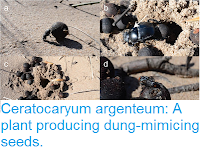
Ceratocaryum argenteum is a large Rush-like Grass native to Cape region in South Africa. It produces lage, hard seeds which Dung Beetles have been observed burrying, despite the fact that they do not appear to be a suitable food source for either the Beetles or their larvae, which has led to suggestions that the seeds somehow mimic the dung of a large Antelope, fooling the Beetles into burrying the seeds.

In a paper published in the South African Journal of Science on 26 July 2016, Jeremy Midgley and Joseph White of the Department of Biological Sciences at the University of Cape Town describe the results of an investigation into the relationship between the seeds of Ceratocaryum argenteum and the Dung Beetles.

Midgley and White placed piles of Ceratocaryum argenteum seeds beside a sand road in the De Hoop Nature Reserve in early in the morning after heavy rain events in February 2016. They found that two species of Dung Beetle, Epirinus flagellatus and Scarabaeus spretus, arrived at the seed stations within a few minutes of placing the seeds, and immediately began rolling the seeds away and burrying them. One specimen of Scarabaeus spretus even flew into a bag containing the seeds before they could be placed. Flesh Flies, Sarcophagidae, and Lesser Dung Flies, Sphaeroceridae, were also attracted to the seeds.

(a) Epirinus flagellatus rolling a Ceratocaryum argenteum seed; (b) Scarabaeus spretus rolling a seed (the arrow indicates a Sphaerocerid Lesser Dung Fly); (c) the large hole made by Scarabaeus spretus for burying several seeds (the arrow indicates the location of the Dung Beetle); and (d) a female Sarcophagid Fly on a seed. Midgley & White (2016).

Two Antelope species present in the De Hoop Nature Reserve, the Eland, Taurotragus oryx, and the Bontebok, Damaliscus pygargus. The two species have different diets, with the Bontenok favouring Grasses and the Eland being a browser with a mixed diet. 

This is a useful difference, as many tropical Grases use a different photosynthetic method to most other plants (which enables them to use less water in the process), as a side affect of which they tend to fix more of the lighter carbon isotope Carbon 12 (12C) and less of the heavier isotope Carbon 13 (13C), which results in the  tissues of animals which eat these Grasses having a distinct isotope signature; useful to archaologists trying to understand the diets of ancient populations and ecologists trying to understand the diets of animals. 

The larvae of Dung Beetles feed on undigested plant tissues within dung balls burried by their parents. This means that a Dung Beetle should have a carbon isotope signature which matches the dung of the animal on which it fed. Midgley and White analysed dung from both the Antelope species as well as a number of individuals of both Dung Beetle. Both Beetles had a carbon isotope signature closely matching that of the Eland dung, suggesting that this is their natural diet. Since other large Dung Beetles are present in the De Hoop Nature Reserve which did not pay any attention to the Ceratocaryum argenteum seeds, Midgely & White suggest that the seeds must specifically be mimicing the Eland dung, presumably be emiting chemical signatures (scents) detectable by the Beetles.

See also...

http://sciencythoughts.blogspot.co.uk/2016/04/onthophagus-clavijeroi-onthophagus.htmlOnthophagus clavijeroi & Onthophagus martinpierai: Two new species of Scarab Beetles from the Trans-Mexican Volcanic Belt.                                                          Mexico has an essentially tropical climate, but is...
http://sciencythoughts.blogspot.co.uk/2015/05/ateuchus-cujuchi-new-species-of-scarab.htmlAteuchus cujuchi: A new species of Scarab Beetle from Rodent burrows in Bolivia. Tuco-tucos, Ctenomys spp., are small South American Rodents which live their entire lives underground within underground burrow systems, never venturing to the surface. Studies of other Rodents with similar...
http://sciencythoughts.blogspot.co.uk/2014/09/a-new-species-of-scarab-beetle-from.htmlA new species of Scarab Beetle from Hardap Province, Namibia.                                    There are currently eight species of Scarab Beetles in the genus Scapanoclypeus, which is known from Namibia and western South Africa. They are... 
Follow Sciency Thoughts on Facebook.

Tuesday, 23 August 2016

Atherigona reversura: Bermudagrass Stem Maggot reported in South America.

The Bermudagrass Stem Maggot, Atherigona reversura, is the larvae of a Muscid Fly (House Fly) which burrows into the shoots of young Grass plants, killing or damaging the plant. It's favoured food is Bermudagrass, Cynodon dactylon, (which doesn't actually come from Bermuda), but it will feed on many species of Grass, and is considered a serious agricultural pest in pastureland in tropical and subtropical areas. The Maggot is native to Burma, China, India, Indonesia, Malaysia, the Philippines, Sri Lanka, and Taiwan, but has been introduced to a number of other areas, including Hawaii, Papua New Guinea, Japan, Oman, the continental United States, and Mexico.

Bermudagrass Stem Maggot identified in a Florida Bermudagrass hay field. Liza Garcia-Jimenez/University of Florida.

In a paper published in the journal Check List on 15 July 2016, Luciano Patitucci of the Museo Argentino de Ciencias Naturales “Bernardino Rivadavia”, Matías Dufek of Biología de los Artrópodos at the Universidad Nacional del Nordeste, and Pablo Mulieri, also of the Museo Argentino de Ciencias Naturales “Bernardino Rivadavia”, report the first known occurances of the Bermudagrass Stem Maggot in South America.

Adult specimens of Atherigona reversura were discovered during a survey of Flies in the Oriental Chaco and Pampas Grasslands ecoregions. The presence of the Fly was established in three provinces, Buenos Aires, Chaco, and Santa Fe. Given the wide range established for the Fly in Argentina, and the variety of ecosystems in which is was found, as well as the widespread growth of Bermudagrass as a fodder crop in South America, Patitucci et al. consider establishing the full range of the Fly in South America a matter of some urgency, and recommend further surveys in other areas of Argentina, as well as areas of Brazil, Paraguay and Uruguay with similar climates.

 Male of Atherigona reversura, lateral view. Pablo Mulieri in Patitucci et al. (2016).

See also...

http://sciencythoughts.blogspot.co.uk/2015/05/western-flower-thrips-reported-in-india.htmlWestern Flower Thrips reported in India. Thrips (the word is both singular and plural),Thripidae, are very small Insects with wings reduced to feathery growths (though this is sufficient to support them in flying due to their small size). They feed by sucking fluids from plants, and as such are...
http://sciencythoughts.blogspot.co.uk/2015/04/tripius-gyraloura-sphaerularid-nematode.htmlTripius gyraloura, a Sphaerularid Nematode infecting the Arundo Gall Midge.          Sphaerularid Nematodes are highly virulent parasites of Insect hosts. While most parasites seek to keep their host alive for as long as possible, enabling them to live and produce offspring for as long as possible, Sphaerularids begging to reproduce at a high...
http://sciencythoughts.blogspot.co.uk/2014/11/two-new-species-of-ironwood-infesting.htmlTwo new species of Ironwood infesting Gall Wasps from Micronesia and Australia.   Ironwood Trees of the genus Casuarinaare native to Australia, Southeast Asia, South America and the islands of the western Pacific. They are widely grown for their timber, as well as for windbreaks and for their ability to stabilize soils in erosion-prone areas...
Follow Sciency Thoughts on Facebook.

Saturday, 4 October 2014

How an invasive Grass species makes American Toads more vulnerable to Wolf Spiders.


Invasive plants can significantly modify local habitats, particularly if they lack herbivores in the environments they are colonising, by both modifying the structure of the environment and excluding native plants which provide food and homes to native animals. One such plant is the Japanese Stilt Grass (Microstegium vimineum), which has invaded moist forest-floor environments across the eastern United States. Japanese Stilt Grass has been shown to modify soil chemistry and Arthropod diversity and abundance in areas where it invades, and lacks any significant herbivores in the United States, allowing it to spread with little impediment.

Japanese Stilt Grass, Microstegium vimineum. Theresa Yednock/National Park Service/Wikimedia Commons.

One Vertebrate species is also apparently affected by the presence of Japanese Stilt Grass, the American Toad (Anaxyrus americanus), which appears to decline where the Grass becomes established. This could potentially be for a number of reasons. Firstly, like all Amphibians, American Toads have permeable skin through which they exchange fluids and gasses with the environment, which may make them vulnerable to changes in soil chemistry. Secondly they feed almost exclusively on Arthropod prey, notably Mites and Ticks (Acari), Spiders (Araneae), Beetles (Coleoptera), Springtails (Collembola), Flies (Diptera), Bugs (Hemiptera), and Ants, Bees and Wasps (Hymenoptera) and changes in the abundance of these prey items may affect the survival of the Toads. Finally the Toads themselves are vulnerable to predation by larger Arthropods, as they metamorphose (change from tadpoles into adult Toads) very young, achieving most of their growth in the terrestrial environment.

American Toad, Anaxyrus americanus. Brad Glorioso/National Wetlands Research Center/USGS.

In a paper published in the journal Ecology in July 2014, Jayna DeVore of the Warnell School of Forestry and Natural Resources at the University of Georgia and the School of Biological Sciences at the University of Sydney, and John Maerz, also of the Warnell School of Forestry and Natural Resources, describe the results of a series of experiments designed to determine exactly how the presence of Japanese Stilt Grass affects the American Toad.

Firstly DeVore & Maerz created enclosures in four areas of woodland in Georgia State that were enclosed in a way that prevented the entrance or exit of Toads but allowed Arthropods free movement. Within these enclosures the numbers of both Toads and the various Arthropod groups were monitored. No correlation between prey species numbers and Toads was found, but Toad numbers did decline in numbers in pens where Wolf Spiders (Lycopsidae) were present in large numbers.

Wolf Spiders are large predatory Spiders that hunt by waiting in ambush for mobile prey, then running it down. Small Toads, which actively seek out prey, moving about as they forage, are particularly vulnerable to this hunting technique, as they cannot feed it they remain immobile (the Spiders do not themselves forage, and will not find stationary prey) and have no defence against the Spiders.

The Carolina Wolf Spider, Hogna carolinensis. Patrick Edwin Moran/Wikimedia Commons.

DeVore & Maerz then carried out a series of cage experiments where Toads were placed in cages with or without Japanese Stilt Grass, and Wolf Spiders (Hogna carolinensis or Hogna helluo). In cages lacking Spiders the Toads survived well, regardless of the presence of the Stilt Grass, suggesting that it does not affect the soil chemistry in a way that harms the Toads. However in cages with Wolf Spiders the Toads suffered significant mortality, and this rose sharply in cages where both Spiders and Grass were present, suggesting that the Grass modifies the environment in a way that makes it easier for the Spiders to hunt the Toads.

Conceptual diagram of explored mechanisms through which Microstegium vimineum invasion can affect the survival and growth of metamorphic Toads, indicating both direct (solid line) and indirect (dashed line) effects. Black arrows are used to portray connections that were altered following invasion, resulting in significant changes in depicted parameters (e.g., densities, survival rates), whereas those that were unaffected are depicted in gray (i.e., growth rates). Significant changes are also annotated with a sign indicating whether the indicated parameter was positively (+) or negatively (-) affected (as compared with adjacent, uninvaded habitats; see Appendix C for effect sizes). In summary, invasion amplified top-down pressure on toads by increasing structural complexity, which dampened the strength of a pre-existing intraguild (IGP)/cannibalistic trophic linkage among Lycosid Spiders, resulting in higher spider densities and, subsequently, lower Toad survival within invaded habitats. The potential for bottom-up effects occurred via post-invasion changes in detrital food webs, which ultimately decreased the availability of edible invertebrates, but Toad growth was unaffected by these reductions. Although we also documented significant changes in abiotic habitat parameters following invasion, these effects alone did not significantly influence Toad survival (linkage not pictured). DeVore & Maerz (2014).

See also…


Sociality is rare in Spiders, which are by nature solitary and aggressive...


Cryptic species are species which resemble one-another physically, and which cannot generally be separated using traditional taxonomic methodology, but which are nevertheless genetically and reproductively...


Cave Spiders (Nesticidae) are found across the Mediterranean Basin, as well as in the Canary Islands and parts of Asia. They are...

Follow Sciency Thoughts on Facebook.