Showing posts with label Hunan Province. Show all posts

Tuesday, 21 December 2021

Phallus cremeo-ochraceus & Phallus rigidiindusiatus: Two new species of Stinkhorn from China.

Stinkhorns are gasteroid Basidiomycote Fungi (Basidiomycote Fungi with spores that develop inside their basidiocarps, rather than on the surface), found throughout the tropical, subtropical regions of the world. These Fungi produce foul-smelling, phallic-looking Mushrooms, which has given them mystic implications in the folklore of many cultures. At least 31 species of Stinkhorn are found in China, some of which are eaten, and even grown commercially. However, the exact taxonomic status of these Chinese Stinkhorns is often unclear, for example, the species Phallus indusiatus has been reported in south and southwestern China since the 1960s, but modern genetics-based taxonomic surveys have suggested that this species is restricted to South America, making the status of Chinese Stinkhorne populations given this name unclear.

In a paper published in the journal MycoKeys on 16 December 2021, Ting Li of the State Key Laboratory of Applied Microbiology Southern China at the Institute of Microbiology of the Guangdong Academy of Sciences, and the College of Science at Tibet University, Wang-Qiu Deng, Bin Song and Ming Zhang, also of the State Key Laboratory of Applied Microbiology Southern China at the Institute of Microbiology of the Guangdong Academy of Sciences, Mu Wang of the Tibet Agricultural and Animal Husbandry University, and Tai-Hui Li, one again of the State Key Laboratory of Applied Microbiology Southern China at the Institute of Microbiology of the Guangdong Academy of Sciences, describe two new species of Stinkhorns from south and southwest China, based upon populations previouslt assigned to Phallus indusiatus

The first new species described is named Phallus cremeo-ochraceus, which refers to the ochre colour of its receptacle (mushroom-head). It has a white or slightly pinkish indusium (net-like structure that hangs from the rim of the receptacle) and pseudostipe (stem). The species was confirmed as new based upon genetic analysis of individuals collected from leaf litter in a Bamboo grove in the Xiaoqikong Scenic Area in Libo County, Guizhou Province, in July 2020.

 
Basidiomata of Phallus cremeo-ochraceus. (a)-(c) GDGM 80700 d GDGM 85857. Scale bars: 5 cm (a), 2 cm (b), (d), 1 cm (c). Li et al. (2021).

The second new species is named Phallus rigidiindusiatus, which refers to the ridged nature of its indusium, which is particularly thick, and therefore rather stiff. This species was found growing in soil in broad-leafed forests and Bamboo groves, at a number of locations in Guangdong, Hunan, and Guizhou provinces.

 
Basidiomata of Phallus rigidiindusiatus. (a) GDGM 54237 (b) GDGM 85470 (c), (e), (f) GDGM 81196 (d) 81195. Scale bars: 5 cm (a)-(c), 3 cm (d), 2 cm (e), 1 cm (f). Li et al. (2021).

See also...


Follow Sciency Thoughts on Facebook.

Follow Sciency Thoughts on Twitter.
 

Thursday, 11 June 2020

Widespread flooding in Guangxi, Hunan and Guizhou Provinces, China.

The provinces of Guangxi and Hunan in southern China have been hit by extensive flooding over the last week, displacing many people from their homes and resulting in at least nineteen deaths. In Guangxi more than 230 000 people have been forced to flee their homes, with over a thousand homes confirmed to have been destroyed, after the Lijiang River burst its banks, flooding a wide area, including parts of the city of Guilin, and resulting in at least six deaths, with several more people still missing. A series of rainfall associated floods and landslides have killed at least thirteen people in Hunan Province, with several more people missing, and Guizhou has also reported at least eight people missing after similar incidents. 

Flooding in Rong'an County, to the east of Guilin in Guangxi Province, China. AFP/Getty Images.

South China has a monsoonal tropical climate, with peak rainfall falling in May and June, when Guangxi can expect to see more than 250 mm of rain per month in a typical year. Landslides are a common problem after severe weather events, as excess pore water pressure can overcome cohesion in soil and sediments, allowing them to flow like liquids. Approximately 90% of all landslides are caused by heavy rainfall.

Flooding in Yangshuo County, to the south of Guilin, on 7 June 2020. AFP.

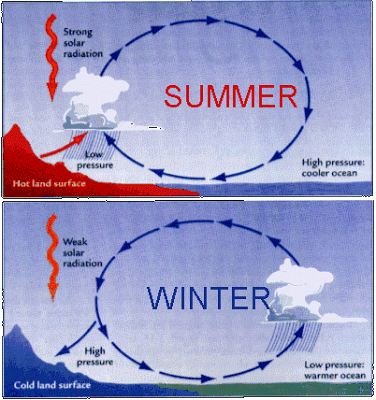
Monsoons are tropical sea breezes triggered by heating of the land during the warmer part of the year (summer). Both the land and sea are warmed by the Sun, but the land has a lower ability to absorb heat, radiating it back so that the air above landmasses becomes significantly warmer than that over the sea, causing the air above the land to rise and drawing in water from over the sea; since this has also been warmed it carries a high evaporated water content, and brings with it heavy rainfall. In the tropical dry season the situation is reversed, as the air over the land cools more rapidly with the seasons, leading to warmer air over the sea, and thus breezes moving from the shore to the sea (where air is rising more rapidly) and a drying of the climate.

  Diagrammatic representation of wind and rainfall patterns in a tropical monsoon climate. Geosciences/University of Arizona.
 
See also...

https://sciencythoughts.blogspot.com/2020/03/landslide-derails-train-in-hunan.htmlhttps://sciencythoughts.blogspot.com/2019/11/magnitude-earthquake-in-guangxi.html
https://sciencythoughts.blogspot.com/2019/10/magnitude-52-earthquake-in-guangxi.htmlhttps://sciencythoughts.blogspot.com/2019/07/thirty-six-confirmed-deaths-following.html
https://sciencythoughts.blogspot.com/2017/08/landslide-in-guizhou-province-china.htmlhttps://sciencythoughts.blogspot.com/2017/01/landslide-kills-at-least-two-in-hunan.html
Follow Sciency Thoughts on Facebook.

Tuesday, 31 March 2020

Landslide derails train in Hunan Province, China.

A train has derailed after hitting a landslide in Hunan Province, China, on Monday 30 March 2020. The driver of the train, a Guangzhou Railway Group operated service between Jinan and Guangzhou, attempted to brake when he saw the landslip, on the southbound section of rail between Matianxu and Qifengdu stations in Yongxing County, but was unable to prevent the collision. The incident resulted in six carriages derailing, one of which subsequently caught fire, one person dying, and 127 people being injured, four of them seriously.

Rescue workers attend a train derailment caused by a landslide in Hunan Province, China, on Monday 30 March 2020. Hunan Emergency Management Department Fire Rescue Bureau.

The incident is reported to have occurred following several days of heavy rain associated with the onset of the Monsoon Season, which typically lasts from the begining of April to the middle of August in Hunan. Landslides are a common problem after severe weather events, as excess pore water pressure can overcome cohesion in soil and sediments, allowing them to flow like liquids. Approximately 90% of all landslides are caused by heavy rainfall. 

Engineers begin the process of clearing the site of a train derailment in Hunan Province on 30 March 2020. AFP.

Monsoons are tropical sea breezes triggered by heating of the land during the warmer part of the year (summer). Both the land and sea are warmed by the Sun, but the land has a lower ability to absorb heat, radiating it back so that the air above landmasses becomes significantly warmer than that over the sea, causing the air above the land to rise and drawing in water from over the sea; since this has also been warmed it carries a high evaporated water content, and brings with it heavy rainfall. In the tropical dry season the situation is reversed, as the air over the land cools more rapidly with the seasons, leading to warmer air over the sea, and thus breezes moving from the shore to the sea (where air is rising more rapidly) and a drying of the climate.

 Diagrammatic representation of wind and rainfall patterns in a tropical monsoon climate. Geosciences/University of Arizona.

See also...

https://sciencythoughts.blogspot.com/2019/11/magnitude-earthquake-in-guangxi.htmlhttps://sciencythoughts.blogspot.com/2019/10/magnitude-52-earthquake-in-guangxi.html
https://sciencythoughts.blogspot.com/2019/10/chloeia-parva-chloeia-bimaculata.htmlhttps://sciencythoughts.blogspot.com/2019/07/thirty-six-confirmed-deaths-following.html
https://sciencythoughts.blogspot.com/2018/12/seven-killed-in-accident-at-chinese.htmlhttps://sciencythoughts.blogspot.com/2017/12/woman-swallowed-by-sinkhole-in.html
Follow Sciency Thoughts on Facebook.

Saturday, 7 October 2017

Terthrothrips levigatus & Terthrothrips trigonius: Two new species of Thrips from south China.

Thrips are tiny (usually less than one millimetre) Insects with greatly reduced wings that resemble feathery stubs. They are plant-parasites, with some species being significant agricultural pests, but due to their small size are often overlooked, and apart from a few species with major economic impact, are not well studied. The genus Terthrothrips are fungivorous Thrips found predominantly in the tropical forests of Central and South America, though five species have been found in Asia, four of them in China.

In a paper published in the journal Zootaxa on 25 September 2017, Chao Zhao and Xiaoli Tong of the Department of Entomology at South China Agricultural University, describe two new species of Terthrothrips from China.

The first new species is named  Terthrothrips levigatus, meaning smooth, referring to an absence of ornamentation on parts of the thorax where ornamentation is found in other species of the genus. The species is described from a female collected in the Shimen National Forest Park, and a male and female collected in the Dinghushan National Nature Reserve, both in Guangdong Province. One of the females was measured at 1725 μm in length, while the male was 1300 μm. All specimens are brown in colour.

Terthrothrips levigatus, female (left) and male (right). Zhao & Tong (2017).

The second new species is named Terthrothrips trigonius, meaning 'triangular' in reference to the shape of the pelta (a shield-like structure on the top of the thorax). This species is described from two female and five male specimens collected from Guangdong, Hunan and Guizhou provinces in south China. One of the female specimens was measured at 1720 μm in length, while the male was 1470 μm. This species is also brown in colour.

Terthrothrips trigonius, female (left) and male (right). Zhao & Tong (2017).

See also...

http://sciencythoughts.blogspot.co.uk/2017/07/caliothrips-chiapas-new-species-of.htmlhttp://sciencythoughts.blogspot.co.uk/2017/02/frankliniella-veracrucensis-new-species.html
http://sciencythoughts.blogspot.co.uk/2015/05/western-flower-thrips-reported-in-india.htmlhttp://sciencythoughts.blogspot.co.uk/2014/04/fossil-thrips-from-early-eocene-of.html
http://sciencythoughts.blogspot.co.uk/2013/10/three-new-species-of-thrips-from-japan.htmlhttp://sciencythoughts.blogspot.co.uk/2013/10/four-new-species-of-thrips-from-china.html
Follow Sciency Thoughts on Facebook.

Saturday, 29 June 2013

Two people killed in Hunan landslide.

Two people were killed when a house collapsed in a landslide in Shuangqiao Village in Hunan Province, central China, following days of rainstorms that have led to flooding across much of the province, and a number of landslides and building collapses. A third person in the building survived the collapse, which occurred at around 1.00 pm local time (around 5.00 am, GMT) on Friday 28 June 2013.

The approximate location of the 28 June 2013 Hunan landslide. Google Maps.

Landslides are a common problem after severe weather events, as excess pore water pressure can overcome cohesion in soil and sediments, allowing them to flow like liquids. Approximately 90% of all landslides are caused by heavy rainfall.


Follow Sciency Thoughts on Facebook.

Tuesday, 10 July 2012

Seven workers killed by mine explosion in Hunan Province, China.

Seven workers were reportedly killed by an explosion at the Xiangzhong Coal Mine in  Lianyuan, Hunan Province on Sunday 8 July 2012, according to news sources in China. The explosion occurred at 6.45 am local time, when 46 workers were in the mine, the other 39 reportedly escaping relatively unscathed. The Xiangzhong Coal Mine is a legally operating mine which produces around 60 000 tonnes of coal per year. No further details are available at this time, but an investigation is said to be under way by local authorities. 

Gas explosions typically occur in mines when miners hit pockets of methane (CH₄), a highly flammable gas that is given off by coal under pressure. Typically when a seam containing pressurized gas is cut into it bursts, releasing the pressure and throwing large blocks of coal into the faces of the miners, often with fatal results. Thus although the gas involved is flammable it does not actually need to ignite to cause fatalities.

Woodcut of a mine gas explosion from Francis Rolt-Wheeler's 1922 book The Boy With the U.S. Miners. Project Gutenberg.


Follow Sciency Thoughts on Facebook.

Monday, 9 July 2012

Miners trapped by flooding at Qielichong Coal Mine in Hunan Province, China.

Sixteen workers were reported trapped by flooding at the Qielichong Coal Mine in Leiyang, Hunan Province, on Wednesday, 4 July 2012, at 6 pm, local time. There were apparently 40 workers in the mine at the time of the flood, 24 of whom escaped promptly. Rescue attempts did not begin till  Thursday morning due to a delay in reporting the incident by the mine owner, who is now in custody. Eight mineworkers were rescued on Sunday morning, with search efforts, reportedly involving more than a thousand people, ongoing for the remaining workers, three of which have reportedly been confirmed to be alive.

Rescue workers carrying a survivor from the Qielichong Coal Mine. Associated Press/Xinhua/Bai Yu.

The flooding was reportedly caused by an inrush of water when the miners broke through into a disused, flooded mineshaft. This sort if accident is, unfortunately, common in areas where mining has been ongoing for some time but record keeping has been poor. The Qielichong Coal Mine is described by authorities as 'licensed', but the area has a history of illegal (i.e. unlicensed) mining, which the government has been trying to clamp down on; it is possible that the miners broke through into one of these illegal, and therefore unrecorded, mines. There have also been a number of  prosecutions for breaches of health and safety regulations at legal mines in the province. It is thought that this may have provoked the owners of the Qielichong Coal Mine to attempt a rescue themselves while concealing the extent of the problem from the authorities, who were eventually called in when the extent of the situation was realized.


Follow Sciency Thoughts on Facebook.