Showing posts with label Kimberlite Pipes. Show all posts

Saturday, 5 August 2017

Nine still missing following flood at Russian mine.

Nine miners are still missing following a flood at the Mir Diamond Mine in Russia's Sakha Republic on Friday 4 August 2017. The incident happened at about 6.30 pm local time, when a pumping station keeping water from a lake in an old pit mine from entering the mineshaft failed. Rescue workers report that 142 mineworkers were below ground at the time of the incident, though 133 of these have now been brought to the surface, with only two requiring medical treatment.

Rescue workers at the Mir Diamond Mine on 4 August 2017. Alrosa Mining/AFP.

The Mir Mine exploits a kimberlite pipe discovered in 1955, and excavated as an open pit mine from 1957 until 2004. Kimberlite pipes are produced by rapid volcanic intrusions carrying magma from the Earth’s mantle rapidly to the surface, often resulting in explosive phreatomagmatic eruptions (explosions caused by hot magma coming into contact with water). These pipes are considered high value economic resources due to the common occurrence of diamonds within them, formed from fragments of coal or plant material that get caught in the magma and are compressed as mineral crystals form in the cooling magma around them.

The open pit crater of the Mir Diamond Mine. AP.

The mine was reopened as a deep pit mine, exploiting the kimberlite pipe beneath the original open pit mine. However the open pit is over a kilometre wide and about 1.7 km deep, and contains a lake with a volume of about 300 000 cubic meters. This means that constant pumping is required to keep the deep pit from flooding, and the failure of one of the pumps used led to Friday's flood.

See also...

http://sciencythoughts.blogspot.co.uk/2017/03/eruption-on-mount-kambalny-kamchatka.htmlhttp://sciencythoughts.blogspot.co.uk/2014/11/giant-sinkhole-opens-up-in-perm-region.html
http://sciencythoughts.blogspot.co.uk/2014/08/two-dead-and-one-missing-after.htmlhttp://sciencythoughts.blogspot.co.uk/2014/05/eruption-on-shivaluch-produces-10-km.html
http://sciencythoughts.blogspot.co.uk/2014/04/one-confirmed-fatality-after-omsk-hit.htmlhttp://sciencythoughts.blogspot.co.uk/2014/01/magnitude-51-earthquake-in-sakha.html
Follow Sciency Thoughts on Facebook.

Tuesday, 30 December 2014

Understanding the Tokapal Kimberlite.


Kimberlites are uncommon geological formations formed by the extrusion of mantle material from deep within the Earth. Despite the relatively small number of kimberlites known, they have been the subject of extensive studies for many years, as they are the source of the deepest known rocks found on the surface of the planet, frequently contain xenoliths of other material that they have accumulated during their passage, and because they are the best known source of diamonds for the mineral extraction industry. There are generally considered to be three forms of kimberlites: Group I Kimberlites, the best known form, associated with Archaean cratons (ancient pieces of the continental lithosphere, emplaced before 2500 million years ago) across the globe. Group II Kimberlites (or orangeites), which have a different mineralogical and chemical composition, and which were thought to be restricted to the Kaapvaal Craton of Southern Africa, until recent discoveries in Russia and India. Group III Kimberlites (or transitional kimberlites) were also thought to be restricted to Southern Africa, but are now known from West Africa, South America, Russia, Australia and India.

Recent discoveries of diamond-bearing Group II Kimberlites in the Bastar Craton of central India have provoked considerable interest in Indian Kimberlites, both for their commercial potential as sources of diamonds, and due to their apparent relationship to the Deccan Traps Flood Basals, emplaced at the end of the Cretaceous.

In a paper published in the journal Geoscience Frontiers on 19 December 2013, Chalapathi Rao of the Department of Geology at Banaras Hindu University, Bernd Lehmann of Mineral Resources at the Technical University ofClausthal, B.K. Panwar and Alok Kumar, also of the Department of Geology at Banaras Hindu University and Datta Mainkar of the Directorate of Geology and Mining in Raipur discuss the results of petrographical and geochemical study of samples from the Tokapal Kimberlite in the Bastar Craton.

(A) Generalised geological map of India showing the location of the Tokapal kimberlite in the Bastar craton, central India. The occurrence of other lamproites and kimberlites in various cratons is also shown. CBF = Chitradurga fault; CITZ = Central Indian tectonic zone; CUB = Cuddapah basin; CB = Chhattisgarh basin; VB =Vindhyan basin; SMB = Singhbhum mobile belt; CIS = Central Indian shear zone; W =Wajrakarur kimberlite field; R = Raichur kimberlite field; Np = Narayanpet kimberlite field; T =Tokapal kimberlite; M =Mainpur kimberlite field; Dv =Damodar valley; Mg = Majhgawan; S = Saptarshi; K = Khadka; N = Nuapada; G =Garledinne; Vk = Vattikod; Kr = Krishna; Rd =Ramadugu. (B) Geological setting of the Tokapal kimberlite system. Rao et al. (2014).

The Tokapal Kimberliteis a roughly saucer-shaped sheet of volcanic rock 2.5 km wide in the Western Indrāvati Basin. It is one of the world’s largest crater kimberlites, covering over 5.5 km2) and being more than 50 m thick across much of its extent, exceeding 90 m in places.

Tokapal tuff exposed in a pit. Rao et al. (2014).

The samples show little contamination by crustal material, but have apparently been somewhat metamorphicly altered since they were emplaced, showing low-temperature serpentinisation and carbonate alteration. This means that of the three major mineral types in the rock (olivines, carbonates and spinels) only the spinels are preserved in their original form. Garnierite is present in the samples, apparently formed from the serpentinisation of olivine, but diamonds are absent.

Back scattered electron (BSE) image of the Tokapal pipe showing olivine macrocrysts (Ol), titanite (Ti) and spinel (Sp). Rao et al. (2014).

Despite this metamorphic influence, the proportions of major elements is thought to have been preserved, enabling inferences to be made from the bulk element composition. The Lanthanum-Ytterbium ratio of the samples are comparable to those seen in the Wajrakarur and Narayanpet kimberlite fields in the south of India, implying a common origin. Other element ratios show strong similarities to those seen in Group II Kimberlites from Southern Africa and Central India, and Group III Kimberlites from Southern India and Southern Africa.

The Tokapal, Wajrakarur and Narayanpet kimberlites, the Majhgawan diatreme and the lamproites of the Cuddapah basin show similar depleted-mantle Neodymium ages (date obtained by comparing the ratio of Samarium147 to its decay product Neodymium143), implying a potential common origin, with the dates obtained suggesting a possible link with the breakup of the ancient supercontinent of Columbia, which formed between 2.0 and 1.7 billion years ago and lasted till about 1.3 billion years ago.

See also…

Palms are an important component of modern tropical ecosystems, with the majority of species (~90%) restricted to tropical rainforests, where they are important understory plants. Palms reach their...
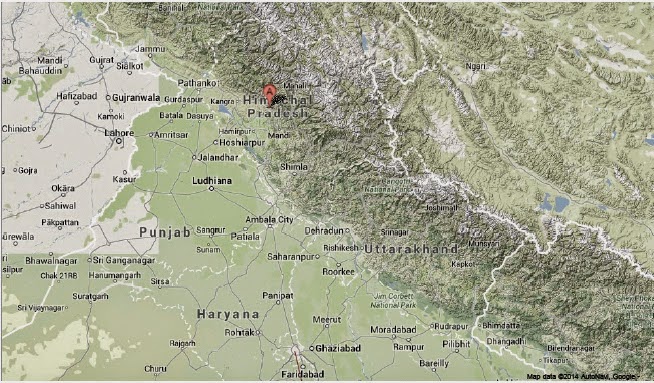
A report in the Times of India on 6 June 2014 has documented a possible volcanic eruption in the Kangra District of Himachal Pradesh State, India. The eruption...

 Sixty-five million years ago the world was a very different place; the land was dominated by giant dinosaurs, pterosaurs filled the skies and the seas swarmed with giant marine reptiles and ammonites. Then overnight (in geological terms) everything changed. The non-avian dinosaurs disappeared, as did the pterosaurs, ammonites and all the marine reptiles except turtles and sea-snakes (crocodiles have since...


Follow Sciency Thoughts on Facebook.

Thursday, 17 April 2014

Preserved wood from an Early Eocene kimberlite pipe in northwestern Canada’s Slave Province.

Kimberlite pipes are produced by rapid volcanic intrusions carrying magma from the Earth’s mantle rapidly to the surface, often resulting in explosive phreatomagmatic eruptions (explosions caused by hot magma coming into contact with water). These pipes are considered high value economic resources due to the common occurrence of diamonds within them. Surprisingly kimberlite pipes also often contain fossil material. This can come from two separate sources; organisms can fall directly into the erupting lava and be entombed within it as it cools (such intrusions of non-volcanic material, organic or otherwise, are known as xenoliths by volcanologists), alternatively material can be preserved in volcanic craters after the eruption, as organisms are buried in fine-grained volcanic ash and clay (volcanic maar), which has high preservational potential.

In a paper published in the journal PLoS One on 19 September 2012, Alexander Wolfe of the Department of Earth and Atmospheric Sciences at the University of Alberta, Adam Csank of the Environment and Natural Resources Institute at the University of Alaska, Anchorage, Alberto Reyes of the Department of Geoscience at the University of Wisconsin, Madison, Ryan McKellar also of the Department of Earth and Atmospheric Sciences at the University of Alberta, Ralf Tappert of the Institute of Mineralogy and Petrography at the University of Innsbruck and Karlis Muehlenbachs, again of the Department of Earth and Atmospheric Sciences at the University of Alberta, describe the discovery of a number of large wood fragments from the Panda Kimberlite Pipe, a volcanic intrusion which forms part of the  Ekati diamond mining concession worked by BHP Billiton in Canada’s Great Slave Province, which has been calculated to be about 53.3 million years old (Early Eocene). The Panda Kimberlite Pipe forms part of the Lac de Gras Field, which contains about 150 such pipes, emplaced between 45 and 78 million years ago. The Panda Pipe is a simple 200 m diameter cylinder, apparently produced by a single eruption.

Wolfe et al. provide a detailed description of a single piece of wood, a large wood fragment which had fallen into the lava and been mummified. The wood is excellently preserved, with only the outermost millimetre having been fusinized (burned), suggesting an absence of free oxygen when it was entombed. The preserved structure of the wood allows the specimen to be assigned to a tree of the genus Metasequoia, a form of Giant Redwood now restricted to central China, but known to have been common in Alaska during the late Palaeocene and Early Eocene, and therefore not a great surprise in Slave Province.

(D) Fossil wood encrusted in olivine-rich volcaniclastic kimberlite. (E) Photograph of the specimen characterized in this study. The wood was split when removed from the ore, revealing a sliver of opaque amber (9.5 cm long by 0.5 cm wide) in the xylem. Wolfe et al. (2012).

Metasequoia requires a high level of humidity to survive, with a minimum of around 1000 mm of rainfall per year. The area where the fossil was recovered has around 280 mm of rainfall per year, suggesting that the climate was much wetter during the Early Eocene (it is possible that this 53 million year old specimen comes from a tree of the same species as the modern Chinese trees, since these are exceptionally long lived organisms). Since the tree was living close to the Paleocene-Eocene Thermal Maximum (about 55.5 million years ago), when the climate is predicted to have been substantially warmer and wetter in this region, this confirms the climatic predictions. Isotopic data obtained from both the cellulose of the wood and an amber (tree resin) inclusion within the fossil suggests that temperatures would have been around 7-12˚C warmer than at present while the tree was living, again tending to confirm the climatic predictions.

(F) RLS in transmitted light showing uniseriate and biseriate bordered pits and cross-fields. (G) TLS showing rays stacked 3–26 cells high. (H). SEM (TS) of ring boundary with earlywood (left) and latewood (right). (I) Close-up of tracheids in TS and calcite crystals within cells (arrows). J. Cross-section of ray with cross-field pits. (K and L) Close-ups of cross-field pits. (M) TLS close-up of rays. (N). Radial longitudinal section showing four contiguous rows of ray parenchyma cells with smooth end walls and no separation between the individual rows of cells. Wolfe et al. (2012).

See also…


Follow Sciency Thoughts on Facebook.