Showing posts with label Mount Urbinas. Show all posts

Sunday, 21 July 2019

Thousands evacuated from homes following series of explosive eruptions on Mount Urbinas, Peru.

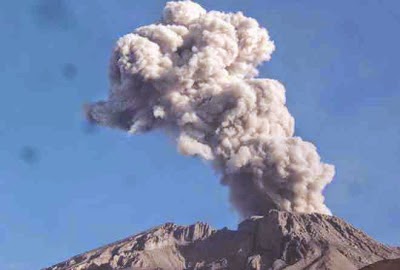
Around 30 000 people have been evacuated from homes in communities close to Mount Urbinas, a small but highly active volcano in the southern Peruvian Andes, generally considered to be Peru's most active volcano, following a series of explosive eruptions that began on Thursday 18 July 2019. The first of these eruptions produced an ash column about 5 km high, and led to ashfalls in communities 25 km from the volcano, prompting the volcano. The evacuees have been relocated to shelters outside the volcano's danger zone, as part of a predetermined emergency plan.

An ash column over Mount Urbinas, Peru. Picture Alliance/DPA/EPA/STR.

The volcanoes of the Peruvian Andes, and of South America in general, are fuelled by the subduction of the Nazca Plate beneath the South American Plate. The Nazca Plate underlies a large chunk of the eastern Pacific Ocean, and is being subducted along Peru-Chile Trench to the west of South America. As it sinks into the Earth, the Nazca Plate passes under South America, where it is heated by friction with the overlying South American Plate and by the heat of the planet's interior. This causes the Nazca Plate to partially melt, and some of this melted material then rises through the South American Plate as magma, fuelling the volcanoes of the Andes. The motion of one plate beneath another is not a smooth process, and the Nazca and South American Plates frequently stick together, then break apart as the pressure builds up, triggering frequent Earthquakes along the western coast of South America, and sometimes further inland.

 The subduction of the Nazca Plate beneath the South American Plate, and how it causes Earthquakes and volcanoes. Pacific Earthquake Engineering Research Center.

See also...

https://sciencythoughts.blogspot.com/2019/05/magnitude-80-earthquake-in-alto.htmlhttps://sciencythoughts.blogspot.com/2019/03/magnitude-70-earthquake-in-azangaro.html
https://sciencythoughts.blogspot.com/2019/02/eleven-known-deaths-as-floods-and.htmlhttps://sciencythoughts.blogspot.com/2018/10/warnings-issued-to-aviation-after.html
https://sciencythoughts.blogspot.com/2018/01/magnitude-71-earthquake-off-coast-of.htmlhttps://sciencythoughts.blogspot.com/2017/06/magnitude-56-earthquake-on-peru-equador.html
Follow Sciency Thoughts on Facebook.

Tuesday, 1 April 2014

Eruption on Mount Urbinas.

Mount Urbinas, a small but highly active volcano in the southern Peruvian Andes, generally considered to be Peru's most active volcano, erupted at 7.42 am local time (1.42 pm GMT) on Monday 31 March 2014, according to the Geophysical Institute of Arequipa, producing an ash column rising 1000 m above the volcano's summit, and leading to the evacuation of the village of Querapi, which is 5 km from Urbinas. The volcano began to show signs of activity in September 2013, after several years of inactivity, but this is the first major eruption since then.

The ash column above Urbinas as seen at 7.44 am local time on 31 March 2014. Observatorio vulcanológico del Ingemmet.

The volcanoes of the Peruvian Andes, and of South America in general, are fueled by the subduction of the Nazca Plate beneath the South American Plate. The Nazca Plate underlies a large chunk of the eastern Pacific Ocean, and is being subducted along Peru-Chile Trench to the west of South America. As it sinks into the Earth, the Nazca Plate passes under South America, where it is heated by friction with the overlying South American Plate and by the heat of the planet's interior. This causes the Nazca Plate to partially melt, and some of this melted material then rises through the South American Plate as magma, fueling the volcanoes of the Andes. The motion of one plate beneath another is not a smooth process, and the Nazca and South American Plates frequently stick together, then break apart as the pressure builds up, triggering frequent Earthquakes along the western coast of South America, and sometimes further inland.

The approximate location of Mount Urbinas. Google Maps.

See also


Follow Sciency Thoughts on Facebook.

Wednesday, 4 September 2013

Small eruptions on Mount Ubinas, Peru.

The Instituto Geofísico del Perú has reported a series of small explosive eruptions on Mount Ubinas, a small but highly active volcano in the southern Peruvian Andes. The initial eruption occurred on Sunday 1 September 2013, and further events occurred on the following two days. However the eruptions are thought to be entirely phreatic in origin, caused by water percolating down from the surface and encountering hot rocks rather than by magma rising from bellow. The area has received a heavy snowfall in the last few days.

Small plume on Mount Ubinas on 2 September 2013. Instituto Geofísico del Perú.

The volcanoes of the Peruvian Andes, and of South America in general, are fueled by the subduction of the Nazca Plate beneath the South American Plate. The Nazca Plate underlies a large chunk of the eastern Pacific Ocean, and is being subducted along Peru-Chile Trench to the west of South America. As it sinks into the Earth, the Nazca Plate passes under South America, where it is heated by friction with the overlying South American Plate and by the heat of the planet's interior. This causes the Nazca Plate to partially melt, and some of this melted material then rises through the South American Plate as magma, fueling the volcanoes of the Andes. The motion of one plate beneath another is not a smooth process, and the Nazca and South American Plates frequently stick together, then break apart as the pressure builds up, triggering frequent Earthquakes along the western coast of South America, and sometimes further inland.

The approximate location of Mount Urbinas. Google Maps.


Follow Sciency Thoughts on Facebook.