Showing posts with label Neuquén Province. Show all posts

Thursday, 22 February 2024

The oldest known rock art in Patagonia, and what it tells us about the people who made it.

Patagonia lies at the southern tip of the Americas, and was one of the last areas to have been settled by Humans, who did not arrive there until the end of the Pleistocene. The area has a unique environment, which would have presented challenges to the people settling there. It also has a climate particularly suitable for the preservation of archaeological remains, making it particularly interesting to archaeologists. The area has extensive rock art, but to date little of this has been accurately dated.

In a paper published in the journal Science Advances on 14 February 2024, Guadalupe Romero Villanueva of the Instituto Nacional de Antropología y Pensamiento Latinoamericano, Marcela Sepúlveda of the Department of Social Sciences at the Universidad de Tarapacá, José Cárcamo-Vega of the Laboratorio de Espectroscopía Vibracional at the Universidad de Chile, Alexander Cherkinsky of the Center for Applied Isotope Studies at the University of Georgia, María Eugenia de Porras of the Instituto Argentino de Nivología, Glaciología  y  Ciencias  Ambientales, and Ramiro Barberena of the Centro de Investigación, Innovación y Creación at the Universidad Católica de Temuco, and the Instituto Interdisciplinario  de  Ciencias Básicas at the Universidad Nacional de Cuyo, present dates for four pieces of rock art from the Cueva Huenul 1 archaeological site in Neuquén Province, in the northern part of Argentinian Patagonia, and discuss the implications of this for the early peopling of the region.

The Cueva Huenul 1 archaeological site is located a kilometre above sealevel, to the east of the Andes amid the inland deserts of northern Patagonia. The Andes present a major topographic barrier, preventing the prevailing westerly winds from carrying moisture from the Pacific to the South American Arid Diagonal, where the Cueva Huenul 1 site is located. Precipitation in the region is between 150 mm and 200 mm each year, 75% of which falls in the winter. Rainfall tends to be higher in the west, closer to the Andes, and dryer to the east. with more abundant vegetation in areas with higher rainfall.

Location  of  Cueva Huenul 1,  other  sites  with  rock  art  in  northern  Neuquén  Province (Argentina),  and  palaeoecological  sites  from  northwestern  Patagonia. María Eugenia de Porras in Villanueva et al. (2024).

The Cueva Huenul 1 site is a cave with a habitable area of 620 m³, formed by the erosion of ignimbrites of the Tilhué Formation beneath an overlying basalt layer of the El Puente Formation, which have not eroded and now form the ceiling of the cave. Excavations within this cave have produced over 5500  lithic artifacts, principally flaked stone objects, and 8800 bone specimens, mostly Guanaco, Lama guanicoe. The site also has a long, and well-defined dating sequence, spanning 12 000 years, with a number of discrete phases of activity identified. The microenvironment within the cave appears to have remained stable and dry over this period, allowing for the excellent preservation of items such as Animal dung, and plant remains. 
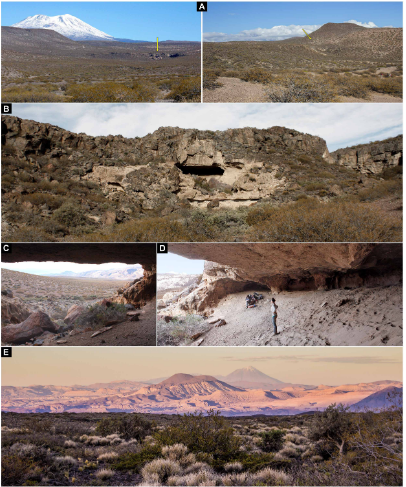
Cueva Huenul 1 environment and landscape. (A) emplacement of Cueva Huenul 1 (yellow arrow) in a volcanic landscape within the Monte desert. (B) to( D) Views of the cave’s geology and topography. (E) View from Cueva Huenul 1 of the volcanic landscape of northwestern Patagonia. Guadalupe Romero Villanueva in Villanueva et al. (2024).

Notably, the Cueva Huenul 1 site has yielded a remarkable quantity of art-related materials, including  perforated  shell  beads, decorated Guanaco bones, and pyro- engraved  gourds. Also found inside the cave was a pit-structure containing a large number of twigs from the desert shrub Senna  aphylla, which have been stained with red ochre. A large amount of pigments, of various colours and in varying states of preparation.

Cueva Huenul 1 site plan and special findings. (A) excavation units at ch1. (B and C) General and detailed view of pit structure filled with vegetal remains of Senna  aphylla stained with red ochre. (D) Pyro-engraved gourd. (E) Perforated shell bead. (F) decorated guanaco (Lama guanicoe) bone. (G) Pigments. each image has an individual metric scale. Guadalupe Romero Villanueva and Ramiro Barberena in Villanueva et al. (2024).

The site has a panoramic view of the surrounding landscape, although it is not visible from any other known archaeological site in the region, nor can any such site be seen from the cave. Other sites in the region include a series of smaller caves and rockshelters, most of which only appear to have been used within the last 2000 years. Some of these, such as El Ciénego and Paso de las Tropas, also have rock art, although it is less diverse in technical style and less formalised than the art at Cueva Huenul 1. The Cueva Yagui site, to the north of Cueva Huenul 1, also records a long timeline, in this case about 8 500 years, and appears to have been more intensely occupied, on the basis of stone tools, abundant ceramics, and faunal remains, with this occupation being particularly intense over the past 2000 years. Both the stratigraphic sequences and the styles of rock art suggest that Cueva Huenul 1, Cueva Yagui, and other sites appear to have been linked.

Cueva Huenul 1 hosts one of the most impressive collections of rock art in northwestern Patagonia, with central portion of the cave’s internal wall and part of the ceiling covered by 895 discrete pieces of rock art, which have been grouped into 466 identifiable motifs. Most of these motifs are geometric shapes rather than pictures, with strokes, dots, circles, and lines being common, and parallel lines, reticulates, polygons, and cruciforms also present, as well as some Human silhouettes and a face, and silhouettes of Guanaco and Choique, Rhea pennata, and some representations of dynamic group  activities. A range of colours are used in the cave art, although a haematite-derived red is the most common, along with different hues of white, yellow, and black.

Examples of the rock art of Cueva Huenul 1. Each tracing has a 10cm scale bar. Guadalupe Romero Villanueva in Villanueva et al. (2024).

A large number of motifs are superimposed over earlier artworks, and there appear to be three distinct degrees of weathering, as well as distinct artistic phases. The majority of the art is presumed to be of Late Holocene origin, based upon similarities to styles of art used at other localities. However, the long history of occupation at the site combined with presence of a clear artistic sequence, raises the possibility that some art at the site may be much older.

Four artworks at the Cueva Huenul 1 site were chosen to be dated. These were all classified as 'comb-shapes' based upon a shared basic morphology of a perpendicular horizontal line with several parallel vertical lines extending downwards from it. Within this simple pattern, however, the comb motifs can be divided into simple and complex forms. Three of the motifs examined, UT3- M48, UT5- S4- M7, and UT3- M37, were of the simple type, while the fourth, UT5-S2-M19, was of the complex form. All of the comb motifs are executed in a reddish black pigment. Most are isolated from other artworks, although one (UT5-S2-M19) is part of a complex series of superimposed images from different periods. 

Dated rock art paintings from Cueva Huenul 1. (A) Motif Ut3- M37. (B) Motif Ut3- M48. (C) Motif Ut5- S4- M7. Guadalupe Romero Villanueva in Villanueva et al. (2024).

By careful examination of the motifs, Villanueva et al. were able to establish that there was no potentially contaminating organic matter  either  on,  within,  or  below  the  paint  layer. Three layers were found to be present, the bedrock, the pigment layer, and an overlying layer of translucent particles forming a patina. The pigment layer was identified spectrographically as amorphous carbon; this was found not to contain any significant amount of phosphates, making it unlikely it was derived from carbonized bone.

Dated rock art motif UT5- S2- M19 from Cueva Huenul 1. (A) Original photograph and digital enhancement with DStretch of the complete rock art panel. (B) Original photograph and digital enhancement with DStretch of the dated black comb-shaped motif. (C) digital tracing of the complete rock art panel showing the dated black comb-shaped motif underlaying a series of superimpositions. Guadalupe Romero Villanueva in Villanueva et al. (2024).

Further examination of the samples by Scanning Electron Microscopy and Energy Dispersive X-Ray Analysis demonstrated the presence of plant cells within the pigment layer of all four examined motifs, as well as a composition consistent with a carbonaceous material mixed into an aluminosilicate matrix (i.e. a mixture of charcoal and clay), with the overlying layer of material rich in calcium and sulphur, probably indicating some form of salt. The precise origin of the wood used to make the charcoal was impossible to determine, although it is likely to have been one of the woody shrubs known to have been growing in the region in the Middle Holocene, such as Prosopis spp., Larrea sp., or Schinus sp..

Cross section microphotography of sample CH1-AMS1 embedded in resin showing three differentiated layers. From the bottom, the layers which can be distinguished are; the bedrock support, the black pictorial layer, and a thin layer of patina or varnish. Marcela Sepúlveda and Guadalupe Romero Villanueva in Villanueva et al. (2024).

Based upon this, Villanueva et al. conclude that the black pigment was formed by the incomplete burning of Plant matter, something which should lead a carbon¹⁴ signature. Since there are no long-lived trees in the region, material from which can give misleading date information, the charcoal can be assumed to have come from a short-lived woody C₃ shrub and/or a Cactus (which have their own Crassulacean acid metabolism resulting in a distinctive carbon isotope signature). It was possible to recover sufficient carbon from three of the motifs to be confident that the isotope signature recovered was accurate, while one sample, taken from motif UT5-S2-M19, yielded a much lower amount of carbon, raising concerns that contamination from later sources (this is the motif which is partially overlain by later artworks), leading to this data being excluded from the remainder of the study. The remaining three motifs were found to be between 7728 and 7565 years old (UT3- M48), between 6271 and 6239 years old (UT5- S4- M7), and between 5643 and 5629 years old (UT3- M37).

As well as the dates obtained for the rock art motifs, Villanueva et al. obtained 16 dates from archaeological remains at the site, in order to build up a stratigraphic sequence. This led them to conclude that there had been four stages of occupation at the site, over a period of about 18 000 years. 

The first phase is calculated to have lasted approximately 4683 years, from about 17 407 to about 12 934 years before the present. During this phase the cave was occupied by Giant Sloths, with no signs of Human activity. 

The second phase is calculated to have lasted approximately 1620 years, from about 11 721 to about 10 162 years before the present, and shows evidence of the first Human activity in the area, including Guanaco bones with cut marks, hearths with charcoal, and a grass bedding structure. 

There is then a significant hiatus in activity, with the third phase starting about 8171 years ago and lasting for approximately 3246 years, till about 5074 years before the present. This phase includes the emergence of rock art at the site, with all three dates obtained for the comb motifs falling within this interval, as well as the ochre covered Plant remains. Assuming that the average Human generation time was about 25 years, this would suggest a cultural tradition using similar symbolism which lasted for about 130 generations. 

The final phase of activity at the cave includes much more intensive activity, includuing the majority of the rock art, as well as cultural similarities to other sites in the region, and spans about 1500 years in the Late Holocene.

Climatically, the area had a sharper east-west variation in moisture during the Late Pleistocene and Early Holocene, until about 10 000 years ago, with the western Andes being wetter than today, while the eastern Andes were drier. The region to the east of the Andes, inclding the Cueva Huenul 1 site, was significantly more arid than today between about 10 400 and 9 400 years ago. From about 10 000 years ago onwards both the Andes and Eastern Patagonia became extremely arid.

The area reached peak aridity in the Middle Holocene, with widespread deserts and only patchy, fragmented areas of habitable land, which could have acted as stepping stones for the first Humans entering the environment. Large areas would have either too dry for occupation, or too unstable to be entered on more than a temporary basis. Nevertheless, Humans did enter the landscape during this time, probably relocating frequently, and needing to maintain social contact over large distances, while at the same time coming up with innovative technologies for subsistence.

By assembling a comprehensive database of radiocarbon dates for Human activity across the South American Arid Diagonal region, Villanueva et al. conclude that during the period 14 000 to 10 400 years before present the first Human population appeared and rapidly grew, expanding to occupy new niches. From about 10 800 to 7000 years ago a period of cultural stasis appeared, combined with a slowly declining population. The oldest rock art at Cueva Huenul 1 is slightly less that 8000 years old, coinciding with the later part of this period of apparent cultural stasis. The population is also thought to have remained fairly static or shrank across South America between about 9000 and about 5500 years ago. 

This suggests that during the Middle Holocene northwestern Patagonia was probably home to a small and scattered population of highly mobile hunter-gatherers, coping with an extremely arid climate with occasional wetter spells. This population was static or shrinking slightly, widely scattered, and having to cope with frequent but unpredictable extreme weather conditions.

The dating of the comb motifs in the rock art of Cueva Huenul 1 gives a date for the origins of rock art in northwestern Patagonia. The repeated nature of these motifs makes it unlikely that these marks were random, with similar marks being repeated several times over a period of about 3000 years, suggesting it was linked to a system for passing information between generations.

Transmission of knowledge can become linked to particular sites, which eventually become key locations for a culture, where people meet to re-enforce cultural identities and maintain extended social networks. Villanueva et al.  suggest that Cueva Huenul 1 first became such a culturally important site during the Late Pleistocene, being used regularly over a period of about 1400 years across the End Pleistocene and Early Holocene. Visits to the site continued into the Middle Holocene, though the behaviour of the visitors changed, with the appearance of activities such as marking the walls. During this phase, there is little sign of non-ritual activities, such as food-processing or tool-making. Villanueva et al. suggest that the transition of the space to a ritual centre where these profane activities were not carried out probably implies that the site was not, as previously assumed, abandoned for long periods during the Middle Holocene, but rather underwent a change of purpose connected to its new, sacred status. 

Villanueva et al. suggest the emergence of sites such as Cueva Huenul 1 which helped hold widely scattered cultures together would have been key to Human survival in the arid landscape of northwestern Patagonia. The emergence or rock art was probably a way of re-enforcing knowledge transfer across generations, building upon an earlier oral tradition. 

The population of many areas in South America apparently struggled to cope with conditions in the Middle Holocene, as increasing aridity fragmented the available liveable spaces, leading to a slowly dwindling population. The first rock art at Cueva Huenul 1 coincides with this period, possibly aiding social cohesion and helping  people to survive a particularly harsh period, before populations began to recover between 7000 and 5000 years ago. 

The dating of the rock art at Cueva Huenul 1 gives an insight into the context in which such art first appeared in Patagonia. Here, a style of art appears around 8000 years ago and persists for over 3000 years. This happened at a time when the climate was much drier and less predictable than today, at a time when Human populations were at best maintaining stasis, and were probably suffering frequent crashes. It this marginal, sparsely populated environment the rock art apparently helped to preserve collective knowledge across multiple generations. 

See also...

Wednesday, 9 August 2023

Direct archaeological evidence for the torture and mutilation of Mapuche prisoners during the sixteenth century 'War of Arauco'.

The conflict between the conquering Spanish and the indigenous peoples of the Americas has retained a reputation for particular brutality, even against the wider context of European conquests of non-European peoples. In Chile the conflict between the Spanish and the indigenous Mapuche people lasted for almost three centuries, from 1536 to 1810, a period known as the 'War of Arauco', although this is somewhat of a misnomer, with the 'war' comprising several periods of intense conflict, interspersed with periods of peace. The Mapuche people were able to resist conquest by the Spanish for so long due to their willingness to adopt the tools of their enemies, including firearms, cavalry, and military tactics.

In 1550 the Spanish commander Pedro de Valdivia reported execution and mutilating Mapuche prisoners by cutting off of hands, feet, noses, ears, and breasts, which was a common practice for Spanish leaders of the time (de Valdivia was defeated in battle, captures and executed by the Mapuche three years later). The tactics used by the Spanish in the Americas typically involved capturing political and religious leaders, forcing surrender through torture, and then publicly massacring important members of the community, usually in brutal ways.

Although well documented, little physical evidence for this conflict exists today, due to the humid climate and regular heavy rains of south-central Chile, which are not favourable for the preservation of archaeological remains. Furthermore, many archaeological collections made in the first half of the twentieth century have either been lost or kept so poorly that it is hard to assess their original context. 

In a paper published in the journal Open Archaeology on 19 July 2023, Juan Francisco Reyes Sánchez of the Equipo Chileno de Antropología Forense, and Alberto Enrique Pérez of the Facultad de Ciencias Sociales y Humanidades at the Universidad Autónoma de Chile, present a study of two burials at the Newen Antug archaeological site in Neuquén Province, Argentina, which show evidence of violence likely to have been linked to the conflict with the Spanish. 

The Newen Antug archaeological site lies on the Argentinian side of the Valdivia River Basin, which forms the border between Chile and Argentina, within the Lácar and Nonthué Lake System. The site was first occupied about 880 years ago, and has yielded, amongst other things, the earliest known canoe burial in South America. 

Newen Antug site, on the shores of Lácar Lake, which is part of a binational archaeological site in the Valdivia river basin. The inset shows the stash of Florentine stirrup location and small Spanish fort location. Reyes Sánchez & Pérez (2023).

It this study Reyes Sánchez and Pérez examine two individuals, one female and one male, which date from the second occupation of the site, Both were laid on their right sides with their legs flexed and their arms parallel to their bodies. Their heads (in both cases) have rotated paraventral on their axial axes as a result of the loss of thoracic volume and the resistance of the intervertebral tissues due to compaction of the grave. 

The grave of the female individual has an east-west axis with the body laid facing to the south. The male individual is laid in a grave with a northwest-southeast axis, facing to the northeast. Three clay pots were placed within the grave of the female, decorated in the local Valdivia Red on White Bichrome tradition, and arranged around her head.

Plan of the excavation of the mortuary features of Individuals 1♀ and 2♂ of the Newen Antug site. Reyes Sánchez & Pérez (2023).

The female individual is estimated to have been 150 cm tall, and based upon morphology of the cranial and postcranial skeleton and examination of tooth wear, the to have been over 52 years old. The male is estimated to have been 168 cm high and 30-40 years old. Radiocarbon dating of a piece of charcoal from the grave of the female individual gave a date of 540 years before the present, consistent with the mid sixteenth century, when the first contact (and conflict) between the Spanish and the Mapuche occurred.

The female is missing both hands and the lower part of the left arm, and has as grave goods the calcaneus and astragalus of a Horse (another sign of contact with the Spanish), and a sharpened partial metatarsus of a South Andean Deer, possibly as a replacement for the missing limb portions. She also has a curved transverse fracture on the left ulna, with a regular border, stepped and with crushed edges, and associated with a longitudinal fracture, and an s an incomplete oblique fracture of the medial portion of the humeral diaphysis. The damage to the right left radius is consistent with a spiral fracture, although the preservation of this bone is not good enough to be certain.

The male also lacks the left hand and the lower part of the left forearm, with a spiral fracture on the e medial diaphysis of the left radius, with the broken edge of both the radius and ulna showing signs of crushing and scaling. Another incomplete fracture is present on the right ulna.

Diagram of skeleton, anterior view. Individual 1♀ and Individual 2♂, respectively. The locations of the lesions are shown in red. Reyes Sánchez & Pérez (2023).

The break to the right ulna of the male skeleton is consistent with a 'parry fracture', i.e. a would suffered while defending against a blow, while the left fibula shows signs of a blunt force injury, probably the result of another blow.

The injury to the left humerus of the female skeleton is consistent with a blunt force injury inflicted while the limb was flexed and rotated, while held in position at the upper end. Such injuries elsewhere have been interpreted as signs of torture, i.e. injuries deliberately inflicted on an individual while they are restrained. 

Both individuals have lost the lower part of their left arms, and both show signs of blunt force trauma to the remaining portion of the bones of the lower arm. This is unusual, and blunt-force injuries do not usually remove portions of limbs. While the injuries produced by sharp blades and blunt objects are generally quite different, prior observations have suggested that heavy axe blows can sometimes produce a hybrid injury, both crudhing part of a limb and hacking off the portion below the site of the blow. This appears to be entirely consistent with the injuries to the limbs of both individuals. 

The injuries to these individuals appear quite different to those seen in individuals injured in conflict settings; instead they show injuries consistent with having been brutalised while being tied down or otherwise restrained. 

Prior to contact with the Spanish dismemberment seen in skeletons was consistent with one of two causes; injury in battle, or post-mortem dismemberment for ritual purposes. Notably, in late pre-contact Andean societies, port-mortem dismemberment of bodies to make war trophies was a common practice, as are pre-death blunt force trauma injuries, particularly to the head area, and cuts on the bones of the neck from where the throat was cut.

The arrival of the Spanish in the Americas brought new technologies and practices of injuries to the area. In southeastern North America, the Gulf of Florida, and Peru, this has been shown to manifest in the widespread execution-style killing of both adults and children, pre-death injuries including pre-death blunt force injuries, lessons caused by blunt-sharp blows, and injuries caused by firearms.

Documents made by the Spanish themselves during this period record captured leaders being tied to tree-trunks and tortured by mutilation, who then had their wounds cauterized before being set free, with the intention that they would live long enough to return to their people and display the traumatic injuries, spreading general alarm. This practice appears to have been carried out on a massive scale, with producing large piles of severed limbs and other bodyparts. One notable form of torment was to disarticulate the hand from the forearm, leaving it dangling by a tendon. Notably, such a practice can be achieved without leaving and cuts on the bones, as can other forms of torture known to have been used during the Spanish invasion, which could therefore also potentially have been used on the Newen Antug individuals.

Engravings by Théodore de Bry showing mutilations of hands and noses (bottom) and torture (top) applied by Spanish soldiers to indigenous people in America. Reyes Sánchez & Pérez (2023).

In 1552 and 1553, Spanish troops under r Francisco de Villagra are known to have passed through the Neuquén Andean lake district, engaging in a number of conflicts with the local population, which resulted in heavy casualties on both sides. 

The two individuals buried at Newen Antug appear to have been members of the community held in high regard, who were buried with special care with symbolic artefacts emphasizing their leadership roles. 

Reyes Sánchez and Pérez interpret the injuries suffered by these two injuries as indications that they were taken hostage by the Spanish, and subjected to torture and mutilation whilst restrained, particularly to the left hands and forearms. Both left arms appear to have been struck with sufficient force to split the arm in two, with the injury most likely caused by a blunt axe impacting at an angle of about 45°. These injuries almost certainly lead to the deaths of their victims, but probably not straight away, something consistent with Spanish records of prisoners being tortured and mutilated before being released to spread fear in their communities.

See also...

Follow Sciency Thoughts on Facebook.

Follow Sciency Thoughts on Twitter. 


Saturday, 8 April 2023

Oceanic Phylloceratid Ammonites from the Middle Jurassic Neuquén Basin of Argentina.

The Neuquén Basin is a sedimentary basin to the east of the Andes in western Argentina, covering about 120 000 km². Here a series of deposits record repeated marine transgressions from the Jurassic well into the Tertiary, and is a significant oil reserve as well as a famous fossil-producing region. During the Middle Jurassic the basin was cut off from the Palaeopacific Ocean by a volcanic arc following the line of the modern Andes. In theory, this enclosed basin should have been devoid of open ocean organisms, such as Phylloceratid Ammonites, however, members of this group are occasionally reported from Middle Jurassic deposits within the Neuquén Basin, suggesting that a connection to to the open ocean was at least sporadically present.

In a paper published in the journal Revue de Paléobiologie, Genève on 15 January 2023, Bernard Jolly of Beaugency in France, Horacio Parent of the Laboratorio de Paleontología, at the Universidad Nacional de Rosario, and Alberto Garrido of the Museo Provincial de Ciencias Naturales 'Prof. Dr. Juan A. Olsacher', and the Centro de Investigación en Geociencias de la Patagonia of the Universidad Nacional del Comahue, describe Phylloceratid Ammonites belonging to three species from an exposure of the Middle Jurassic Los Molles Formation in Picún Leufú Department of Neuquén Province, Argentina. 

The outcrop from which the specimens were collected lies about 7 km to the west of the point where National Road-40 crosses the Arroyo Picún Leufú stream. The rocks here are of Aalenian Age (between 174.1 and 170.3 million years old), with most of the sequence being covered, but several layers of black shale and fine, calcarious sandstone exposed.

(A) The Neuquén Basin with indication of the study area. (B) Geological map of the study area with indication of the studied section. Jolly et al. (2023).

The first three specimens described are juvenile phragmocones (chambered sections of the shell, where the Animal lived before reaching maturity) assigned to the species Phylloceras perplanum, which has previously been recorded from Hungary and France. These are compressed and very involute Ammonites, with smooth, slightly rounded sides. The Argentinian specimens are very close to the French and Hungarian specimens in both form and dimensions.

The next three specimens are three more juvenile phragmocones, referred to the genus Calliphyloceras, and considered to show affinities to the species Calliphyloceras achtalense, which has previously been recorded from Georgia (eastern Europe) and France. These are compressed specimens with constrictions perfectly matching specimens of Calliphyloceras achtalense from what would have been the ancient Tethys Ocean, although slightly smaller and with with a narrower umbilicus. The European/Tethyan specimens are also slightly younger, dating from the Bajocian (170.3 to 168.3 million years ago).

The final specimen described is an entire conche (outer shell) assigned to the genus Costiphylloceras, and assigned to a new species, Costiphylloceras limayense, in reference to the Rio Limay, into which the Picún Leufú flows. The new species is erected on the basis of the occurrence of pronounced ribs on the upper third of the flanks, particularly on the ventral side. 

Phylloceratid Ammonites from the lower Aalenian of Picún Leufú; Los Molles Formation. (A)-(C): Phylloceras perplanum; juvenile phragmocones; (A) MOZ-PI-6640; (B) MOZ-PI-6641; (C) MOZ-PI-6642). (D)-(F) Calliphylloceras aff. achtalense; phragmocones; (D) MOZ-PI-6637; (E) MOZ-PI-6638; (F) MOZ-PI-6643). (G) Costiphylloceras limayense; phragmocone (MOZ-PI-6639). Jolly et al. (2023).

See also...


Online courses in Palaeontology. 

Follow Sciency Thoughts on Facebook.

Follow Sciency Thoughts on Twitter.


Monday, 27 December 2021

Patagoniapteris artabeae: A new species of Dipteridacean Fern from the Triassic of Argentina.

The Family Dipteridaceae today contains ten species of Ferns divided into two genera, found in tropical and subtropical areas of Asia, Australia, and the Pacific Islands. However, in the past they were much more widespread and diverse, with fossils known from all over the world. The oldest examples appear in the fossil record in the Middle Triassic, leading to speculation that they may have first evolved in the Early Triassic or even the Permian, and they reached their maximum diversity in the Late Triassic and Early Jurassic, after which they appear to have declined throughout the remainder of the Mesozoic, a pattern also seen in many other Fern groups.

The Dipteridaceae have distinctive bilobed, fan-shaped fronds, born on long stipes (leaf stems), with toothed margins and reticulate (meshed) veination. Sori (spore-bearing bodies) are scattered across the undersides of these fronds.

In a paper published in the journal Acta Palaeontologica Polonica on 29 November 2021, Silvia Cristina Gnaedinger of the Área de Paleontología at the Centro de Ecología Aplicada del Litoral of the Consejo Nacional de Investigaciones Científicas y Técnicas, and Ana María Zavattieri of the Departamento de Paleontología at the Instituto Argentino de Nivología, Glaciología y Ciencias Ambientales, describe a new species of Dipteridacean Fern from the Paso Flores Formation of Neuquén Province in Argentina.

The Paso Flores Formation is found within the Neuquén Basin, a rift valley to the east of the Andes that formed in the Late Triassic and Early Cretaceous by extensional rifting on the western margin of the Gondwanan supercontinent. The formation is a sedimentary system recording a braided river system and alluvial fan. It overlies a late Palaeozoic volcanic system unconformably, and is itself overlain unconformably by Early Jurassic volcanic rocks. This formation has produced a wide range of Late Triassic fossil Plants, including three previous Dipteridacean Ferns.

 
Generalised outline of the Neuquén Basin, showing the location of the studied area of the Paso Flores Formation, Neuquén Province, Patagonia, Argentina. Gnaedinger & Zavattieri (2021).

The new species is named Patagoniapteris artabeae, where 'Patagoniapteris' means 'Patagonian Fern' and 'artabeae' honours Argentinian palaeobotanist Analia Artabe for her important contributions to the knowledge of the Triassic and Jurassic floras of Argentina. The species is described from a series of sterile and fertile frond fragment impressions. These fronds are dissected into two equal and opposite rachial arms, each one having more than 18 primary segments. The primary segments are fused together for the lower third of their length, the remaining parts are free and lance-shaped, with undulating to deeply dissected margins, The primary and secondary veins are simple, with the tertiary veins forming an irregular polygonal mesh.

 
Dipteridacean Fern Patagoniapteris artabeae from the upper Norian–Rhaetian, Upper Triassic Paso Flores Formation, Neuquén Province, Argentina. (A) MCF-PBPH 066, part of the frond showing fused and dissected portions. (A₁), (A₂) basal portion of a rachial arm with the lamina of the primary segments fused. (A₃) detail showing primary segments with the dissected portion of the lamina. (B) MCF-PBPH 415, primary segments of fertile frond; (B₁), (B₂) deeply dissected lobes. (C), (D) Primary segments of sterile frond. MCF-PBPH 067d (C) and MCF-PBPH 069 (D). (C), (D₁) deeply dissected lobes. (D₂) detail of a lobe of the primary segment, showing secondary and tertiary veins. Scale bars 10 mm. Gnaedinger & Zavattieri (2021).

See also...


Online courses in Palaeontology. 

Follow Sciency Thoughts on Facebook.

Follow Sciency Thoughts on Twitter.


Thursday, 8 November 2018

Lavocatisaurus agrioensis: A new species of Rebbachisaurid Sauropod Dinosaur from the Early Cretaceous of Argentina.

The Rebbachisaurids are a group of Diplodocimorph Sauropod Dinosaurs known from the Cretaceous of South America, Africa and Europe. They are considered to be the sister group to the other two Diplodocimorph clades, the Diplodocids and the Dicraeosaurid, which along with their presence on both sides of the Atlantic (implying they must have appeared before this ocean opened) suggests that they first appeared in the Middle Jurassic, though the earliest fossils confidently assigned to the group date from the middle of the Early Cretaceous, with the group persisting till the middle of the Late Cretaceous, making them the last surviving Diplodocimorph group.

In a paper published in the journal Acta Palaeontologica Polonica on 29 October 2018, José Canudo of the Facultad de Ciencias at the Universidad de Zaragoza, José Carballido of the Museo ‘Egidio Feruglio’, Alberto Garrido of the Museo Provincial de Ciencias Naturales ‘Prof. Dr. Juan Olsacher’ and the Departamento Geología y Petróleo at the Universidad Nacional del Comahue, and Leonardo Salgado of the Instituto de Investigación en Paleobiología y Geología at the Universidad Nacional de Río Negro, describe a new species of Rebbachisaurid from the Early Cretaceous Rayoso Formation at Agrio del Medio in Neuquén Province in Patagonia.

The new species is named Lavocatisaurus agrioensis, where ‘Lavocatisaurus’ honours the French palaeontologist René Lavocat (1909-2007), who described Rebbachisaurus, the first known Rebbachisaurid and the genus from which the group takes its name, and ‘agrioensis’ means ‘from Agrio’. The species is described from a fragmentary yet still partly articulated skeleton comprising both dentaries, the left surangular, premaxillae and maxillae, the left jugal, the right squamosal, the quadrates, 23 isolated teeth and two series of 8 and 9 maxillary teeth, thehyoid bone, 11 cervical vertebrae (including the atlas and axis), 28 caudal vertebrae, cervical ribs, 2 dorsal ribs, a humerus, and a fragment of what is probably the radius, plus 24 other bone fragments thought to have come from juvenile specimens of the same species.


Rebbachisaurid Sauropod Lavocatisaurus agrioensis from Agrio del Medio (Argentina), Aptian–lower Albian. (A) Axis in lateral view (A₁) photograph, (A₂) drawing; eight cervical vertebrae in lateral view view (A₃) photograph, (A₄) drawing; anterior caudal vertebra in lateral view (A₅); middle caudal vertebra in lateral view (A₆); posterior caudal vertebra in lateral view (A₇); posteriormost caudal vertebra in lateral view (A₈); left tibia in lateral view (A₉). (B) Left scapula from a juvenile specimen, in lateral view. (C) Skeletal reconstruction based on the holotype and paratype specimens. Scale bars are 10 cm. Canudo et al. (2018). 

See also...

http://sciencythoughts.blogspot.com/2018/10/maraapunisaurus-fragillimus-edward.htmlhttps://sciencythoughts.blogspot.com/2018/09/ledumahadi-mafube-giant-sauropodomorph.html
https://sciencythoughts.blogspot.com/2018/07/lingwulong-shenqi-new-species-of.htmlhttps://sciencythoughts.blogspot.com/2017/03/dinosaur-phylogenetics-radical-new.html
https://sciencythoughts.blogspot.com/2016/10/savannasaurus-elliottorum.htmlhttps://sciencythoughts.blogspot.com/2016/04/notocolossus-gonzalezparejasi-new.html
Follow Sciency Thoughts on Facebook.

Friday, 15 December 2017

Shark remains from the Early Cretaceous of Argentina.

Sharks first appeared during the Devonian, and are still dominant predators in the seas of today. They form an important part of the marine fossil record in many areas, and are occasionally used for stratigraphy (dating rocks), though often they are usually only represented by their teeth, which are mineralised and grown and shed throughout their lives. Despite this, as with all groups. there are gaps in their fossil record, with areas where, despite apparently having good Shark habitats, Sharks remains are absent from the fossil record. One such area is southwestern Gondwana (South America and Antarctica), where Shark remains are common from the Late Cretaceous and Cainozoic, but almost entirely absent from the Jurassic and Early Cretaceous.

In a paper published in the journal Cretaceous Research on 13 September 2017, Soledad Gouiric-Cavalli and Alberto Cione of the Divisi on Paleontología Vertebrados at the Museo de La Plata, and the Consejo Nacional de Investigaciones Científicas y Técnicas, and Darío Lazo, Cecilia Cataldo, and María Aguirre-Urreta, also of the Consejo Nacional de Investigaciones Científicas y Técnicas, and of the Instituto de Estudios Andinos “Don Pablo Groeber” at the Universidad de Buenos Aires, describe two partial Shark specimens from the Early Cretaceous Agrio Formation of Neuquén Province in Argentina.

The first specimen described is a partial spine from the dorsal fin of a Hybodont Shark, a group of highly distinctive Sharks that appeared in the Devonian and which are generally thought to have become extinct at the End of the Cretaceous. This is incomplete, and broken into two fragments, but is extremely distinctive, with a pulp cavity, a keel on its foreward surface, and a series of denticle bases on its rear surface, features not seen in anything other than the spines of Hybodonts.

Hybodontiformes fin spine. (A) Silhouette of the fin spine in which preserved parts are shown. (B)-(C) Posterior fin spine margin to show the denticle bases. (D) Cross section of the fin spine in their anterior margin at level illustrated in (A) with a circle. (E) Close-up of (B) to show denticle bases. (F) Cross section of the fin spine at level shown in (A). Scale bars are 20 mm in (A) and (C), 2 mm in (D), and 3 mm in (E) and (F). Gouiric-Cavalli et al. (2017).

The second specimen described is a partial tooth assigned to an unknown member of the genus Protolamna, a group of Mackeral Sharks that went extinct at the end of the Cretaceous. This is a small tooth, only 4 mm in height, though the tip of the cusp is missing.

Protolamna sp. (A) Labial view. (B) Lingual view. Scale bar is 2 mm. Gouiric-Cavalli et al. (2017).

See also...

http://sciencythoughts.blogspot.co.uk/2017/12/american-tourist-killed-by-shark-in.htmlhttp://sciencythoughts.blogspot.co.uk/2017/12/californian-student-recovering-after.html
http://sciencythoughts.blogspot.co.uk/2016/09/megachasma-alisonae-megamouth-shark.htmlhttp://sciencythoughts.blogspot.co.uk/2016/01/mollisquama-sp-pocket-shark-from-gulf.html
http://sciencythoughts.blogspot.co.uk/2015/11/evidence-of-shark-predation-on-whale.htmlhttp://sciencythoughts.blogspot.co.uk/2015/07/carcharocles-megalodon-did-megashark.html
Follow Sciency Thoughts on Facebook.