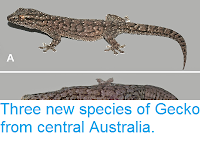
The first new species described is named Gehyra versicolor, meaning ‘variable in colour’. The species comprises populations in South Australia, Northern Territory, Queensland, New South Wales and Victoria previously assigned to the species Gehyra variegata, a species name that is now restricted to populations in South Australia and Western Australia, with a small overlap in South Australia where populations of both species occur. Both species are highly variable, and cannot be distinguished from one-another physically. However the species are genetically distinct, and can be told apart by karyotype (the gross morphology of the chromosomes) without full genetic screening.

Gehyra variegata. (A) Adult female from a rocky microhabitat from Fraser Range, Western Australia, showing a complex reticulate pattern, with strongly contrasting dark markings strongly margined with white. (B) Adult female from an arboreal microhabitat from Maralinga South Australia, showing a less well-developed pattern with weaker pale margins. Hutchinson et al. (2014).
Gehyra versicolor; (B) and (C) adult females from arboreal microhabitats at New Year’s Gift Bore, 9.6 km southewest of Bopeechee, South Australia, showing strong and weak pattern variants typical of both inter- and intra-population variation for this species. (D) Adult male from Witchelina Station, South Australia, with speckled patterning sometimes seen in rock dwelling populations. Hutchinson et al. (2014).
Karyotypes which of (A) Gehyra variegata from the Maralinga area, South Australia. (C) Gehyra versicolor from Yudnamutana Bore, Flinders Ranges, South Australia. Hutchinson et al. (2014).
Map showing the documented occurrence of Gehyra variegata (dark grey) and Gehyra versicolor (light grey). Hutchinson et al. (2014).
The second new species described is named
Gehyra moritzi, in honour of
Craig Moritz of the
Australian National University in Canberra, and
University of California, Berkeley, in recognition of his work on the genetics of Australian Geckos. The species comprises populations of Geckos in the rocky mountains of north-central Northern Territory, from Devils Marbles in the north to the James Range in the south and west to King’s Canyon, that were identified as a probable separate species by Moritz in the 1970s. The species can be identified by karyotype or scale count, but is not otherwise distinguishable.

Gehyra moritzi. (B) Adult male from Corroboree Rock, Northern Territory, showing a strongly contrasting variant of the colour pattern. (C) Adult female from Emily Gap, Northern Territory, showing a weakly contrasting variant of the colour pattern. (D) Adult male from 2 km south of Devils Marbles, Northern Territory, with a pattern of light and dark markings that are smaller relative to the pattern in specimens from the MacDonnell Ranges as exemplified by specimen (B). Hutchinson et al. (2014).
The final new species described is named Gehyra pulingka, meaning ‘of the rocks’ or ‘of the rocky hills’ in Pitjantjatjara, a language spoken in the area where it lives. The species comprises populations of Geckos from northern South Australia, eastern Western Australia and southern Northern Territories formerly assigned to the species Gehyra montium, and distinguishable by karyotype and scale count.
Gehyra pulingka (B) adult female from Umuwa, South Australia, showing a variant of the species’ colour pattern with dense patterning of dark and light markings. (C) Adult male from Kutjurntari Waterhole, Western Australia, showing a sparse patterning of larger, more widely scattered light and dark markings. Hutchinson et al. (2014).
See also…