Showing posts with label Old World Vultures. Show all posts

Friday, 4 July 2025

Necrosyrtes monachus: Mass death of Hooded Vultures reported in The Gambia.

A mass death event affecting Hooded Vultures, Necrosyrtes monachus, has occurred in the town of Gunjur, in Kombo South District, The Gambia, according to the West African Bird Study Association. The association was contacted by local residents at 11.00  am local time on Thursday 3 July 2025, by local residents concerned by the sight of a large number of dead and dying Birds. When a team of researchers led by Fagimba Camara arrived at the site, they found 23 dead Vultures and a 24th in a sick and distressed condition.

A researcher from the West African Bird Study Association collecting dead Hooded Vultures, Necrosyrtes monachus, in Gunjur, The Gambia, following a mass death event on Thursday 3 July 2025. West African Bird Study Association.

Hooded Vultures are classed as Critically Endangered under the terms of the International Union for the Conservation of Nature's Red List of Threatened Species. There are thought to be around 131 000 adult Hooded Vultures alive, spread across 45 African countries. However, the species is estimated to have suffered a 68% population decline in three generations, and sudden population collapses have been recorded in several countries, including Côte d’Ivoire, Togo, Benin, Ghana, Nigeria, Kenya, and Botswana, and illegal killings of Birds have been recorded in several countries, including Guinea Bissau, Burkina Faso, and The Gambia.

The current distribution and conservation status of the Hooded Vulture, Necrosyrtes monachusInternational Union for the Conservation of Nature.

The researchers from the West African Bird Study Association have collected samples from the Gunjur Vultures for analysis, but it is thought most likely that the Birds have died as a result of poisoning. This is the most common cause of mass deaths among Vultures, not because they are targeted themselves, but because they will eat both bait put out for large predators which target livestock (itself an illegal activity in almost all countries), as well as the bodies of other Animals which have been poisoned, intentionally or otherwise.

See also...

Saturday, 17 October 2020

England's only Vulture returns to France.

A Bearded Vulture, Gypaetus barbatus, which has spent the summer in England's Peak District has returned to France. The Bird, which has a 2.5 m wingspan, was originally thought to have escaped from captivity, but DNA on two feathers recovered by a Yorkshire birdwatcher showed it to be a female Vulture which had hatched in the French Alps the previous year, part of a breeding program seeking to help re-establish the re-establish a permanent population there. The Vulture has spent four months in England, being sited in Derbyshire, Yorkshire, Lancashire, Lincolnshire, Cambridgeshire and Norfolk, but was seen flying out to sea over the coast of East Sussex on Thursday 15 July 2020. This is fairly typical behaviour for young Bearded Vultures, who often range over wide areas before returning to the area where they were raised, and is unlikely to result in a permanent population becoming established in the UK, although this is the second such Bird to have visited the UK in a relatively short period of time, with a previous visit having occurred in 2016, the first time the species had been recorded in Britain.

 
A Bearded Vulture, Gypaetus barbatus, over Derbyshire in July 2020.

Bearded Vultures are currently classified as Near Threatened under the terms of the International Union for the Conservation of Nature’s Red List of Threatened Species, having suffered sharp population declines in many areas of Asia and Africa since the start of the twenty-first century. In Europe the species was almost wiped out by the beginning of the twentieth century, due to a perception that it was a major predator of spring lambs, but in recent years has expanded its range due to successful conservation and reintroduction programs. The species is also reported to be doing well in the Himalayas and the highlands of Ethiopia, and is the subject of an active conservation plan in South Africa, but across the rest of its range, which includes all of Africa, South Asia and the Mediterranean Basin, populations of Bearded Vultures have been severely impacted by habitat loss due to expanding Human infrastructure, reduced food availability due to the disappearance of other species, deliberate poisoning intended to protect livestock from large carnivores, and, in places, active trophy hunting.

See also...


Follow Sciency Thoughts on Facebook.

Follow Sciency Thoughts on Twitter


Friday, 6 March 2020

Necrosyrtes monachus: Around a thousand Hooded Vultures have died in Guinea Bissau in the last few days.

The Vulture Conservation Foundation has reported the deaths of around a thousand Vultures, the majority of them the Critically Endangered Hooded Vulture, Necrosyrtes monachus, in Guinea Bissau, since 23 February this year (2020). The Vultures have been found in groups, mostly around the towns of Bafatá and Gabu, suggesting that whole populations are being hit simultaneously, with witnesses reporting that the Birds seemed to foam at the beak before dying, and were showing signs of extreme thirst, which may be indicative of strychnine poisoning, possibly by people trying to control feral Dogs, which are a considered a problem in the area.


Hooded Vultures, Necrosyrtes monachus, consuming a dead ferral Dog, in The Gambia, West Africa, in 2016. Paul Walter/Flikr/Wikimedia Commons.

Hooded Vultures are classed as Critically Endangered under the terms of the International Union For the Conservation of Nature’s Red List of Threatened Species (there are only two higher categories, ‘Extinct in the Wild’ and ‘Extinct’). They were once widespread across much of sub-Saharan Africa, but have died out or suffered massive population losses across much of their former range. One of the few areas where populations have remained reasonably stable encompasses Guinea Bissau, the Casamance area of Senegal, and The Gambia, which makes a sudden, large, die-off of the Birds in this region particularly alarming. If the cause of the deaths is poisoning, then it is likely that the deaths will remain confined to one region, but if they are the result of an unknown disease, then there is a possibility that the die-off may spread to other Vulture populations. Unfortunately Guinea Bissau is one of Africa's poorest nations, and has been suffering from political instability for some years, with the effect that the country has few veterinary or medical facilities capable of carrying out tests to determine the cause of the deaths.

The distribution of known Vulture die-offs in Guinea Bissau since 23 February 2020. Vulture Conservation Foundation.

See also...

https://sciencythoughts.blogspot.com/2019/04/assessing-genetic-diversity-of.htmlhttps://sciencythoughts.blogspot.com/2018/02/vultures-and-lions-poisoned-outside.html
https://sciencythoughts.blogspot.com/2014/12/establishing-vulture-safe-zones-across.htmlhttps://sciencythoughts.blogspot.com/2013/04/a-fossil-vulture-from-miocene-of.html
Follow Sciency Thoughts on Facebook.

Monday, 8 April 2019

Assessing the genetic diversity of the Endangered Cape Vulture in breeding colonies in South Africa.

Many species of Old World Vultures, Gypaetinae and Aegypiinae, have suffered severe declines in population in recent years, particularly in Africa and Asia, with sixteen of the twenty three species currently listed as Threatened, Endangered or Critically Endangered by the International Union for the Conservation of Nature. Despite considerable conservation efforts in recent years, many of these species have continued to decline, leading to rising concern amongst conservationists. One particular worry is that many of these Bird species may have suffered a decline in genetic diversity, which can reduce the ability of populations to cope with diseases or other crises; this is particularly true when populations become fragmented due to habitat loss, with the effect that each individual population contains only a fragment of the total genetic diversity of the species, so that these smaller populations may be threatened by the effects of inbreeding even thought the total population is quite large.

The Cape Vulture, Gyps coprotheres, is a Southern African species currently considered to be Endangered under the terms of the  International Union for the Conservation of Nature's Red List of Threatened Species. This species was formerly found across Southern Africa, from the Democratic Republic of Congo, Zambia, Zimbabwe, and northern Mozambique, south as far as the Cape of Good Hope. The Species is now absent from parts of the northern and possibly the eastern extent of this range, but more worryingly now only breeds at a very limited number of sites in South Africa, Lesotho, and Botswana, with sightings of the Birds in other areas almost exclusively of young Birds, which range widely after fledging but tend to return to the area where they hatched when they reach breeding age.

 A Cape Vulture, Gyps coprotheres. Chris Van Rooyen/Project Vulture.

In a paper published in the journal Scientific Reports on 2 April 2019, Courtneë Kleinhans and Sandi Willows-Munro of the School of Life Sciences at the University of KwaZulu-Natal, describe the results of a genetic study of Cape Vulture breeding populations at six breeding colonies in South Africa.

Kleinhans and Willows-Munro collected genetic samples from Cape Vultures 24 sites around six breeding colonies in South Africa, at Potberg, Collywobbles, Msikaba, Umzimkulu, Skeerpoort, and Kransberg. The genetic material was obtained from feathers, Vultures that had died from a variety of causes, blood samples from Vultures captured as part of a program to fit Birds with GPS tracking systems, and museum specimens from known points of origin. In addition to Cape Vultures, three other Vulture species present were sampled, these being the Near Threatened Bearded Vulture, Gypaetus barbatus; the Critically Endangered Hooded Vulture, Necrosyrtes monachus; and the Critically Endangered White-backed Vulture, Gyps africanus.

Distribution of Gyps coprotheres. Extant and extinct geographical distribution of Gyps coprotheres is shown. The 24 sampling localities for the 605 Gyps coprotheres included in the present study are shown (black dots). White dots indicate the six breeding colonies. Northern, Middle and Western regional grouping are also shown. Kleinhans & Willows-Munro (2019). 

Surprisingly, the sampled Cape Vultures were less genetically diverse than the other three species, including the Critically Endangered Hooded and White-backed Vultures. Some of the Cape Vultures sampled also showed signs of inbreeding, as did some of the Near Threatened Bearded Vultures (although the South African population of this species is known to be small and isolated, so it this is not a total surprise), but not the Critically Endangered Hooded and White-backed Vultures. Some of the Cape Vultures.

The Cape Vultures did not appeared to be completely tied to reproducing in the same nesting areas as where they were raised (something which can cause severe problems for species in which reproducing populations fall too small), but rather the colonies could be grouped into three regional populations; with Birds apparently moving freely between the Skeerpoort and Kransberg colonies in the north of the country, and between the Collywobbles, Msikaba, and Kransberg colonies in the east. The Potberg colony in the Western Cape was isolated from the other colonies, and the Birds there showed the lowest level of genetic diversity, which was not unexpected as this colony is already considered at risk and is being monitored carefully.

See also...

https://sciencythoughts.blogspot.com/2018/12/tyto-alba-barn-owl-from-dinaledi.htmlhttps://sciencythoughts.blogspot.com/2018/02/vultures-and-lions-poisoned-outside.html
https://sciencythoughts.blogspot.com/2015/09/hummingbird-nesting-success-improved-by.htmlhttps://sciencythoughts.blogspot.com/2015/02/the-diet-of-breeding-grass-owls-in.html
https://sciencythoughts.blogspot.com/2014/12/establishing-vulture-safe-zones-across.htmlhttps://sciencythoughts.blogspot.com/2014/08/fossil-owls-from-early-pliocene-of.html
Follow Sciency Thoughts on Facebook.

Thursday, 15 February 2018

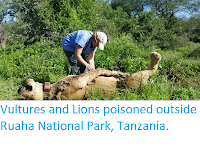
Vultures and Lions poisoned outside Ruaha National Park, Tanzania.

The Ruaha Carnivore Project has reported a mass poisoning of Lions and Vultures close to the Ruaha National Park in Tanzania, this week. The organisation investigated after receiving a warning from a radio collar on one of the Lions that the animal had died. They found the bodies of six Lions, the adult female with the collar, plus three female and two male subadults, close to a cow carcass which had apparently been poisoned before being scavenged by the animals. In addition to the Lions, a total of 74 dead Vultures were found at the site, along with four sick Birds which were taken to a treatment centre within the park; one of these Vultures subsequently died, but the remaining three appear to be doing well.

The body of a Lioness found close to the Ruaha National Park in Tanzania, having apparently been poisoned. Ruaha Carnivore Project.

The poisoning of Lions and other predators is becoming increasingly common in Tanzania, and results from the conflict between Cattle-herding communities and wildlife. The population of Tanzania has risen from 25 million in 1990 to 56 million in 2016, prompting the expansion of agriculture and pastoral activities into new areas, provoking conflict with wildlife. Traditionally, predation of Cattle by Lions or other predators would have resulted in the hunting and killing of the animals, but with this now more heavily policed by the authorities, many communities have turned to poisoning as an alternative, in this instance leading to the deaths not only of the Lions, but also the Vultures, probably unintended victims.

The bodies of Vultures found close to the Ruaha National Park in Tanzania, having apparently been poisoned. Ruaha Carnivore Project.

See also...

http://sciencythoughts.blogspot.co.uk/2018/02/suspected-poacher-eaten-by-lions-in.htmlhttp://sciencythoughts.blogspot.co.uk/2017/11/panthera-leo-gigantic-lion-from-middle.html
http://sciencythoughts.blogspot.co.uk/2017/03/the-down-side-of-animal-tagging-in.htmlhttp://sciencythoughts.blogspot.co.uk/2016/05/latimeria-chalumnae-tanzanian.html
http://sciencythoughts.blogspot.co.uk/2015/08/global-superpredator-how-human.htmlhttp://sciencythoughts.blogspot.co.uk/2014/12/establishing-vulture-safe-zones-across.html
Follow Sciency Thoughts on Facebook.

Monday, 22 December 2014

Establishing Vulture Safe Zones across South Asia.


In the late 1990s and early 2000s it became apparent that the Oriental White-backed Vulture, Gyps bengalensis, Long-billed Vulture, Gyps indicus, and Slender-billed Vulture, Gyps tenuirostris, were undergoing rapid population declines across Bangladesh, India, Nepal and Pakistan, loosing roughly 30-40% of their population each year. This was eventually found to have been caused by widespread use of the non-steroidal anti-inflammatory drug Diclofenac as a veterinary medicine for Cattle, the main food source of these Vultures across much of their range. Diclofenac and related drugs were found to be highly toxic to the Vultures, with mass death events occurring due to incidental poisoning.

This population decline was so severe that all three species were classed as Critically Endangered under the terms of the International Union Forthe Conservation of Nature’s Red List of Threatened Species (there are only two higher categories, ‘Extinct in the Wild’ and ‘Extinct’), and many Birds were taken from the wild for use in a captive breeding program, to prevent the Vultures from becoming completely extinct (conservationists are generally extremely reluctant to do this as it is expensive, time consuming, and there is a very high mortality rate – typically 40-60% - among captive bred birds released in the wild).

Since this time the use of Diclofenac as a veterinary medicine has been banned across all four countries, though it is known that medicine officially designated for Human use is still widely used to treat Cattle, and that in some areas it has been replaced with related drugs which are equally toxic to Vultures, and populations in some areas have stabilized enough that Saving Asia’s Vultures from Extinction, an umbrella group of governmental and non-governmental agencies involved in conservation across South Asia, is beginning the first steps of a re-introduction programme for the Vultures.

In a paper published in the July-September 2014 edition of the journal Mistnet, Ananya Mukherjee and Toby Galligan of the Royal Society forthe Protection of Birds, Vibhu Prakash of the Bombay Natural History Society, Khadananda Paudel of Bird Conservation Nepal, Uzma Khan of WWF Pakistan, Satya Prakash of the Neo Human Foundation, Sachin Ranade, Kartik Shastri and Ruchi Dave, also of the Bombay Natural History Society and Paul Donald and Chris Bowden, also of the Royal Society for the Protection of Birds, discuss the creation of Vulture Safe Zones for the re-introduction of Gyps Vultures across South Asia.

The Critically Endangered White-backed Vulture, Gyps bengalensis. Dhritiman Mukherjee/Misnet/Bombay Natural History Society.

While ideally it would be desirable to fully eliminate the use of Diclofenac and similar non-steroidal anti-inflammatory drugs across South Asia, making the entire region once more a safe environment for the Vultures, nobody believes that this is a reasonable prospect in the near future. Instead the Vulture Safe Zone concept, which was developed by Bird Conservation Nepal and which is now being spread to Bangladesh, India and Pakistan, seeks to create a network of safe areas across the countries where populations can recover and re-introductions occur, with the long-term aim of re-establishing the Birds across their full range.

Mukherjee et al. recommend the initial creation of provisional Vulture Safe Zones centred on surviving breeding colonies of Vultures. Due to the far-ranging foraging activities of the Birds, such a provisional Safe Zone should have a radius of at least 100 km. This means it will cover over 30 000 km2 of land, an area likely to include hundreds of communities, millions of potential Diclofenac-using livestock owners, tens of millions of Cattle and may also cross state and national borders.

Once such an area has been identified, it is necessary to establish a team of field biologists and advocacy officers, capable of monitoring drug-use in Cattle and the health of Vultures, as well as communicating the aims of the project and hazards of Diclofenac use to local communities and decision makers.

Awareness workshop at Forest Department, DudhwaNational Park in Uttar Pradesh. Ananya Mukherjee/Misnet/Bombay Natural History Society.

The most important process in the establishment of a Vulture Safe Zone is the advocacy of Diclofenac-awareness to pharmacists, veterinarians, paravets (unqualified animal-healthcare practitioners) and livestock owners within the provisional Safe Zone. Such a process would typically start with meetings with government officials responsible for forest and environmental management, drug control and animal husbandry, which would then be followed up by meetings with grassroots organisations such as dairy cooperatives and community groups. It is particularly important to identify and reach networks of untrained veterinary workers (paravets) working within Cattle-herding communities.

Within the provisional Vulture Safe Zone the Vulture population should be subject to regular surveying, particularly of breeding success. Where possible subsidised alternatives to Diclofenac and similar non-steroidal anti-inflammatory drugs, such as Meloxicam, can be distributed; in Nepal local NGOs carried out a variety of awareness raising projects, such as ritually burning supplies of Diclofenac. Local pharmaceutical companies should also be contacted and reminded of their responsibilities, particularly the legal implications of killing highly protected Birds.

Distribution of subsidized Meloxicam in Jharkhand. Satya Prakash/Misnet/Bombay Natural History Society.

Within a provisional Vulture Safe Zone it is recommended that the safety of the Vultures be monitored in three ways.

Firstly local pharmacies should be monitored for Diclofenac and similar non-steroidal anti-inflammatory drugs. Diclofenac is not actually illegal for Human consumption, though it is for use in livestock, creating a problem of supplies which are officially for Humans but used in Cattle. However vials genuinely intended for Human use contain doses in the 2-5 ml range, while those for Cattle are typically 30-50 ml (i.e. 10 times as large), making monitoring supplies for intended use possible. Where Diclofenac is being sold for livestock use it is recommended that advocacy work be stepped up. Where it has apparently disappeared it is still important to carry out regular surveys.

Once obvious supplies of veterinary Diclofenac have disappeared from local pharmacies it is possible to begin monitoring Cattle and other domestic Ungulate carcasses for the presence of the drug (doing this before the supplies have been eliminated tends to be a waste of resources). Ideally around 800 carcasses should be monitored over a two year period within each provisional Vulture Safe Zone, though in practice finding this many carcasses can be a challenge.

Vulture carcasses can also be monitored for the presence of Diclofenac, but these can be even harder to locate. Instead Saving Asia’s Vultures from Extinction are experimenting with satellite telemetry, attaching radio transmitters to a small number of Vultures (monitoring the whole population in this way would be impossible as the process is expensive and requires specialist skills), in order to monitor their movements and locate the carcasses quickly if they die.

Mukherjee et al. also note that Vulture restaurants have been successfully combined with Vulture Safe Zones in Nepal. Such restaurants provide safe feeding environments for the Vultures at a single geographical point, which is of limited direct value since Vultures are dying of poisoning rather than starvation across South Asia, however these can be high-profile locations which attract the attention of decision makers, communities, and donor organizations, thereby raising the profile of Vulture conservation. At Vulture restaurants elderly Cattle are bought from or donated by the local community and looked after till they die of natural causes. While they are being cared for alternatives to Diclofenac and similar non-steroidal anti-inflammatory drugs are used if pain relief is necessary. Since Diclofenac can remain in the bodies of Cattle for up to a week, only Cattle which have been looked after at the restaurant for at least ten days are used to feed the Vultures, other animals being buried to avoid accidental poisoning. However while such sites are good at raising the profile of Vulture conservation, they are expensive to run, and serious thought needs to be given as to whether such funds could be used on other forms of advocacy.

Saving Asia’s Vultures from Extinction and associated groups are currently working on the establishment of twelve Vulture Safe Zones at,  Southern Sindh in Pakistan, Southern Gujarat, Central Gujarat, Lowland Uttarakhand, Central Madhya Pradesh, North-eastern Uttar Pradesh, Northern Jharkhand and Central Assam in India; Western Lowland and Central Highland in Nepal and Southern and  Northern Bangladesh.

Vultures in aviary at a Conservation Breeding Centre. Chris Bowden/RSPB//Misnet/Bombay Natural History Society.

See also…

http://sciencythoughts.blogspot.co.uk/2014/08/arsenic-levels-in-soil-around-cattle.html Arsenic levels in soil around cattle-dipping sites in the Vhembe District of Limpopo Province, South Africa.                               Arsenic-based cattle-dips were used in South Africa from their first becoming available in1893 until their...
Birdlife International published an assessment of the conservation status of 350 newly described Bird Species for International Union for the Conservation of Nature's Red List of Threatened Species on 24 July 2014, the first such assessment by the organization...


The Old World Vultures are divided into two subfamilies, the Gypaetinae and the Aegyptiinae, both of which belong to the Bird of Prey family, Accipitridae, which also includes Eagles, Hawks and other Birds of Prey. The New World Vultures and Condors are more distantly related, and placed in a separate family, the Cathartidae, within the order Accipitriformes, which also includes the Ospreys and Secretary Birds. Both groups of Old World Vultures are currently restricted to Africa and Eurasia, but are known in the fossil record of North America.


Follow Sciency Thoughts on Facebook.

Saturday, 6 April 2013

A fossil Vulture from the Miocene of Nebraska.

The Old World Vultures are divided into two subfamilies, the Gypaetinae and the Aegyptiinae, both of which belong to the Bird of Prey family, Accipitridae, which also includes Eagles, Hawks and other Birds of Prey. The New World Vultures and Condors are more distantly related, and placed in a separate family, the Cathartidae, within the order Accipitriformes, which also includes the Ospreys and Secretary Birds. Both groups of Old World Vultures are currently restricted to Africa and Eurasia, but are known in the fossil record of North America.

In a paper published in the journal PLoS One on 9 November 2012, Zihui Zhang of the College of Life Sciences at Capital Normal University in Beijing, Alan Feduccia of the Department of Biology at the University of North Carolina, and Helen James of the Department of Vertebrate Zoology at the National Museum of Natural History in Washington DC, describe a new Gypaetinid Vulture from the Late Miocene of Nebraska.

The specimen was found in a 2 m deep volcanic ash bed, originating from a major eruption that occurred in Idaho in the Late Miocene, close to the town of Orchard in Antelope County, Nebraska. It is placed within the subfamily Gypaetinae, which includes the modern Palm-nut Vulture, Egyptian Vulture and Lammergeier, and which is previously known in North America from Pleistocene deposits at Rancho la Brea.

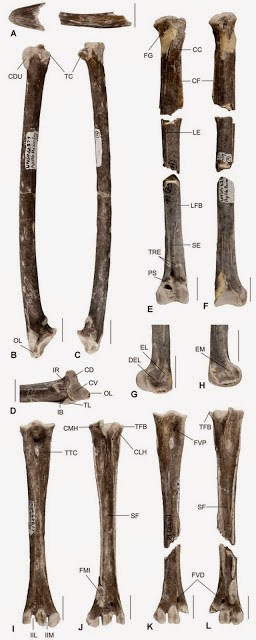
The new species is given the name Anchigyps voorhiesi, meaning Voorhies' Almost-Vulture, after Michael Voorheis, who discovered the Orchard ash beds and led the excavation of fossils from them. The species is described from two extremely fragmentary specimens, one comprising a three leg-bones, one wing-bone and part of the lower beak, the other a single leg-bone. This is quite common with fossils of birds, since the skeleton is extremely fragile, with the most robust bones in the legs.

Anchigyps voorhiesi. A, tip and part of the left ramus of the mandible. B–D, right ulna in ventral (B), dorsal (C) and cranial (D) views. E–H, left tibiotarsus in anterior (E), posterior (F), lateral (G) and medial (H) views. I–J, right tarsometatarsus in anterior (I) and posterior (J) views. K–L, left tarsometatarsus in anterior (K) and posterior (L) views. Abbreviations: CC, crista cnemialis cranialis; CD, cotyla dorsalis; CDU, condylus dorsalis ulnae; CF, crista fibularis; CLH, crista lateralis hypotarsi; CMH, crista medialis hypotarsi; CV, cotyla ventralis; DEL, depressio epicondylaris lateralis; EL, epicondylus lateralis; EM, epicondylaris medialis; FG, facies gastrocnemialis; FMI, fossa metatarsi I; FVD, foramen vasculare distale; FVP, foramina vascularia proximalia; IB, impressio m. brachialis; IIL,incisure intertrochlea lateralis; IIM, incisure intertrochlea medialis; IR, incisure radialis; LE, linea extensoria; LFB, linea m. fibularis brevis; OL, olecranon; PS, pons supratendineus; SF, sulcus flexorius; TC, tuberculum carpale; TFB, tuberculum m. fibularis brevis; TL, tuberculum lig. collateralis ventralis; TRE, tuberositas retinaculi extensori; TTC, tuberositas m. tibialis cranialis. Scale bars equal 1 cm. Zhang et al. (2012).

Follow Sciency Thoughts on Facebook.