Showing posts with label Placodonts. Show all posts

Friday, 9 January 2015

A new Placodont specimen from the Late Triassic of Switzerland.


Psephoderma alpinum is an armoured Placodont (a group of Marine Reptiles known only from the Triassic and thought to be related to Plesiosaurs) known from a number of locations in the Alps. It has a long rostrum (snout) which may have been used to probe soft sediments in a similar way to modern Batoid Rays, and large, flattened teeth which were probably used to crush Clams and other hard prey.

In a paper published in the Swiss Journal of Geoscience on 20 November 2014, James Neenan and Torsten Scheyer of the Palaeontological Institute and Museum at the University of Zurich, describe a new specimen of Psephoderma alpinum from an exposure of the Kössen Formation on Mount Schesaplana, the highest peak in the Rätikon Range,  which straddle the border between Switzerland and Austria.

The skull of Psephoderma alpinum. Photographs of the specimen in dorsal (a) and palatal (b) views. Virtual reconstructions based on lCT data in dorsal (c) and palatal (d) views. Scale bar 20 mm. Neenan & Scheyer (2014).

The new specimen is a nearly intact skull 146.5 mm in length, but slightly crushed dorsolaterally (flattened from above). This specimen reveals a number of features of the skull that have now previously been observed, including the structure of the braincase, which was revealed by CT scanning the specimen at the Steinmann Institute at the University of Bonn.

The specimen lacks the extensive nerve network in the snout seen in other animals that use their snouts to sift through sediment, including the closely related Chinese Placodont, Psephochelys polyosteoderma, which casts doubt upon this interpretation of the biology of Psephoderma alpinum. It also shows poor preservation of the occipital region (at the back of the skull), which has previously been reported in other specimens. Neenan and Scheyer suggest that this may indicate that these specimens were juveniles with incompletely mineralized skeletons, or alternatively that Psephochelys polyosteoderma may have been less reliant on hard (durophagus) prey than other Placodonts, and therefore needed less heavy mineralization on parts of the skull; this fits well with the sediment sifting interpretation of the feeding habits of the animal, differing from the evidence from the nerves of the snout, so it is likely that at least one of these pieces of evidence is taphonomic (preservational) rather than biological in origin.

See also…
Placodonts were a group of Sauropterygian Reptiles (a group related to Snakes and Lizards that includes the better known Pliosaurs and Plesiosaurs which survived to the end of the Mesozoic) from the mid-to late Triassic. They were large animals, ranging one to...


Follow Sciency Thoughts on Facebook.

Saturday, 3 August 2013

New species of Placodont from the Middle Triassic of the Netherlands.

Placodonts were a group of Sauropterygian Reptiles (a group related to Snakes and Lizards that includes the better known Pliosaurs and Plesiosaurs which survived to the end of the Mesozoic) from the mid-to late Triassic. They were large animals, ranging one to three meters in length. The Placodonts were Lizard-like in morphology, with cylindrical bodies similar in shape to Marine Iguanas, though unlike the Iguanas they had broad flattened teeth, suggesting that their diet consisted primarily of shelled Molluscs. Some later Placodonts developed bony body armor, presumably as a defense against larger Marine Reptiles.

In a preliminary paper available on the website of the journal Acta Palaeontologica Polonica on 12 April 2013, Nicole Klien of the Steinmann-Institut für Geologie, Mineralogie und Paläontologie at the University of Bonn and Torsten Scheyer of the Paleontological Institute and Museum at the University of Zurich describe a new species of Placodont from the Middle Triassic Lower Muschelkalk of Winterswijk in the eastern Netherlands. 

The new species is named Pararcus diepenbroeki, where Pararcus  means 'paired arches', a reference to the structure of the neural arches (structures on the dorsal surface of the vertebrae),  and diepenbroeki honours Gerben Diepenbroek, a Winterswijk fossil collector who discovered the specimen and donated it to the Steinmann-Institute.

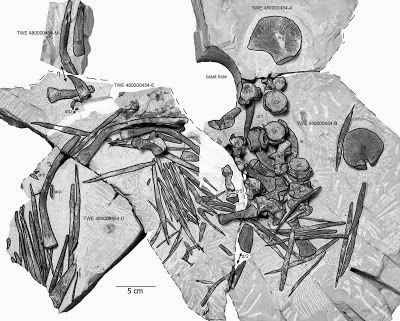
Outline and overview of the connected slabs TWE 480000454-A, -B, -D, -E, and -M. from which Pararcus diepenbroeki is described. TWE 480000454-A shows a single plate-like girdle bone (is). TWE 480000454-B contains disarticulated vertebrae from the posterior presacral and sacral region (c1-11, na1-3), fragments of dorsal ribs (dr1, dr2), elements of gastral ribs (unlabelled), the second ischium (is), the round, plate-like pubis (pu), and three bones, most likely representing sacral- or caudal ribs (?cr1-3). TWE 480000454-D, -E, and -M mainly contain dorsal ribs (dr3-9) and elements of gastral ribs as well as two more isolated halves of neural arches (na4, na5), and a caudal rib (cr1). Klien & Scheyer (2013).

The species is described from a partial disarticulated skeleton from a number of limestone slabs, produced by blasting at the Winterswijk Quarry. The remains include vertebrae and ribs from the posterior trunk and sacral region (base of the spine), two ischia (bottom lobes of the pelvis), one pubis (middle part of the pelvis), hind limb bones, caudal vertebrae and ribs, gastral ribs and armour plates.

Overview of slabs TWE 480000454-K, -J, and –G. (A) TWE 480000454-K contains a disarticulated neural arch (na7, na8), caudal ribs (cr4-6), an ungual (un), a possible caudal rib (?cr6), gastral rib fragments, and plate-like, curved, as well as keeled, shield-like armour plates. TWE 480000454-K is connected with TWE 480000454-J by a caudal rib (cr3). (B) TWE 480000454-J contains another caudal rib (cr2), half of a neural arch (na6), fragments of dorsal ribs, and armour plates. (C, D) Details of slab TWE 480000454-G which contains remains of caudal vertebrae (cvc1-10, nacv), haemapophyses, elements of a gastral ribs, several bones of zeug- and autopodium (?llb, mt, ta, ph), and armour plates (arp). Klien & Scheyer (2013).


Although it is an incomplete and disarticulated specimen, on the basis of comparison to skeletal elements from similar finds Klien & Scheyer suggest that the living animal was about 135 mm in trunk-vent length (i.e. its length excluding the head and tail). They also suggest that it was not a fully grown animal, as it had unfused neural arches and incompletely ossified margins to the girdle elements.

The approximate location of the Winterswijk Quarry. Google Maps.


Follow Sciency Thoughts on Facebook.