Showing posts with label Seabirds. Show all posts

Sunday, 7 April 2024

Ardenna buchananbrowni: A new species of diving Shearwater from the Pliocene of Taranaki, New Zealand.

Shearwaters, Procellariidae, are a diverse group of Tube-nosed Seabirds, Procellariiforms, with a fossil record going back to at least the Miocene (some Oligocene fossils have been assigned to the group - but the status of these is uncertain). All living and fossil Shearwaters are placed within three genera, the relatively large Calonectris, weighing 470–1060 g; the somewhat smaller Ardenna, weighing 320–950 g; and the notably smaller Puffinus, weighing 120–575 g (confusingly, Puffins are not Shearwaters at all, but members of the Auk family, Alcidae, with the generic name Fratercula). Shearwaters have a fairly good fossil record in the Northern Hemisphere, but until 2018 the known remains from the Southern Hemisphere comprised a few fragmentary bones from Mio-Pliocene assemblages in Chile, Peru, and South Africa. This changed with the discovery of Ardenna davealleni, a large gliding Shearwater from the Pliocene Taranaki Seabird Assemblage.

In a paper published in the journal Taxonomy on 6 April 2024, Alan Tennyson of the Museum of New Zealand Te Papa TongarewaRodrigo Salvador of the Arctic University Museum of NorwayBarbara Tomotani of the Department of Arctic and Marine Biology at the Arctic University of Norway, and Felix Marx, also of the Museum of New Zealand Te Papa Tongarewa, describe a second Pliocene Shearwater from the Taranaki Assemblage.

The new species is described from two specimens. The first of these, NMNZ S.49931, is a partial articulated skeleton, comprising a complete skull and premaxilla, posterior right mandible, sternum, furcula, right coracoid, a row of articulated thoracic vertebrae, four ribs, both humeri, right ulna, right radius, and several small unidentified fragments, which was collected from Ohawe Beach, southern Taranaki, by Karl Raubenheimer. The second specimen, NMNZ S.49666, is another partial skeleton, comprising a complete skull and premaxilla, left quadrate, right coracoid, both humeri (missing their distal ends), right ulna, probable right radius, one vertebra, and several small unidentified fragments, collected by John Buchanan-Brown at Waihi Beach, South Taranaki. The species is placed in the genus Ardenna, and given the specific name buchananbrowni, in honour of John Buchanan-Brown.

Pliocene fossil Shearwater Ardenna buchananbrowni. (Top) Photograph of holotype NMNZ S.49931 and (bottom) explanatory line drawing. Tennyson et al. (2024).

Ardenna buchananbrowni is a small Shearwater, falling within the upper part of the size range of the genus Puffinus, and its general shape falls within the range of both Puffinus and diving members of the genus Ardenna. However, it is closest in form to Ardenna tenuirostris, the living Short-tailed Shearwater or Muttonbird, leading Tennyson et al. to conclude that it was a small diving member of the genus Ardenna.

Pliocene fossil shearwater Ardenna buchananbrowni, paratype NMNZ S.49666, with elements identified. Tennyson et al. (2024).

The genera Ardenna and Puffinus are calculated to have diverged about 10.4 million years ago, based upon molecular clock data, with members of the genus Puffinus becoming specialised in diving, and some members of the genus Ardenna also later becoming specialist divers, and converging in form with Puffinus. The Taranaki Seabird Assemblage has been dated to between 3.36 and 3.06 million years before the present, making Ardenna buchananbrowni the oldest known diving Ardenna as well as the smallest, and demonstrating that members of the genus had adapted to a diving lifestyle in the Southern Ocean more than 3 million years ago.

See also...

Monday, 1 May 2023

Macronectes tinae: A new species of Giant Petrel from the Pliocene of Taranaki, New Zealand.

Giant Petrels, Macronectes spp., are the largest members of the Avian Family Procellariidae, and are easily identifiable by their large size, heavyset body, and distinctive bulbous beak. The genus currently comprises two species, the Southern Giant Petrel, Macronectes giganteus, found on Antarctica and the southern tips of Australia, Africa, and South America, and the Northern Giant Petrel, Macronectes halli, which ranges slightly further north, although there is a large overlap between the distributions of the two species. Bones assigned to the genus Macronectes have been uncovered in Pleistocene and Holocene deposits in New Zealand, although these are fragmentary, and have never been assigned to species level. 

In a paper published in the journal Taxonomy on 30 January 2023, Alan Tennyson of the Museum of New Zealand Te Papa Tongarewa and Rodrigo Salvador of the Department of Arctic and Marine Biology at the Arctic University of Norway, and the Arctic University Museum of Norway, describe a new species of Giant Petrel based upon  skull and a partial humerus from the Pliocene deposits of the Tangahoe Formation in the sedimentary Whanganui Basin in the western portion of New Zealand’s North Island.

The specimens were collected from beach boulders at South Taranaki, with the two specimens about 2 km apart, making it unlikely that they came from the same original Bird. Both were found by fossil collector Alastair Johnson, the skull in 2017 and the humerus in 2019, and are now housed in the collection of the Museum of New Zealand Te Papa Tongarewa. The new species is named Macronectes tinae, where 'tinae' honours Tina King, the late partner of Alastair Johnson; the fossil skull was her favorite fossil.

Skull (holotype, NMNZ S.048502) of Macronectes tinae, partially embedded in matrix, in different views; scale bar is 5 cm. (A) Dorsal view. (B) Lateral view (right). (C) Lateral view (left). (D) Anterior view. (E) Caudal view. Tennyson & Salvador (2023).

The large bulbous bill of the skull specimen, caused by a wider and enlarged corpus ossis premaxillaris and a deeper proximal premaxilla, leaves little doubt that it belongs in the genus Macronectes. However, this skull is distinctly smaller than that of either extant species assigned to the genus, which, combined with the Pliocene age of the fossil, is deemed sufficient by Tennyson and Salvador to justify the creation of a new species.

Only the shaft and distal end of the humerus are preserved, so that the main diagnostic feature of the genus Macronectes, a weakly developed second (dorsal) fossa pneumotricipitalis muscle attachment on the proximal end, cannot be observed. However, the bone does appear to come from a Fulmarine Procellariid Bird, and is to large to belong to any known member of that group other than a Giant Petrel, as well as being of an appropriate size for Macronectes tinae, as determined by the skull, leading Tennyson and Salvador to refer it to the species.

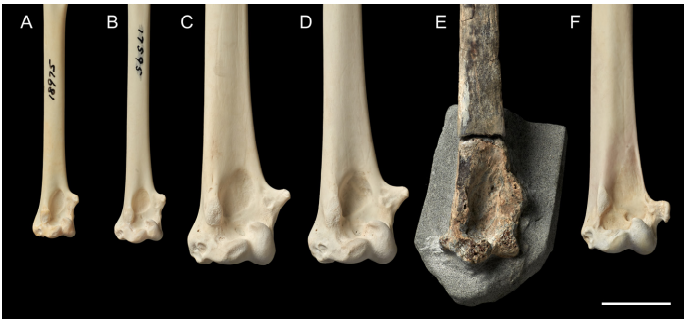
Detail of proximal end of the left humeri of selected Procellariiformes in cranial view; scale bar is 2 cm. (A) Antarctic Petrel, Thalassoica antarctica, NMNZ OR.018975. (B) Antarctic Fulmar, Fulmarus glacialoides, NMNZ OR.017595. (C) Southern Giant Petrel, Macronectes giganteus, NMNZ OR.029141. (D) Northern Giant Petrel, Macronectes halli, NMNZ OR.029173. (E) Macronectes tinae, paratype NMNZ S.048870. (F) Indian Yellow-nosed Albatross, Thalasarche carteri, NMNZ OR.02847. Tennyson & Salvador (2023).

Macronectes tinae is similar enough to modern Giant Petrels to be placed in the same genus with a high degree of confidence. It does, nevertheless, have some morphological variations, which would have had some functional differences in the living Bird, although, given the fragmentary nature of the specimen, it is difficult to asses what these would have been. It is, however, likely to have lived in a similar environment to modern Giant Petrels, which, unlike their closest relatives, are shorebirds rather than true pelagic ocean-dwellers, and unlike them capable of walking on land, where they are gregarious opportunistic scavengers and predators. The Tangahoe Formation in Taranaki is considered to represent a shore environment, with other fossils including colonial marine Mammals and a Penguin, making it likely that Macronectes tinae lived in similar environment to its modern relatives.

Artistic reconstruction of Macronectes tinae in its palaeoenvironment. A darker plumage was chosen for the reconstruction because a darker colouration in Giant Petrels seems to be related to warmer regions, as Taranaki had warmer temperatures during the Pliocene. Simone Giovanardi in Tennyson & Salvador (2023).

See also...

Online courses in Palaeontology

Follow Sciency Thoughts on Facebook.

Follow Sciency Thoughts on Twitter.


Tuesday, 2 August 2022

First recording of a Light-mantled Albatross from Asia.

Albatrosses, Diomedeidae, are large-bodied Seabirds with an almost entirely Southern Hemisphere distribution. The Light-mantled Albatross, Phoebetria palpebrata, is generally restricted to Southern Ocean. This species is currently considered Near Threatened under the terms of the International Union for the Conservation of Nature's Red List of Threatened Species, largely due to their being caught as bycatch by longline fisheries. The global population of Light-mantled Albatrosses was last estimated at 21 600 breeding pairs in 1998.

In a paper published in the Journal of Threatened Taxa on 26 July 2022, Hameed Byju of the Centre of Advanced Study in Marine Biology at Annamalai University, and Natarajan Raveendram of the Iragukal Amritha Nature Trust record of a Light-mantled Albatross from Rameswaram Island, off the southeast coast of Tamil Nadu State, India, which is, to the best of their knowledge, the first recording of this Bird from anywhere in Asia.

The Albatross was first spotted on 8 September 2020, in on Anthoniyapuram Beach by local fishermen, who informed the Tamil Nadu Forest Department as the Bird appeared weak and unable to fly. The Albatross was collected and allowed to rest, before flying away. It would not take food.

A Light-mantled Albatross, Phoebetria palpebrata, on Anthoniyapuram Beach on Rameswaram Island, Tamil Nadu, on 8 September 2022. Francis Aravind in Byju & Raveendram (2022).

See also...

Follow Sciency Thoughts on Facebook.

Follow Sciency Thoughts on Twitter.


Tuesday, 1 December 2020

'Giant' Pelagornithid Birds from the Eocene of Seymour Island, Antarctica.

Bony-toothed Birds (Odontopterygiformes: Pelagornithidae) are an extinct clade of large, pelagic, volant Birds with a fossil record spanning from the late Paleocene to the late Pliocene and a global distribution. As their colloquial name suggests, the most obvious diagnostic characteristic of this clade is the modification of the tomial crest of the premaxillae, maxillae, and dentaries into a variety of tooth-like bony projections that lack dental tissues (or homology to teeth). The sizes and spacing of these projections vary across the clade but are consistent within species, following a set sequence of large and small pseudoteeth covered in life by the rhamphotheca. This pseudodentition, along with hooked premaxillae and the presence of intraramal joints, has been hypothesised to indicate dietary preferences for Fish or Squid skimmed from the top of the water column. Pelagornithids and the extinct Teratorns (Teratornithidae) from the Neogene and Quaternary are the largest volant Birds known, and while the body sizes of Pelagornithids vary, the majority of known specimens and species derive from individuals considered large (3.5–4.5 m wingspan) and even giant (5–6 m wingspan). 

Though they have a nearly global distribution, Pelagornithid specimens from Antarctica are rare and limited to isolated elements; most of which derive from the Eocene sediments of the La Meseta and Submeseta Formations on Seymour (Marambio) Island, near the Antarctic Peninsula. The published specimens from these formations include two partial maxillae, one fragment of a humerus, one dentary fragment, and one distal tarsometatarsus.

In a paper published in the journal Scientific Reports on 26 October 2020, Peter Kloess of the Department of Integrative Biology and Museum of Paleontology at the University of California, Berkeley, Ashley Poust, also of the Department of Integrative Biology and Museum of Paleontology at the University of California, Berkeley, and of the Department of Paleontology at the San Diego Natural History Museum, and Thomas Stidham of the Institute of Vertebrate Paleontology and Paleoanthropology of the Chinese Academy of Sciences, the Center for Excellence in Life and Paleoenvironment, and the University of Chinese Academy of Sciences, add to this assemblage by describing a more than 12 cm long pelagornithid dentary fragment, University of California Museum of Paleontology (UCMP) 323792.

 
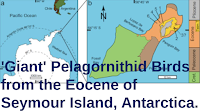
(a) Map of Antarctica with location of Seymour Island highlighted. (b) Generalized geologic map of Seymour Island. Numbers indicate localities containing Antarctic Pelagornithid specimens: (1) UCMP RV8405; (2) DPV 13/84; (3) Specimen MLP 78-X-26-1; (4) IAA 1/95; (5) IAA 1/906; (6) UCMP RV870; and (7) Specimen USNM 494035. Kloess et al. (2020).

Kloess et al. also revise the stratigraphic placement of the previously reported tarsometatarsus specimen, UCMP 322176, within the La Meseta Formation Pelagornithid assemblage. With these two specimens, the known Pelagornithid record from Seymour Island is now represented by six specimens representing multiple taxa; three from the early Eocene (including the presence of a giant-bodied specimen in a temporal period previously represented only by large-sized individuals) and three from the middle to late Eocene (represented by giant-sized individuals). A nearly complete Pelagornithid humerus awaits formal description and would add to this collection of specimens.

The geology of Seymour Island records Cretaceous to latest Eocene marine strata along with Pliocene to Pleistocene glaciomarine deposits restricted to the northern portion of the island. These Eocene strata contain deltaic, estuarine, and shallow marine deposits filling an incised valley, and the Eocene sediments have been subdivided using two different approaches. The first method designates 'Telm' units (an acronym for Tertiary Eocene La Meseta) based on lithofacies, and the second relies on unconformities to divide the La Meseta Formation into allomembers. Some authors have gone further in elevating the uppermost Submeseta Allomember to formation status and subdividing that new formation into the Laminate, Turritella, and Superior Allomembers (formerly the Submeseta I, II, and III units, respectively). Kloess et al. use both the Telm units and the allomembers in accordance with the work of various authors, and refer the reader to the combined stratigraphic column for correlations.

 
Geochronological context and estimated body size classes of known Pelagornithid specimens from Antarctica. Left, stratigraphic section of the La Meseta and Submeseta Formations. and pelagornithid specimens recovered from Seymour Island. Furthest right, the pelagornithid specimen found in East Antarctica (USNM 494035). Two methods (middle columns) are shown for the subdivision of the La Meseta and Submeseta strata. Numbers and pelagornithid outlines correspond to specimen localities displayed above. The colors and relative sizes of Pelagornithid outlines correspond to the 'large' (in gray) and 'giant' (in black) size-types. Kloess et al. (2020).

Recently, there has been uncertainty regarding the age of the La Meseta and Submeseta Formations. A combination of age-dating methods, such as strontium isotopes, magnetostratigraphy, and lithostratigraphy, indicate that the La Meseta Formation is early to middle Eocene in age and the Submeseta Formation is middle to late Eocene in age. However, studies of Dinoflagellate cysts support a middle to late Eocene age for the La Meseta Formation. Kloes et al. refer to the dates generated from the combined methodology because of the inclusion of the Submeseta Formation into these geochronological and stratigraphic studies.

The La Meseta and Submeseta Formations have yielded many Avian fossils, including Penguins, Falconiforms, Procellariiforms, Anseriforms, Palaeognaths, and Pelagornithids. The Pelagornithids from these deposits are represented by six published specimens. One partial maxilla: MLP 08-XI-30-42 was recovered from locality DPV 13/84. This locality has been assigned to multiple, parallel subunits of the La Meseta Formation: within Telm 7; at the base of level 38; and within the Turritella Allomember (equivalent to the Submeseta II Allomember. The Turritella Allomember has been dated between 41.1 and 37.7 million years on Seymour Island.

Another maxillary fragment (MLP 78-X-26-1) was described first by Eduado Tonni and Alberto Cione. These authors placed the specimen within the upper portion of the La Mesesta Formation, though its location was not shown on their included maps. A published catalogue of La Meseta fossil material housed in the Museo de La Plata confirms that the specimen comes from an unknown locality and the authors attribute it to the highest stratigraphic unit, Telm 7. MLP 78-X-26-1 was later assigned to locality DPV 13/84 within the Submeseta II Allomember but it is unclear how the assignment to this locality was determined. We use the conservative placement of MLP 78-X-26-1 within Telm 7, which encompasses the Turritella and Superior Allomembers (formerly Submeseta II and III, respectively), to indicate this specimen’s stratigraphic placement. Telm 7 has been dated between 41.1 and 34.0 million years old.

A distal Pelagornithid humerus (MLP 12-I-20-4) was recovered from locality IAA 1/95. This Pelagornithid-bearing locality is in the same stratigraphic horizon as the Mammal-bearing locality IAA 1/90, located within a Naticid Gastropod-dominated conglomerate layer in Telm 5 and the Cucullaea I Allomember. Additionally, a recently published rostral dentary fragment (IAA-PV 175) from locality IAA 1/90 was described by Carolina Acosta Hospitaleche and Marcelo Reguero confirming that identification and publishing the first image of this specimen (however, without identifying its specimen number). In a review of the Phorusrhacid material from the Cretaceous and Palaeogene of Antarctica, Marcos Cenizo reassigned the tarsometatarsus (identifying the specimen number as 'UCR 22176') to the Pelagornithidae. Claudia Tambussi and Federico Degrange incorrectly refer to this specimen as cast UCR 22175; the specimen number used (revised as UCMP 322175), corresponds to a fragment of a premaxilla reassigned from Phorusrhacidae to an unknown genus and species of Palaeognath.

UCMP 322176 has been attributed to the Submeseta Formation. However, a review of the original locality information indicates that rather than the Submeseta Formation, the tarsometatarsus was recovered from the same stratigraphic horizon as UCMP locality RV8200 (formerly RV-8200) within Telm 5 (the La Meseta Formation). UCMP locality RV8200 is equivalent to the locality DPV 6/84, stratigraphically higher than IAA 1/90, and within the Cucullaea I Allomember. The Cucullaea I Allomember is dated between 51.6 and 49.1 million years, and Telm 5 is dated between 51.3 and 46.2 million years. These dates yield an estimate of 51.3–49.1 million years for the age of fossils from UCMP locality RV8702.

For the first time, Kloess et al. include high resolution images of the original tarsometatarsus fossil to highlight aspects of its morphology because previous authors have published only images of casts made from UCMP 322176. A detailed description of this tarsometatarsus, including observations of characters that this specimen shares with the Dasornis and Pelagornis morphotypes and size comparison to other known distal tarsometatarsus fragments, was presented by Marcos Cenizo, and the specimen was assigned further to a 'giant' size-type (estimated 5–6 m wingspan). The reassessed stratigraphic placement of this specimen to the La Meseta Formation, where it joins other La Meseta specimens identified as 'large' size-types (estimated 3.5–4.5 m wingspan), indicates that Seymour Island was inhabited by two different size classes of Pelagornithids during the early Eocene.

 
Photographs of the original fossil material of the pelagornithid distal right tarsometatarsus UCMP 322176 in: dorsal (a), medial (b), plantar (c), lateral (d), and distal views (e). Residual mold lines from the castmaking process can be observed on the medial, lateral, and trochlear surfaces (b), (d), and (e). Osteological abbreviations: cid canalis interosseus distalis, dlr dorsal longitudinal ridges, flc fovea ligamentum collateralium, fm I fossa metatarsi I, fvd foramen vasculare distale, pmp processus medianoplantaris, pp plantar 'pit', tr metatarsal trochlea. Kloess et al. (2020).

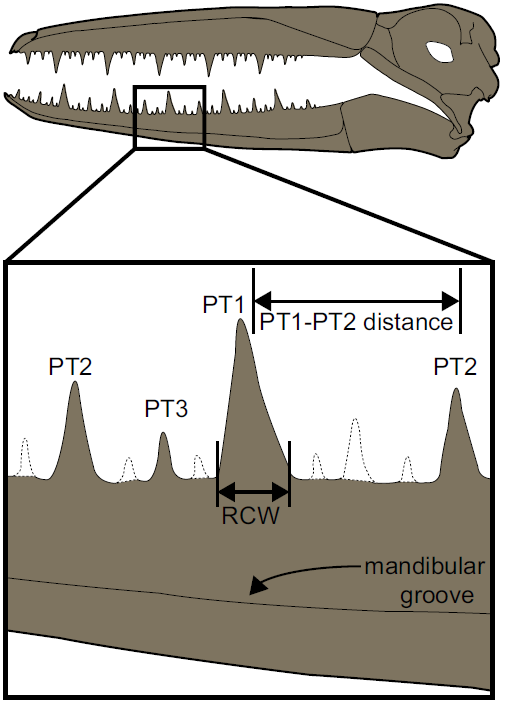
UCMP 323792 is a partial left dentary 12.2 cm long, preserving a region of the mandible rostral to the intraramal joint. The dentary is relatively flat with a prominent mandibular groove (lateral longitudinal sulcus, external groove, neurovascular sulcus, or longitudinal furrow) tracing the ventral length of the specimen. The groove is asymmetric, with a flatter ventral side compared to the gently sloping dorsal side. At the caudal end of the fragment, the groove is 11.4 mm dorsal to the ventral edge of the dentary, and 9.0 mm dorsal to that edge at the rostral end. The groove is 19.5 mm ventral to the dorsal edge of the dentary at the caudal end, and 15.8 mm ventral to the dorsal edge of the rostral preserved end. Overall, the groove approaches the ventral edge of the bone rostrally.

 
Left Pelagornithid dentary fragment UCMP 323792 in lateral (a), medial (b), and dorsal views (c). (d) Line drawing of dorsal view to elucidate location of pseudoteeth. Pseudoteeth depicted as dashed outlines. Note on PT1 the presence of a mediocaudal crest and its tip is offset from the midline. Abbreviations: MC mediocaudal, PT pseudotooth. Kloess et al. (2020).

Though the rostroventral portion of the dentary is missing, the dorsal edge of the mandibular groove and Meckel’s canal are visible. This specimen shows that the groove is immediately adjacent to Meckel’s canal and thus likely related to the nutrient supply for the growing multipart rhamphotheca.

Given that UCMP 323792 derives from an inexact location within the dentary rostral to the intraramal joint, Kloess et al. compared measurements of its dorsoventral height to those collected from published images of complete dentaries from the largest Pelagornithids, Pelagornis chilensis, and Pelagornis sandersi, both 'giant' size-type Pelagornithids from the Miocene and late Oligocene, respectively. Measurements from these specimens were collected from the base of the most rostral and most caudal PT1s, as well as the PT1 closest to the midpoint between them. The rostral height measurement from UCMP 323792 (24.8 mm) is greater than the most rostral heights of Pelagornis chilensis, and Pelagornis sandersi, 19.9 and 9.0 mm respectively, and just less than heights from their midpoints, 28.7 and 25.5 mm respectively. The most caudal heights of these species (Pelagornis chilensis: 40.1 mm; Pelagornis sandersi: 34.2 mm) is greater than the caudal height of UCMP 323792 (30.9 mm). Based on these measurements, UCMP 323792 falls well within the range of heights of these largest known Pelagornithids and the fragment likely comes from near the rostrocaudal midpoint of the dentary.

While UCMP 323792 has low, worn pseudoteeth similar to the oldest, smallest, and geographically closest Pelagornithid to Antarctica, Protodontopteryx ruthae, the preserved pseudoteeth in the maxilla and mandible of Protodontopteryx ruthae from the early Paleocene of New Zealand are weathered to the point that size class identification is impossible though it can be noted that the specimen exhibits approximately regular spacing of its pseudoteeth. The entire length of the preserved right dentary of Protodontopteryx ruthae measures less than the preserved length of UCMP 323792, and helps to document the very large diversity of body sizes within the clade.

A wide shallow groove is visible along the ventral dentary. Gerald Mayr and David Rubilar-Rogers used the term 'neurovascular sulcus' for both the medial and lateral mandibular grooves in their figures of Pelagornis chilensis. The portion of the dentary dorsal to the groove is convex in profile and dorsoventrally taller (16.4 mm rostrally and 24.9 mm caudally) relative to the ventral dentary edge (about 6.3 mm). Evidence of erosive events (pits, black Lichen, and weathering cracks) are readily visible on this side of the specimen. Similar evidence of wear can be observed on the rounded and broken pseudoteeth. Lichen and related pits, resulting from apothecia, have been observed on fossils from the Submeseta Formation and their presence indicates the dentary had been exposed medial side up at the subaerial surface prior to its discovery.

Four low, worn pseudoteeth are visible. All of the pseudoteeth exhibit the remnants of a mediocaudal ridge, similar to those observed in other Pelagornithids. Based on the regular pattern of pseudotooth spacing observed in other pelagornithids, some of the smaller bony projections may have been worn away from UCMP 323792, and the possibility that even smaller, intermediately-spaced pseudoteeth (i.e. PT4s and PT5s) were present previously and also worn away cannot be ruled out. It is likely that there is a pseudotooth missing between the PT1 and the caudalmost PT2, and one missing rostral to the most rostral PT2.

 
Diagram approximating the location of the dentary fragment, UCMP 323792, within a Pelagornithid mandible. PT numbers indicate size class of pseudotooth, with PT1 representing the largest 'teeth' and PT3 the smallest 'teeth'. Bars indicate method for measuring rostrocaudal width and the distance between PT1 and PT2s. Dashed lines indicate the possible locations of missing pseudoteeth. PT pseudotooth, rostrocaudal width. Kloess et al. (2020).

The distance measured from the existing PT1 to each of the remaining PT2s is greater than similar measurements from the largest Pelagornithids, Pelagornis chilensis, and Pelagornis sandersi. Since there is only one PT1 present in UCMP 323792, Kloess et al. measured the distance between the PT2s present as a proxy for calculating the space intervening between PT1s, and estimate that distance as 66.5 mm. This estimate of pseudoteeth spacing from UCMP 323792 is greater than all measurements compiled from various Pelagornithids, by Antoine Louchart, Vivian de Buffrénil, Estelle Bourdon, Maïtena Dumont, Laurent Viriot, Jean-Yves Sire, except those within the larger range of measurements from Pelagornis chilensis (ranging from 53.9 to 76.0 mm). The base width of the PT1 present (14.7 mm) also is larger than those compiled by Louchart et al. except for the larger measurements from Pelagornis chilensis (12.5–15.6 mm) and Pelagornis longirostris (13.3–15.9 mm), a Pelagornithid of unknown Cainozoic age with cranial dimensions similar to Pelagornis chilensis. Based on these measurements, UCMP 323792 may represent one of the largest Pelagornithids found to date.

The first reconstruction of a Pelagornithid rostrum from Dasornis (Odontopteryx) toliapica indicates a repeating pattern of pseudoteeth. Hildegard Howard's description of Pelagornis (Osteodontornis) orri provided details of the pattern of spacing and placement of pseudoteeth sizes; the largest pseudoteeth were spaced regularly along the length of the rostrum with the interstitial space bisected by moderately-sized pseudoteeth and then further split evenly by the presence of the smallest pseudoteeth. Although this pattern of pseudoteeth spacing has been observed in Pelagornithid specimens identified since Howard’s observations, exceptions have been noted, for example at the tip of the rostrum or duplicate PT2s between PT1s.

Louchart et al. reported known differences in the distribution and size of pseudoteeth between Odontopterygiform species and calculated a regression line, based on the space between the largest pseudoteeth (PT1s) and a ratio of the rostrocaudal widths of pseudoteeth of different sizes, that supports a proposed mechanism for pseudotooth size and spacing based on inhibition zones. UCMP 323792 does not follow the pattern described by Louchart et al., but rather maintains a relatively low (extrapolated) intervening space between PT1s, as well as a lower value for the ratio of pseudotooth widths. To account for the difference between the reported regression line To account for the difference between the reported regression line and calculations from UCMP 323792, Kloess et al. consider taphonomic effects which have altered the specimen including, but not limited to, weathering of the pseudoteeth diminishing in vivo base widths and the loss of PT1s. Alternatively, measurements from UCMP 323792 may not align with the regression line for biological reasons, such as: this specimen may reflect a different ontogenetic stage or clade of Pelagornithid from those specimens used in previous calculations, and thus may have a different pattern of pseudotooth spacing altogether. However, the regression line as published does not prescribe identification to taxon or ontogenetic age based on Pseudotooth measurements and would require the addition of more specimens to properly make these assessments.

The new pelagornithid dentary fragment described above (UCMP 323792) provides an opportunity to reexamine the previously identified Antarctic Pelagornithid fossils, offering insight into the presence of coexisting morphotypes in the Southern Ocean throughout the Eocene. The measured and extrapolated spacing between pseudoteeth of UCMP 323792 point to a giant individual, but the use of widths from worn pseudoteeth may not be well-suited for detailed comparisons. Most rostral specimens of Pelagornithids are partial, fragmentary, or taphonomically altered. If the metric of Louchart et al. is inappropriate for incomplete specimens, such as UCMP 323792, the general utility of many specimens for size regression is called into question, as is the use of spacing for taxonomic discrimination except in cases where intact segments can be confidently positioned within the oral cavity. The regression calculated by Louchart et al. also excluded specimens with the smallest pseudoteeth (PT4s and PT5s), those most susceptible to erosion and weathering, and thus potentially excluded exceptionally preserved specimens.

The updated stratigraphic context for the Pelagornithid distal right tarsometatarsus (UCMP 322176) implies the presence of a 'giant' Pelagornithid taxon in the early Eocene of Antarctica. The other Pelagornithid material from the early Eocene La Meseta Formation (a distal humerus, MLP 12-I-20-4, and a partial dentary fragment, IAA-PV 175) exhibit morphology and size similar to 'large; Pelagornithids, such as cf. Gigantornis sp. The stratigraphically-reassigned tarsometatarsus (UCMP 322176) possesses morphological affinities to both the Dasornis and Pelagornis morphotypes though its width is greater than tarsometatarsi identified as 'giant' Pelagornis taxa. The difference in sizes of these specimens suggests that 'large-' and 'giant-sized' Pelagornithid taxa co-occurred in the early Eocene of Antarctica, and that the giant size class of Pelagornithids evolved quite early in their history.

With the reassignment of a recently published partial dentary (IAA-PV 823) as a Perciform Fish, the late Eocene of Seymour Island is currently unambiguously represented by only 'giant' size-type specimens of Pelagornithids. However, the fragmentary humerus (USNM 494035) from Mount Discovery indicates the presence of multiple Pelagornithid size-types and taxa across Antarctica during this time. Therefore, it would appear that the two Pelagornithid morphotypes, and the largest two Pelagornithid size-types spanned from the early Eocene to the late Eocene of Antarctica. The Eocene La Meseta and Submeseta Pelagornithid specimens suggest the presence of an unnamed species larger than known Eocene taxa. Known specimens that approach the size of these Antarctic specimens have been recovered from Oligocene and Miocene strata, but not yet the Eocene. Furthermore, the reassigned La Meseta tarsometatarsus (UCMP 322176), with characteristics intermediate between the two accepted morphotypes, may represent an unnamed species larger than all known Pelagornithid taxa. None of the specimens from Antarctica have been identified to genus, nor have any of them been used to establish new taxonomic names. However, there are likely at least two taxa (or species lineages) present through the Eocene of Seymour Island, and that only with the discovery and description of more overlapping skeletal elements may we begin to evaluate the alpha level diversity of Pelagornithids present in this ancient ecosystem. Nevertheless, these unnamed remains are a tantalizing suggestion that the largest Bird that ever flew may have soared its way over the Antarctic seas during an Eocene with a unique, and distinctively large-bodied, coastal Avifauna. In addition, the distribution of Pelagornithid body sizes in the same pelagic Antarctic ecosystem likely reflects ecological differences related to diet or foraging strategy, and indicates stability in those ecological niches through much of the Eocene. This updated fossil record of Pelagornithids on Seymour Island reinforces the ideas that along with Penguins and Palaeognaths, Pelagornithids were a common and even a dominant avian clade throughout the Eocene of Antarctica, and potentially competed with other soaring Birds for foraging and nesting spaces. These Pelagornithids would have occupied a high trophic level in Antarctic seas, a role today filled by Albatrosses and other pelagic Avian clades, and the combined utilisation of marine resources by pelagic Birds and Penguins seen today likely extended into the deep past.

See also...


Online courses in Palaeontology. 

Follow Sciency Thoughts on Facebook.

Follow Sciency Thoughts on Twitter.


Sunday, 12 January 2020

Fratercula arctica: Tool use observed in Atlantic Puffins, the first known example of this behaviour in a Seabird.

The evolution of tool use is one of the most enduring puzzles in behavioural biology. Investigating the distribution of tool use across different species is key to understanding its adaptive value and hence its evolution in the natural world, and ultimately to understanding the evolutionary history of our own species. Tool use is the exertion of control over an object with the goal of altering the physical properties of another object, substance, surface or medium, or controlling the flow of information between the tool user and the environment or other organisms in the environment. Tools can be used for several purposes, mainly related to feeding, defence, aggression, social displays, or physical maintenance. True tool use requires manipulation of an object detached from the substrate, unlike borderline tool use where the tool remains part of the substrate. Tool use is a rare but phylogenetically widespread behaviour in the wild. It is most common in Birds and Mammals, mainly in the Passeriformes and Primates, some of which use or even manufacture tools to complete complex tasks. Tool use appears to span a continuum between two broad types: genetically based behavioural specialisations, inflexible and applied in a single context, and more flexible behavioural innovations, whose development may also rely partially on genetics but which can be applied creatively to new contexts. The ability of animals to use tools creatively has been linked to their cognitive capacities. Animal tool use is most frequent, and has been most discussed, in a need-for-resources framework, mainly related to feeding. Using tools for physical maintenance is also relatively common; for example, chimpanzees use tools to groom, scratch, or wipe themselves. In birds, captive Parrots have been reported to scratch with sticks, but to date the only avian tool use for physical maintenance reported in the wild is 'anting', depositing Ants on one’s plumage, which is observed in many species, but mostly Passerines.

In a paper published in the Proceedings of the National Academy of Sciences of the United States of America on 30 December 2019, Annette Fayet of the Department of Zoology at the University of Oxford, Erpur Snær Hansen of the South Iceland Nature Research Centre, and Dora Biro, also of the Department of Zoology at the University of Oxford,provide evidence of a wild Seabird performing another form of tool use for physical maintenance.

Fayet et al. observed two Atlantic Puffins, Fratercula arctica, Charadriiform Seabirds (i.e. members of the group that also includes Sandpipers, Plovers, Gulls, Auks, and their relatives), scratching with a stick. They describe our observations and discuss their implications in the context of animal tool use. 

Puffins nest on colonies around the North Atlantic, mostly on grassy slopes on predator-free islands. As part of a study on Skomer Island, Wales, observations have been made each June since 2012 at dusk, when Puffins gather on the colony to preen, sleep, and socialise. The Birds’ behaviour was observed with a spotting scope. On 18 June 2014 on Skomer Island an adult Puffin was observed holding a wooden stick in its bill and using it to scratch its back for about five seconds. The Bird was sitting on the sea under the colony’s cliffs, among other members of the same species. Shortly thereafter the Bird took off (still holding the stick, albeit it is unclear for how long) and was lost from view.

In July 2018, Browning motion-activated cameras were deployed near Puffin nests on Grimsey Island, Iceland, to record patterns of nest attendance. The cameras were configured to record ten seconds of footage after each movement detection, with a minimum thirty second pause after each video. On 13 July 2018 on Grimsey Island a camera trap recorded similar behaviour. In the video, an adult Puffin picks up a wooden stick from the ground then uses it to scratch its chest feathers. The video stops shortly after this first bout of scratching. On later videos, the stick is on the ground. It eventually disappears after about twenty four hours, presumably displaced by a Bird or the wind.

Puffin scratching with a stick. Grimsey Island, Iceland. Fayet et al. (2019).

The two instances of Puffins using a stick as a tool for body care represent recorded evidence of a wild Bird exhibiting this behaviour, while to date, in the wild only primates and elephants have been observed scratching with a tool. It is also evidence of true tool use in a Seabird, confirming the behaviour in an avian order previously thought to lack the ability, need, or opportunity to use tools. Furthermore, this suggest that while this behaviour is rare it is not restricted to a single population. Each of these conclusions has important implications for our understanding of the distribution and adaptive significance of tool use in the animal kingdom.

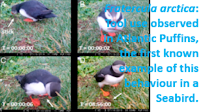
Screenshots of a Puffin scratching with a stick. Time stamps (hours: minutes: seconds) indicate time elapsed since the first panel. The stick’s location is indicated by an arrow. (A) Puffin picking up the stick. (B) Puffin holding the stick. (C) Puffin scratching its chest with the stick. (D) Nine hours later, the stick is still visible on the ground. Fayet et al. (2019).

The observations of Puffins rubbing their body with a stick fit the definition of tool use, as they involved the direct manipulation of a detached object toward a specific part of the environment (the Birds’ plumage) with a specific goal. It is important to note that the observations cannot be mistaken for the collection of nest material. Puffins preferentially collect soft material like grass or feathers to line their nests then quickly carry these inside their burrow, as frequently observed on both study colonies. In Wales, the Puffin was sitting on the water and therefore was not collecting nest material on land. Puffins often assemble in rafts near the colony to rest, preen, and bathe. The observed Puffin engaged in body care like many of its neighbours and most likely picked up the stick on land before flying to the water. In Iceland, videos recorded after the tool-use episode showed the stick on the ground, confirming that the Bird did not take it to its nest. Fayet et al. are therefore confident that our observed Puffins did not pick up the sticks as nest lining material.

Puffin taking a feather inside its burrow to line its nest. Grimsey Island, Iceland. Fayet et al. (2019).

Using sticks is common across tool-using taxa, but mostly in a foraging context to extract food from a cavity. Fayet et al.'s observations aside, stick tool use has exclusively been documented for extractive foraging in wild Birds, which remains the primary use even in Primates. Other, less common uses include communication or defence such as Chimpanzee dominance displays, investigation of novel objects by captive New Caledonian Crows, and scratching by Primates, wild Elephants, and captive Parrots. Since the observed Puffins appeared to be rubbing the sticks on their plumage, it is reasonable to rule out foraging, investigation, or communication as the behavior’s function: Puffins only catch prey underwater, and they were not interacting with other Puffins or probing objects with the stick. As such, they were most likely engaged in body care.

Puffin taking grass inside its burrow to line its nest. Grimsey Island, Iceland. Fayet et al. (2019).

Two alternatives for the function of the stick can be proposed: It may have been used for its mechanical properties, to dislodge parasites or relieve an itch, or its chemical properties, in a manner similar to anting, where Birds rub Ants or plants on their plumage, presumably for their antiparasitic properties. The latter hypothesis seems less likely as the sticks used by the Puffins seemed dry and therefore unlikely to have released chemical substances. As regards the former hypothesis, the absence, so far, of reports of wild Birds using sticks as mechanical tools for preening could be due to a lack of need for this behaviour, as Birds can access most of their body with their beak. Nonetheless, reports of captive Parrots scratching with stick-like objects suggest this behaviour may exist in the wild but has remained unreported due to its rarity. The case of the Puffins may reflect a specific ecological need which only occurs in some circumstances. For example, Puffins suffer from Seabird Ticks, Ixodes uriae, which were particularly abundant on Grimsey Island in the summer of 2018. The stick may have helped with scratching or dislodging them, perhaps more effectively than the beak. In either case, mechanical or chemical application, investigating the role of parasites as potential drivers of the emergence of bodycare-related tool use, for example by testing whether tool use prevalence correlates with parasite load in populations, would be an interesting avenue for future research.

Thus, Fayet et al.'s observations indicate that wild Birds may have a wider tool-use repertoire for physical self-maintenance than current evidence suggests. The fact that several species of Parrots showed this behaviour in captivity further supports this hypothesis, and the pattern of such behaviour having been observed multiple times independently and in different species may suggest that the behaviour may not simply be an artifact of captivity. Furthermore, the similarity of tool use between Birds and Primates has been mainly discussed in the context of feeding to date. Fayet et al.'s findings highlight the need to broaden this discussion to include other functions such as physical maintenance.

More broadly, the findings provide evidence of true tool use in a Seabird. This suggests tool use is rare in this group, but can no longer be considered absent. Tool use is present in a small number of Bird species (less than 1% of known genera) and is mostly related to feeding, presumably because of the high fitness gains reaped by accessing concealed food sources, especially when these are more profitable than non-concealed ones. Seabirds feed at sea, mainly on Fish, and have evolved unparallelled abilities to dive, swim, and catch prey underwater. The ocean seems an unlikely setting for Seabirds to evolve tool use, not least because of the lack of objects to use as tools and of concealed food sources in the water. Tool use, indeed, seems even rarer in aquatic animals than terrestrial ones. Seabirds only visit land to breed, which limits the opportunity for tool use and could favour its use for non-foraging purposes like courtship or physical maintenance. Such behaviours may also remain unreported because Seabirds are difficult to observe: They spend most of their time at sea, underground, or on inaccessible cliffs, and many are nocturnal. Fayet et al.'s finding of another physical maintenance tool-use behaviour in wild Birds besides anting suggests that tool use can emerge without strong selective pressure to obtain resources.

The fact that the two observations occurred on distant populations also raises interesting questions regarding their implications for the Birds’ underlying cognition. One possibility is that the behaviour arose by independent behavioural innovations as flexible problem solving by the Puffins observed, or that they socially learned this behaviour from other innovators. Alternatively, the behaviour could have a genetic component (in that it appears along a fixed developmental pathway without the need for innovation), present in both populations but rarely exhibited. Currently there is no way to distinguish between these scenarios; careful experimentation and information on the Birds’ history of interactions with sticks and conspecifics may reveal the extent to which stick use represents behavioural innovation and has the potential for social transmission. The propensity for behavioural innovation has been shown to increase with relative brain size in Birds and Primates. Seabirds’ relative brain size is comparatively small and they are not generally described as possessing sophisticated cognitive abilities. However, they feed in patchy, unpredictable environments, where they must integrate multiple sources of physical and social information to make complex decisions in space and time. Solving such problems requires behavioural flexibility and skills in multiple domains including learning, memory, and planning, also evidenced by high levels of fidelity in migration and foraging routes in numerous species. As such, Seabirds’ cognitive capacities may have been considerably underestimated. The fact that to date the only other Birds seen scratching with a stick are Parrots, which are prolific tool users and problem solvers, supports this hypothesis.

In summary, our discovery of another type of tool use in wild Birds, outside of the Passeriform order where most avian tool use is known to occur, and of a form so far restricted in the wild to Primates and Elephants, highlights the importance of widening the discussion on the evolution of animal tool use to a broader framework. While efforts to identify a single unifying driver for the emergence of all tool use are unlikely to succeed, a more complete picture of the range of contexts and taxa in which tool use occurs will allow behavioural scientists to break the phenomenon down into more meaningful categories for analysis. Fayet et al. therefore encourage researchers to include species not traditionally considered as good candidates for tool use and to report unusual behaviours across species. Their finding also warrants further studies on Seabird cognition, a topic almost entirely unstudied but clearly rife with opportunity for future research.

See also...

https://sciencythoughts.blogspot.com/2018/08/sternula-antillarum-hundreds-of-least.htmlhttps://sciencythoughts.blogspot.com/2018/02/kumimanu-biceae-new-species-of-giant.html
https://sciencythoughts.blogspot.com/2017/11/coconut-crabs-observed-predating.htmlhttps://sciencythoughts.blogspot.com/2017/02/a-hesperornithiform-bird-from-late.html
https://sciencythoughts.blogspot.com/2016/09/choerodon-cyanodus-tool-use-observed-in.htmlhttps://sciencythoughts.blogspot.com/2015/11/fumicollis-hoffmani-new-species-of.html
Follow Sciency Thoughts on Facebook.

Wednesday, 8 August 2018

Sternula antillarum: Hundreds of Least Tern nests destroyed by volleyball players on Alabama barrier island.

The nest of hundreds of Least Terns, Sternula antillarum, have been destroyed by beach goers playing volleyball on a barrier island in Mobile Bay, Alabama, according the the Birmingham Audubon Society. The damage was noticed by Andrew Haffenden, a wildlife researcher who was carrying out a survey on a neighbouring spit of land that had formerly been used by the Birds (many seabirds nest almost exclusively on offshore islands that cannot be reached by terrestrial predators, with Terns favouring sand bank islands, which constantly form, disappear, and become connected and disconnected from other land masses, requiring the Birds to regularly move their nesting sites), when he noticed a group of tents on an island about a kilometre and a half offshore. 

A hatchling Least Tern on an offshore island in Mobile Bay. Andrew Haffenden/Birmingham Audobon.

Haffenden immediately raised the issue with the U.S. Fish & Wildlife Service and Alabama Department of Conservation and Natural Resources. An investigation of the island revealed a volleyball net had been set up on the island, and an area around it cleared of nests, with hundreds of eggs being placed into piles where they baked in the sun. The Audubon Society has now placed a symbolic fence around the nesting area (a symbolic fence is intended to warn people not to enter an area, but not to physically exclude them, in this case a rope on a series of posts), which seems to be being respected, and the island is now being visited regularly by patrols by the Alabama Department of Conservation and Natural Resources.

 Abandoned tents on an offshore island in Mobile Bay used for nesting by Least Terns. Ben Raines/AL.

Least Terns are migratory Birds nesting around the shores and inland waterways of North America during the summer and overwintering in Central America and the Caribbean. They are not considered threatened internationally, but many US populations are considered to be vulnerable, particularly those that nest on inland waterways that have been heavily modified by Humans, and on the Gulf Coast, where they were badly effected by pollution following the Gulf Oil Spill of 2010.

See also...

https://sciencythoughts.blogspot.com/2017/11/coconut-crabs-observed-predating.htmlhttps://sciencythoughts.blogspot.com/2016/08/alabama-river-hit-by-sulphuric-acid.html
https://sciencythoughts.blogspot.com/2015/11/predation-of-cape-fur-seals-by-kelp.htmlhttps://sciencythoughts.blogspot.com/2015/10/dairy-wastewater-spill-kills-hundreds.html
https://sciencythoughts.blogspot.com/2015/03/methyl-mercury-levels-in-feathers-of.htmlhttps://sciencythoughts.blogspot.com/2012/10/extinct-gastropod-rediscovered-in.html
Follow Sciency Thoughts on Facebook.