Thursday, 2 June 2022

Magnitude 6.1 Earthquake in Sichuan Province, China, kills at least four people.

The China Earthquake Networks Center recorded a Magnitude 6.1 Earthquake at a depth of about 17 km, in Lushan County, about 65 km to the southwest of the city of Chengdu in Sichuan Province, at about 5.00 pm local time on Wednesday 1 June 2022 (about 9.00 am GMT). The event was followed by a Magnitude 4.1 aftershock about three minutes later. Four people are known to have died following these events, with a further fourteen injured, one of them seriously, and a number of buildings have been damaged.

A car partially buried by an Earthquake in Sichuan Province, China, on 1 June 2022. Visual China Group/Getty Images.

Much of western China and neighbouring areas of Central Asia and the Himalayas, are prone to Earthquakes caused by the impact of the Indian Plate into Eurasia from the south. The Indian Plate is moving northwards at a rate of 5 cm per year, causing it to impact into Eurasia, which is also moving northward, but only at a rate of 2 cm per year. When two tectonic plates collide in this way and one or both are oceanic then one will be subducted beneath the other (if one of the plates is continental then the other will be subducted), but if both plates are continental then subduction will not fully occur, but instead the plates will crumple, leading to folding and uplift (and quite a lot of Earthquakes). The collision of the Indian and Eurasian plates has lead to the formation of the Himalayan Mountains, the Tibetan Plateau, and the mountains of southwest China, Central Asia and the Hindu Kush.

The movement of India into Eurasia over the last 71 million years. USGS.

See also...

Follow Sciency Thoughts on Facebook.

Follow Sciency Thoughts on Twitter. 

Fireball meteor over Maine.

The American Meteor Society has received reports of a bright fireball meteor being seen over Maine slightly after 10.15 pm local time on Wednesday 1 June 2022 (slightly after 2.15 am on Thursday 2 June, GMT). People witnesses observing the event from Connecticut, Massachusetts, Maine, New Hampshire, New York, Quebec and Vermont. A fireball is defined as a meteor (shooting star) brighter than the planet Venus. These are typically caused by pieces of rock burning up in the atmosphere, but can be the result of man-made space-junk burning up on re-entry.

The 1 June 2022 Fireball seen from Orrington, Maine. Daniel Philips/American Meteor Society/YouTube.

Objects of this size probably enter the Earth's atmosphere several times a year, though unless they do so over populated areas they are unlikely to be noticed. They are officially described as fireballs if they produce a light brighter than the planet Venus. The brightness of a meteor is caused by friction with the Earth's atmosphere, which is typically far greater than that caused by simple falling, due to the initial trajectory of the object. Such objects typically eventually explode in an airburst called by the friction, causing them to vanish as an luminous object. However, this is not the end of the story as such explosions result in the production of a number of smaller objects, which fall to the ground under the influence of gravity (which does not cause the luminescence associated with friction-induced heating).

Heat map showing areas where sightings of the meteor were reported (warmer colours indicate more sightings), and the apparent path of the object (blue arrow). American Meteor Society. 

These 'dark objects' do not continue along the path of the original bolide, but neither do they fall directly to the ground, but rather follow a course determined by the atmospheric currents (winds) through which the objects pass. Scientists are able to calculate potential trajectories for hypothetical dark objects derived from meteors using data from weather monitoring services.

Witness reports can help astronomers to understand these events. If you witness a fireball-type meteor over the US you can report it to the American Meteor Society here.  

See also...

Follow Sciency Thoughts on Facebook.

Follow Sciency Thoughts on Twitter. 

Wednesday, 1 June 2022

A Thyreophoran osteoderm from the Early Jurassic of northeastern Germany.

Early Jurassic Dinosaur fossils are rare in Europe, with only a few specimens known from Dorset in England, central Portugal, and several sites in Germany. One of the German sites which produces Dinosaur material is the Grimmen Clay Pit in Mecklenburg-Western Pomerania, northeastern Germany. This site was formerly worked for clays for the aggregates industry, and comprises a detached block of Lower Toarcian clay within a Pleistocene glacial sequence. This block has been badly distorted, making it hard to establish an internal stratigraphy, but contains fossiliferous concretions, which have produced numerous Ammonites (which have been used to establish its age), as well as marine, and more rarely terrestrial, Vertebrate material. 

In a paper published in the journal Paläontologische Zeitschrift on 19 January 2022, Marco Schade of the Institute of Geography and Geology and Zoological Institute and Museum at the University of Greifswald, and the Department of Earth and Environmental Sciences at  Ludwig-Maximilians-Universität, and Jörg Ansorge, also of the Institute of Geography and Geology at the University of Greifswald, describe an osteoderm from a Thyreophoran Dinosaur from the Grimmen Clay Pit.

The osteoderm, given the catalogue number GG 504, was discovered in several pieces by Jörg Ansorge in 2017, and subsequently prepared by him. The internal structure of the bone examined by micro-computed tomography at the Department of Cytology and Evolutionary Biology at the University of Greifswald.

GG 504, osteoderm of an unknown Thyreophoran Dinosaur. (a) Top view of the slightly convex side; (b) view on the acute edge, showing the inclination of the osteoderm and its base towards the less convex side; (c) cross section of the proximodistal mid-length; d, intertrabecular spaces filled with aragonite; (e) magnified part of a cross section. Abbreviations: ae, acute edge; al, aragonitic layers; be, blunt edge; co, cortex. Schade & Ansorge (2022).

The specimen comprises five separate fragments, which can be assembled to form a single piece with a maximum dimension of 15.5 cm. From the overall shape of this piece, Schade and Ansorge calculate that it represents about 75% of the original bone. Distinct striations can be seen on both surfaces of the specimen, appearing wrinkled under a light microscope, though these are rougher and more irregular on the more convex side. The osteoderm is thickest in the middle of what Schade and Ansorge assess to be its forward edge, where it is about 2 cm thick, tapering to the rear and either side. Both sides of the bone are convex, although one more than the other, with the specimen being slightly bent and the more convex side forming the inner part of the bend. The osteoderm appears to have originally been sub-parallel along much of its length, tapering towards the rear.
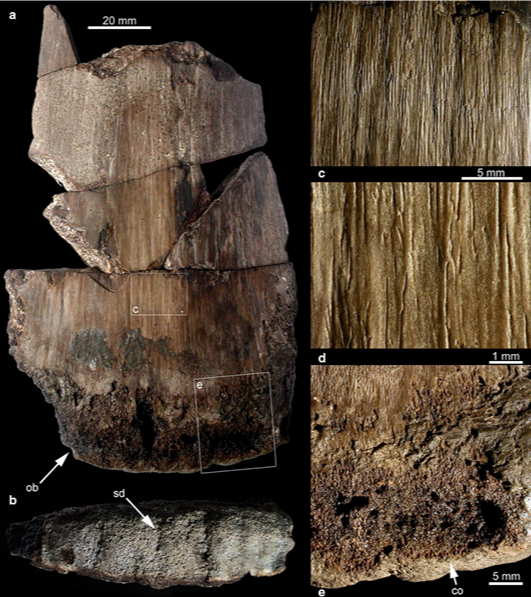
GG 504, osteoderm of an unknown Thyreophoran Dinosaur. (a) Top view of the pronounced convex side; (b) base in proximal view; (c) close-up of striated cortex shown in (a); (d) magnified cortex; (e) close-up of section close to the base shown in (a). Abbreviations: co, cortex; ob, offset base; sd, slight depression. Schade & Ansorge (2022).

The bulk of the osteoderm appears to be made up of Haversian bone (bone made up of a series of parallel tubes, which in life would have held blood vessels), surrounded by a thin, laminated cortex. These laminae are separated by layers of aragonite in places, and appear to show lines of arrested growth.

GG 504, osteoderm of an unknown Thyreophoran Dinosaur. (a) Magnified section of the distal-most fragment, arrow points towards former apex; (b) close-up of cortex from the pronounced convex side shown in (a), arrows without lines hint towards potential lines of arrested growth; (c) close-up of cortex from the slightly convex side shown in (a). Abbreviations: ?ShF, potential Sharpey’s fibres; ?so, potential secondary osteons; vc, vascular cavities. Schade & Ansorge (2022).

Specimen GG 504 resembles a previously described specimen, GG 85/1 23, which has been assigned to Emausaurus, an early diverging Thyreophoran Dinosaur (that is to say, an early Thyreophoran Dinosaur that cannot be confidently assigned to either of the main Thyreophoran groups, the Stegosaurs and Ankylosaurs, and which presumably lived before those groups diverged), and which was also recovered from the Grimmen Clay Pit. However, GG 504 is significantly larger than GG 85/1 23 (15.5 cm vs 4.5 cm), and GG85/1 23 is the largest known osteoderm associated with Emausaurus. Furthermore, GG 85/1 23 has a rougher, more vascularised base than GG 504, and a less symmetrical shape.

GG 504 also shows some resemblances to osteoderms associated with Scutellosaurus lawleri, another early diverging Thyreophoran from the Early Jurassic of Arizona, although again it is significantly larger than any osteoderm associated with this species (Scutellosaurus lawleri is only thought to have reached about 120 cm in total length).

See also...


Online courses in Palaeontology. 

Follow Sciency Thoughts on Facebook.

Follow Sciency Thoughts on Twitter.

Wednesday, 18 May 2022

Fireball meteor over southwest England.

Witnesses across much of southern, central and northwest England, as well as the Chanel Islands and parts of Wales, France, Belgium and the Netherlands, have reported observing a bright fireball slightly before 9.45 pm local time (slightly before 8.45 pm GMT) on Monday 16 May 2022. The fireball is described as having moved from southeast to northwest first appearing over Southampton and vanishing over to the east of Bristol. A fireball is defined as a meteor (shooting star) brighter than the planet Venus. These are typically caused by pieces of rock burning up in the atmosphere, but can be the result of man-made space-junk burning up on re-entry.

 
A bright fireball meteor on 16 May 2022, observed from Slough in Berkshire. Shamalia Siddiqi/Twitter/BBC.
 
Objects of this size probably enter the Earth's atmosphere several times a year, though unless they do so over populated areas they are unlikely to be noticed. They are officially described as fireballs if they produce a light brighter than the planet Venus. The brightness of a meteor is caused by friction with the Earth's atmosphere, which is typically far greater than that caused by simple falling, due to the initial trajectory of the object. Such objects typically eventually explode in an airburst called by the friction, causing them to vanish as an luminous object. However, this is not the end of the story as such explosions result in the production of a number of smaller objects, which fall to the ground under the influence of gravity (which does not cause the luminescence associated with friction-induced heating).
 
 
Heat map showing areas where sightings of the meteor were reported (warmer colours indicate more sightings), and the apparent path of the object (blue arrow). American Meteor Society.

These 'dark objects' do not continue along the path of the original bolide, but neither do they fall directly to the ground, but rather follow a course determined by the atmospheric currents (winds) through which the objects pass. Scientists are able to calculate potential trajectories for hypothetical dark objects derived from meteors using data from weather monitoring services.

See also...



Follow Sciency Thoughts on Facebook.

Follow Sciency Thoughts on Twitter.


Tuesday, 17 May 2022

Three dead and several missing following landslide in Assam State, India.

Three people have died and several more are missing following a landslide in Assam State, India, on Saturday 14 May 2022. The incident happened in the evening when part of a hillslope in Dimo Hasao District collapsed following several days of heavy rain in the area associated with the Indian Monsoon Season. Landslides are a common problem after severe weather events, as excess pore water pressure can overcome cohesion in soil and sediments, allowing them to flow like liquids. Approximately 90% of all landslides are caused by heavy rainfall.

 
A landslide in Dimo Hasao District, Assam, which killed at least three people on Saturday 14 May 2022. Press Trust of India.

The incident comes amid widespread flooding in Assam, which has displaced thousands of people in five districts, and at least eighty homes destroyed in 10 villages. Numerous roads and rail lines have been swept away, severely hampering travel within the state. Monsoon Season typically lasts from May to October each year in Assam, and frequently brings with it flooding and related events. However, this year many areas of the state also had unusual pre-monsoonal rains through much of April, which led to the ground already being waterlogged by the time the monsoon arrived, and therefore a much more rapid onset of flooding problems.

 
Diagrammatic representation of wind and rainfall patterns in a tropical monsoon climate. Geosciences/University of Arizona.

Monsoons are tropical sea breezes triggered by heating of the land during the warmer part of the year (summer). Both the land and sea are warmed by the Sun, but the land has a lower ability to absorb heat, radiating it back so that the air above landmasses becomes significantly warmer than that over the sea, causing the air above the land to rise and drawing in water from over the sea; since this has also been warmed it carries a high evaporated water content, and brings with it heavy rainfall. In the tropical dry season the situation is reversed, as the air over the land cools more rapidly with the seasons, leading to warmer air over the sea, and thus breezes moving from the shore to the sea (where air is rising more rapidly) and a drying of the climate. This situation is particularly intense in South Asia, due to the presence of the Himalayas. High mountain ranges tend to force winds hitting them upwards, which amplifies the South Asian Summer Monsoon, with higher winds leading to more upward air movement, thus drawing in further air from the sea.

See also...



Follow Sciency Thoughts on Facebook.

Follow Sciency Thoughts on Twitter. 

Sunday, 8 May 2022

One dead and thousands need hospital treatment as dust storms sweep across Iraq.

One person has died and about 5000 more have needed hospital treatment as a series of dust storms swept across Iraq last week. The majority of cases were from Baghdad, Anbar, and Najaf provinces, with the elderly and people with existing respiratory problems, such as asthma, being particularly vulnerable. Most patients were sent home after receiving oxygen treatment, although more serious cases were retained for further treatment. At the worst times flights within the country were cancelled.

 
A dust storm enveloping Baghdad on Sunday 1 May 2022. Ahmad Al-Rubaye/AFP/Getty Images.

Iraq is prone to dust storms, particularly during the summer months, when a long dry season is combined with prevailing winds blowing down from the mountainous northwest of the country towards the Persian Gulf. These are driven by high pressures over the Black Sea, and eastern Mediterranean, but typically lose their moisture on the western sides of the mountains, bringing water to western Turkey, but warm, dry air to Iraq and Arabia.

 
A patient receives treatment for dust inhalation in a hospital in Baghdad. Reuters.

While this is an expected problem, the dust storms have been getting much more severe in recent years, due to a combination of rising temperatures and lower rainfall. Temperatures in the country now exceed 50°C regularly in the summer months, and the coutry has received 50% less rainfall this year than last year. Predictions based upon current global warming models suggest that the Tigris and Euphrates rivers, which provide most of the country's water, could run dry in the summer months within 20 years, potentially making parts of the country uninhabitable.

See also...


Follow Sciency Thoughts on Facebook.

Follow Sciency Thoughts on Twitter. 


Crocodile killed following death of child in Siaya County, Kenya.

A Crocodile has been killed after a fatal attack on a child in Siaya County, Kenya, on Saturday 7 April 2022. The Animal is reported to have snatched a three-year-old boy and mauled him to death while his helpless mother looked on. in the East Asembo area, where the family has gone to collect water from Lake Victoria. The same Crocodile, described as over five metres in length, was later killed by local fishermen who caught the Animal by offering it meat attached to a hook and rope, before dragging it from the water and attacking it with pangas and axes. 

 
Crocodile killed by localfishermen in East Asembo, Kenya, on Saturday 7 May 2022. Isaiah Gwengi/The Standard.

The Kenya Wildlife Service has warned against villagers taking such matters into their own hands, asking that instead such attacks are reported so that the problem can be addressed by proffesionals who may be able to relocate problem Animals. Nile Crocodiles, Crocodylus niloticus, are considered to be of Least Concern under the terms of the  International Union for the Conservation of Nature’s Red List of  Threatened Species, but are still protected in many countries, due to historic hunting which decimated populations in many areas. The number of attacks on Humans by Crocodiles and Hippopotemus on the Kenyan shores of Lake Victoria have risen sharply in recent years, something which is thought to be driven by a rising Human population encroaching on areas where the Animals live. In August 2020 a 32-year-old woman was killed by a Crocodile while collecting water from the same beach.

See also...


Follow Sciency Thoughts on Facebook.

Follow Sciency Thoughts on Twitter.