Showing posts with label East African Rift. Show all posts

Wednesday, 8 April 2026

Ugandan farmers attempt to stop oil pipeline in UK courts.

A group of farmers from across Uganda are attempting to prevent the completion of the East African Crude Oil Pipeline, which it intended to carry crude oil from western Uganda to the Indian Ocean port of Tanga in Tanzania, by bringing a court case in London against the pipeline's owner, EACOP Ltd., arguing that the construction of the pipeline contravenes Clause 39 of the Ugandan Constitution, which guarantees that 'Every Ugandan has a right to a clean and healthy environment', as well as breaching the Ugandan National Environment Act and National Climate Change Act.

The East African Crude Oil Pipeline is intended to carry oil from two oilfields, the Tilenga and Kingfisher oil fields, on the shores of Lake Albert, to the Tanzanian coast. The Tilenga Oil Field is being developed by the French multinational TotalEnergies, while the Kingfisher Oil Field is being developed by the China National Offshore Oil Corporation. Between them the two companies plan to drill more than 400 wells, eight of which will lie within the Murchison Falls National Park. Because of the dense nature of the oil, the pipeline will need to be heated to 50°C along its entire 1443 km length, making it the world's largest heated pipeline, and significantly increasing the project's carbon footprint. The project was initiated in 2016 and is 78% complete, having been the subject of numerous legal challenges and protests in East Africa.

The planned route of the East African Crude Oil Pipeline. TotalEnergy.

EACOP Ltd. is 62% owned by TotalEnergies, with the China National Offshore Oil Corporation owning 8%, and the Uganda National Oil Company and Tanzania Petroleum Development Corporation owning 15% each. However, it is registered as a company in London, leading the Ugandan farmers to hope that bringing a case there may be effective. A number of previous cases brought in Uganda and Tanzania by farmers evicted from their lands to make way for the pipeline have been unsuccessful (according to figures provided by TotalEnergy, around 100 000 people in the two countries will have lost some land to the project, with around 5000 forced to relocate completely).

The project's leaders have asserted that the project is an essential part of the transition to carbon neutrality, and that it's footprint will be offset by a number of social and environmental projects. These include a package of US$19 million in payments plus US$22 in in-kind compensation for persons affected by the Tilinga Oil Field, and US$32 million in cash plus US$68 million in in-kind compensation for persons affected by the East African Crude Oil Pipeline, training in agricultural practices and small business-development, distribution of food  items recommended by the United Nations World Food Program (e.g. rice, pulses, oil), the rebuilding of a health centre in Buliisa District, funding for 338 students from Buliisa, Nwoya Pakwach, Nebbi and Masindi districts to take O-and A-level science courses, the renovation of twelve staff housing units at Anaka General Hospital, drilling of several boreholes in Bulisa District, which will improve access to water for 4000 people and 10 000 cattle, the provision of a number of 5-day courses at Makerere University  taught by professionals or experts from TotalEnergies, as well as access to six online courses for thousands of students, the construction of a 115 MW solar park and 100 MW wind farm in Tanzania, the construction of renewable energy projects capable of producing 60mw of energy, instillation of a 15mw solar plant at the Tilenga Central Processing Facility, the potential development of a 150mw solar thermal facility at the Tilenga Central Processing Facility, restoration of 10 km² of rain forest, the protection of 100 km² of natural forest, projects to protect populations of Antelopes and Giraffes in Murchison Falls National Park, and a wetlands restoration project in the White Nile Delta.

However, the Ugandan farmers, with the support of global campaign group Avaaz, contend that the environmental impact of the pipeline significantly outweighs any potential benefits in a number of ways. 

Firstly, the project is predicted to produce greenhouse gasses equivalent to 372 million tonnes of carbon dioxide over its planned 20 year lifetime. This is equivalent to the entire greenhouse gas emissions of Uganda for 58 years, significantly contributing to global climate change, something which is already impacting Uganda, which has suffered record-breaking floods, devastating and frequent droughts and erratic rainfall patterns in recent years.

Secondly, the pipeline is proposed to run through the Lake Victoria Basin, an environment where a significant oil leak or spill could have a catastrophic impact on Lake Victoria, an important natural habitat, source of water to people in three countries, and a major source of water to the Nile.

Thirdly, the pipeline is predicted to run through several internationally important wildlife reserves and habitats, including the Murchison Falls National Park, the Taala Forest Reserve, and the Bugoma Forest Central Forest Reserve, potentially impacting a range of habitats and endangered species. 

To this end they have appointed solicitor Joe Snape of the UK law firm Leigh Day, which specialises in environmental and humans rights cases with international dimensions, to represent them in London, and hope to begin legal proceedings in May 2026. 

Snape, who has previously represented members of the Ogale and Bille communities of the Niger Delta who have been affected by the activities of oil companies, has stated that 'Our clients believe the EACOP pipeline will result in enormous damage to the global climate as well as severe damage to their local environment. Our clients are already living on the frontline of the climate crisis and argue this pipeline will only exacerbate the impact they, and other vulnerable communities around the world, experience on their lives and livelihoods. They are calling for the pipeline construction and operations to be halted to stop this damaging impact on the climate in Uganda and elsewhere around the world.'

See also...

Monday, 24 November 2025

Ethiopian volcano erupts for first time in recorded history.

Hayli Gubbi, a shield volcano in the Afar Region of Ethiopia, erupted on Sunday 23 November 2025, for what appears to be the first time in recorded history. The volcano erupted for under twelve hours, from about 11.30 am to about 11.00 pm local time (about 8.30 am to about 8.00 pm GMT), producing an ash column about 14 km high, which drifted to the east over the Red Sea, according to the Toulouse Volcanic Ash Advisory Centre. Nobody was directly hurt by the eruption, but local farmers report crops being covered with ash, which may potentially lead to famine in the region.

An ash cloud over Hayli Gubbi on 23 November 2025. Afar Government Communication Service.

Hayli Gubbi is a 493 m high scoria cone (cone of ash) sitting on an older shield volcano (dome shaped volcano made up of layers of lava) located at the southernmost end of the Erte Ale Volcanic Chain. The volcano has never been observed to erupt before, and it is thought not to have erupted since the Late Pleistocene, more than 12 000 years ago, although the remote location of the volcano means that it has not been studied well. 

The deserts of Northern Ethiopia and Southern Eritrea are extremely volcanicly active, with dozens of volcanoes fed by an emerging divergent margin along the East African Rift; the Erta Ale Chain lies on the Ethiopian Rift, the boundary between the Nubian Plate and the Danakil Microplate. The African Plate is slowly splitting apart along the Ethiopian Rift and the East African Rift to the south (which is splitting the Nubian Plate to the West from the Somali Plate to the East). Arabia was a part of Africa till about thirty million years ago, when it was split away by the opening of the Red Sea Rift (part of the same rift system), and in time the Ethiopian and East African Rifts are likely to split Africa into a number of new landmasses.

Rifting in East Africa. The Danakil Microplate is the red triangle to the east of the Afar depression at the southern end of the Red Sea. Università degli Studi di Firenze.

See also...

Saturday, 4 January 2025

Magnitude 5.8 Earthquake in the Afar Region of Ethiopia linked to activity on Mount Dafan.

The Ethiopian Geological Institute has reported a Magnitude 5.8 Earthquake at a depth of 10.0 km, in the Awash Fentale Woreda (District) of the Afar Region of Ethiopia, about 150 km to the northeast of Addis Ababa, slightly after 4.50 am local time (slightly after 0.50 am GMT) on Saturday 4 January 2025. There are no reports of any damage or injuries arising from this quake, but it was felt as far away as Addis Ababa, and it is possible that some minor damage has occurred.

The approximate location of the 4 January 2024 Ethiopian Earthquake. USGS.

This is the latest in a series of Earthquakes in the Central Ethiopia, which began in the third week of December 2024. Clusters of Earthquakes are concerning in northern or central Ethiopia, as the area is volcanic, and seismic movements can be linked to magma moving into chambers beneath volcanoes from deeper in the Earth, which in turn can be a predictor of future volcanic eruptions. On this occasion the Ethiopian Geological Institute has suggested that the Earthquakes may be linked to a fissure eruption on Mount Dafan, a shield volcanoe in the Dulacha Woreda, which opened on 2 January producing a sustained jet of steam and hot water. Residents of the area have been evacuated as a precaution against a future, larger eruption.

A vent which opened on Mount Dafan in the Dulacha Woreda of Ethiopia on 3 January 2024, producing a sustained jet of steam and hot water. Ethiopian Geological Institute/Facebook.

The deserts of Northern Ethiopia and Southern Eritrea are extremely volcanically active, with dozens of volcanoes fed by an emerging divergent margin along the East African Rift. The African Plate is slowly splitting apart along the Ethiopian Rift and the East African Rift to the south (which is splitting the Nubian Plate to the West from the Somali Plate to the East). Arabia was a part of Africa till about thirty million years ago, when it was split away by the opening of the Red Sea Rift (part of the same rift system), and in time the Ethiopian and East African Rifts are likely to split Africa into a number of new landmasses. This rifting exerts pressure on the rocks around the margin of the sea, slowly pushing them apart, not smoothly but in fits and starts as the pressure overcomes the tendency of the rocks to stick together, creating shocks that we experience as Earthquakes.

Rifting in East Africa. The Danakil Microplate is the red triangle to the east of the Afar depression at the southern end of the Red Sea. Università degli Studi di Firenze.

See also...

Wednesday, 2 August 2023

Magnitude 5.6 Earthquake to the south of Massawa, Eritrea.

The United States Geological Survey recorded a Magnitude 5.6 Earthquake at a depth of 10.0 km, roughly 42 km to the south of the city of Massawa in central Eritrea, at about 8.15 pm local time (about 5.15 pm GMT) on Tuesday 1 August 2023. There are no reports of any damage or injuries from this quake, but people have reported feeling the event in Asmara, the capitol of Eritrea, as well as in Tigray Province, Ethiopia.

The approximate location of the 1 August 2023 Eritrea Earthquake. USGS.

The deserts of Northern Ethiopia and Eritrea are extremely volcanically active, with dozens of volcanoes fed by an emerging divergent margin along the East African Rift; the volcano Erta Ale is on the Ethiopian Rift, the boundary between the Nubian Plate and the Danakil Microplate. The African Plate is slowly splitting apart along the Ethiopian Rift and the East African Rift to the south (which is splitting the Nubian Plate to the West from the Somali Plate to the East). Arabia was a part of Africa till about thirty million years ago, when it was split away by the opening of the Red Sea Rift (part of the same rift system), and in time the Ethiopian and East African Rifts are likely to split Africa into a number of new landmasses. This rifting exerts pressure on the rocks around the margin of the sea, slowly pushing them apart, not smoothly but in fits and starts as the pressure overcomes the tendency of the rocks to stick together, creating shocks that we experience as Earthquakes.

Rifting in East Africa. The Danakil Microplate is the red triangle to the east of the Afar depression at the southern end of the Red Sea. Università degli Studi di Firenze.

See also...

Follow Sciency Thoughts on Facebook.

Follow Sciency Thoughts on Twitter.


Monday, 20 March 2023

Possible eruption on Mount Nyamulagira, Democratic Republic of Congo.

Scientists at the Goma Volcanological Observatory have reported seeing bright lights consistent with an eruption on the summit of Mount Nyamulagira, a 3058 m high shield volcano in the Virungu Mountains of eastern Democratic Republic of Congo, about 25 km to the north of Lake Kivu. This was accompanied by seismic activity beneath the volcano, which is often indicative of magma moving into chambers prior to an eruption. Mount Nyamalugira, which lies in North Kivu Province, is often considered to be Central Africa's most active volcano, having erupted more than 40 times since 1885. Due to the highly active nature of the volcano it presents little threat to human life, because nobody chooses to live near it, though concerns have occasionally been raised about the threat it presents to wildlife in the Viruga National Park.

The approximate location of Mount Nyamulagira. Google Maps.

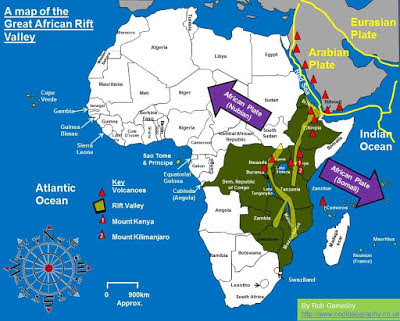
Mount Nyamulagira lies on the Eastern Branch of the East African Rift, which is slowly splitting the African Plate in two along a line from the Red Sea through Ethiopia, and which includes the great lakes and volcanoes of east-central Africa. This has the potential to open into a new ocean over the next few tens of millions of years, splitting Africa into two new, smaller, continents; Nubia to the west and Somalia to the east.

Movement on the African Rift Valley, with associated volcanoes. Rob Gamesby/Cool Geography.

See also...

Follow Sciency Thoughts on Facebook.

Follow Sciency Thoughts on Twitter.


Wednesday, 28 December 2022

Magnitude 5.5 Earthquake in southern Eritrea.

The United States Geological Survey recorded a Magnitude 5.5 Earthquake at a depth of 10.0 km, in southern Eritrea, roughly 64 km to the north of the city of Ādīgrat in the Tigray Region of Ethiopia, slightly after 3.20 pm local time (slightly after 12.20 pm GMT) on Monday 26 December 2022. There are no reports of any damage or injuries from this quake, but people may have felt it locally.

The approximate location of the 26 December 2022 Eritrea Earthquake. USGS.

The deserts of Northern Ethiopia and Eritrea are extremely volcanically active, with dozens of volcanoes fed by an emerging divergent margin along the East African Rift; the volcano Erta Ale is on the Ethiopian Rift, the boundary between the Nubian Plate and the Danakil Microplate. The African Plate is slowly splitting apart along the Ethiopian Rift and the East African Rift to the south (which is splitting the Nubian Plate to the West from the Somali Plate to the East). Arabia was a part of Africa till about thirty million years ago, when it was split away by the opening of the Red Sea Rift (part of the same rift system), and in time the Ethiopian and East African Rifts are likely to split Africa into a number of new landmasses. This rifting exerts pressure on the rocks around the margin of the sea, slowly pushing them apart, not smoothly but in fits and starts as the pressure overcomes the tendency of the rocks to stick together, creating shocks that we experience as Earthquakes.

Rifting in East Africa. The Danakil Microplate is the red triangle to the east of the Afar depression at the southern end of the Red Sea. Università degli Studi di Firenze.

See also...


Follow Sciency Thoughts on Facebook.

Follow Sciency Thoughts on Twitter.