Showing posts with label Isoptera. Show all posts

Monday, 2 February 2015

First evidence of Human consumption by Katydids and Woodlice.

Modern forensic science typically involves the detailed examination of corpses where foul play is suspected, with the aim of identifying any marks on the body, and relating them to the cause of, and circumstances surrounding, the death of the person in question. Numerous Arthropods are known to feed on vertebrate carrion, including Human remains, and marks left by feeding Arthropods have in the past been mistaken for burns, evidence of intravenous drug use, bite marks, defensive wounds and a variety of other forms of evidence. As such forensic scientists in a number of areas have begun to experiment with Human remains left to decompose in the environment, in order to better understand how Arthropod feeding traces and other forms of environmental destruction affect a body after death.

In a paper published in the Journal of Medical Entomology in January 2015, a team of scientists led by Jennifer Pechal of the Department of Biology at the University of Dayton and the Department of Entomology at Michigan State University, discuss the results of an experiment in which a body was left exposed at the Forensic Anthropology Center at Texas State University, and subsequently targeted by a variety of Arthropods not previously associated with the consumption of Human remains.

Firstly the cadaver was targeted by a gravid female Katydid, Pediodectes haldemani, which began feeding on the lower right arm of the body, approximately 32 hours after it was placed in the field. Katydids, Tettigoniidae, are Orthopteran Insects related to Grasshoppers and Crickets, but unlike these plant-eating groups they are generally omnivorous in their dietary preferences, and the species Pediodectes haldemani is known to be almost totally carnivorous. While Katydid have previously been recorded consuming vertebrate carrion, this is the first recorded instance of the consumption of Human remains by a Katydid, and Pechal et al. suggest that this might be slightly atypical behaviour, fuelled by a need for extra protein in the gravid female.

A gravid, female Pediodectes haldemani (Orthoptera: Tettigoniidae) feeding on the right forearm of a set of human remains (top), and the resulting physical artifact (indicated by the black arrow) on the remains by the feeding Pediodectes haldemani (bottom). Pechal et al. (2015).

Secondly the remains were visited by a Common Woodlouse, Armadillidium cf. vulgare, this time feeding on the lower left arm. Woodlice are terrestrial Isopod Crustaceans, with a typicalldetritivorous diet; they are most commonly associated with plant remains, but are known to eat carrion, though once again this is the first time that a Woodlouse has been recorded eating Human remains.
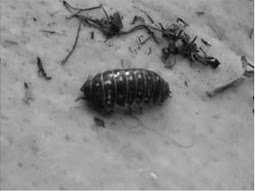
Armadillidium cf. vulgare (Isopoda: Armadilidiidae) feeding on the left forearm of a human set of remains (top), and the resulting artifact (indicated by theblack arrow) on the remains from the isopod activity (bottom). Pechal et al. (2015).

Finally the body was visited by a colony of Red Fire Ants, Solenopsis invicta, an imported species in the US, but which has become common in grasslands; Ants, including Red Fire Ants, are common visitors to carrion. On this occasion it is unclear whether the Ants actually fed on the remains, rather they entered the body via the hole left by the Katydid’s feeding and appeared to build a shelter there, using soil and small pieces of woody debris, a structure which would have been difficult to interpret had its construction not been observed.

A structure consisting of soil, small organic woody debris, and other organic material by red imported Fire Ants, Solenopsis invicta (Hymenoptera: Formicidae), in the artifact resulting from Pediodectes haldemani feeding activity on the leftforearm of the descendent. The structure was re-constructed each time the remains were disturbed for sampling purposes. The small dots surrounding the debris pile are fly artifacts or speck. Pechal et al. (2015).

See also…

http://sciencythoughts.blogspot.co.uk/2015/01/two-new-species-of-katydids-from.htmlTwo new species of Katydids from Pakistan. Katydids (or Buschcrickets), Tettigonioidea, are Members of the Insect Order Orthoptera, which also includes Crickets and Grasshoppers. They are...


http://sciencythoughts.blogspot.co.uk/2014/11/the-impact-of-yellow-crazy-ant-on.htmlThe impact of the Yellow Crazy Ant on the Vallée de Mai Palm Forest of Praslin Island. Ants are often highly adaptable animals, and many species have proven to be highly invasive pests, able to reach new homes by hitching a ride on cargo moved by Humans, and often proceeding modify the ...
http://sciencythoughts.blogspot.co.uk/2014/10/three-new-species-of-katydid-from-china.htmlThree new species of Katydid from China. Katydids of the genus Xizicusand its close relatives are found across eastern Asia, though the taxonomy of the group is currently somewhat confused, in part due to publications being published in different languages...

Follow Sciency Thoughts on Facebook.

Saturday, 11 October 2014

Interpreting the relationship between Ants and Termites from a single piece of Mexican Amber.


Ants and Termites are eusocial Insects that have dominated many tropical ecosystems since at least the Early Cretaceous. Relationships between the two groups (which are not closely related) are complex, with some species able to tolerate one-another and even share nests, while others are deeply hostile, typically with Ants feeding on Termites or Termites fighting to keep all Ants away from their territories. However, while these relationships have been extensively studied in modern representatives of the group, understanding how these Insects may have interacted in the remote past is much more difficult.

In a paper published in the journal PLoS One on 20 August 2014, David Coty of the Muséum National d’Histoire Naturelle in Paris, Cédric Aria of the Department of Natural History-Palaeobiology at the Royal Ontario Museum and the Department of Ecology & Evolutionary Biology at the University of Toronto, and RomainGarrouste, Patricia Wils, Frédéric Legendre and André Nel, also of the of the Muséum National d’Histoire Naturelle in Paris, describe a single piece of amber from the Salt River Amber Mine in Chiapas State, Mexico, which includes several different Ants and Termites, and discuss the implications of this for relationships between the groups.

General configuration of the Mexican amber. (A) Overview of the amber piece, under optical microscope. Scale bar is 3 mm. (B) Three dimensional replica of the same; colours define taxonomic groups, viz. purple for Azteca Ants, blue for Nasutitermes Termites, red for Neivamyrmex Ant, green for small Psocodea. Labels: Az1, Azteca Ant nearest to predation scene; Az2 and Az3, two other Azteca Ants, both trapped in a flow distinct to that of the others inclusions and whose physical density matches that of the Nasutitermes soldier; Na1, Nasutitermes worker trapped between the Neivamyrmex mandibles; Na2, isolated Nasutitermes termite closest to predation scene; Na3, Nasutitermes worker with damaged gaster; Na4, Nasutitermes soldier; Ne, Neivamyrmex Ant; Ps, Psocodea; Scale bar is 3 mm. Aria et al. (2014).

The Amber contains four Termites assigned to a single (unknown) species of the genus Nasutitermes, three workers and a soldier, as well as three Ants of the genus Azteca and one Neivamyrmex Army Ant.

Neivamyrmex, like all Army Ants, are voracious predators, attacking invertebrate and invertebrate prey alike, typically with a sudden attack by a large number of Army Ants overwhelming the prey. Other Ants and Termites are favoured prey for such Insects, and nests will always be attacked when encountered. The Neivamyrmex Ant in the amber has a small worker Termite in its jaws, which suggests that it was engaged in such an attack when it became stuck in, and overwhelmed by, the plant resin which later became preserved as amber. Potentially the Termite could have been seized reflexively by the trapped, dying Ant, or the Ant could have become trapper while trying to scavenge a Termite previously caught in the resin, but one of the other worker Termites shows signs of damage typical of an Army Ant attack suggesting that the two species were fighting before becoming overwhelmed. The presence of a soldier Termite also supports this hypothesis, as in modern members of the genus Nasutitermes, members of this caste remain inside the nest for most of the time, only emerging when the nest is threatened or attacked, and never moving far from the nest.

Details of the Termites. (A) General side view of the NeivamyrmexAnt holding a Nasutitermes Termite (Na1) between its mandibles, under optical microscope, scale bar is 1 mm. (B) Detail of damaged gaster of Nasutitermes worker (Na3) closely contiguous to a Nasutitermes soldier (Na4), scale bar is 1 mm. (C) Side view of closely contiguous Nasutitermes soldier (Na4) and worker (Na3), black arrow: digestive tube of Nasutitermes worker scale bar is 1 mm.Aria et al. (2014).

The situation with the AztecaAnts is more complex. Some modern members of this genus are able to co-occupy the nests of some species of Nasutitermes, on either a seasonal or permanent basis. This is not an entirely benign relationship, as the Ants do consume some of the Termites, but the benefits to the Termites appear to outweigh the costs of removing the Ants; the Termites consume dead Ants, which are a rich source of nitrogen, although they do not actively predate the Ants, and the two species appear to cooperate when defending the nest against mutual threats, such as Army Ants. Aria et al. suggest that the presence of Azteca Ants alongside Nasutitermes Termites that were apparently engaged in defending their nest against an Army Ant attack strongly suggests that such a relationship was occurring in this instance, and that the Ants and Termites were engaged in a defence of a mutual nest against the invading Army Ants.

The precise age of amber from the Salt River Mine has yet to be determined, however it is thought to be at least Middle Miocene in age, suggesting that the mutualistic relationship between Azteca Ants and Nasutitermes Termites is at least that old.

See also…

Leafcutter Ants harvest vegetation from the tropical rainforests of South and Central America, which they then carry back to their nests and use as feed in fungal farms. Each species of Ant has its own unique...


Thief Ants of the genus Solenopsis are one of the most numerous and widespread Ant groups, particularly in the tropics. However they are not greatly studied or understood, despite the fact that some species are...


Ants are among the most widespread and abundant of Insect groups, with over 13 000 described species. They play a major role in the shaping of modern ecosystems and landscapes, and many other species of animals, plants and even fungi have commensal...


Follow Sciency Thoughts on Facebook.


Thursday, 19 September 2013

A new species of Soldierless Termite from the Caribbean, Central and South America.

Termites (Isoptera) are an ancient group of social insects related to Cockroaches; in fact many entomologists (scientists that study insects) now regard them as a specialized group of social Cockroaches rather than a separate group. Termites consume woody, cellulose-rich plant material that most other Insects (or animals of any sort) cannot digest, and have a unique stomach fauna that helps them do so, comprising either Eukaryotic Flagellates (most Termites) or a variety of Prokaryotic organisms (members of the Family Termitidae). Termites are eusocial Insects with a caste system comprising sexual adults that breed and workers that forage for food and feed the young and sexual adults, as well as building and maintaining their nests. Many Termite species also produce a soldier cast, which defend foraging workers and the nest against invaders and predators (particularly Ants) but which cannot forage or feed for themselves and have to be looked after by the workers.

In a paper published in the journal Zootaxa on 17 May 2013, Rudolf Scheffrahn of the Fort Lauderdale Research and Education Center of the Institute for Food and Agricultural Sciences at the University of Florida, describes a new species of Termite from a number of locations in Central and South America and the Caribbean.

The new species is named Compositermes vindai, where 'Compositermes' means an aggregation, something made up of parts, a reference to the structure of the gut, and 'vindai' honours Boudanath (Vinda) Maharajh, an entomologist from Trinidad and Tobago who worked with the Fort Lauderdale team on surveys in various countries and who died in 2009. It is placed in the Subfamily Apicotermitinae, members of the Ternitidae that lack a soldier cast and which are known from South America and Africa. Compositermes vindai was found living in small colonies under rocks or in larger colonies of Termites belonging to the genus Cornitermes, a mound-building species which does have a soldier caste.

Compositermes vindai workersand nymph in gallery of Cornitermes sp. mound. Scheffrahn (2013).

The sexual adult, or imago, of Compositermes vindai is unknown; most Termite species have their description based upon the imago, however Compositermes vindai has been collected by scientists from the University of Florida from sites in French Guiana, Panama, Paraguay, Tobago and Trinidad over the period 1996 to 2010, and given the large number of specimens Scheffren suggests it is appropriate to formally describe the species from the worker.


Collection localities of Compositermes vindai (red dots) and University of Florida collection localities (small black dots). Scheffrahn (2013).