Showing posts with label Krasnoyarsk Republic. Show all posts

Saturday, 6 June 2020

Russian authorities to investigate all industrial installations on areas of permafrost following diesel spill in Krasnoyarsk Krai.

Authorities in Russia are launching a widespread investigation into industrial sites located on areas of permafrost following a 20 000 tonne diesel spill at a site in the city of Norilsk in Krasnoyarsk Krai on Friday 29 May 2020. The spill is thought to have been caused by the collapse of a fuel tank located on permafrost at a site owned by Norilsk Nickel, the world's largest producer of nickel and palladium, which was not reported to authorities for two days after it was detected, leading to a spill that covered an area of about 350 km² and spread 12 km down the Ambarnaya River. 

Series of satellite images take between 23 May and 1 June 2020, showing the spread of diesel down the Ambarnaya River following a spill at an industrial plant in Norilsk, Krasnoyarsk Krai. Copernicus Sentinel/ESA.

Around 55% of Russia's territory is located on permafrost (land that remains permanently frozen), and this land includes many industrial sites, including mines and oil and gas wells. The Arctic Council has been warning for some years that such sites were at risk due to rapid warming, both globally, and locally due to heat generated at such sites, and while newer industrial sites in Russia are typically built with this in mind, it is unclear to what extent older sites have been modified to take possible thawing of permafrost.

Spilled diesel on the Ambarnaya River in Krasnoyarsk Krai, following the collapse of a fuel storage tank at Norilsk on 29 May 2020. AFP.

The Russian Investigative Committee has launched a criminal enquiry into the Norilsk spill, and the director of the plant at which it occurred, Vyacheslav Starostin, has been arrested and faces charges of negligence and pollution. Specialists in pollution from the Russian Emergencies Ministry have been flown to the scene of the incident, though it is likely that the clean-up process could take several years in what it thought to be the worst oil spill in the Arctic Circle since the Exxon Valdes incident in Alaska in 1989.

Oil spills are potentially harmful to aquatic life in a variety of ways. Most obviously it can coat the outside of organisms, causing damage to external structures such as the feathers of Birds and fur of Mammals, as well as smothering many aquatic invertebrates and plants. It also contains a variety of chemicals which can be directly toxic upset the hormonal balance of many animals. Oil also impedes the feeding of aquatic organisms, coating both food and feeding organs, but provides an excellent food source for Bacteria, which can lead to Eutrophication events - dramatic increases in Bacteria numbers, which then use all the oxygen in the water, leading other organisms to asphyxiate.

See also...

https://sciencythoughts.blogspot.com/2019/10/three-dead-at-nickel-mine-in.htmlhttps://sciencythoughts.blogspot.com/2019/10/flooding-kills-at-least-fifteen.html
https://sciencythoughts.blogspot.com/2019/10/former-director-of-russian-diamond-mine.htmlhttps://sciencythoughts.blogspot.com/2019/08/siberian-mine-evacuated-after-fire.html
https://sciencythoughts.blogspot.com/2018/06/siberian-river-turned-red-pollution.htmlhttps://sciencythoughts.blogspot.com/2017/08/nine-still-missing-following-flood-at.html
Follow Sciency Thoughts on Facebook.

Thursday, 24 October 2019

Three dead at Nickel Mine in Krasnoyarsk Krai, Russia.

Three miners have been found dead at the Nornickel-operated Taimyr Nickel mine in Krasnoyarsk Krai, Siberia. The men were discovered 1345 m bellow the ground in the 1532 m deep mine on the Taimyr Peninsula, within the Arctic Peninsula, at about 4.30 pm local time on Tuesday 22 October 2019, having apparently asphyxiated. One of the dead men had apparently set out to look for the others after they had initially gone missing. All three were carrying unused breathing equipment, suggesting that they were caught unaware by the gas that killed them. There was no sign of any collapse within the mine.

The Taimyr Nickel mine in Krasnoyarsk Krai, Siberia. Russia Travel Blog.

The cause of the incident has yet to be determined. Pockets of gas, which can be exposed by blasting or other excavation activity are a problem in all underground mines. Typically when a seam containing pressurised gas is cut into it bursts, releasing the pressure and throwing large blocks of coal into the faces of the miners, often with fatal results. Thus although the gas involved is flammable it does not actually need to ignite to cause fatalities. However gas can seep into mines less dramatically, with potentially fatal consequences if it is not noticed. Mine gas is more usually associated with coal pits, where it is produced by compression of the coal, driving of volatile organic compounds, but can affect other forms of mine.

See also...

https://sciencythoughts.blogspot.com/2019/10/flooding-kills-at-least-fifteen.htmlhttps://sciencythoughts.blogspot.com/2019/10/former-director-of-russian-diamond-mine.html
https://sciencythoughts.blogspot.com/2019/07/flooding-in-siberia-kills-at-least.htmlhttps://sciencythoughts.blogspot.com/2018/06/siberian-river-turned-red-pollution.html
https://sciencythoughts.blogspot.com/2017/08/understanding-conection-between.htmlhttps://sciencythoughts.blogspot.com/2017/08/nine-still-missing-following-flood-at.html
Follow Sciency Thoughts on Facebook.

Monday, 21 October 2019

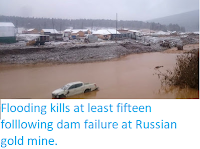
Flooding kills at least fifteen folllowing dam failure at Russian gold mine.

Fifteen people have died and five more are still missing following the collapse of a series of dams at a gold mine in Krasnoyarsk Krai on Saturday 19 October 2019. The dam had apparently been built across the Seiba River, which produces alluvial gold (gold which is present in a rock formation at a very low level, but which is eroded out of the rock by the action of water, and then concentrated in certain places by the action of the water). Such dams can either form a body of more-or-less still water on a fast moving watercourse, causing it to drop its sediment load, in this case including gold, or simply allow miners access to areas when gold rich sediments would normally be covered by water. The flood is reported to have swept away a number of housing blocks being used by workers at the mine, leading to the fatalities.

Flooding at an alluvial gold mine in Krasnoyarsk Krai, following a dam collapse on 19 October 2019. Russian Emergencies Ministry/TASS.

Following the collapse an investigation by Russian federal authorities has established that the mines owners did not have permission to dam the river, and that the mine's overseer did not hold a relevant mining qualification. The chief executive officer of the mining company Sisim has been arrested following the incident, as has a senior manager at the company, and the site overseer. 

See also...

https://sciencythoughts.blogspot.com/2019/10/former-director-of-russian-diamond-mine.htmlhttps://sciencythoughts.blogspot.com/2019/07/flooding-in-siberia-kills-at-least.html
https://sciencythoughts.blogspot.com/2018/06/siberian-river-turned-red-pollution.htmlhttps://sciencythoughts.blogspot.com/2017/08/understanding-conection-between.html
https://sciencythoughts.blogspot.com/2017/08/nine-still-missing-following-flood-at.htmlhttps://sciencythoughts.blogspot.com/2014/01/magnitude-51-earthquake-in-sakha.html
Follow Sciency Thoughts on Facebook.

Saturday, 16 June 2018

Siberian river turned red pollution following failure of mine tailings pond.

A river in Siberia has turned red after a mine tailings pond failed this week. The Daldykan River in the north of the Krasnoyarsk Krai (Republic) in Siberia was effected by runoff from the Nornickel operated Nadezhda Metallurgical Plant, which is a deep red colour due to a high iron salt content.

The River Daldykan in northern Krasnoyarsk, turned red by iron salts from a nickel plant tailings pond. Siberian Times.

The Nadezhda Metallurgical Plant is a Soviet era installation, which were largely constructed without consideration of environmental issues in a drive to industrialise rapidly. The plant was fined an undisclosed amount by environmental watchdog Rosprirodnadzor in 2016 following a similar incident, and has reportedly undergone some environmental remediation work since. However, while the size of the fine has not been revealed, the maximum fine that could have been imposed would have been 40 000 roubles (US$650), a fine of limited consequence to a company such as Nornickel, which has estimated about US$16 500 000 000, and it is unclear to what extent the environmental watchdog could genuinely sanction the company, which is 28% owned by Russian president Vladamir Putin.

See also...

http://sciencythoughts.blogspot.com/2018/03/microbial-biodiversity-around-garga-hot.htmlhttp://sciencythoughts.blogspot.com/2017/08/understanding-conection-between.html
http://sciencythoughts.blogspot.com/2016/12/fireball-over-southern-siberia.htmlhttp://sciencythoughts.blogspot.com/2014/04/one-confirmed-fatality-after-omsk-hit.html
http://sciencythoughts.blogspot.com/2012/10/earthquake-under-lake-baikal.htmlhttp://sciencythoughts.blogspot.com/2012/02/earthquake-in-tuva-republic-southwest.html
Follow Sciency Thoughts on Facebook.

Sunday, 25 March 2018

Phyllocnistis indistincta, Phyllocnistis saepta & Phyllocnistis verae: Three new species of Leaf-mining Moths from Asia.

Moths of the Family Gracillariidae are found throughout the world except on Antarctica and some remote islands. Their larvae are leaf-miners, worm-like caterpillars that live in tunnels inside leaves. Some groups of Gracillarid Moths are specialist miners of the leaves of some of the most ancient groups of Angiosperms (flowering plants) such as Laurels and Magnolias, and fossils leaf mines that resemble those of the Moths have been found in fossilised leaves from the Cretaceous of North America, which also suggests this is an ancient association. However the oldest fossils of the Moths themselves are from (Eocene) Baltic amber, and there is no way to connect these moths to the leaf mines, so it is quite conceivable that the Moths have only recently colonised these plants, and that the burrow shape is coincidental, simply a good shape for a leaf mine in this sort of leaf.

In a paper published in the journal ZooKeys on 18 February 2018, Natalia Kirichenko of the Sukachev Institute of Forest, the Siberian Federal University, and Zoologie Forestière, Paolo Triberti of the Museo Civico di Storia Naturale in Verona, Shigeki Kobayashi of the Entomological Laboratory at Osaka Prefecture University, Toshiya Hirowatari of the Entomological Laboratory at Kyushu University, Camiel Doorenweerd of the Department of Plant and Environmental Protection Sciences at the University of Hawai'i, and the Naturalis Biodiversity Centre, Issei Ohshima of the Department of Life and Environmental Sciences at the Kyoto Prefectural University, Guo-Hua Huang of the Hunan Provincial Key Laboratory for Biology and Control of Plant Diseases and Insect Pests at the Hunan Agricultural University, Min Wang of the Department of Entomology at the South China Agricultural University, Emmanuelle Magnoux, also of Zoologie Forestière, and Carlos Lopez-Vaamonde, again of Zoologie Forestière, and of the Institut de Recherche sur la Biologie de l’Insecte at the Université François-Rabelais de Tours, describe three new species of Leaf-mining Moths from Dogwood trees, Cornus sp., in Asia. All are placed in the genus Phyllocnistis.

The first new species is named Phyllocnistis indistincta, in reference to the colouration of the forewing, with indistinct yellow-white bands. This species has wing-spans of between 4.0 and 6.5 mm, and is white in colour with yellow, orange, brown and black markings. It was found on Wedding Cake Trees (Cornus controversa), Flowering Dogwoods (Cornus florida), and Korean Dogwoods (Cornus kousa), on Honshu, Shikoku and Kyushu islands, Japan.

Phyllocnistis indistincta, male specimen. Scale bar is 1 mm. Kirichenko et al. (2018).

The second new species described is named Phyllocnistis verae, in honour of Vera Kirichenko, the mother of Natalia Kirichenko. This species has wingspans of 6.0-6.1 mm and is white with dark brown and orange markings. This species was found at a single location, beside the Yenisei River in Krasnoyarsk Krai, Siberia, on a White Dogwood tree, Cornus alba.

Phyllocnistis verae, male specimen. Scale bar is 1 mm. Kirichenko et al. (2018).

The final new species is named Phyllocnistis saepta, meaning 'to block' in reference to the shape of a blotch on the forewing. This species has a wingspan of 5.0 mm and is white in colour with orange, brown and black markings. This species was found living at a single location in Weixi County, in Yunnan Province, China, on a Large-leaf Dogwood, Cornus macrophylla.

 Phyllocnistis saepta, male specimen. Scale bar is 1 mm. Kirichenko et al. (2018).

See also...

http://sciencythoughts.blogspot.co.uk/2018/03/dahlica-somae-dahlica-ochrostigma-two.htmlhttp://sciencythoughts.blogspot.co.uk/2018/01/elcysma-ziroensis-new-species-of-burnet.html
http://sciencythoughts.blogspot.co.uk/2017/12/lactura-rubritegula-new-species-of.htmlhttp://sciencythoughts.blogspot.co.uk/2017/08/pyrophleps-ellawi-new-species-of.html
http://sciencythoughts.blogspot.co.uk/2017/07/nagiella-occultalis-new-cryptic-species.htmlhttp://sciencythoughts.blogspot.co.uk/2017/06/boalda-poguei-new-species-of-owlet-moth.html
Follow Sciency Thoughts on Facebook.

Tuesday, 6 December 2016

Fireball over southern Siberia.

Witnesses have reported seeing a bright fireball meteor over much of the Khakassia and Krasnoyarsk republics in southern Siberia at about 6.50 pm local time on Tuesday 6 December 2016. The meteor is reported to habe flaired brightly, but with a 'cold light, like a fluorescent lamp', for three to four seconds, and that about 30 secondes after that a lound bang was heard. Natan Eysmont of the Russian Space Research Institute has suggested that this could have been caused by a small stoney asteroid 10-15 m in diameter.

The 6 December 2016 Siberian fireball meteor as seen from Sayanogorsk in Khakassia. RT.

A fireball is defined as a meteor (shooting star) brighter than the planet Venus. These are typically caused by pieces of rock burning up in the atmosphere, but can be the result of man-made space-junk burning up on re-entry. Objects of this size probably enter the Earth's atmosphere several times a year, though unless they do so over populated areas they are unlikely to be noticed. It is possible that this object will have produced meteorites that reached the surface (an object visible in the sky is a meteor, a rock that falls from the sky and can be physically held and examined is a meteorite) aound the Babik Valley area, accoriding to local authorities.

See also...

http://sciencythoughts.blogspot.co.uk/2016/12/the-gemenid-meteors.htmlhttp://sciencythoughts.blogspot.co.uk/2016/11/fireball-over-florida.html
http://sciencythoughts.blogspot.co.uk/2016/11/the-leonid-meteors.htmlhttp://sciencythoughts.blogspot.co.uk/2016/10/fireball-over-eastern-great-lakes-region.html
http://sciencythoughts.blogspot.co.uk/2016/09/fireball-over-cyprus.htmlhttp://sciencythoughts.blogspot.co.uk/2016/09/fireball-over-north-carolina.html
Follow Sciency Thoughts on Facebook.