Showing posts with label Lepidoptera. Show all posts

Friday, 10 October 2025

Batrachedra olei: A new species of Frog Moth from La Gomera, Canary Islands.

Frog Moths, Batrachedridae are a small group of largely tropical Moths, which gain their name from their resting posture, in which the front legs are held under the body while the back legs sprawl at the side, causing them to sit upright in a similar manner to a Frog. There are ten genera within the Family Batrachedridae, with the most abundant genus, Batrachedra, containing 114 known species and being found on every continent except Antarctica.

In a paper published in the journal SHILAP Revista de lepidopterologĂ­a on 30 September 2025, Per Falck, an independent researcher from Neksø in Denmark describes a new species of Batrachedra, from the island of La Gomera in the Canaries. 

The new species is named Batrachedra olei in honour of the Danish lepidopterist Ole Karsholt, who Per Falck identifies as a good friend, and who helped him which both the content and the language of the research paper. The species is described from a series of specimens attracted to an actinic light (the sort of light in electric 'fly-killers') set up at locations on the island of La Gomera between 2021 and 2024.

Batrachedra olei, male, La Gomera, 11.5 mm wingspan. Falck (2025).

Specimens of Batrachedra olei range from 7.5 to 12.5 mm in wingspan, and have are white on their heads, necks, and the forepart of their thoraxes, while the hindpart of their thoraxes, their abdomens, their hindwings, and their antennae are yellowish grey. The forewings of the species are yellowish ochreous mottled with grey scales, with two indistinct, longitudinal streaks.

 Batrachedra olei, female, La Gomera, 12 mm wingspan. Falck (2025).

Adults of Batrachedra olei were found on the northern part of La Gomera between January and November, no juvenile specimens were found. The species is probably endemic to the island. Batrachedra olei is the first species discovered in the Canary Islands. There are seven previously described species of Batrachedra from Europe and North Africa, but a DNA barcode analysis recovered an unnamed species from South Africa as the closest relative to Batrachedra olei.

See also...

Wednesday, 17 January 2024

Cigaritis meghamalaiensis: A new species of Lycaenid Butterfly from the southern Western Ghats of India.

Lycaenid Butterflies or 'Blues' are a widespread and highly successful group of Lepidopteran Insects, noted for their blue or metallic colouring. With about 6000 known species, Lycaenids are found on all continents and comprise about 30% of all described Butterfly species. The group is particularly notable for its relationship with Ants, with the females of many species laying their eggs in or near to Ant nests, and the young of many species being able to induce the Ants to feed them while they mature within the nest. This relationship appears to have mutualistic roots, with some members of the group having larvae which are guarded by the Ants while they feed, and which produce a sugar-rich honeydew which the Ants consume. Silverlines, Cigaritis spp., are a genus of Lycaenid Butterflies found across Africa, South and Southeast Asia.

In a paper published in the journal Entomon on 31 December 2023,  Ramasamy Kamaya Naicker of  Saptur Palace and the Vanam Trust, Sujitha Prabhakaran Chandrika of the Department of Zoology at the University of Kerala, Baiju Kochunarayanan of Sreerangam, Jebine Jose of Kaduvathookil House, Manoj Kripakaran of Shyladhri, Rajkumar Chidambaram Palaniappan, also of the Vanam Trust, Vinayan Padmanabhan Nair of Nethaji Housing Colony, Kalesh Sadasivan of Greeshmam and the Travancore Nature History Society describe a new species of Cigaritis from the southern Western Ghats of India.

The new species is named Cigaritis meghamalaiensis, where 'meghamalaiensis' means 'from Meghamalai' , in reference to the region where it was discovered; the name 'Meghamalai' means 'cloud mountain', so the name also refers to the subtropical montane cloud forests where the species is found. The species was first observed at high elevations within the Periyar Tiger Reserve in Kerala State, and subsequently also found in the adjoining Meghamalai Mountain Range of Tamil Nadu.

Cigaritis meghamalaiensis Field images of males, females and seasonal forms. (A) Male, typical colouration; (B( female, typical colouration; (C) male upperside; (D) female upperside; (E) dry season male underside; (F) dry season female underside; (G) mating; (H) oviposition. Ramasamy Naicker in Naicker et al. (2023).

Males of Cigaritis meghamalaiensis have forewings that are black on the upper side with extensive metallic blue markings, and hindwings that are grey with blue markings. In females the forewings are grey with metallic blue markings and the hindwings are a lighter grey with blue markings. In both sexes the undersides of the wings in both sexes are a pale pinkish brown with pinkish orange markings.

Cigaritis meghamalaiensis. Early stages, larval pens, and attending Ants. (A) Freshly laid egg; (B) larvae being attended by Crematogaster Ants inside the larval pen; (C) intermediate instar larvae and its attending Ant; (D) larval pen under the bark of a shola tree opened to reveal the walls (white arrows), and two larvae inside it marked 1 and 2  (blue arrows). Kalesh Sadasivan & Jebin Jose in Naicker et al. (2023).

Butterflies were observed flying between December and June, although they were surprisingly reluctant to the wing, making them easy prey to Spiney Lizards and other predators. They were found only on the fringes of subtropical evergreen forests. Females were observed to fly around trees with populations of predatory Acrobat Ants, Crematogaster spp.. Mating was observed in April, and eggs were laid between April and December, on the bark of trees and shrubs such as Neolitsea spp. and  Clerodendrum infortunatum, always in the presence of Crematogaster wroughtonii Ants, either in dark crevices on the stems or directly in the Ants' nests.

Cigaritis meghamalaiensis, habitat and host plants. (A) Sub-tropical Evergreen forests of Meghamalais (1400m above sealevel); (B) Neolitsea cassia, a host tree; (C) typical climate inside the misty cloud forests; (D) female ovipositing inside Crematogaster nest on Clerodendrum infortunatum. Ramasamy Naicker, Kalesh Sadasivan, & Jebin Jose in Naicker et al. (2023).

Larvae were observed in 'pens' under the bark of the trees, where they were tended by Crematogaster wroughtonii Ants. These pens each contained 3-4 larvae, and appeared to be constructed specifically by the Ants, away from their own nests. This suggests that the relationship is mutual rather than parasitic, with the Ants gaining some benefit from the relationship, possibly consuming some product produced by the caterpillars. 

See also...


Saturday, 27 April 2019

Thaumetopoea processionea: Warnings issued as Oak Processionary Moth invades Milton Keynes.

The public has been warned to be wary after colonies of Oak Processionary Moth caterpillars, Thaumetopoea processionea, have been sighted in several parts of Milton Keynes this week. Forestry England issued the warning about the caterpillars, which are native to southern Europe, after large colonies were spotted in gardens and parks in the Buckinghamshire town. The caterpillars are covered in a dense coat of tiny hairs, which are covered in toxins that can cause skin complaints and respiratory problems, particulalrly in children, and which can achieve very high population densities in countries, such as the UK, where they have no natural predators.

 Oak Processionary Moth caterpillars, Thaumetopoea processionea, on a tree trunk. Henry Kuppen/Forest Research.

Oak Processionary Moths are native to parts of Southern and Central Europe, where they have a number of natural predators. However a combination of a warming climate and accidental transplantation by Humans has led to the species becoming established in a number of countries in Northern Europe, where, in the absence of predators, they can form very large colonies, presenting problems for public health. They were first introduced to England by accident in 2005, and have spread across much of the southeast of the country.

As well as the obvious problems caused by detect contact with the caterpillars, the detached hairs, which can remain toxic for up to a decade, can present problems in themselves. Each individual hair has very little toxin, and does not present any danger to Humans, but they hairs can become concentrated in places such as the surfaces of still ponds, or in the hoppers of lawnmowers, resulting in unexpected contact with sufficient hairs to cause problems in places where the caterpillars are not present, which is particularly hazardous as the cause of the health problems triggered will not be clear, delaying appropriate treatment.

See also...

https://sciencythoughts.blogspot.com/2018/12/idia-sp-mass-aggregations-of-litter.htmlhttps://sciencythoughts.blogspot.com/2018/11/psoralis-darienensis-new-species-of.html
https://sciencythoughts.blogspot.com/2018/05/vansoniella-chirindensis-new-species-of.htmlhttps://sciencythoughts.blogspot.com/2018/04/cotesia-nuellorum-new-species-of.html
https://sciencythoughts.blogspot.com/2018/04/thaumetopoea-processionea-warnings.htmlhttps://sciencythoughts.blogspot.com/2018/04/ephysteris-kullbergi-ephysteris.html
Follow Sciency Thoughts on Facebook.

Tuesday, 4 December 2018

Idia sp.: Mass aggregations of Litter Moths in hollow trees in Florida.

Many species of Insects form mass aggregations, but this form of behaviour is seldom documented in Lepidopterans (Butterflies and Moths), with only a few species known to indulge in such activity. Monarch Butterflies, , are known to overwinter in clusters in the forests of Mexico, similar behaviour has been observed in species belonging to several related genera, as well as in one species of Skipper. Some Moths are also known to exhibit similar behaviour, with species shown to aestivate in clusters during the hottest parts of the summer in Greece and Australia.

In a paper published in the journal Tropical Lepidoptera Research on 13 July 2018, Andrei Sourakov of the McGuire Center for Lepidoptera and Biodiversity at the Florida Museum of Natural History at the University of Florida, describes mass aggregations of a type of Litter Moth, Idia sp. From two locations in Florida.

Sourakov observed the Moths forming aggregations inside a hollow Southern Red Oak, Quercus falcata, in San Felasco State Park, and a Sweetgum, Liquidambar styraciflua, located in the Natural Area behind the Florida Museum of Natural History on the University of Florida campus in Gainesville. Large numbers of Moths were observed inside both trees, orientated towards the top of the tree and apparently resting. The larvae of litter Moths are detritivores living in leaf litter, and none appeared to be present within the trees, making it unlikely that the Moths had accumulated there after emerging from pupae. Indeed, the Moths present appeared to be a mixture of fresh, young Moths and older Insects with a more worn appearance, suggesting that Moths were returning to these roosting sights.

Large aggregation of over 400 moths of Idia sp. found inside a large hollow Southern Red Oak in San Felasco State Park, Alachua, Florida. The photograph was taken with a 28 mm lens and flash, with the camera placed at the bottom of the tree, at 20:30 on 8 July 2018. Sourakov (2018).

The Moths were seen within the roosts throughout the hours of daylight during the months of April, May, June and July, roughly the period during which these Moths are present as active adults. Moths were only observed in two trees, despite the inspection of hundreds of trees during several years of observations, suggesting that these trees were intentionally chosen as communal roosts rather than found at random by large numbers of Moths. No mating was observed within the trees, though Sourakov suggests that the Moths may be locating the aggregation site through sex pheromones.

See also...

https://sciencythoughts.blogspot.com/2018/05/vansoniella-chirindensis-new-species-of.htmlhttps://sciencythoughts.blogspot.com/2018/04/cotesia-nuellorum-new-species-of.html
https://sciencythoughts.blogspot.com/2018/04/thaumetopoea-processionea-warnings.htmlhttps://sciencythoughts.blogspot.com/2018/04/ephysteris-kullbergi-ephysteris.html
https://sciencythoughts.blogspot.com/2018/04/chelonus-spinigaster-new-species-of.htmlhttps://sciencythoughts.blogspot.com/2018/03/phyllocnistis-indistincta-phyllocnistis.html
Follow Sciency Thoughts on Facebook.

Sunday, 25 November 2018

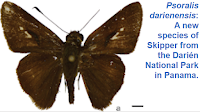
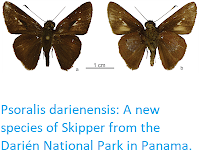
Psoralis darienensis: A new species of Skipper from the Darién National Park in Panama.

Skippers, Hesperiidae, are a large group of Butterflies named for their quick darting flights. They are global in distribution, but reach their maximum diversity in the tropical regions of Central and South America.

In a paper published in the journal Tropical Lepidoptera Reasearch on 31 May 2018, Fabian Gaviria, Ricardo Siewert, Olaf Mielke, and Mirna Casagrande of the Laboratório de Estudos de Lepidoptera Neotropical at the Universidade Federal do Paraná, describe a new species of Skipper from the Darién National Park in Panama.

The new species is placed in the genus Psoralis, which currently contains 12 species from South America, and given the specific name darienensis, meaning 'from Darién'. The species is described from two male specimens collected from an abandoned mine site within the Darién National Park, at an altitude of about 1500 m above sealevel. These are brown in colour with yellow and black markings and a forewing length of 19 mm.

Psoralis darienensis. Male from Darién National Park, Darién Province, Panama, dorsal (a) and ventral (b) views. Gaviria et al. (2018).

See also...

https://sciencythoughts.blogspot.com/2016/08/lepidochrysops-liberti-ceratrichia-fako.htmlhttps://sciencythoughts.blogspot.com/2015/01/a-new-species-of-giant-swallowtail.html
https://sciencythoughts.blogspot.com/2014/11/a-new-species-of-satyrine-butterfly.htmlhttps://sciencythoughts.blogspot.com/2013/03/the-taxonomic-implications-of-host.html
Follow Sciency Thoughts on Facebook.

Sunday, 27 May 2018

Vansoniella chirindensis: A new species of Slug Moth from Zimbabwe.

Slug Moths, Limacodidae, are small, typically hairy, Moths which get their common name from the Slug-like appearance of their caterpillars. They have a global distribution, but are most common and diverse in the tropics, with over 270 species described from sub-Saharan Africa.

In a paper published in the journal Deutsche Entomologische Zeitschrift on 16 March 2018, Wolfram Mey of the Museum fĂĽr Naturkunde describes a new species of Slug Moth from Zimbabwe.

The new species is placed in a new genus, Vansoniella, in honour of George van Son (1898–1967), the former Curator of Lepidoptera of the Transvaal Museum (now part of the Ditsong Museums), who collected the specimen from which the species is described, and given the specific name chirindensis, meaning 'from Chirinda' in reference to the Chirinda Forest Mount Selinda, in what is now eastern Zimbabwe. The species is described from a single male specimen collected by van Son in 1937. It has a wingspan of 16 mm and translucent wings, distinctly unusual in a Slug Moth, and is otherwise golden brown in colour, with a body covered in dense fur.

Vansoniella chirindensis, male specimen in dorsal view. Mey (2018).

See also...

http://sciencythoughts.blogspot.co.uk/2018/04/thaumetopoea-processionea-warnings.htmlhttp://sciencythoughts.blogspot.co.uk/2018/04/ephysteris-kullbergi-ephysteris.html
http://sciencythoughts.blogspot.co.uk/2018/03/phyllocnistis-indistincta-phyllocnistis.htmlhttp://sciencythoughts.blogspot.co.uk/2018/03/dahlica-somae-dahlica-ochrostigma-two.html
http://sciencythoughts.blogspot.co.uk/2018/01/elcysma-ziroensis-new-species-of-burnet.htmlhttp://sciencythoughts.blogspot.co.uk/2017/12/lactura-rubritegula-new-species-of.html
Follow Sciency Thoughts on Facebook.

Saturday, 28 April 2018

Cotesia nuellorum: A new species of Braconid Wasp from Texas.

Braconid Wasps are small parasitoid wasps (Wasps whose larvae grow inside the bodies of a living animal host) targeting a variety of Insect and Spider species. They are unusual in that they will lay multiple eggs within the same host (most parasitoid Wasps lay a single egg on each host), thereby allowing multiple larvae to mature within a large host, which is not necessarily killed in the process. Braconid Wasps are often fearsome in appearance, but are harmless, other than to targeted host species, as they lack stings. Members of the genus Cotesia target large Butterfly and Moth caterpillars, including many species considered to be significant agricultural pests, making them of considerable interest to entomologists.

In a paper published in the journal ZooKeys on 5 February 2018, James Whitfield of the Department of Entomology at the University of Illinois, Urbana, and Robert Nuelle Jr. and Robert Nuelle III, of the Sam Houston State Natural History Collections Huntsville, describe a new species of Cotesia from Texas.

The new species is named Cotesia nuellorum, in honour of Robert Nuelle Jr. and Robert Nuelle III, who discovered the first examples of the species, raised from an infected Hickory Horned Devil caterpillar, Citheronia regalis, found in the Sam Houston National Forest in Walker County, Texas, and subsequently from an infected Luna Moth, Actias luna, from the same location. 

Larva of Citheronia regalis with emerged larvae and cocoons of Cotesia nuellorum, in rearing container. Robert Nuelle Jr. in Whitfield et al. (2018).

The adult Wasps reach 2.0-2.2 mm in length, with males slightly smaller than the females, and are black in colour with dark brown markings and brown legs. The species was found in an area of managed woodland in Texas, but is likely to be more widely distributed, as both known host species are widespread in North America and known to be prone to Braconid infections across their range.

Cotesia nuellorum, adult female in lateral view. Whitfield et al. (2018).

See also...

http://sciencythoughts.blogspot.co.uk/2018/04/chelonus-spinigaster-new-species-of.htmlhttp://sciencythoughts.blogspot.co.uk/2018/02/seneciobracon-novalatus-new-species-of.html
http://sciencythoughts.blogspot.co.uk/2014/09/two-new-species-of-braconid-wasps-from.htmlhttp://sciencythoughts.blogspot.co.uk/2014/08/four-new-species-of-braconid-wasps-from.html
http://sciencythoughts.blogspot.co.uk/2014/07/a-new-species-of-braconid-wasp-from.htmlhttp://sciencythoughts.blogspot.co.uk/2014/03/three-new-species-of-braconid-wasps.html
Follow Sciency Thoughts on Facebook.