Showing posts with label La Réunion. Show all posts

Saturday, 28 April 2018

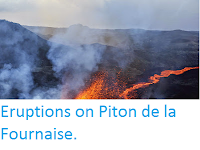
Eruption on Piton de la Fournaise, Réunion Island.

The Observatoire Volcanologique du Piton de la Fournaise reported an eruption on Piton de la Fournaise, an active volcano on Réunion Island, an overseas department of France in the Indian Ocean, on Friday 27 April 2018. Seismic activity beneath the volcano began to increase sharply at about 8.15 pm local time, followed by an eruption that started at about 11.50 pm. This has been accompanied by the opening of an eruptive fissure on the southern flank of the volcano. Access to the summit of the volcano, which is home to several popular tourist trails, has been closed off due to concerns about the possibility of a collapse, and the Toulouse Volcanic Ash Advisory Centre has issued a warning to aviation in the area. 

Eruption on Piton de la Fournaise on 27 April 2018. Préfet de La Réunion/Twitter.

Piton de la Fournaise is believed to have been active for about 530 000 years, though its geology is complicated to unravel as lava flows are interbedded with those from Piton des Neiges, a larger, older and now extinct volcano to the northwest, which is responsible for the formation of about two thirds of the island. The island sits on the Réunion Hotspot, a deep mantle plume which is thought to have been active for about 66 million years, originally forming under what is now northeastern India, where it was responsible for the Deccan Traps flood basalts, then moving southward across the Indian Ocean (or more precisely sitting still while the continental plate upon which India and the Indian Ocean sit moves to the north), over time forming the Laccadive Islands, the Maldives, the Seychelles, Rodrigues Island, Mauritius and Réunion.

 The location of Piton de la Fornaise on Réunion Island.  Google Maps.

See also...

http://sciencythoughts.blogspot.co.uk/2018/04/volcanic-activity-on-reunion-island.htmlhttp://sciencythoughts.blogspot.co.uk/2017/01/magnitude-55-earthquake-in-central.html
http://sciencythoughts.blogspot.co.uk/2015/05/eruptions-on-piton-de-la-fournaise.htmlhttp://sciencythoughts.blogspot.co.uk/2015/02/eruptions-on-piton-de-la-fournaise.html
http://sciencythoughts.blogspot.co.uk/2014/01/fifteen-injured-as-cyclone-bejisa.htmlhttp://sciencythoughts.blogspot.co.uk/2012/05/eruption-on-mount-karthala.html
Follow Sciency Thoughts on Facebook.

Thursday, 5 April 2018

Volcanic activity on Réunion Island.

The Observatoire Volcanologique du Piton de la Fournaise reported a sharp rise in seismic activity beneath Piton de la Fournaise, an active volcano on Réunion Island, an overseas department of France in the Indian Ocean, from the middle of February onwards. Such activity often signifies magma moving through chambers beneath a volcano, and therefore can be a precursor to volcanic eruptions. On 23 March the observatory measured a rise in carbon dioxide and sulphur dioxide being produced in fumaroles from the summit of the volcano, then on 3 April an intermittent fissure about a kilometre in length opened up on the north flank of the mountain, which two lava fountains could be observed. This was accompanied by further seismic activity, triggering a number of landslides on the volcano's flanks.

A lava fountain on the north flank of Piton de la Fournaise on 3 April 2018. ipreunion.

Piton de la Fournaise is believed to have been active for about 530 000 years, though its geology is complicated to unravel as lava flows are interbedded with those from Piton des Neiges, a larger, older and now extinct volcano to the northwest, which is responsible for the formation of about two thirds of the island. The island sits on the Réunion Hotspot, a deep mantle plume which is thought to have been active for about 66 million years, originally forming under what is now northeastern India, where it was responsible for the Deccan Traps flood basalts, then moving southward across the Indian Ocean (or more precisely sitting still while the continental plate upon which India and the Indian Ocean sit moves to the north), over time forming the Laccadive Islands, the Maldives, the Seychelles, Rodrigues Island, Mauritius and Réunion.

 The location of Piton de la Fornaise on Réunion Island.  Google Maps.

See also...
 
http://sciencythoughts.blogspot.co.uk/2017/01/magnitude-55-earthquake-in-central.htmlhttp://sciencythoughts.blogspot.co.uk/2015/05/eruptions-on-piton-de-la-fournaise.html
http://sciencythoughts.blogspot.co.uk/2015/02/eruptions-on-piton-de-la-fournaise.htmlhttp://sciencythoughts.blogspot.co.uk/2014/01/fifteen-injured-as-cyclone-bejisa.html
http://sciencythoughts.blogspot.co.uk/2012/05/eruption-on-mount-karthala.html
Follow Sciency Thoughts on Facebook.

Thursday, 2 January 2014

Fifteen injured as Cyclone Bejisa batters Réunion.

Fifteen people have been injured, two seriously, as Cyclone Bejisa moved past the island of Réunion (an overseas department of France in the southwest Indian Ocean) on Thursday 2 January 2013, brinig with it winds of up to 150 km per hour and eight meter high waves. The storm also left 200 000 people (roughly a quarter of the island's population) without water supplies, and 175 000 without electricity. The island's main airport, Roland Garros, was closed, and postal services suspended.

A deserted street in La Possession, on the northeast coat of Réunion, on 2 January 2014. Richard Bouhet/AFP.

Tropical storms are caused by solar energy heating the air above the oceans, which causes the air to rise leading to an inrush of air. If this happens over a large enough area the inrushing air will start to circulate, as the rotation of the Earth causes the winds closer to the equator to move eastwards compared to those further away (the Coriolis Effect). This leads to tropical storms rotating clockwise in the southern hemisphere and anticlockwise in the northern hemisphere.These storms tend to grow in strength as they move across the ocean and lose it as they pass over land (this is not completely true: many tropical storms peter out without reaching land due to wider atmospheric patterns), since the land tends to absorb solar energy while the sea reflects it.

Waves battering a harbour wall at Saint-Gilles on the west coast of Réunion, on 2 January 2014. Richard Bouhet/AFP.

The low pressure above tropical storms causes water to rise there by ~1 cm for every millibar drop in pressure, leading to a storm surge that can overwhelm low-lying coastal areas, while at the same time the heat leads to high levels of evaporation from the sea - and subsequently high levels of rainfall. This can cause additional flooding on land, as well as landslides, which are are a common problem after severe weather events, as excess pore water pressure can overcome cohesion in soil and sediments, allowing them to flow like liquids. Approximately 90% of all landslides are caused by heavy rainfall.


Follow Sciency Thoughts on Facebook.