Showing posts with label Réunion Island. Show all posts

Saturday, 28 April 2018

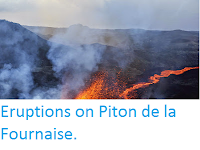
Eruption on Piton de la Fournaise, Réunion Island.

The Observatoire Volcanologique du Piton de la Fournaise reported an eruption on Piton de la Fournaise, an active volcano on Réunion Island, an overseas department of France in the Indian Ocean, on Friday 27 April 2018. Seismic activity beneath the volcano began to increase sharply at about 8.15 pm local time, followed by an eruption that started at about 11.50 pm. This has been accompanied by the opening of an eruptive fissure on the southern flank of the volcano. Access to the summit of the volcano, which is home to several popular tourist trails, has been closed off due to concerns about the possibility of a collapse, and the Toulouse Volcanic Ash Advisory Centre has issued a warning to aviation in the area. 

Eruption on Piton de la Fournaise on 27 April 2018. Préfet de La Réunion/Twitter.

Piton de la Fournaise is believed to have been active for about 530 000 years, though its geology is complicated to unravel as lava flows are interbedded with those from Piton des Neiges, a larger, older and now extinct volcano to the northwest, which is responsible for the formation of about two thirds of the island. The island sits on the Réunion Hotspot, a deep mantle plume which is thought to have been active for about 66 million years, originally forming under what is now northeastern India, where it was responsible for the Deccan Traps flood basalts, then moving southward across the Indian Ocean (or more precisely sitting still while the continental plate upon which India and the Indian Ocean sit moves to the north), over time forming the Laccadive Islands, the Maldives, the Seychelles, Rodrigues Island, Mauritius and Réunion.

 The location of Piton de la Fornaise on Réunion Island.  Google Maps.

See also...

http://sciencythoughts.blogspot.co.uk/2018/04/volcanic-activity-on-reunion-island.htmlhttp://sciencythoughts.blogspot.co.uk/2017/01/magnitude-55-earthquake-in-central.html
http://sciencythoughts.blogspot.co.uk/2015/05/eruptions-on-piton-de-la-fournaise.htmlhttp://sciencythoughts.blogspot.co.uk/2015/02/eruptions-on-piton-de-la-fournaise.html
http://sciencythoughts.blogspot.co.uk/2014/01/fifteen-injured-as-cyclone-bejisa.htmlhttp://sciencythoughts.blogspot.co.uk/2012/05/eruption-on-mount-karthala.html
Follow Sciency Thoughts on Facebook.

Thursday, 5 April 2018

Volcanic activity on Réunion Island.

The Observatoire Volcanologique du Piton de la Fournaise reported a sharp rise in seismic activity beneath Piton de la Fournaise, an active volcano on Réunion Island, an overseas department of France in the Indian Ocean, from the middle of February onwards. Such activity often signifies magma moving through chambers beneath a volcano, and therefore can be a precursor to volcanic eruptions. On 23 March the observatory measured a rise in carbon dioxide and sulphur dioxide being produced in fumaroles from the summit of the volcano, then on 3 April an intermittent fissure about a kilometre in length opened up on the north flank of the mountain, which two lava fountains could be observed. This was accompanied by further seismic activity, triggering a number of landslides on the volcano's flanks.

A lava fountain on the north flank of Piton de la Fournaise on 3 April 2018. ipreunion.

Piton de la Fournaise is believed to have been active for about 530 000 years, though its geology is complicated to unravel as lava flows are interbedded with those from Piton des Neiges, a larger, older and now extinct volcano to the northwest, which is responsible for the formation of about two thirds of the island. The island sits on the Réunion Hotspot, a deep mantle plume which is thought to have been active for about 66 million years, originally forming under what is now northeastern India, where it was responsible for the Deccan Traps flood basalts, then moving southward across the Indian Ocean (or more precisely sitting still while the continental plate upon which India and the Indian Ocean sit moves to the north), over time forming the Laccadive Islands, the Maldives, the Seychelles, Rodrigues Island, Mauritius and Réunion.

 The location of Piton de la Fornaise on Réunion Island.  Google Maps.

See also...
 
http://sciencythoughts.blogspot.co.uk/2017/01/magnitude-55-earthquake-in-central.htmlhttp://sciencythoughts.blogspot.co.uk/2015/05/eruptions-on-piton-de-la-fournaise.html
http://sciencythoughts.blogspot.co.uk/2015/02/eruptions-on-piton-de-la-fournaise.htmlhttp://sciencythoughts.blogspot.co.uk/2014/01/fifteen-injured-as-cyclone-bejisa.html
http://sciencythoughts.blogspot.co.uk/2012/05/eruption-on-mount-karthala.html
Follow Sciency Thoughts on Facebook.

Thursday, 24 September 2015

Stick Insects of the Mascarene Islands.

The Mascarene Islands, Mauritius, Réunion and Rodrigues, lie in the western Indian Ocean, to the east of Madagascar and to the south of the Seychelles. They form part of a chain of biodiversity hotspots across the eastern Indian Ocean, where many islands and island groups have developed unique faunas and floras seen nowhere else. However, while Madagascar and the Seychelles are continental fragments left over from the breakup of Gondwana and started as islands with some unique fauna, the Mascarene Islands are of volcanic origin, formed by hotspot volcanism in a similar way to Hawaii or the Canary Islands, and all of the flora and fauna there must have reached the islands since they first rose above the waves, about 8-10 million years ago in the case of Mauritius, the oldest and largest of the islands.

Much of the fauna of the Mascarenes, shows a close affinity with that of Madagascar, the largest landmass in the southeast Indian Ocean and only 700 km from Mauritius. Mascarene Groups such as Day Geckos, Slit Eared Skinks, Giant Tortoises, Land Snails and Orb Spiders have all been shown to have originated from Madagascar. Other animals have been shown to be of Indo-Pacific origin, having apparently descended from animals that crossed the 5600 km of open-ocean from Australia or 7000 km from New Guinea. This group includes the famous but extinct Dodos and Solitaires, Skinks of the genus Leilopisma and Geckos of the genus Nactus.

The Stick Insects, Phasmatodea, of the Mascarenes present a unique problem to biogeographers, as they include members of four different subfamilies and one species of uncertain origin, apparently implying repeated colonization of the islands by members of different Stick Insects from different areas. Given the remoteness of the Mascarene Islands, this would be implausible for a group of flying, wide-ranging Insects, and is highly unlikely for Stick Insects, which have only very weak flying abilities, being able to slow their descent when falling from a tree, but not to make long, trans-oceanic migrations.

In a paper published in the journal BMC Evolutionary Biology on 16 September 2015, Sven Bradler of the Johann-Friedrich-Blumenbach-Institute of Zoology andAnthropology at the Georg-August-University Göttingen, Nicolas Cliquennois of the Collège français in Antsirabe, Madagascar and Thomas Buckley of Landcare Research, the School of BiologicalSciences at The University of Auckland and the Allan Wilson Centre, describe the results of a genetic study of the origin of Mascarene Stick Insects, which included data from 120 species of Stick Insects from around the globe, including seven species from Mauritius and three from Réunion (the single described Stick Insect species from Rodrigues, Xenomaches incommodus, is thought to be extinct, and no material was available for inclusion in the study).

Mascarene stick insects. (a) Couple of Apterograeffea reunionensis (Platycraninae) from Réunion. (b) Male of Epicharmus marchali (Xeroderinae) from Mauritius. (c) Female of Rhaphiderus spiniger (Tropidoderinae) from Réunion. Bradler et al. (2015).

Bradler et al. found that, contrary to expectations, all of the Mascarene Stick Insects belonged to a single lineage within the Lanceocercata, an Australasian group, having split from their closest Australian relatives about 27.15 million years ago, and with all the Mascarene Island Stick Insects having shared a last common ancestor that lived about 22.03 million years ago. The group has subsequently diversified into a number of forms that closely resemble members of other groups through convergent evolution, i.e. evolving the same traits to deal with similar ecological problems. For example, the Mascarene genus Apterograeffea has been considered to be a member of the Platycraninae (Coconut Stick Insects), closely resembling members of this group due to also having greatly enlarged cheeks, which support extra muscles which support the mandibles when chewing on tough foliage, while the Mauritian Epicharmus has been assigned to the Xeroderinae, resembling several members of this group with which it shares the habit of living on tree bark.

Chronogram of the sampled stick insect specimens with taxa distributed across the Indian Ocean highlighted in tones of red. Numbers at nodes indicate bootstrap values (left) and clade posterior probabilities (right); grey bars show 95 % highest probability density. Circled numbers refer to fossil calibration points: (1) Renphasma, (2) Eophasma, (3) fossil Malacomorpha, (4) fossil Clonistria. Abbreviations: Pl, Pliocene; Qu, Quaternary. Bradler et al. (2015).

This timescale is slightly problematic for the colonisation of the Mascarene Islands, as it requires the Stick Insects to have separated from their Australian relatives and begun diversifying into newly available niches considerably before the origin of the islands.

However, the Mascarene islands are of volcanic origin, the latest in a chain of islands formed by the movement of a volcanic hotspot, the Réunion Hot Spot, moving southwards across the Indian Ocean. Volcanic hot spots are formed where deep plumes of hot magma rising up from the Earth's interior intersect with the tectonic plates on the surface of the planet. Since these plumes originate deep within the mantle, their movement at the surface is independent of the movement of the tectonic plates. This means that while the currant Mascarene Islands, Mauritius, Réunion and Rodrigues, are quite young, a chain of previous islands, now sunken beneath the seas, extends northwards from them along the line of the volcanic hotspot.

Bradler et al. reason that the Mascarene Island Stick Insects could have originally colonised one of these sunken islands, most probably Siant Brandon, which lies 385 km to the northeast of Mauritius and which first emerged from the sea about 31 million years ago, or Nazareth Bank, slightly to the north of Saint Brandon, which first emerged about 35 million years ago, and subsequently colonised the current Mascarene Islands from these now sunken 'stepping stones', possibly via the smaller uprisings of Baissac Bank and Soudan Bank.

Dispersal scenario of Mascarene stick insects superimposed on a map of the Indian Ocean. (a) Current map of the Indian Ocean. (b) Enlarged view of Mascarene plateau. Red arrows indicate postulated colonisation events: The ancestral Mascarene stick insect arrived on currently submerged islands located to the North of Mauritius followed by a radiation and at least three (maximal six) independent dispersals to Mauritius and another three dispersals to Réunion, most likely facilitated by ocean currents. Bradler et al. (2015).

See also...
http://sciencythoughts.blogspot.co.uk/2015/05/eruptions-on-piton-de-la-fournaise.htmlEruptions on Piton de la Fournaise.
The Observatoire Volcanologique du Piton de la Fournaise reported a sharp rise in sulphur dioxide emissions from Piton de la Fournaise, a shield volcano which forms much of the eastern part of Réunion...
http://sciencythoughts.blogspot.co.uk/2015/05/syzygium-pyneei-new-species-of-myrtle.html


Syzygium pyneei: A new species of Myrtle from Mauritius. 
The genus Syzygium is the largest within the Myrtle family, Myrtaceae, with over 1200 described species from across the tropical and subtropical regions of the Old World, including fifteen previously described species from Mauritius.


http://sciencythoughts.blogspot.co.uk/2015/02/eruptions-on-piton-de-la-fournaise.htmlEruptions on Piton de la Fournaise, Réunion Island.                                          On Wednesday 4 February 2014 the Observatoire Volcanologique du Piton de la Fournaise recorded 180 Earthquakes between 4.00 and 9.00 am, on Piton de la Fournaise, a shield volcano which forms much...
Follow Sciency Thoughts on Facebook.

Sunday, 24 May 2015

Eruptions on Piton de la Fournaise.

The Observatoire Volcanologique du Piton de la Fournaise reported a sharp rise in sulphur dioxide emissions from Piton de la Fournaise, a shield volcano which forms much of the eastern part of Réunion Island, an island in the western Indian Ocean which forms a department of France, on 3 May 2015, followed by a similar rise in hydrogen sulphide emissions on 5 May. From 4 May onwards a rise in Earthquake activity beneath the mountain, which often signifies magma moving through chambers beneath a volcano, was detected, combined with inflation of the base of the summit cone. This seismic activity climbed steadily till 17 May, when about 200 events were recorded over a period of about 90 minutes, between 11.00 am local time and 12.30 pm. A second burst of intense seismic activity began at about 12.50 pm, followed by an eruption from a new fissure to the southeast of Dolomieu Crater. A total of three new fissures were detected in the area that afternoon, all producing lava fountains, and tw lava flows were also observed, and a gas plume which rose about 4 km over the summit of the volcano and drifted to the northwest. The most westerly of the new fissures stopped emitting lava before midnight, and by morning on 18 may only a single fissure was active, producing a lava fountain reaching 40-50 m in height and a flow that travelled 4 km from the opening, as well as a smaller gas plume, with a high hydrogen sulphide and carbon dioxide content. On 19 May the fissure activity had subsided, with fountains reaching at most 20-30 m in height, and the lava flow proceeding only another 750 m during the day.

Lava fountain and flow emerging from a new fissure on Piton de la Fournaise. Clicanoo.

Piton de la Fournaise is believed to have been active for about 530 000 years, though its geology is complicated to unravel as lava flows are interbedded with those from Piton des Neiges, a larger, older and now extinct volcano to the northwest, which is responsible for the formation of about two thirds of the island. The island sits on the Réunion Hotspot, a deep mantle plume which is thought to have been active for about 66 million years, originally forming under what is now northeastern India, where it was responsible for the Deccan Traps flood basalts, then moving southward across the Indian Ocean (or more precisely sitting still while the continental plate upon which India and the Indian Ocean sit moves to the north), over time forming the Laccadive Islands, the Maldives, the Seychelles, Rodrigues Island, Mauritius and Réunion.

The location of Piton de la Fornaise on Réunion Island.  Google Maps.

See also...

On Wednesday 4 February 2014 the Observatoire Volcanologique du Piton de la Fournaise recorded 180 Earthquakes between 4.00 and 9.00 am, on Piton de la Fournaise, a shield volcano which forms much of...


A report in the Times of India on 6 June 2014 has documented a possible volcanic eruption in the Kangra District of Himachal Pradesh State, India. The...


The Volcanic Observatory of Goma have issued a warning of a possible impending eruption on Mount Nyamulagira, an active volcano close to Mount Nyiragongo in the Virungu Mountains of eastern Democratic Republic of Congo, about 25 km to the north of Lake Kivu. Mount Nyamalugira is often considered...


Follow Sciency Thoughts on Facebook.

Friday, 13 February 2015

Eruptions on Piton de la Fournaise, Réunion Island.

On Wednesday 4 February 2014 the Observatoire Volcanologique du Piton de la Fournaise recorded 180 Earthquakes between 4.00 and 9.00 am, on Piton de la Fournaise, a shield volcano which forms much of the eastern part of Réunion Island, an island in the western Indian Ocean which forms a department of France, with five events exceeding Magnitude 2. The activity increased after 9.00 am, prompting an investigation of the mountain. At about 11.00 am observers spotted a 500 m in the central caldera, about 100 m to the west of Bory Crater, the smaller and more westerly of the two main craters within the caldera. Lava was scene erupting from this fissure, reaching a height of about 10 m, and flowing in a number of streams to the south and southwest. Earthquake activity subsided that evening, though it did not cease, continuing at a low level until a second major outburst on 10 February, followed by a return to a lower level of activity. Visits to the caldera on 8 an 9 February revealed lava was still flowing, while gas emissions were detected on 6 February. This is the first activity on the volcano since December 2010.

Lava flow on Piton de la Fournaise on 11 February 2014. ile-en-ile.

Piton de la Fournaise is believed to have been active for about 530 000 years, though its geology is complicated to unravel as lava flows are interbedded with those from Piton des Neiges, a larger, older and now extinct volcano to the northwest, which is responsible for the formation of about two thirds of the island. The island sits on the Réunion Hotspot, a deep mantle plume which is thought to have been active for about 66 million years, originally forming under what is now northeastern India, where it was responsible for the Deccan Traps flood basalts, then moving southward across the Indian Ocean (or more precisely sitting still while the continental plate upon which India and the Indian Ocean sit moves to the north), over time forming the Laccadive Islands, the Maldives, the Seychelles, Rodrigues Island, Mauritius and Réunion.

See also...

Possible volcanic eruption in Himachal Pradesh State, India.
A report in the Times of India on 6 June 2014 has documented a possible volcanic eruption in the Kangra District of Himachal Pradesh State, India. The...


Eruptions on Barren Island.
NASA's MODIS (Moderate Resolution Imaging Spectroradiometer) system, mounted on the Terra (EOS AM) and Aqua (EOS PM) satellites, detected a hotspot developing over the Baren Island Volcano in the Andaman Islands over the period 10-16 October...

Eruption on Mount Karthala.
Mount Karthala is the southernmost, and larger, of two shield volcanoes making up the island of Grand Comore (Ngazidja). Shield volcanos are broad, dome-shaped, volcanoes made up of successive layers of lava; shield volcanoes do not have the classic 'cone-shape'...


Follow Sciency Thoughts on Facebook.