Showing posts with label Protostar. Show all posts

Wednesday, 6 December 2023

A James Webb Space Telescope image of Protostar HH 797.

An image taken by the James Webb Space Telescope shows Herbig Haro object 797 (HH 797) in previously unseen detail. A Herbig Haro object is an elongate gas nebula formed by jets of gas blown on the stellar winds emerging from the poles of a young protostar colliding with gas and dust left over from the cloud from which the star formed at speeds of several hundred kilometres per second.

HH 797, a narrow, horizontal nebula that stretches from edge to edge of the lower half of the image. NASA/ESA/CSA.

HH 797 lies close to the IC 348 star-forming region within the constellation of Perseus, which is a little over a thousand light years from Earth. The IC 348 cluster is about 2 million years old, and contains about 400 stars, about half of which still have circumstellar disks.

HH 797 cannot be seen at visible wavelengths, as it is still buried within the cloud of dust and gas from which it has formed; the James Webb image has been taken in the infra-red part of the spectrum, collecting light emitted by excited hydrogen and carbon monoxide molecules heated to thousands of degrees centigrade by the interaction of the gas jets and the surrounding cloud.

The light emitted by the gas at the southern end of the plumes (bottom right) has been shown to be slightly red shifted as it reaches us, implying that the southern end of the plume is moving away from us, while the light from the gas at the northern end of the plume (bottom left) is slightly blue shifted, indicating that it is moving towards us.

The central part of the HH 797 nebula, from which the gas plumes are emerging. The protostar itself is invisible, creating a dark area. NASA/ESA/CSA.

See also...

Follow Sciency Thoughts on Facebook.

Follow Sciency Thoughts on Twitter.


Monday, 20 November 2023

Understanding the protoplanetary disk of the eruptive protostar V900 Mon.

Mass accretion is a crucial stage in the development of young stars, with material accreting onto young stellar objects from the circumstellar disks surrounding them. Some (and possibly all) young stars undergo explosive eruptions during this stage of their evolution, linked to episodes of increased mass accretion onto the star. This is best documented in FU Orionis-type protostars, a class of stellar objects with protoplanetary disks more compact than seen in other types of young stellar object.

The FU Orionis-type protostar V900 Mon was discovered in 2012, and is about 4000 light years from Earth within Thommes' Nebula in the constellation of Monoceros, and lying within the Galactic Plane, where light is known to be scattered by higher levels of interstellar dust, making objects appear dimmer. This is likely to be more true for V900 Mon, which is still embedded within the dust cloud from which it formed.

Observations of the distribution of Carbon Monoxide around V900 Mon, made with the Atacama Large Millimeter/submillimeter Array (ALMA), have shown that the star is surrounded by two cones of material, each with an opening angle of 70°, with the western outflow oriented roughly 250° east-of-north. Such wide cones typically eject gas at much lower rates than the bipolar outflow jets seen around T Tauri-type young stars, ejecting material at less than 100 km per second. 

The nebula around V900 Mon is very bright on its western side, and very faint on its eastern side, as is the carbon monoxide emission stream, consistent with us viewing the star pole on, so that material behind the surrounding disk is obscured. It has been calculated that the circumstellar disk around V900 Mon measures 82 AU by 71 AU (where 1 AU is the distance between the Sun and the Earth) with an inclination of about 28°, and can be seen from the Earth at an angle of 169°, almost pole-on. Estimates of the amount of material in the disk range between 1% and 30% of the mass of our Sun; a mass at the larger end of this range would make it one of the largest FU Orionis-type disks known.

The eruptive activity of FU Orionis-type protostars is presumed to have a profound impact on the circumstellar environment, including the crystallization of amorphous silicates, although this has never been observed. Curiously, crystallization via thermal annealing has been detected around the T-Tauri star EX Lupi, which has much cooler outbursts (less than 1000 K). A previous attempt to detect large-sized silicate grains in the circumstellar disk of V900 Mon using the Very Large Telescope Imager and Spectrometer for mid Infrared was inconclusive.

In a paper published on the arXiv database at Cornell University on 13 November 2023, and accepted for publication in the journal Astronomy & Astrophysics, a team of scientists led by Foteini Lykou of the Konkoly Observatory of the Hungarian Research Network Research Centre for Astronomy and Earth Sciences, present the results of a new study of V900 Mon, made using the MATISSE instrument at La Silla Paranal Observatory, with additional data from the Multi Unit Spectroscopic Explorer (MUSE) at the European Southern Observatory, the SpeX: 0.7-5.3 Micron Medium-Resolution Spectrograph and Imager at the Institute for Astronomy on Mauna Kea, and the MID-infrared Interferometric instrument of the Very Large Telescope.

V900 Mon has been observed to brighten steadily for the past 20 years (it has been located in older images since its discovery), with a brief period of dimming in 2018-19. It has also become slightly bluer since the dimming event. It is likely that the brightening has been caused by a diminishing of the dust cloud around the star, rather than by the star actually getting brighter.

Young stellar objects, including FU Orionis-type protostars, tend to have an inner accretion disk which reaches to less than 1 AU from the star, and an outer passive disk, which may reach as far as 100 AU from the star, with the hotter inner disk emitting radiation at much shorter wavelengths than the cooler outer disk. 

Data from the MATISSE instrument suggests that the inner disk of V900 Mon reaches no more than 1.5 AU from the star, and the majority of the material in the outer disk no more than 10 AU. Combined with the ALMA data, this suggests that the disk is inclined at 14°, and that Earth-bound viewers are seeing it at an angle of 158°, almost pole-on. 

The star at the centre of the V900 Mon system cannot actually be seen in the MUSE images, which are dominated by the reflection nebula (Thommes’ Nebula), although the outer disk can be detected. The disk was notably bluer when a larger aperture used, suggesting that the nebula is scattering light more at this end of the spectrum.

White image of V900 Mon and Thommes’ Nebula from MUSE (4700 – 9300Å). The cross sign marks the location of the star and the drawn green line marks the bulk of the emitting region that includes the ellipsoidal component. The field of view is 1′×1′. The image has been stretched at arbitrary levels of the square root of intensity to enhance nebula features. Lykou et al. (2023).

The images show the star+disk system, an ellipsoidal-like component adjacent to the star toward the northwest, and a large-scale source to the west and southwest (Thommes’ Nebula), though Lykou et al. were able to remove much of the interference from the latter two using a corrective algorithm. 

Once this was done, spectrographic analysis revealed what appears to be a jet-like structure emerging from the stellar region, with a knot of material about 27 000 AU (0.43 light years) from the star. The position of this aligns with the previously detected carbon monoxide outflow, being close to 250° east of north,  perpendicular to the disk’s major axis. Taking into account the 14° inclination of the disk, the actual distance from the star to the knot may be 111 600 AU (1.77 light years).

Continuum-subtracted Hydoigen-α linemap of V900 Mon and Thommes’ Nebula. The map has been linearly scaled to enhance the emission features (in white) and designate scattered light continuum from the nebula and background sources (black-shaded regions). The green contours (arbitrary levels) mark the carbon monoxide (2-1) moment zero map, showing the blue-shifted emission component to the west and part of the red-shifted wide-angle lobe to the east. The emission-line knot (E.L.K.) is clearly visible and co-aligned to the blue-shifted carbon monoxide outflow, as indicated by the guiding arrow (position angle roughly 250° east-of-north). The field of view is 50′′×50′′. Lykou et al. (2023).

The spectra of the knot suggest that it is comprised of excited gas, and appears blue shifted compared to the other structures, suggesting that it's motion is towards the viewers at a speed of about 100 km per second. The knot is estimated to have left the star about 5150 years ago, long before the most recent eruption of V900 Mon, which is thought to have happened since the 1960s, although it will be possible to calculate the exact age of the knot only when the true motion of the knot is known, and it will only be possible to calculate this once it has been determined whether the gas in the knot is expanding, something which will require repeated observations.

There also appears to be some sort of structure to Thommes' Nebula, with at least one globule within, which does not appear to be an emission from the star. The nature of this is, however, unclear, and will require further observations.

MATISSE observations of the V900 Mon system show a structure at the centre of the system less than 3 AU in diameter, which Lykou et al. interpret as an inner accretion disk, something expected in a FU Orionis-type protostar system. Modelling of the system suggests that the inner radius of this disk is equal to about 2 stellar radii, though this is poorly constrained. This inner disk is estimated to be emitting 314 times as much light as our Sun.

Material is thought to be accreting from the disk onto the star at a rate of about 0.000 04 times the mass of our Sun each year, or roughly the mass of Jupiter over 30 years. 

The protoplanetary disks of FU Orionis-type protostars are thought to be silicate-rich, although silicates could only be detected in the outer disk of V900 Mon at distances of greater than 10 AU, suggesting that silicates are either absent from the inner part of the disk, or are sheilded from observation by other material. 

Crystalline silicates are commonly detected in the protoplanetary disks of Herbig and T Tauri stars, but are apparently absent in the disks of FU Orionis-type protostars, which also seems to be the case for V900 Mon, with the detected silicates in the disk being more consistent with large amorphous grains.

Theoretically, eruptive outbursts from protostars might be caused by the presence of a companion body, with outbursts occurring when this body passes through the cirumstellar disk, causing a peak in the amount of material accreting onto the protostar. A possible companion body has been detected in the Z CMa FU Orionis-type protostar system, but none of the observations of V900 Mon suggest the presence of such a body. 

It is possible that a flyby star could have interacted with the circumstellar disk of V900 Mon within the last century. If such a star was travelling at less than 10 km per second then it should still be within the field of view of Lykou et al.'s observations, but no such star could be detected.

Because we are essentially looking down upon the V900 Mon system, the obscuring of the inner part of the disk could be due to the presence of either a clump of dust above the system, or at the origin of the molecular outflow emanating from the disk. A similar phenomenon has been observed in the Herbig Ae star HD163296, which is known to have associated Herbig-Haro objects (bright patches of nebulosity formed when narrow jets of partially ionised gas ejected by stars collide with nearby clouds of gas and dust at several hundred kilometres per second), with a dust cloud having apparently caused the star to dim.

Cartoon indicating the presumed geometry of the system. The drawing is not to scale. Lykou et al. (2023).

The nature of the dust causing this dimming cannot be directly determined, though Lykou et al. reason that it is likely to be mostly small grains of amorphous silica, with a grain size of less than 0.1 μm. If this dust is constrained within a radius of less than 5 AU, then it will have a mass in the region of 990 000 000 000 000 kilotonnes, roughly equivalent to the mass of the Dwarf Planet Ceres, although this is based upon a very rough analysis and cannot be assumed to be an accurate figure. Future imaging of the system at different wavelengths should allow a more accurate estimate to be made.

Examination of historic images of V900 Mon taken at a variety of wavelengths show that one feature consistently recovered is a 'helicoidal' tail fanning out to more than 20'' west-southwest of the star. The emission-line knot discovered by Lykou et al. is not visible in any of the previous images of the system, suggesting it is either not visible at the wavelengths utilised by those studies, or is to dim at those wavelengths to be detected.

Lykou et al. also looked for any additional knot formed by a more recent eruption, within the past 30 years. If such a knot was assumed to move at about 25 km per second, then it would be no more than 13'' from the star in the images. It was not possible to detect such a knot in the data, but this may reflect the proximity of the knot to the star, and it is possible that such a knot will be detected in future observations, now that it is being looked for.

Drawing of the individual nebular features at the V900 Mon reflection nebula.  Lykou et al. (2023).

See also...

Follow Sciency Thoughts on Facebook.

Follow Sciency Thoughts on Twitter.


Thursday, 14 April 2016

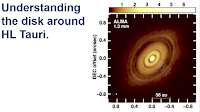
Understanding the disk around HL Tauri.

HL Tauri is a young protostar (star which is still gaining mass by accretion from a surrounding disk, the accretion disk, and is emitting ionized material in jets from its poles) 140 parsecs (457 light years) from our Solar System in the constellation of Taurus. It's disk has been known and observed for a number of years, however recent observations by the Atacama Large Millimeter/submillimeter Array (ALMA) revealed this disk to be divided into a series of light and dark bands. This is surprising, as such banding is usually associated with planet formation in a more developed disk (a protoplanetary disk) with darker zones forming where (invisible) planets have formed and either accreted or tidally pushed away the (visible) dust in a the dark bands.
 
In a paper published on the arXiv database at Cornell University Library on 11 March 2016, a team of astronomers led by Carlos Carrasco-González of the Instituto de Radioastronomíay Astrofísica discuss a series of new observations of HL Tauri made with the Very Large Array (VLA) of the National Radio Astronomy Observatory at wavelengths of 6.7, 7.0 and 7.3 mm (observations of remote objects at different wavelengths tend to reveal different features, as different molecules reflect light at different wavelengths) between December 2014 and September 2015.

Atacama Large Millimeter/submillimeter Array of HL Tauri at a wavelength of 1.3 mm. The positions of the reported dark (D1-D7; dotted lines) and bright rings (B1-B7; dashed lines) are shown. Carrasco-González et al. (2016).

Carrasco-González et al. were able to observe many of the features seen in the ALMA images of HL Tauri, including the innermost dark and light bands. However the much longer wavelengths used by the enabled a much more detailed study of the inner part of the disk, an area essentially opaque in the ALMA images. This enabled Carrasco-González et al. to make estimations of the density of particles and average grain sizes within different parts of the disk. 

Left: VLA image at 7.0 mm with an angular resolution of ~20 au (0.”15; tapered image). Right: Close-up to the center of the disk. VLA image at 7.0 mm with an angular resolution of ~10 au (~0.”7; natural weighting). The positions of the reported dark (D1-D7; dotted lines) and bright rings (B1-B7; dashed lines) from the ALMA images are shown. The inner disk and the first pair of dark (D1) and bright (B1) rings are clearly seen in the 7.0 mm images. Carrasco-González et al. (2016).

The VLA observations showed showed structure within the dust distribution in the innermost bright ring of HL Tauri. Here the dust was found to form clumps or knots, most of which were of a temporary nature, but with one particularly dense clump on the northeastern part of the limb being more permanent in nature. Carrasco-González et al. suggest that this is possibly a protoplanet in the earliest stages of formation, and that therefore planet formation around of HL Tauri is beginning in the brighter areas of the disk, not the lighter, with the bright areas representing parts of the disk with higher densities due to early stage planetary accretion rather than areas from which dust has been cleared by later stage planetary formation.

(a) Superposition of the VLA 7.0 mm image (contours; naturally weighted image; beam size 0:”067) over the ALMA 1.3 mm image (colour scale). Contour levels are -4, 4, 6, 8, 10, 15, 20, 25, 30, 40, 50, 100, and 150 times the rms of the 7.0 mm map, 3.5 μJy beam-1. The two arrows mark the direction of the collimated jet at a P.A. of ~45º. (b) A close-up to the center of the disk. Colour scale is the ALMA 1.3 mm image and contours are from the high angular resolution VLA 7.0 mm image (robust 0 weighted image; beam size 0:”04). Contour levels are 3, 4, 5, 6, 7, 8, 12, 16, 20, 24, 28, 32, 40, 48, and 56 times 7 μJy beam-1. (c) and (d): Comparison between sub-bands contour images at 7.3 mm and 6.7 mm (robust 0.4 weighting; beam sizes 0:”053) over the 7.0 mm colour scale image. Contours in both panels are 8, 9, 10, 11, 12, 13, 14, 15, and 16 times 6 μJy beam-1.

See also...

http://sciencythoughts.blogspot.co.uk/2014/07/the-keplerian-disk-of-class-i-protostar.htmlThe Keplerian Disk of Class I Protostar L1489 IRS.                                                Recent studies of the Keplerian Disks around other Protostars with the Submillimeter Array (SMA) have suggested that in the early Class 0 Protostar stage little rotation occurs within the Keplerian Disk and the rate of infalling (i.e. the rate at which material falls from...
http://sciencythoughts.blogspot.co.uk/2014/07/protoplanetary-disks-around-class-i.htmlProtoplanetary disks around Class I Protostars in the ρ Ophiuchi Star Forming Region.                                                        Stars are thought to form from the aggregation of material from vast clouds of molecules known as Stellar Nurseries or Star Forming...
http://sciencythoughts.blogspot.co.uk/2012/08/water-and-hydroxides-in-circumstellar.htmlWater and Hydroxides in the Circumstellar Disk around HD 163296.                                  HD 163296 is a young Herbig Ae star (a star producing heat by gravitational collapse, which is expected will fuse Hydrogen in the future, but which has not reached this stage yet) slightly under 400 light years from Earth. It is surrounded by a fairly well documented circumstellar disk, which reaches slightly over 900 AU from the star (i.e. over 900 times as far from the star as Earth is from the...
Follow Sciency Thoughts on Facebook.

Monday, 28 July 2014

The Keplerian Disk of Class I Protostar L1489 IRS.

Recent studies of the Keplerian Disks around other Protostars with the Submillimeter Array (SMA) have suggested that in the early Class 0 Protostar stage little rotation occurs within the Keplerian Disk and the rate of infalling (i.e. the rate at which material falls from the Disk onto the Protostar) is high. In late Class 0 stage and early Class 1 Stage Protostars, infalling continues and the Keplerian Disk begins to rotate due to angular momentum. Eventually in later stage Class 1 Protostars the Keplerian Disk begins to rotate  so fast that centrifugal force prevents further accretion of material onto the Protostar, which then ceases the main stage of its growth (though it will still need to undergo several stages of evolution before being regarded as a true star). The remaining material in the Keplerian Disk can then form a Protoplanetary Disk, from which planets and other bodies can form around the star.

In a paper published on the arXiv database at Cornell University Library on 10 July 2014, a team of scientists led by Hsi-Wei Yen of the Academia Sinica Institute of Astronomy and Astrophysics in Taipei describe the results of a study of the Class I Protostar L1489 IRS with the Atacama Large Millimeter/submillimeter Array (ALMA), and the conclusions drawn from this.

L1489 IRS is located in the Taurus Molecular Cloud, roughly 140 parsecs from Earth (456.6 light years). It is surrounded by a protostellar envelope containing about 3% of the Sun’s mass which reaches about 4200 AU from the central Protostar (i.e. 4200 times the distance at which the Sun orbits the Earth), within which a faint molecular outflow, reaching several thousand AU from the Protostar and flowing both north and south, has been observed. Within this envelope a Keplerian Disk has been observed, which SMA observations suggest reaches about 200 AU from the Protostar and contains about 0.4% of the Sun’s mass, while Combined Array for Research in Millimeter-wave Astronomy (CARMA) observations suggest this disk reaches 250-450 AU from the Protostar and contains about 0.5% of the Sun’s mass. The Protostar itself is estimated to be 1.4 times as massive as the Sun (SMA) or 1.8 times as massive (CARMA).

Yen et al. determined a Keplerian Disk reaching 700 AU from the Protostar, containing approximately 0.5% of the Sun’s mass. The central Protostar has a mass equivalent to 1.6 time that of the Sun and has an angle of inclination of 66˚. The disk is 15-25 AU deep with a temperature of 30-50 K (-243 to -223˚C) at a distance of 100 AU. 

Moment 0 map (contour) overlaid on the moment 1 map (color) of the C¹⁸O (2–1) emission in L1489 IRS. A filled ellipse at the bottom-right corner denotes the beam size. A cross shows the protostellar position. Contour levels are from 3σ to 15σ in steps of 3σ, from 15σ to 50σ in steps of 5σ, and then from 50σ to 90σ in steps of 10σ, where 1σ is 10 mJy Beamˉ¹ km sˉ¹. Yen et al. (2014).

Yen et al. also detected the presence of significant areas of blue- and red-shifted material beyond this disk and offset from it at angles of about 65˚ to the north and 35˚to the south. In astronomy red- and blue-shifting are taken to be signs of movement away ant towards the observer; this is because the speed of light is absolute, so an object moving towards the observer will compress the lightwaves slightly and an object moving away extend them slightly.

These areas of red- and blue-shifted material are reversed with regard to the known areas of outflow from the protostar (i.e. blue to the north, where material outflowing from the Protostar will appear red and red to the south where material outflowing from the Protostar will appear blue), so Yen et al. conclude that these are areas where material is inflowing onto the Keplerian Disk, and from there accreting onto the Protostar.

Schematic figure demonstrating the configuration of Yen et al.’s model of a flared Keplerian disk with two streams of infalling flows toward the disk. Blue and red arrows show the directions of the blueshifted and redshifted outflows, respectively. Yen et al. (2014).

Yen et al.  further conclude that the protostellar envelope around L1489 IRS still contains about 2% of the Sun’s mass, and that material is infalling from this to the Keplerain disk at a rate of 0.00004-7% of the Sun’s mass per year.

See also…


Stars are thought to form from the aggregation of material from vast clouds of molecules known as Stellar Nurseries or Star Forming...


HD 163296 is a young Herbig Ae star (a star producing heat by gravitational collapse, which is expected will fuse Hydrogen in the future, but which has not reached this stage yet) slightly under 400 light years from Earth. It is surrounded by a fairly well documented circumstellar disk, which reaches slightly over 900 AU from the star...


Protostars are areas within molecular clouds where stars are forming, areas of increased density surrounded by dusty envelopes of gas hundreds of AU across (AU stands for Astronomical Unit, 1 AU being the average distance between the Earth and the Sun). As these...


Follow Sciency Thoughts on Facebook.

Wednesday, 2 July 2014

Protoplanetary disks around Class I Protostars in the ρ Ophiuchi Star Forming Region.

Stars are thought to form from the aggregation of material from vast clouds of molecules known as Stellar Nurseries or Star Forming Regions. The initial protostars (Class 0 Protostars) are embedded in envelopes of gas and dust up to 0.1 parsecs (0.3 light years) across. Over time this dust envelope begins to rotate and collapse under the influence of the protostars gravity, a stage referred to as a Class I Protostar. Eventually most of this material is accreted into rotating protoplanetary disk about a Class II Protostar through the conservation of angular momentum (put in simple terms, material is able to remain in a disk on a single plain around the equator of a fast rotating object, but on any other plain is thrown away from the object). Within these disks dust size particles accrete over time into larger bodies, eventually forming asteroids even planets thousands of kilometres across. Finally the majority of the material in the protoplanetary disk is either accreted into larger bodies or blown away by stellar radiation from the new star, leaving a Class III Protostar, surrounded by a system of planets and debris disks.

In a paper published on the online arXiv database at Cornell University Library on 5 May 2014, and accepted for publication in the journal Astronomy & Astrophysics a team of scientists led by Anna Miotello of the European Southern Observatory and the Dipartimento di Fisica at the Universita’ degli Studi di Milano describe the results of a study of two Class I Protostars in the ρ Ophiuchi Star Forming Region with the Australian Telescope Compact Array at wavelengths of 3 mm, 3 cm and 6 cm, and the results obtained from attempts to build models that fit these observations.

The protostars of the ρ Ophiuchi Star Forming Region are about 815 light years from Earth in the constellation of Ophiuchus. The two bodies studied were Elias29 and WL12. Elias29 is calculated to have a mass 3 times that of the Sun, an effective radius 5.9 times that of the Sun and a surface temperature of 4786 k (compared to 5778 K for the Sun), while WL12 is thought to have a mass 0.6 times that of the Sun, an effective radius 3.5 times that of the Sun and a surface temperature of 3980 K.

Elias29 map: detection of the source at 3 mm. The total flux of the source at 3 mm is 10.36 mJy, with a 3σ rms of 0.18 mJy. Miotello et al. (2014).

Miotello et al. calculate that Elias29 either has a dense protoplanetary disk reaching to about 15 AU (15 times the distance at which the Earth orbit’s the Sun) from the central star or a thinner disk reaching 50-200 AU from the star. The properties of the smaller, thicker disk were impossible to model, but the larger, thinner disk would almost certainly contain pebbles with sizes that could be measured in centimetres. WL12 appears to have an optically thick disk with a mass at least 30% of that of our Sun, reaching to about 30 AU from the star.

WL12 map: detection of the source at 3 mm. The total flux of the source at 3 mm is 17.48 mJy, with a 3σ rms of 0.22 mJy. Miotello et al. (2014).

Both stars appear to have mineral grains in the millimetre range already forming within their disks. The disks appear to be relatively compact, but also rather thicker than models would predict; Miotello et al. suggest that this may be due to magnetic fields generated by the protostars countering the angular momentum of the spinning disk. They further suggest that this mechanism is only likely to be efficient during the early part of the Class I Protostar stage, while the disk is relatively massive.

See also…


HD 163296 is a young Herbig Ae star (a star producing heat by gravitational collapse, which is expected will fuse Hydrogen in the future, but which has not reached this stage yet) slightly under 400 light years from Earth. It is surrounded by a fairly well documented circumstellar disk, which reaches slightly over 900 AU from the star...


Protostars are areas within molecular clouds where stars are forming, areas of increased density surrounded by dusty envelopes of gas hundreds of AU across (AU stands for Astronomical Unit, 1 AU being...


T Chamaeleontis is a young star (about 7 million years old) roughly 326 light years from Earth in the constellation of Chamaeleon. It has a mass of about 1.5 × that of our sun, and is surrounded by an...


Follow Sciency Thoughts on Facebook.

Tuesday, 21 August 2012

Water and Hydroxides in the Circumstellar Disk around HD 163296.

HD 163296 is a young Herbig Ae star (a star producing heat by gravitational collapse, which is expected will fuse Hydrogen in the future, but which has not reached this stage yet) slightly under 400 light years from Earth. It is surrounded by a fairly well documented circumstellar disk, which reaches slightly over 900 AU from the star (i.e. over 900 times as far from the star as Earth is from the Sun). Such disks around young stars are thought to provide the reserve of material from which planets form, making understanding the processes that go on within them important for understanding the formation of planets.

Hubble Space Telescope image of the disk around HD 163296. Grady et al. (2000).

In a paper published on the online arXiv database at Cornell University Library on 17 July 2012, and in the journal Astronomy & Astrophysics on 18 July 2012, a team of scientists led by Davide Fedele of the Max Planck Institut für Extraterrestrische Physik describe the discovery of a band of warm, gaseous, Water (H₂O) and Hydroxide (HO) molecules within the HD 163296 Circumstellar Disk, using the Spitzer Space Telescope.

The H₂O producing region was found to be 15-20 AU from the star, and to have a temperature of 200-300 K (-73.15 to 26.85 ℃). This would be to cold for gaseous water on Earth, but in space water sublimates directly from a solid to a gas, so this is less surprising. It is not clear if the molecules were being produced by the disk, or were being ejected from the star, which is known to produce microjets of material from its polar regions.


Follow Sciency Thoughts on Facebook.

Monday, 21 May 2012

The formation of a Keplerian Disk in the L1551 NE Protostellar System.

Protostars are areas within molecular clouds where stars are forming, areas of increased density surrounded by dusty envelopes of gas hundreds of AU across (AU stands for Astronomical Unit, 1 AU being the average distance between the Earth and the Sun). As these objects gain mass their gravity increases, causing more material to spiral inwards. This causes the disk of surrounding material to rotate faster and faster. Eventually the inner part of the disk rotates to fast for the outermost parts to keep up, causing this to be lost. The remaining, fast spinning inner disk is called a Keplerian Disk. Most of the material in this will spiral in and add to the mass of the developing star, though some may remain in orbit forming a planetary system.

L1551 is a molecular cloud containing a number of protostellar systems, in the constellation of Taurus, roughly 450 light years from Earth. One of these is the L1551 NE system, a binary system thought to be very young due to its coolness (~91 K, or -182°C) and the high ratio of matter in the surrounding disk compared to that in the two central protostars. In a paper published in the online arXiv database at Cornell University Library on 17 May 2012, a group of scientists led by Shigehisa Takakuwa of the Academia Sinica Institute of Astronomy and Astrophysics in Taiwan discuss the results of a study of the L1551 NE system using the SubMillimeter Array on Mauna Kea, Hawaii.

The L1551 molecular cloud (center). L1551 NE is at the top left of the cloud (this is the northeast, east and west are reversed on sky images as they are looking up. Caltech.

Takakuwa et al. imaged the L1551 NE system at 330-335 GHz, enabling them to plot the density of ¹³CO and ¹⁸CO, hopefully proxies for the density of molecular material as a whole. This enabled them to map a Keplerian disk in the system measuring about 300 AU in diameter, and an outer disk measuring about 600 AU. The whole disk system has a mass roughly equivalent to 12% that of our Sun, the inner disk about 0.09%. The two protostars a combined mass equivalent to 80% of the Suns.

Diagram showing the extent of the disc around the two protostars of the L1551 NE system (A & B). Contours reflect density. The arrows the direction of material being ejected by L1551 NE A.

See also Fomalhaut b; not a planet after all? The strange debris disk of 99 HerculisPSR J1719-1438b. The Diamond PlanetThe Protostar HOPS-68 and Stars and Exoplanets on Sciency Thoughts YouTube.

Follow Sciency Thoughts on Facebook.

Sunday, 12 June 2011

The Protostar HOPS-68

HOPS-68 is a protostar located in the Orion Nebula, 1450 light years from Earth. Stellar nebulae are vast cloud of gas and dust floating in space, thought to have been formed by the deaths of earlier stars. Protostars are areas within stellar nebulae that have started to fall in on themselves due to gravity; effectively new stars being born.

Protostars have a roughly whirlpool shaped structure, with a disc of material being sucked in and accreted onto the forming core (this is a vast oversimplification). Due to gravitational effects, not all the material falls directly onto the new star; some of it is slung out in two massive plumes at the north and south poles. These are usually the only visual features of protostars, since the core remains hidden at the centre of a dark accretion disk, but the superheated plumes can stick out far (sometimes light years) on either side.

An artist's impression of a protostar.


On April 19 this year a paper appeared in the Astrophysical Journal Letters from a team lead by Charles Poteet and Thomas Megeath of the University of Toledo, detailing the results of a spectrographic study of the Protostar HOPS-68 using the Spitzer Space Telescope. This found the presence of the mineral forsterite (Mg2SiO4), a form of olivine, apparently being ejected in the plumes then falling back into the accretion disk. Poteet et al. theorized that this was forming in heat caused by friction between atoms and molecules in the inner part of the accretionary disk.

Olivine is a common mineral in both the Earth’s crust and in meteorites, it is a mixture (technically a solid solution) of magnesium silicate (forsterite, Mg2SiO4) and iron silicate (fayalite, Fe2SiO4). Olivine is greenish in colour, and there have been some news stories and pictures of green crystals around HOPS-68. In fact it is the iron that gives olivine its green colour; forsterite, which lacks iron, is colourless.

Colourless forsterite crystals.

Olivine forms at relatively low pressures. It is one of the most abundant minerals in the Earth’s crust and upper mantle, but bellow a depth of 400 km magnesium-iron silicate forms different minerals, depending on the depth; these can be used to infer the depth at which rocks formed. Only the olivine form is ever found in meteorites.

Olivine has long been known in meteorites, and was found in the comets Wild 2 and Temple 1 by the Stardust rocket space probe, so its discovery around a protostar was not that much of a surprise. It had previously been thought that meteors containing it might be remnants of larger bodies, which could have had a liquid phase similar to terrestrial lava or magma in their evolution, but comets are mostly ice, and are thought to stem from a much earlier stage in the solar system’s evolution, they are remnants of our own protoplanetary disk; geologists can date rocks by a variety of techniques, and do not believe any olivine found in our solar system predates the system itself. Poteet et al.’s suggestion that olivine crystals could form by friction within the central part of an accretionary disk very early in a solar system’s evolution, then be ejected into other parts of the disk would solve this problem.

See also; Could there be life on Gliese 581d?,
Stars on Sciency Thoughts YouTube,
Exoplanets on Sciency Thoughts YouTube.