Showing posts with label Ranid Frogs. Show all posts

Friday, 1 September 2017

Rana luanchuanensis: A new species of Brown Frog from Henan Province, China.

Brown Frogs, Rana spp., are found across much of Eurasia and the Americas, with over a hundred species currently recognised. They tend to be small and dull coloured, which can make them difficult to tell apart, and tend to have slim waists, smooth skin, and slender legs. These Frogs typically breed early in spring in temperate regions, and throughout the year in the tropics and subtropics, with females laying large bundles of eggs in standing or slow-moving water, and under the right circumstances can undergo rapid population explosions.

In a paper published in the journal ZooKeys on 29 August 2017, Haipeng Zhao of the Kunming Institute of Zoology of the Chinese Academy of Sciences, the Kunming College of Life Science at the University of Chinese Academy of Sciences, and the School of Life Science at Henan University, Junxiao Yang, also of the Kunming Institute of Zoology of the Chinese Academy of Sciences, and the Kunming College of Life Science at the University of Chinese Academy of Sciences, Chunping Wang of the Henan Forestry Survey and Planning Institute, Pipeng Li of the Center for Chinese Endemic Herp-breeding and Conservation Research, and Liaoning Key Laboratory of Evolution and Biodiversity at Shenyang Normal University, Robert Murphy, again of the Kunming College of Life Science at the University of Chinese Academy of Sciences, and also of the Centre for Biodiversity and Conservation Biology at the Royal Ontario Museum, Jing Che, again of the Kunming Institute of Zoology of the Chinese Academy of Sciences, and Zhiyong Yuan of the College of Forestry at the Southwest Forestry University, describe a new species of Brown Frog from Luanchuan County in western Henan Province in central China.

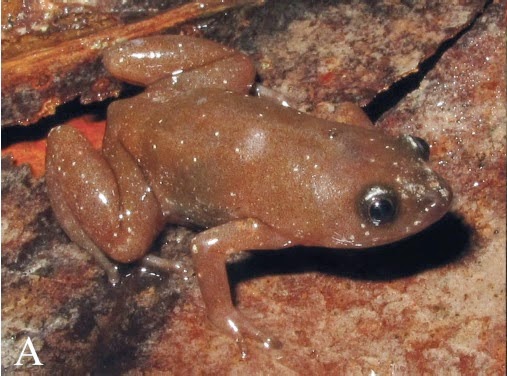
The new species is named Rana luanchuanensis, meaning 'from Luanchuan'. It is a small species, with males reaching 27.2-33.0 mm and females 23.7-41.2 mm. The Frogs are greyish brown in colour, with black, brown and grey markings, and a white belly. They have a distinctive black stripe that runs from the nose back through the line of the eyelids. The species was found living in slow, shallow streams with extensive gravel beds.

Rana luanchuanensis, live specimen. Zhao et al. (2017).

See also...

http://sciencythoughts.blogspot.co.uk/2017/05/hyperolius-ruvuensis-new-species-of.htmlhttp://sciencythoughts.blogspot.co.uk/2017/01/pristimantis-ashaninka-new-species-of.html
http://sciencythoughts.blogspot.co.uk/2016/08/leptobrachella-itiokai-new-species-of.htmlhttp://sciencythoughts.blogspot.co.uk/2016/07/pristimantis-prometeii-new-species-of.html
http://sciencythoughts.blogspot.co.uk/2016/03/microhyla-laterite-new-species-of.htmlhttp://sciencythoughts.blogspot.co.uk/2015/12/painted-frogs-from-middle-miocen-of.html
Follow Sciency Thoughts on Facebook.

Monday, 3 November 2014

A new species of Leopard Frog from New York City.


Cryptic species are species that closely resemble other species, and cannot be separated by simple, non-invasive examination. While taxonomists have known about cryptic species for a long time, it was not realised how numerous such species were until taxonomists began to use genetics to determine relationships between species, about twenty years ago. The presence of cryptic species can have a profound influence on conservation efforts, as ‘species’ thought to be wide ranging with large populations and broad environmental tolerances can turn out to be complexes of closely related but reproductively isolated species, each with a smaller population and distribution, and narrower range of environmental tolerances.

In a paper published in the journal PLoS One on 29 October 2014, a team of scientists led by Jeremy Feinberg of the Department of Ecology, Evolution,and Natural Resources at Rutgers University describe a new, cryptic, species of Leopard Frog from New York City and the surrounding areas of the American East Coast.

The new species is named Rana kauffeldi, after the herpetologist Carl Kauffeld, who studied Leopard Frogs in the eastern United States in the 1930s, and concluded that there might be an undescribed species in the New York/New Jersey area. Fienberg et al. recommend that it be given the common English name ‘Atlantic Coast Leopard Frog’


Rana kauffeldiwas first identified on Staten Island, where it was noticed due to its distinctive call, which differs from that of the two other Leopard Frogs found in the northeastern United States, the Northern Leopard Frog, Rana pipiens, and the Southern Leopard Frog, Rana sphenocephala, by its call (Rana pipiens and Rana sphenocephala are themselves cryptic, and can only be readily separated by their calls, though these two species have long been known to science). It was subsequently confirmed as a separate species by genetic analysis, and subsequently found to be distributed in coastal areas from Connecticut to North Carolina. The species favours coastal freshwater wetlands, including tidally influenced waterways, marshes and wet meadows.

Rana kauffeldi, male specimen in dorsolateral view. Fienberg et al. (2014).

Rana kauffeldi is only the second species of Frog discovered in North America north of Mexico since 1986. It is also the first new species of Frog discovered in New England since 1882, and only the seventh species of Amphibian ever discovered in New York State. Its presence in one of the world’s largest and most densely populated metropolises is therefore somewhat of a surprise, particularly as it is a fairly large and conspicuous species. While the detection of new Frog species by genetic data is new, the detection of such species by their calls is a long established procedure; for example the Gray Treefrogs Hyla versicolor and Hyla chrysoscelis, small, tree-dwelling and inconspicuous species from the eastern United States, have been recognised as separate species for over 60 years.

See also…

Cryptic species are species which resemble one-another physically, and which cannot generally be separated using traditional taxonomic methodology, but which are nevertheless genetically and reproductively isolated. Genetic studies of many groups of...


Many species of Amazonian Amphibians are considered to be highly threatened due to habitat loss, with the potential for the situation to become much worse due to climate change in the near future. This has led to increased efforts to understand the ecology and...


The Cambay Shale formation from the Vastan Lignite Mine to the northeast of Surat in Gujarat State, India, has produced a diverse and significant Vertebrate...

Follow Sciency Thoughts on Facebook.