Showing posts with label Stick Insects. Show all posts

Saturday, 24 November 2018

Phyllium yapicum: A new species of Leaf Insect from Yap Island, Micronesia.

Leaf Insects, Phylliidae are a group of Stick Insects, Phasmida, currently known from as far west as the Seychelles, as far east as Fiji, as far north as Tibet and as far south as New Caledonia. Several new species have been described in this group in recent years, but most of these have been cryptic species (i.e. species which so closely resemble other species that they cannot readily be told apart by physical examination, but which are reproductively isolated from them) split from other species with ranges previously presumed to have larger ranges than was actually the case, rather than new populations living in areas where these Insects had not previously been observed.

In a paper published in the journal Insecta Mundi on 31 August 2018, Royce Cumming and Sierra Teemsma of the Montreal Insectarium describe a new species of Pyllid Leaf Insect from Yap Island in Micronesia.

The new species is placed in the widespread genus Phyllium, and given the specific name yapicum, in reference to the island where it was discovered. It is described from a single female specimen, which was collected in 1980 and deposited in the collection of the California Academy of Natural Sciences, where it has remained overlooked until now. The specimen is 73.4 mm in length and yellow and brown in colour, though it is likely to have been a bright green when alive.

Phyllium yapicum. (A) Dorsal view. (B) Ventral view. (C) Thorax side view. Cumming & Teemsma (2018). 

Phyllium yapicum appears to be most closely related to other members of the genus Phyllium from the Philippines, which is unsurprising as this is the nearest area where they have been recorded to date. However, Yap is separated from the Philippines by 1400 km of open ocean, which would seem rather hard for a Leaf Insect to cross, so Cumming and Teemsma suggest that there may be undiscovered species of Phyllium on the islands of Palau or Guam.

See also...

https://sciencythoughts.blogspot.com/2015/09/stick-insects-of-mascarene-islands.htmlhttps://sciencythoughts.blogspot.com/2014/12/two-new-species-and-one-new-subspecies.html
https://sciencythoughts.blogspot.com/2014/10/a-new-species-of-leaf-insect-from.htmlhttps://sciencythoughts.blogspot.com/2013/06/a-new-species-of-stick-insect-from.html
Follow Sciency Thoughts on Facebook.

Thursday, 24 September 2015

Stick Insects of the Mascarene Islands.

The Mascarene Islands, Mauritius, Réunion and Rodrigues, lie in the western Indian Ocean, to the east of Madagascar and to the south of the Seychelles. They form part of a chain of biodiversity hotspots across the eastern Indian Ocean, where many islands and island groups have developed unique faunas and floras seen nowhere else. However, while Madagascar and the Seychelles are continental fragments left over from the breakup of Gondwana and started as islands with some unique fauna, the Mascarene Islands are of volcanic origin, formed by hotspot volcanism in a similar way to Hawaii or the Canary Islands, and all of the flora and fauna there must have reached the islands since they first rose above the waves, about 8-10 million years ago in the case of Mauritius, the oldest and largest of the islands.

Much of the fauna of the Mascarenes, shows a close affinity with that of Madagascar, the largest landmass in the southeast Indian Ocean and only 700 km from Mauritius. Mascarene Groups such as Day Geckos, Slit Eared Skinks, Giant Tortoises, Land Snails and Orb Spiders have all been shown to have originated from Madagascar. Other animals have been shown to be of Indo-Pacific origin, having apparently descended from animals that crossed the 5600 km of open-ocean from Australia or 7000 km from New Guinea. This group includes the famous but extinct Dodos and Solitaires, Skinks of the genus Leilopisma and Geckos of the genus Nactus.

The Stick Insects, Phasmatodea, of the Mascarenes present a unique problem to biogeographers, as they include members of four different subfamilies and one species of uncertain origin, apparently implying repeated colonization of the islands by members of different Stick Insects from different areas. Given the remoteness of the Mascarene Islands, this would be implausible for a group of flying, wide-ranging Insects, and is highly unlikely for Stick Insects, which have only very weak flying abilities, being able to slow their descent when falling from a tree, but not to make long, trans-oceanic migrations.

In a paper published in the journal BMC Evolutionary Biology on 16 September 2015, Sven Bradler of the Johann-Friedrich-Blumenbach-Institute of Zoology andAnthropology at the Georg-August-University Göttingen, Nicolas Cliquennois of the Collège français in Antsirabe, Madagascar and Thomas Buckley of Landcare Research, the School of BiologicalSciences at The University of Auckland and the Allan Wilson Centre, describe the results of a genetic study of the origin of Mascarene Stick Insects, which included data from 120 species of Stick Insects from around the globe, including seven species from Mauritius and three from Réunion (the single described Stick Insect species from Rodrigues, Xenomaches incommodus, is thought to be extinct, and no material was available for inclusion in the study).

Mascarene stick insects. (a) Couple of Apterograeffea reunionensis (Platycraninae) from Réunion. (b) Male of Epicharmus marchali (Xeroderinae) from Mauritius. (c) Female of Rhaphiderus spiniger (Tropidoderinae) from Réunion. Bradler et al. (2015).

Bradler et al. found that, contrary to expectations, all of the Mascarene Stick Insects belonged to a single lineage within the Lanceocercata, an Australasian group, having split from their closest Australian relatives about 27.15 million years ago, and with all the Mascarene Island Stick Insects having shared a last common ancestor that lived about 22.03 million years ago. The group has subsequently diversified into a number of forms that closely resemble members of other groups through convergent evolution, i.e. evolving the same traits to deal with similar ecological problems. For example, the Mascarene genus Apterograeffea has been considered to be a member of the Platycraninae (Coconut Stick Insects), closely resembling members of this group due to also having greatly enlarged cheeks, which support extra muscles which support the mandibles when chewing on tough foliage, while the Mauritian Epicharmus has been assigned to the Xeroderinae, resembling several members of this group with which it shares the habit of living on tree bark.

Chronogram of the sampled stick insect specimens with taxa distributed across the Indian Ocean highlighted in tones of red. Numbers at nodes indicate bootstrap values (left) and clade posterior probabilities (right); grey bars show 95 % highest probability density. Circled numbers refer to fossil calibration points: (1) Renphasma, (2) Eophasma, (3) fossil Malacomorpha, (4) fossil Clonistria. Abbreviations: Pl, Pliocene; Qu, Quaternary. Bradler et al. (2015).

This timescale is slightly problematic for the colonisation of the Mascarene Islands, as it requires the Stick Insects to have separated from their Australian relatives and begun diversifying into newly available niches considerably before the origin of the islands.

However, the Mascarene islands are of volcanic origin, the latest in a chain of islands formed by the movement of a volcanic hotspot, the Réunion Hot Spot, moving southwards across the Indian Ocean. Volcanic hot spots are formed where deep plumes of hot magma rising up from the Earth's interior intersect with the tectonic plates on the surface of the planet. Since these plumes originate deep within the mantle, their movement at the surface is independent of the movement of the tectonic plates. This means that while the currant Mascarene Islands, Mauritius, Réunion and Rodrigues, are quite young, a chain of previous islands, now sunken beneath the seas, extends northwards from them along the line of the volcanic hotspot.

Bradler et al. reason that the Mascarene Island Stick Insects could have originally colonised one of these sunken islands, most probably Siant Brandon, which lies 385 km to the northeast of Mauritius and which first emerged from the sea about 31 million years ago, or Nazareth Bank, slightly to the north of Saint Brandon, which first emerged about 35 million years ago, and subsequently colonised the current Mascarene Islands from these now sunken 'stepping stones', possibly via the smaller uprisings of Baissac Bank and Soudan Bank.

Dispersal scenario of Mascarene stick insects superimposed on a map of the Indian Ocean. (a) Current map of the Indian Ocean. (b) Enlarged view of Mascarene plateau. Red arrows indicate postulated colonisation events: The ancestral Mascarene stick insect arrived on currently submerged islands located to the North of Mauritius followed by a radiation and at least three (maximal six) independent dispersals to Mauritius and another three dispersals to Réunion, most likely facilitated by ocean currents. Bradler et al. (2015).

See also...
http://sciencythoughts.blogspot.co.uk/2015/05/eruptions-on-piton-de-la-fournaise.htmlEruptions on Piton de la Fournaise.
The Observatoire Volcanologique du Piton de la Fournaise reported a sharp rise in sulphur dioxide emissions from Piton de la Fournaise, a shield volcano which forms much of the eastern part of Réunion...
http://sciencythoughts.blogspot.co.uk/2015/05/syzygium-pyneei-new-species-of-myrtle.html


Syzygium pyneei: A new species of Myrtle from Mauritius. 
The genus Syzygium is the largest within the Myrtle family, Myrtaceae, with over 1200 described species from across the tropical and subtropical regions of the Old World, including fifteen previously described species from Mauritius.


http://sciencythoughts.blogspot.co.uk/2015/02/eruptions-on-piton-de-la-fournaise.htmlEruptions on Piton de la Fournaise, Réunion Island.                                          On Wednesday 4 February 2014 the Observatoire Volcanologique du Piton de la Fournaise recorded 180 Earthquakes between 4.00 and 9.00 am, on Piton de la Fournaise, a shield volcano which forms much...
Follow Sciency Thoughts on Facebook.

Tuesday, 23 December 2014

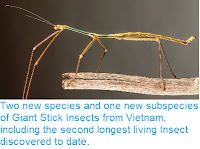
Two new species and one new subspecies of Giant Stick Insects from Vietnam, including the second longest living Insect discovered to date.


Giant Stick Insects, Pharnaciini, are large members of the Stick Insect family, Phasmatidae, found across South and Southeast Asia and South America. They include the longest known Insects in the world, making them of obvious interest to entomologists and collectors, but are still relatively unknown, with new species, even very large species, being found on a regular basis, largely due to their cryptic habits; they tend to live in deep forests, and resemble sticks.

In a paper published in the European Journal of Taxonomy on 27 November 2014, Joachim Bresseel and Jérôme Constant of the Royal Belgian Institute ofNatural Sciences describe two new species and one new subspecies of Giant Stick Insects from Vietnam, as part of a review of the Pharnaciini within that country.

The first new species described is placed in the genus Phryganistria, which has previously been recorded from northeast India, Bhutan, Bangladesh, Myanmar, south China, Laos and Vietnam, and given the specific name tamdaoensis, meaning ‘from Tam Dao’, in reference to the Tam Dao National Park, where the species was first discovered; it was also found in the Tay Yen Tu Nature Reserve in Bac Giang Province and Da Krong Nature Reserve in Quang Tri Province. The species is described from 48 adult specimens, 25 males and 23 females, and 50 eggs.

Phryganistria tamdaoensis, male in lateral view, captive reared from Tam Dao National Park. Bruno Kneubühler in Bresseel & Constant (2014).

Adult males of this species ranged from 165.5 mm to 202.8 mm in length reached 9.3 mm in width. They have a smooth, glossy surface, predominantly golden brown, with a black are on the body surrounding the middle pair of legs and distinct blue fields on the inner surface of the limbs. Adult females examined ranged from 203.9 mm to 228.7 mm in length, and were light brown or light green in colour, with distinct mottling and some pink markings.

Phryganistria tamdaoensis, female in lateral view, captive reared from Tam Dao National Park. Bruno Kneubühler in Bresseel & Constant (2014).

The eggs of Phryganistria tamdaoensis are about 6 mm in length and dark brown in colour. They are oval, but laterally compressed (slightly flattened) with a distinct keel, and attached to a surface by a concave capitulum with a distinct stalk.

Egg of Phryganistria tamdaoensis,captive reared from Da Krong Nature Reserve. (E) Dorsal view. (F) Detail of operculum and capitulum. (G) Polar area. (H) Ventral view. Bruno Kneubühler in Bresseel & Constant (2014).

Newly hatched nymphs are 20-25 mm in length and green in colour with brown antennae and reddish markings on its limbs, but essentially resemble the adults.

Freshly hatched nymphof Phryganistria tamdaoensis,captive reared from Da Krong Nature Reserve. Bruno Kneubühler in Bresseel & Constant (2014).

Finally Bresseel & Constantnote that specimens of Phryganistria tamdaoensisfrom the Da Krong Nature Reserve differ from those from the Tam Dao National Park and the Tay Yen Tu Nature Reserve, from which they are removed by several hundred kilometres, in several anatomical features as well as in the absence of the black area on the bodies of the male and in the eggs being smaller and more strongly compressed, and suggest  that this population might represent a separate subspecies.

The second new species described is placed in the genus Phobaeticus, which has previously been recorded from India, Sri Lanka, Bangladesh, Myanmar, Laos, Thailand, Peninsular Malaysia, Singapore, Sumatra, Bangka Island, Borneo, Palawan and the Philippines, and given the specific name trui, in honour of the Vietnamese entomologist Vu Tru Hoang of the Institute of Ecology & Biological Resources at the Vietnamese Academy of Sciences. This species is described from ten specimens, four adult males, two adult females and female nymphs from Bach Ma National Park in Thuathen-Hue Province and one adult male from the Da Krong Nature Reserve in Quang Tri Province.

Phobaeticus trui, female (top) and male (bottom) specimens in Bach Ma National Park. Bresseel& Constant (2014).

Adult male specimens of Phobaeticus trui examined ranged from 171 mm to 192 mm in length and were pale brown with greenish blue and black markings. Females ranged from 234 mm to 266 mm in length, and were robust and mid-to-dark brown with darker and lighter markings.

Phobaeticus trui male specimen from Da Krong Nature Reserve. Bresseel & Constant (2014).

In addition Bresseel & Constant describe a new subspecies of the previously described Phryganistria heusii. This species has previously been known from a population in Cuc Phuong National Park, with Bresseel& Constant also recording its presence in Tam Dao National Park; these populations being assigned to the subspecies Phryganistria heusii heusii.

Phryganistria heusii heusii, female specimen from Tam Dao National Park. Bresseel & Constant (2014).

The new subspecies is named Phryganistria heusii yentuensis, meaning ‘from Yen Tu’, in reference to the Tay Yen Tu Nature Reserve in Bac Giang Province, where it was discovered. This is an exceptionally large Stick Insect, with males reaching 177.0-245.0 mm in length, and females 221.0-337.4 mm, making this the second longest living Insect known. Males are light brown or ornange-brown, with black and blue markings. Females are green or brown with pinkish markings.

Joachim Bresseel with a 31.7 cm female specimen of Phryganistria heusii yentuensisfrom Tay Yen Tu Nature Reserve. Bresseel & Constant (2014).

See also…

Leaf Insects, Phylliidae, are small Insects related to Stick Insects, noted for their remarkable camouflage patterns, which resemble leaves. There are 53 described living species, 40 of which are placed in a single genus, Phyllium, and one known fossil, Eophyllium messelensis, from the 47 million year old Messel Shale in Germany, which appears most of the...

Stick Insects, Phasmida, are large insects noted for their camouflage abilities, frequently resembling sticks or leaves. They are related to Mantises, Cockroaches and Termites, and like them undergo hemimetabolous...
http://sciencythoughts.blogspot.co.uk/2013/04/the-bmc-ecology-image-competition.html The BMC Ecology Image Competition.        Scientific journals are the mainstay of academic communication within the sciences, the place where new ideas are put forward in papers for which the authors, rather than the editors, take responsibility. They are not, on the whole, noted for either competitions or artistic content. All such rules have exceptions however, and this year the editors of the journal BMC Ecology decided to hold an Ecology Image Competition, which would be open only to scientists working...


Follow Sciency Thoughts on Facebook.

Thursday, 9 October 2014

A new species of Leaf Insect from Indonesian Papua.

Leaf Insects, Phylliidae, are small Insects related to Stick Insects, noted for their remarkable camouflage patterns, which resemble leaves. There are 53 described living species, 40 of which are placed in a single genus, Phyllium, and one known fossil, Eophyllium messelensis, from the 47 million year old Messel Shale in Germany, which appears most of the morphological characteristics seen in modern members of the group, suggesting strongly that it already lived a similar lifestyle.

In a paper published in the journal Zootaxa on 2 October 2014, Thomas van de Kamp of the Institute for Photon Science and SynchrotronRadiation at the Karlsruhe Institute of Technology and the State Museum ofNatural History Karlsruhe and Frank Hennemann of Freinsheim in Germany, describe a new species of Leaf Insect from the mountains of Indonesian Papua.

The new species is named Phyllium riedeli, in honour of the entomologist and Weevil specialist Alexander Riedel. The species is named from a single female specimen collected in a Nothofagus (Southern Beech) forest over 2000 m above sea level. It is the smallest known member of the genus Phyllium, at 56.3 mm, and has a broad abdomen, tapering to a point. It is pale green in colour, with red markings.

Female specimen of Phyllium riedeli in (A) dorsal and (B) ventral views. Van de Kamp & Hennemann (2014).

The female laid four eggs after being captured. These were light brown in colour, slightly glossy and 5.6-5.9 mm in length. It was not possible to incubate any of the eggs.

Egg of Phyllium riedeli.(A) Lateral aspect; (B) dorsal aspect; (C) ventral aspect.c = opercular crown; da= dorsal appendage; mc = micropylar cup; mp = micropylar plate; op = operculum; pa = polar appendage; vml = ventromedian lamella. Van de Kamp & Hennemann (2014).

See also…

Stick Insects, Phasmida, are large insects noted for their camouflage abilities, frequently resembling sticks or leaves. They are related to Mantises, Cockroaches and Termites, and like them undergo hemimetabolous development; the larval forms resemble the...


http://sciencythoughts.blogspot.co.uk/2013/04/the-bmc-ecology-image-competition.html The BMC Ecology Image Competition.        Scientific journals are the mainstay of academic communication within the sciences, the place where new ideas are put forward in papers for which the authors, rather than the editors, take responsibility. They are not, on the whole, noted for either competitions or artistic content. All such rules have exceptions however, and this year the editors of the journal BMC Ecology decided to hold an Ecology Image Competition, which would be open only to scientists working...
Follow Sciency Thoughts on Facebook.

Thursday, 20 June 2013

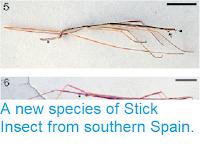
A new species of Stick Insect from southern Spain.

Stick Insects, Phasmida, are large insects noted for their camouflage abilities, frequently resembling sticks or leaves. They are related to Mantises, Cockroaches and Termites, and like them undergo hemimetabolous development; the larval forms resemble the adults, and never pupate or undergo a radical metamorphosis during their development. In many species of Stick Insect (and other Insects) the males do not have a sex chromosome (such as the Y chromosome in humans), instead having an odd number of chromosomes (i.e. they have one unpaired X chromosome). Some such species breed sexually, with the males contributing one or zero X chromosomes to the young and the females (which have two X chromosomes); offspring either inherit one or two chromosomes, which determines their sex. In other species all the offspring produced by sexual reproduction are female, the males are produced pathogenically (without sex). In other species a Y chromosome is present, and reproduction follows a similar pattern to that seen in mammals.

In a paper published in the journal Contributions to Zoology in 2012, Valerio Scali, Liliana Milani and Marco Passamonti of the Department of Biologia Evoluzionistica Sperimentale at the University of Bologna, describe a new species of Stick Insect from southern Spain, discovered during a review of Iberian members of the genus Leptynia.

The new species is named Leptynia annaepaulae in honour of Anna Paola Bianchi, of Rome University La Sapienza, a student of Stick Insects who first pointed out that there appeared to be a unique species of Leptynia in southern Spain, but who did not formally describe it. Member of the genus Leptynia are notoriously hard to tell apart, and are usually distinguished by karyotype (number and shape of chromosomes), and the males of Leptynia annaepaulae are essentially similar to other species found in Iberia, brownish Stick Insects reahing 4-6 cm in length. However the females have a distinctive pink colour which immediately makes them stand out. 

The male (top) and female (bottom) of Leptynia annaepaulae. Scali et al. (2012).


Follow Sciency Thoughts on Facebook.