Showing posts with label Tetanurans. Show all posts

Saturday, 19 October 2019

Siamraptor suwati: A new species of Allosauroid Dinosaur from the Early Cretaceous of Thailand.

The Tetanurans are a large subgroup of the Theropod Dinosaurs, including the Spinosaurs, Tyranosaurs, Ornithomimids, Maniraptors, Therizinosaurs, Oviraptors, Birds, Troodontids, Dromeosaurs, Allosaurs, Raptors and other groups. They appeared in the Middle Jurassic and different groups have flourished ever since, though only one group, the Birds, survived the end-Cretaceous extinction. The first of these groups to come to prominence were the Allosauroids and Megalosauroids, groups which began to produce large-bodied species in the Middle Jurassic, and dominated the top-predator roles in most terrestrial ecosystems until the early Late Cretaceous.

In a paper published in the journal PLoS One on 9 October 2019, Duangsuda Chokchaloemwong of the Northeastern Research Institute of Petrified Wood and Mineral Resources at Nakhon Ratchasima Rajabhat University, Soki Hattori of the Institute of Dinosaur Research at Fukui Prefectural University, and the Fukui Prefectural Dinosaur Museum, Elena Cuesta, also of the Institute of Dinosaur Research at Fukui Prefectural University, Pratueng Jintasakul, also of the Northeastern Research Institute of Petrified Wood and Mineral Resources at Nakhon Ratchasima Rajabhat University, and Masateru Shibata and Yoichi Azuma, again of the Institute of Dinosaur Research at Fukui Prefectural University, and the Fukui Prefectural Dinosaur Museum, describe a new species of Allosauroid Dinosaur from the Early Cretaceous Khok Kruat Formation of Nakhon Ratchashima Province in northeastern Thailand.

The Khok Kruat Formation forms the uppermost unit of the Khorat Group and is widely distributed in the Khorat Basin of northeastern Thailand. The formation is 430–700m thick and consists mainly of reddish-brown siltstones and sandstones, laid down in a fluvial (river) environment. The formation is of Aptian age, between 125 and 113 million years old. The Khok Kruat Formation has produced a number of Dinosaur fossils, most of them from the Ban Saphan Hin (Saphan Hin Village) site in the northwest of the Muang District in Nakhon Ratchashima Province, which has been excavated by the Japan-Thailand Dinosaur Project.

Locality map of new Theropod material and stratigraphy of Khorat Group. (A) map of Nakhon Ratchasima Province, Thailand; (B) distribution map of the Khok Kruat Formation in Nakhon Ratchasima Province; (C) enlarged locality map of Suranaree and Khok Kruat subdistricts with the subdistrict boundaries; (D) a photograph of the excavation site; (E) stratigraphic column of the Khorat Group. A red-coloured star indicates the new Theropod locality, the dotted lines indicate the subdistrict boundaries, and the grey-colored lines indicate the roads in (C) respectively. Chokchaloemwong et al. (2019).

The new species is named Siamraptor suwati, where 'Siamraptor' means 'Thailand thief' and 'suwati' honours Suwat Liptapanlop, who supports and promotes the work of the Northeastern Research Institute of Petrified Wood and Mineral Resources. The new species is described from disarticulated cranial and postcranial elements from at least three individuals. This material comprises three right premaxillae, a right and a left maxillae, a left jugal, two posterior parts of the left mandible comprising the surangular, prearticular, and articular, a posterior part of the left mandible comprising the surangular and prearticular, three anterior cervical vertebrae, three posterior dorsal vertebrae, a middle caudal vertebra, a manual ungual, a right ischium, a distal part of the right tibia, and a left pedal phalanx IV-1. All of these are materials were found in a small area (125 m x 160 m) of a single layer of a single locality, and the overlapping materials exhibit the same diagnostic features.
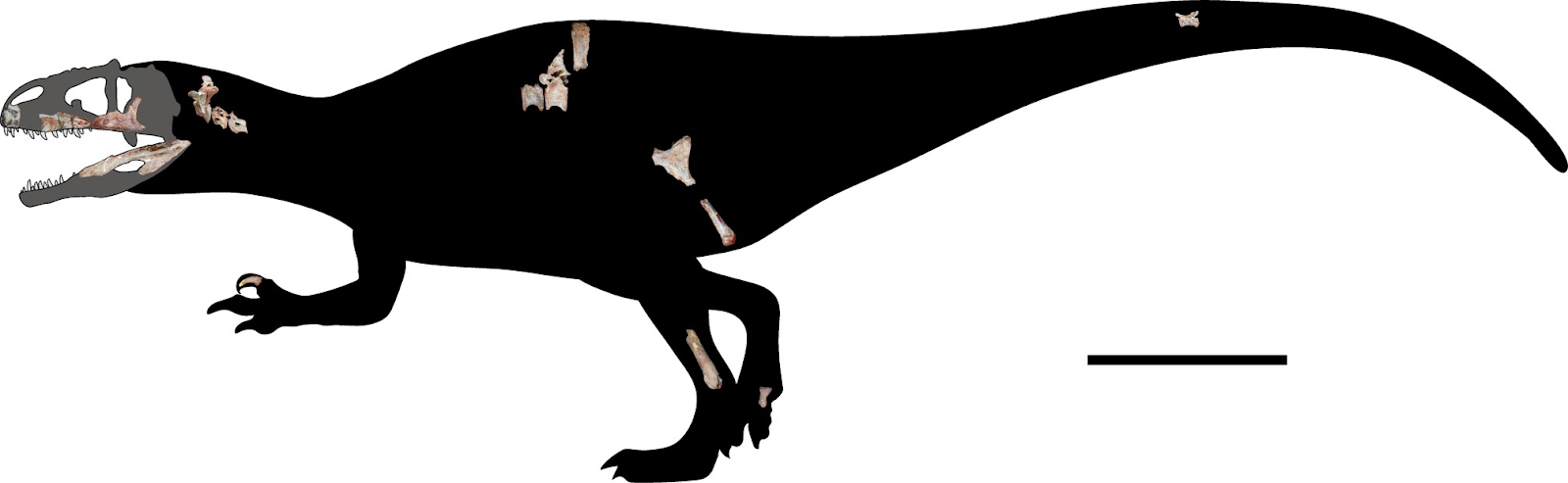
Skeletal reconstruction of Siamraptor suwati. Cranial elements were scaled to fit in with the holotype (surangular). Scale bar equals 1 m. Chokchaloemwong et al. (2019).

Siamraptor suwati is adjudged to be an Allosauroid on the basis of a straight ventral margin on the jugal (cheekbone), a dorsoventrally deep anterior process below the orbit, a surangular (bone at the back of the jaw) with a deep oval concavity at the posterior end of the lateral shelf and four posterior
surangular foramina (openings), a long and narrow groove along the suture between the surangular and prearticular bones, an articular bone with a foramen at the notch of the suture with prearticular bone, an anterior cervical vertebra (formost vertebra in the neck) with an additional pneumatic foramen in the  parapophysis (transverse processe that projects from the centrum of the vertebra), and cervical and posterior dorsal vertebrae penetrated by a pair of small foramina bilaterally at the base of neural spine. 

See also...

https://sciencythoughts.blogspot.com/2019/06/phuwiangvenator-yaemniyomi-vayuraptor.htmlhttps://sciencythoughts.blogspot.com/2018/10/evidence-of-giant-theropods-from-late.html
https://sciencythoughts.blogspot.com/2017/07/neovenator-salerii-neuroanatomy-of.htmlhttps://sciencythoughts.blogspot.com/2015/08/isolated-theropod-teeth-from-middle.html
https://sciencythoughts.blogspot.com/2014/05/a-megatheropod-tooth-from-early.htmlhttps://sciencythoughts.blogspot.com/2012/02/mamenchisaurid-sauropod-dinosaur-from.html
 
Follow Sciency Thoughts on Facebook.

Monday, 20 August 2018

Juvenile pedal ungual of a juvenile Spinosaur from the Cretaceous Kem Kem Beds of Morocco.

The Kem Kem Beds of southeastern Morocco and neighbouring areas of Algeria are noted for the production of numerous Late Cretaceous Vertebrate fossils, including Fish, Crocodylomorphs, Turtles, and Dinosaurs, particularly large Theropods. These fossils appear to have come from a wide range of environments, and are poorly sorted stratigraphically (i.e. not arranged in time related order), and are generally thought to be the result of geological mixing.

In a paper published in the journal PeerJ on 30 May 2018, Simone Maganuco and Cristiano Dal Sasso of the Museo di Storia Naturale di Milano describe a pedal ungual (toe claw) from the Kem Kem Beds, which they interpret as having come from a juvenile Spinosaur.

Spinosaurs were exceptionally large Theropod Dinosaurs (the biggest species, Spinosaurus aegyptiacus is thought to have exceeded Tyrannosaurus, Giganotosaurus and Carcharodontosaurus in size, reaching about 11 m in length) with a distinctive morphology, including a long, Crocodile-like snout and a sail on the lower back and tail. The Spinosaurs are divided into two groups, the Baryonychines from Laurasia (North America, Europe and Asia) and the Spinosaurines in Gondwana (Africa, South America, India, Madagascar, Antarctica, Australia and New Zealand, though the group is not known from all these areas). However while the closely related Megalosaurs are well established in the Middle Jurassic, almost all known Spinosaur specimens come from the Cretaceous, making the origins of the group somewhat obscure. 

The specimen described by Maganuco and Dal Sasso is a 18.2 mm in length, though it is thought to have lost about 2 mm from its tip, and closely resembles the pedal ungual of Spinosaurus aegyptiacus, with a flattened profile, a slightly convex upper surface and a porous structure. The specimen is, of course considerably smaller than the pedal ungual of Spinosaurus aegyptiacus, with the holotype for this species (i.e. specimen from which the species was named) having toe claws between 87 and 130 mm in length, however Spinosaurs were Tetanurans, a group which is thought to have changed little in morphology as they grew and developed, and isolated uguals of intermediate size have been referred to the genus Spinosaurus on this basis. Maganuco and Dal Sasso suggest that if the proportions did remain constant in life, then this specimen would have come from a Spinosaur about 1.78 m in length, the smallest known member of the group.

Pedal ungual phalanx of Spinosaurus. Specimen MSNM V6894 in right lateral (A), left lateral (B), dorsal (C), plantar (D), proximal (E), and distal (F) views. Abbreviations: as, articular surface; co, cortex; et, extensor tubercle; sb, spongy bone; vf, vascular furrow. Scale bar equals 5 mm. Michele Zilioli in Maganuco & Dal Sasso (2018).

See also...

https://sciencythoughts.blogspot.com/2017/07/neovenator-salerii-neuroanatomy-of.htmlhttps://sciencythoughts.blogspot.com/2017/06/understanding-integument-of.html
https://sciencythoughts.blogspot.com/2017/06/megalosaurus-bucklandii-understanding.htmlhttps://sciencythoughts.blogspot.com/2017/03/daspletosaurus-horneri-new-species-of.html
https://sciencythoughts.blogspot.com/2016/03/fragmentary-abelisaurid-remains-from.htmlhttps://sciencythoughts.blogspot.com/2015/08/isolated-theropod-teeth-from-middle.html


Follow Sciency Thoughts on Facebook.

Saturday, 22 August 2015

Isolated Theropod teeth from the Middle Jurassic of Niger.


Unlike Mammals, Dinosaurs replaced their teeth throughout their lives, continuously growing new teeth and shedding older, worn ones. This, combined with the hard enamel coating found on all vertebrate teeth, makes isolated teeth the most commonly encountered Dinosaur specimens, so being able to accurately assign teeth to specific Dinosaur groups has great importance for understanding the origins and distributions of such groups. Within the Theropods, some groups have  very distinctive teeth which allow confident assignment of teeth by simple examination, for example Spinosaurid teeth have deeply veined enamel and fluted ridges, as well as tiny denticles (toothlets) on the carinae (cutting blades on the back of the tooth), however most groups lack such obvious characteristics and therefore palaeontologists have developed methods based upon morphometric analysis (mathematical comparison of different measurements and angles on a tooth, bone or shell), which allow isolated teeth to be compared to teeth found in situ on more complete fossil specimens.

In a paper published in the journal Acta Palaeontologica Polonca on 1 July 2015,  Alejandro Serrano-Martínez of the Grupo de Biología Evolutiva at the Universidad Nacional de Educación a Distancia, the Departamento de Biología at the Universidad Autónoma de Madrid and the Departamento de Paleobiología at the Museo Nacional de Ciencias Naturales, Daniel Vidal, also of the Departamento de Biología at the Universidad Autónoma de Madrid, Lara Scisio of the Department of Geological Sciences at the University of Cape Town, Francisco Ortega, also of the Grupo de Biología Evolutiva at the Universidad Nacional de Educación a Distancia, and Fabien Knoll of the Departamento de Paleobiología at the Museo Nacional de Ciencias Naturales, the School of Earth, Atmospheric and Environmental Sciences at the University of Manchester and the School of Earth Sciences at the University of Bristol describe four isolated Theropod Dinosaur teeth that were found in association with a fossil Sauropod, Spinophorosaurus nigerensis, from the late Middle Jurassic Tiourarén Formation of Aderbissinat in Niger.

The first tooth, MUPE HB-142 is also the best preserved, lacking only its tip, estimated to have been 31 mm in height, laterally compressed (flattened sideways) and curved towards the tip. It has an unserrated carina on its upper portion, and large, closely spaced denticles, with a density of roughly 2.25 denticles per mm. The crown of the tooth has undulations (wrinkles) close to the carina, and a slightly braded enamel texture.

MUPE HB-142 in close-up (A1), labial (A2), distal (A3), lingual (A4), and basal (A5) views. Scale bars (A1) 5 mm, all others 1 cm. Serrano-Martínez et al. (2015).

Morphometric analysis of MUPE HB-142 suggests that it probably derived from a Megalosaurid, as it shows affinities with Megalosaurus, Dubreuillosaurus and Afrovenator. However it also shows some affinities with the basal Tetanuran Torvosaurus, (the Tetanurans are a wider group which include the Megalosaurs, Allosaurs, Spinosaurs and other groups, basal Tetanurans are Tetanurans that predate the splitting of the Tetanurans into these groups) and falls within the morphospace (complete range of size and shapes) of both Megalosaurus and Allosaurus, though it is closer to average values for Megalosaurus, so the possibility that this tooth came from an Allosaurid cannot be ruled out.

The second tooth examined, MUPE HB-118, is the largest tooth in the collection, with a total height of 37.47 mm. This is similar in shape to MUPE HB-142, with denticles on the top third portion of the tooth and a similar braided texture to the enamel. The carina has chisel-like denticles, with a density of 3 per mm.

MUPE HB-118 in lateral (B1), close-up (B2), lateral (B3), distal (B4), and basal (B5) views. Scale bars, (B2) 2 mm, all others 1 cm. Serrano-Martínez et al. (2015).

This tooth also shows affinities to the Megalosaurids Megalosaurus, Dubreuillosaurus and Afrovenator, as well as with the early Neotheropod Dilophosaurus (related to but not included in the early Tetanurans) and the basal Tetanuran  Piatnitzkysaurus. Like MUPE HB-142 it falls within the morphospace of both Megalosarus and Allosaurus, but while MUPE HB-142 was closer to average values for Megalosaurus, MUPE HB-118 falls closer to average values for Allosaurus.  However the similarity of MUPE HB-118 to the teeth of Dubreuillosaurus and Afrovenator, combined with its proximity to another tooth assigned to a Magalosaurid and the absence of known Allosaurid teeth from the Southern Hemisphere in the Middle Jurassic leads Serrano-Martínez et al. to conclude that this is also a Magalosaurid tooth.

The third tooth examined, MUPE HB-125, is the smallest in the sample, and has a broken apex, and an estimated crown height of 20.26 mm. It is laterally flattened with a curved tip, though less so than MUPE HB-142 and MUPE HB-118. It has a carina occupying ¾ of the length of the tooth, with convex denticles on its bottom part and chisel-like denticles towards the top. The enamel of the tooth is unwrinkled, and shows only weak texturing.

MUPE HB-125 in lateral (C1, C3) and distal (C2) views. Scale bar 1 cm. Serrano-Martínez et al. (2015).

This tooth shows affinities to Allosaurus the Megalosaurids Dubreuillosaurus and Afrovenator,  and the basal Tetanuran Erectopus, but does not fall within the morphospace of any known Dinosaur group, lying between the values of Allosaurids, Megalosaurids and Dromaeosaurids. Again the close proximity of this tooth to other Megalosaurid teeth, and absence of known Allosaurid teeth from the Southern Hemisphere in the Middle Jurassic leads Serrano-Martínez et al. to conclude that this is more likely to be a Megalosaurid than an Allosaurid tooth.

The final tooth examined, MUPE HB-87, is less curved than the other specimens and 23.82 mm in height. It has a deeply veined enamel texture, and week undulations on the labial (inner) side of its carina. The carina itself has tightly packed chisel shaped denticles towards its tip, with smaller more convex denticles lower down.

MUPE HB-87, from the Middle Jurassic Tegama Group, Niger; in distal (A), lingual (B), mesial (C), and labial (D) views; close-up view of the labial side (E). Note the deeply veined enamel surface texture and the shape and size of the distal denticles. Scale bars (A−D), 1 cm; (E), 1 mm. Serrano-Martínez et al. (2015).

This tooth shows affinities to Allosaurus the basal Tetanuran Berberosaurus, but falls within the morphospace of the Spinosaurid group. It shows the deeply veined enamel texture typical of Spinosaurids (and never top date recorded in any non-Spinosaurid Dinosaur), but lacks the fluted ridges also typical of the group. It shows reduction in the size of denticles on the carina, but not to the extent seen in later Spinosaurids, and has other features intermediate between Spinosaurids and other Tetanuran groups, suggesting that it is an early member of the Spinosaur group, probably close to the split between this group and the related Megalosaurids.

The Spinosaurs are divided into two groups, the Baryonychines from Laurasia (North America, Europe and Asia) and the Spinosaurines in Gondwana (Africa, South America, India, Madagascar, Antarctica, Australia and New Zealand, though the group is not known from all these areas). However while the closely related Megalosaurs are well established in the Middle Jurassic, almost all known Spinosaur specimens come from the Cretaceous, making the origins of the group somewhat obscure. The Spinosaurines are generally considered to be more derived than the Baryonychines, which led palaeontologists to theorize that the group originated in Laurasia and spread to Gondwana, however recent discoveries of possible Spinosaurid teeth from the Middle Jurassic of Tanzania and Niger, combined with the presence of the group in Australia, which split away from the rest of Gondwana early in the break-up of the supercontinent, leads Serrano-Martínez et al. to suggest an alternative view, that the Spinosaurs originated in Africa in the Middle Jurassic and from there spread to other areas of Gondwana, as well as to Laurasia through Iberia and Europe.

Generalized palaeogeographic locations of spinosaurids (yellow) and the specimen of HB site (red), through time from Bajocian/Bathonian, Tithonian, Barremian−Aptian, and Albian−Cenomanian. Serrano-Martínez et al. (2015).

See also…

Large carnivorous Theropod Dinosaurs are considered to have been the top predators in Late Cretaceous...


Terrestrial faunas of the Triassic comprised a wide variety of large Vertebrates, including Synapsids and both Dinosaurian and non-Dinosaurian Archosaurs. At the end of the Triassic a major extinction event wiped out or greatly reduced most of these groups, with the...


A Megatheropod tooth from the Early Cretaceous of Guanxi Province, China.
In recent years China has become a focus for studies...


Follow Sciency Thoughts on Facebook.

Sunday, 1 September 2013

A basal Tetanuran Dinosaur tooth from the Late Jurassic of the Czech Republic.

The Tetanurans are a large subgroup of the Theropod Dinosaurs, including the Spinosaurs, Tyranosaurs, Ornithomimids, Maniraptors, Therizinosaurs, Oviraptors, Birds, Troodontids, Dromeosaurs, Allosaurs, Raptors and other groups. They appeared in the Middle Jurassic and different groups have flourished ever since, though only one group, the Birds, survived the end-Cretaceous extinction.

In a forthcoming paper in the journal Acta Palaeontologica Polonica, available online since 4 February 2013, Daniel Madzia of the Institute of Geological Sciences at Masaryk University describes a basal Tetanuran tooth from the Late Jurassic carbonate rocks of Švédské šance on the southeastern margin of the Bohemian Massif.

Basal Tetanuran Dinosaur tooth from the Late Jurasic of Švédské šance in the Czech Republic. Madzia (2012).

The specimen was apparently transfered to the Institute of Geological Sciences at Masaryk University from the collection of the German Technical University in Brno when that institution closed in 1945 in the aftermath of World War II, and had a label in German identifying it as a tooth of Teleosaurus, a Jurassic marine Crocodile, which it does not closely resemble. Madzia (wisely) does not attempt to identify the tooth to any group more specific than the Tetanurans. Tetanuran Dinosaurs, particularly Allosaurs and Spinosaurs, were abundant across much of Europe by the Late Jurassic, but this is the first such material known from the Czech Republic.


Follow Sciency Thoughts on Facebook.