
Early and Middle Pleistocene Human remains are extremely rare in
northern Europe, having to date been found only at a single location (Biache-Saint-Vaast)
in France, as well as three locations in the UK (Swanscombe, Boxgrove and
Pontnewydd) and seven sights in Germany (Sarstedt, Bilzingsleben,
Weimar-Ehringsdorf, Maur, Reilingen, Steinheim and Bad Cannstatt).
In a paper published in the journal PLoS One on 8 October 2014, a
team of scientists led by Jean-Philippe Faivre of the Unité Mixte de Recherchede la Préhistoireàl’Actuel: Culture, Environnement et Anthropologie at the Université de Bordeaux describe the
discovery of Middle Pleistocene Human remains from an additional site in
northern France, Tourville-la-Rivière in Normandy, for the first time.

Location of the open-area site of Tourville-la-Rivière
and other Northwest European (north to 45˚N and west to 16˚E) contexts,
contemporaries of Early and Middle Pleistocene, that have yielded Human
remains. Faivre et al. (2014).
The Tourville-la-Rivière site is a gravel quarry in the Seine Valley
that has produced traces of Human activity since 1967, but has not previously
produced any actual Human remains. Previous finds have included 726 stone tools
as well as a wide variety of animal remains, some of which show signs of
processing by Humans. The stone tools include numerous Levallois blades but no Levallois
cores (rocks from which the blades would have been split off), which has led to
the suggestion that the blades were being imported to the site (this is
significant as it is thought that the first stone tool users made the tools
they needed at the site they used them, then discarded them when they were
finished, as is seen to some extent in Chimpanzees; the retaining of tools for
later use being a development indicative of more advanced forward planning).
Non-Lavallois blades and some non-Lacallois cores have also been discovered at
the site, as well as some Rocourt-type tools (which are formed in a slightly
different way, producing longer blades). The site has been dated to between 183
000 and 226 000 years old.

The Tourville-la-Rivièresite: General view of the site
during excavation. Faivre et al. (2014).
Human remains were discovered at the Tourville-la-Rivière site by Antoine
Cottard of the Institut national de recherches archéologiques préventives at the Centre
archéologique de Grand Quevilly and Aminte Thomann. The material comprises the
left humerus, radius and ulna (arm bones) all being blackened and eroded. The
black colouration is probably indicative of having decomposed in standing
water.

The Tourville human remains in situ. The posterior and
medial surfaces were the first to be made visible for the radial (# 1175) andulnar
(# 1176) diaphyses, respectively, while the postero-medial surface of the
humeral diaphysis (#1174) and posterior surface of the distal extremity were the
first to be exposed. (A)distal extremity of the humerus, posterior face; (B) fragments
of the distal portion of the humeral diaphysis.Several elements have since been
refitted to the diaphysis; (C) the humeral diaphysis, medial to posteromedial
face, proximal extremityto the north-west; D: radius, posterior face, proximal
extremity to the north; (E) ulna, medial face, proximal extremity to the north.
Dotted lines indicate the alignment of the broken part of the distal and
proximal extremities of the ulna and radius. Faivre et al. (2014).
The precise taxonomy of Early and Middle Pleistocene Humans from
Europe is debatable, with experts holding differing opinions as to whether
Neanderthals should be seen as a different species or just a distinct
population of early modern Humans. Whatever their relationship to modern
Humans, the group do present a distinctive set of morphological traits which
enable their identification as a distinct subset of human remains, presumably
with a shared ancestry. Identification of Neanderthals usually depends on
examination of the skulls and teeth of specimens, which are not present in the Tourville-la-Rivière
material; identification of bones from other parts of the body is harder, as
there is considerable overlap between morphologies found in Neanderthals,
Modern Humans and other Early Modern Human populations. Nevertheless on this
occasion Faivre et al. feel confident
in assigning these bones to the Neanderthal group, as their morphology falls
within a range seen in 70.5% of Neanderthal specimens, but only 8.8% of other
Early Modern Humans and 2.8% of Modern Humans.

The Tourville left upper limb remains. Top: humerus;
bottom left: ulna; bottom right: radius. For all the bones: A: anterior view;
M:medial view; P: posterior view; L: lateral view. Faivre et al. (2014).
See also…

Ritual or symbolic behaviour is
generally taken as a sign of cognitive levels comparable to those of
modern humans by palaeoanthropologists studying ancient human
populations. The earliest signs of this are often taken as the use of
red ochre by Neanderthals in Europe and Archaic modern humans in Africa,
but some specialists regard this as slightly suspect, since red ochre
does have non-ritual applications.

Red ochre is a dye made from the mineral hematite (Fe₂O₃). It's use by
ancient humans is generally assumed to be ritual, though modern...
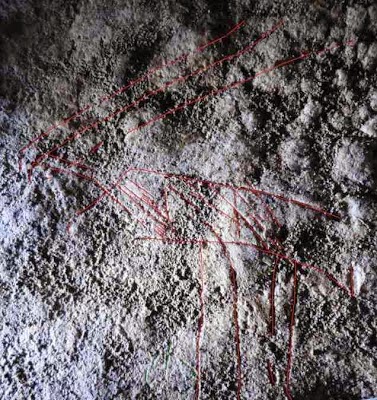
On Tuesday this week (26 July 2011) Bristol University announced the discovery of a carving of a speared reindeer in a cave on the Gower Peninsula. It is thought the carving could be over 14 000 years old and is possibly Britain's oldest known art.
Follow Sciency Thoughts on Facebook.


