Showing posts with label Makemake. Show all posts

Thursday, 28 March 2024

Dwarf planet 136472 Makemake reaches oposition.

The dwarf planet 136472 Makemake will reach opposition (i.e. be directly opposite the Sun seen from Earth) on Saturday 30 March 2022 at 8.28 pm GMT. This means that it will both be at its closest to the Earth this year, about 51.80 AU (51.80 times the average distance between the Earth and the Sun, or about 7 776 097 000 km), and completely illuminated by the Sun. While it is not visible to the naked eye observer, the planets have phases just like those of the Moon; being further from the Sun than the Earth, 136472 Makemake is 'full' when directly opposite the Sun. The planet will be in the constellation of Coma Berenices and at its highest point in the sky at about midnight local time from anywhere on Earth (this is because the rising and setting of objects in the sky is caused by the Earth's rotation, not the movement of the object). (Even at it's very brightest 136472 Makemake will only have a Magnitude of 17.1, making it almost impossible to see with any but the largest of Earth-based telescopes, and where resolvable it will only be possible to see it as a point of light indistinguishable from a faint star.

The orbit and position of 136472 Makemake (2005 FY9) at 10.00 pm on Monday 28 March 2022. JPL Small Body Database Browser.

136472 Makemake orbits the Sun on an eccentric orbit tilted at an angle of 29.0° to the plane of the Solar System, which takes it from 37.8 AU from the Sun (37.8 times the average distance at which the Earth orbits the Sun) to 52.8 AU from the Sun (52.8 times the average distance at which the Earth orbits the Sun. With an average distance of 45.3 AU, 136472 Makemake completes one orbit around the Sun every 305 years. This means that the planet is almost stationary compared to the faster moving Earth, so that it reaches Opposition only two days earlier each year than the year before, and reaches Solar Conjunction (when it is directly on the opposite side of the Sun to the Earth), roughly six months later.

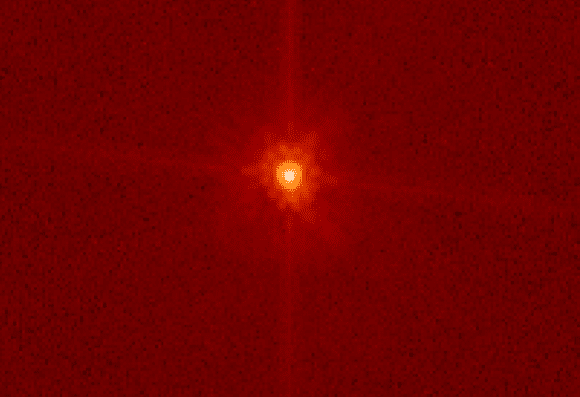
Hubble Space Telescope image of 136472 Makemake. Mike Brown/NASA.

136472 Makemake was discovered on 31 Match 2005 by a team led by Mike Brown of the Palomar Observatory in California. With a diameter of 1430 km it is considered to be the fourth largest dwarf planet in the Solar System (after 134340 Pluto, 136199 Eris, and 136108 Haumea) as well as the twenty second largest body in the Solar System, excluding the Sun (several moons, including our own, are larger). Makemake is also the second-brightest Kuiper belt object, after Pluto.

The surface of 136472 Makemake appears reddish at visual wavelengths, and spectral analysis suggests that it's surface is covered primarily by methane ice, with large amounts of ethane and tholins as well as smaller amounts of ethylene, acetylene and high-mass alkanes. Notably, nitrogen, although present, is observed at much lower levels than on Pluto and Triton, where it is the most abundant ice. 136472 Makemake apparently lacks any form of atmosphere, although it does have a satellite, S/2015 (136472) 1, which is estimated to be 175 km in diameter and orbits at a distance of at least 25 000 km, with an orbital period of at least 12 days.

See also...

Sunday, 27 March 2022

Dwarf planet 136472 Makemake reaches oposition.

The dwarf planet 136472 Makemake will reach opposition (i.e. be directly opposite the Sun seen from Earth) on Monday 28 March 2022 at 9.50 pm GMT. This means that it will both be at its closest to the Earth this year, about 51.75 AU (51.75 times the average distance between the Earth and the Sun, or about 7 714 890 000 km), and completely illuminated by the Sun. While it is not visible to the naked eye observer, the planets have phases just like those of the Moon; being further from the Sun than the Earth, 136472 Makemake is 'full' when directly opposite the Sun. The planet will be in the constellation of Coma Berenices and at its highest point in the sky at about midnight local time from anywhere on Earth (this is because the rising and setting of objects in the sky is caused by the Earth's rotation, not the movement of the object). (Even at it's very brightest 136472 Makemake will only have a Magnitude of 17.2, making it almost impossible to see with any but the largest of Earth-based telescopes, and where resolvable it will only be possible to see it as a point of light indistinguishable from a faint star.


The orbit and position of 136472 Makemake (2005 FY9) at 10.00 pm on Monday 28 March 2022. JPL Small Body Database Browser.

136472 Makemake orbits the Sun on an eccentric orbit tilted at an angle of 29.0° to the plane of the Solar System, which takes it from 37.8 AU from the Sun (37.8 times the average distance at which the Earth orbits the Sun) to 52.8 AU from the Sun (52.8 times the average distance at which the Earth orbits the Sun. With an average distance of 45.3 AU, 136472 Makemake completes one orbit around the Sun every 305 years. This means that the planet is almost stationary compared to the faster moving Earth, so that it reaches Opposition only two days earlier each year than the year before, and reaches Solar Conjunction (when it is directly on the opposite side of the Sun to the Earth), roughly six months later.

 
Hubble Space Telescope image of 136472 Makemake. Mike Brown/NASA.

136472 Makemake was discovered on 31 Match 2005 by a team led by Mike Brown of the Palomar Observatory in California. With a diameter of 1430 km it is considered to be the fourth largest dwarf planet in the Solar System (after 134340 Pluto, 136199 Eris, and 136108 Haumea) as well as the twenty second largest body in the Solar System, excluding the Sun (several moons, including our own, are larger). Makemake is also the second-brightest Kuiper belt object, after Pluto.

The surface of 136472 Makemake appears reddish at visual wavelengths, and spectral analysis suggests that it's surface is covered primarily by methane ice, with large amounts of ethane and tholins as well as smaller amounts of ethylene, acetylene and high-mass alkanes. Notably, nitrogen, although present, is observed at much lower levels than on Pluto and Triton, where it is the most abundant ice. 136472 Makemake apparently lacks any form of atmosphere, although it does have a satellite, S/2015 (136472) 1, which is estimated to be 175 km in diameter and orbits at a distance of at least 25 000 km, with an orbital period of at least 12 days.

See also...


Follow Sciency Thoughts on Facebook.

Follow Sciency Thoughts on Twitter. 


Wednesday, 4 May 2016

Hubble Space Telescope discovers a moon orbiting the Dwarf Planet Makemake.

Makemake is the largest known body in the Kuiper Belt and the second-brightest Trans-Neptunian Object (after Pluto). It has a very bright albedo (it reflects a lot of light), with a surface apparently covered by methane ice, and is known to rotate on its access every 7.771 hours. However much less is known about the mass and density of Makemake than the other two largest Kuiper Belt Objects, Pluto and Eris, as in the case of these objects satellites have been discovered, the orbital properties of which have helped astronomers to understand the parent bodies.

In a paper published on the online arXiv database at Cornell University Library on 25 April 2016, Alex Parker and Marc Buie of the Southwest Research Institute, Will Grundy of the Lowel Observatory and Keith Noll of NASA's Goddard Space Flight Center announce the discovery of a moon orbiting Makemake by the Hubble Space Telescope.

The moon was detected in two sets of images, take on 1 & 29 April 2015 with the Hubble Space Telescope's Wide-Field Camera 3, with the change in relative position between Earth and Makemake between these dates sufficient to make it extremely unlikely that the object is unrelated to the Dwarf Planet. Since Makemake has previously been imaged by Hubble instruments capable of spotting such an object, it is thought that the moon must be in an orbit edge on to the telescope, so that it is hidden by the brightness of the planet much of the time.

The new moon is provisionally named S/2015 (136472) 1, where 'S' indicates the body is a satellite, '2015' is the year of the discovery, '136472' refers to Makemake (the 136 472nd minor planet discovered) and '1' indicates the first such satellite of Makemake discovered in 2015.

Left panels: Co-registered stack of all visit 1 images (top) and visit 2 images (bottom). Images are displayed in their original array coordinates with identical stretch to best compare PSF structure. Right: WCS-rotated stack of visit 1 images with co-registered visit 2 images subtracted, showing S/2015 (136472) 1. Stack is 33rd percentile of six input images. Arrows indicate 100in Ecliptic North and East for each visit; white for visit 1 and green for visit 2. Green trace indicates masked region where S/2015 (136472) 1 would not have been recoverable in visit 2 as determined by injecting synthetic sources. White cross indicates centroid of Makemake. Parker et al. (2016).

S/2015 (136472) 1 is estimated to have an average orbital distance of between 21 100 and 300  000 km, and an orbital period of between 12.4 and 660 days and to have an orbit with an inclination between 63° and 87° to the Makemake equator and between 83° and 105° to the plane of the Solar System. This would result in the moon being visible to the Hubble Space Telescope between 50% and 90% of the time.

See also...

http://sciencythoughts.blogspot.co.uk/2016/03/sputnik-planum-apparently-young-feature.htmlSputnik Planum: An apparently young feature on the surface of Pluto.                                 Pluto was the first known and is one of the largest bodies in the Kuiper Belt, a field of Dwarf Planets and smaller bodies beyond Neptune which are thought to have been beyond the zone of true-planet formation, and therefore to reflect the nature of the early Solar System. In July 2015 the New Horizons spacecraft flew past Pluto, making a detailed survey of the surface...
http://sciencythoughts.blogspot.co.uk/2016/02/deciphering-rings-of-10199-chariklo.htmlDeciphering the rings of 10199 Chariklo. 10199 Chariklo is a Centuar (asteroid or comet-like body found between the orbits of Jupiter and Neptune), which was first discovered in 1997 and subsequently found to be the largest such body, with an...
 
http://sciencythoughts.blogspot.co.uk/2015/04/assessing-composition-of-ices-on.htmlAssessing the composition of ices on the surface of Makemake.                                  The Dwarf Planet Makemake is one of the three largest Trans-Neptunian Objects, with a diameter of about 1400 km, along with Pluto and Eris (2370 km 2330 km respectively). Makemake is thought to have a...


Follow Sciency Thoughts on Facebook.
 

Thursday, 30 April 2015

Assessing the composition of ices on the surface of Makemake.


The Dwarf Planet Makemake is one of the three largest Trans-Neptunian Objects, with a diameter of about 1400 km, along with Pluto and Eris (2370 km 2330 km respectively). Makemake is thought to have a roughly circular orbit, remaining at about 45.7 AU from the Sun, while those of Pluto and Eris are more eccentric, taking them substantially closer to and further away from the Sun during the course of a single orbit (Pluto even spends part of its orbit inside the orbit of Neptune). All of these bodies are thought to have icy surfaces, and while those of Eris and Pluto are thought to undergo substantial heating and cooling as their distance from the Sun varies, leading to significant reworking of surface ices, that of Makemake if thought to remain close to 37K throughout its orbital cycle. This in theory means that the surface of Makemake should have undergone little reworking, and could therefore preserve a composition from early in the history of the Solar System.

The orbit of Makemake.  JPL Small Body Database Browser.

In a paper published in the journal Astronomy & Astrophysics on 10 April 2015 and on the arXiv database at Cornell University Library on 9 April 2015, Vania Lorenzi of the Fundación Galileo Galilei, Noemi Pinilla-Alonso of the Department of Earth and Planetary Sciences at the University of Tennessee and Javier Licandro of the Instituto Astrofísico de Canarias and the Departamento deAstrofísica at the Universidad de La Laguna, describe the results of a spectrographic analysis of the surface of Makemake carried out with the medium-resolution spectrograph ISIS on the 4.2 m William Herschel Telescope at the Roque de LosMuchachos Observatory on La Palma Island in the Canaries.

While all ices reflect light, specific ices will only do so at specific wavelengths, enabling astronomers to determine the surface composition of remote icy objects by analysing the spectra of sunlight reflected from them.

Lorenzi et al. were able to observe Makemake for 6.3 hours, 82% of one of its rotational periods (a ‘day’ on the surface of the Dwarf Planet), obtaining good data that enabled them to assess the composition of 70% of its surface. They found that the studied surface was homogenous (unvarying), which supports the idea that it is relatively unperturbed. The surface of Makemake appears to be covered by granular ice, containing a mixture of methane (CH4) and nitrogen (N2).

See also…

For over a century Pluto was the only known bright object in the Solar System beyond Neptune, but in the past two decades a large number of such objects...
 
http://sciencythoughts.blogspot.co.uk/2014/09/observations-of-new-horizons-candidate.htmlObservations of New Horizons candidate bodies with the Hubble Space Telescope.      The New Horizons Spacecraft was launched in January 2006, and is due to pass through the Pluto System (Pluto is now recognized to be...
 
The dwarf planet Pluto will reach opposition slightly before 3.00 am GMT on Friday 4 July 2014; this means that it will be directly opposite the Sun in the sky when viewed from Earth, on this occasion in the...


Follow Sciency Thoughts on Facebook.

Tuesday, 13 January 2015

Searching for bright objects in the Outer Solar System.


For over a century Pluto was the only known bright object in the Solar System beyond Neptune, but in the past two decades a large number of such objects have been discovered. The difficulty in seeing finding such objects lies not in observing them at all, but rather in detecting their movement, which is what reveals them to be a part of the Solar System rather than remote astronomical objects. Typically the movement of a body in the Inner Solar System can be detected from observations made hours apart, in which Outer Solar System objects appear effectively motionless. Only with the advent of long-term wide-field surveys, which enable the tracking of such objects over several months, has enabled the detection of many more such objects, though once their orbits and magnitudes were established, it has been possible to locate many of these objects in photographic plates taken by observatories dating back to the 1950s.

In a paper published on the arXiv database at Cornell University Library on 6 January 2015, Mike Brown of the California Institute of Technology, Michelle Bannister of the University of Victoria and The Australian National University, Andrew Drake, George Djorgovski, Matthew Graham, Ashish Mahabal and Ciro Donalek of the California Institute of Technology, Steve Larson, Eric Christensen and Ed Beshore of  the Lunar and PlanetaryLaboratory at The University of Arizona and Rob McNaught of The Australian National University, describe the results of a study of data collected by the Catalina Sky Survey in the Northern Hemisphere and Siding Spring Survey in the Southern Hemisphere, with the objective of discovering previously undetected bright objects on the Outer Solar System.

The Catalina Sky and Siding Spring Surveys are designed to search for Near Earth Objects, but are also capable of detecting other bright objects in the sky. 

The Catalina Sky Survey uses the 0.7 m Catalina Schmidt telescope at the Catalina Observatory in Arizona. It is capable of detecting objects with magnitudes of up to about 19.5 (in astronomy larger magnitudes equate to dimmer objects; the human eye can detect objects with magnitudes of up to about 5, while the Sun, Moon and inner planets have negative magnitudes, i.e. magnitudes of less than zero), with each image covering 8.1 square degrees of sky. Brown et al. used data from the Catalina Sky Survey collected between 6 December 2005 and 21 April 2012, covering approximately 19700 square degrees of sky between declinations of -25 and +70 (where zero is directly over the equator, +90 is directly over the North Pole and -90 is directly over the South Pole).  

The Siding Spring Survey operates from the 0.5 m Uppsala Schmidt telescope at Siding Spring Observatory in Australia, and is capable of detecting objects with magnitudes of 19.0 or less, with each image covering 4.2 square degrees of sky. Brown et al. used data collected by the Siding Spring Survey between 20 February 2005 and 29 April 2012, covering approximately 14100 square degrees of sky from declination -80 to 0. Since there is some overlap between the two surveys, the total area covered is approximately 29700 square degrees, although it is impossible to survey for objects at galactic latitudes of less than 10 degrees (i.e. within 10 degrees of the plain of the galaxy) due to the density of the stars in this part of the sky.

(a) Coverage of the Catalina Sky Survey (CSS). The shading shows the number of opposition seasons in which each field has been covered 4 or more times. The equal area plot is centred at an RA of 180 degrees and a declination of 0 degrees with grid marks placed every 30 degrees of RA and declination. Contours of galactic latitude of 10 and 20 degrees are shown as well as a line showing the ecliptic. (b) Coverage of the Siding Spring Survey (SSS). All parameters are as in (a) except that the plot is centredat an RA of 0 degrees. Brown et al. (2015).

The Catalina Sky and Siding Spring Surveys are intended to search for Near Earth Objects (asteroids and comets whose paths bring them close to the Earth) as such the data produced by them has already been filtered for moving objects closer than 25 AU from the Sun (i.e. 25 times as far from the Sun as the Earth or less).  An object moving in a circular prograde orbit (the same direction as the planets, forwards) at a distance of 25 AU will appear to be moving in a retrograde orbit (the opposite direction to the planets, backwards) at a speed of 4.9 arcseconds per hour (the total sky, imagined as a sphere, is divided into 360 degrees, each of which can be subdivided into 60 arcminutes, each arcminute comprises 60 arcseconds); objects more distant from the Sun than the Earth appear to be moving in a retrograde orbits as they are moving more slowly than the Earth. For this reason Brown et al. looked for candidate objects sighted four times within a night within 4.9 arcseconds of one-another, counting these observations as a single sighting.

Some of these sightings were found to repeat at the same location on subsequent occasions. Such sightings are assumed to have been of undocumented astrophysical sources outside the Solar System. Objects which were not subsequently resighted were also excluded, being assumed to be either optical effects or one off astrophysical events. Objects which were subsequently observed within 4 arcseconds of the original sighting were retained as possible sightings of bright trans-Neptunian objects. This resulted in 1.2 million candidate objects in the Catalina Sky Survey Field and 2.3 million candidate objects in the Siding Spring Survey Field.

(a) The locations of transients in the Catalina Sky Survey. To allow viewability only every 20th transient is shown. (b) The locations of transients in the Siding Spring Survey.Every 20thtransient is shown. Brown et al. (2015).

Such candidate objects were suspiciously common around the edges of the fields, particularly on the Siding Spring Survey and around the northern extent of the Catalina Sky Survey, making it likely that a lot of false sightings were present in these areas, probably stationary stars being recorded as moving objects. The comparatively high number of sightings in the Siding Spring Survey also made analysing this data more difficult. However a known bright Kuiper Belt objects, such as the dwarf planet Makemake, could be identified within the data, suggesting that the method was capable of detecting real objects.

Since objects in the Outer Solar System must follow Keplerian orbits, Brown et al. next looked for objects for which such orbits could be defined. This required a minimum of three separate sightings, since three orbital parameters can be derived from each sighting, and a minimum of seven parameters are needed to define a Keplerian orbit. Three randomly selected points will not usually resolve to a Keplerian orbit, ruling out sets of sightings of different objects. In order to make the data manageable, only groups of sightings made from pairs separated by less than 120 days were considered. However this resulted in a total of 160 billion potential triplets in the Catalina Sky Survey Data and 18 trillion potential triplets in the Siding Spring Survey data, which would take a prohibitive amount of computational time to process.

In order to further reduce the data volume, Brown et al. then looked for triplets which were moving on linear paths through the solar system perpendicular to the Earth-object vector. This reduced dataset still included known objects such as Makemake, and reduced the number of candidate triplets to 140 million in the Catalina Sky Survey data and 3 billion in the Siding Spring Survey data.

Brown et al. next calculated Keplerian orbits for these remaining triplets, ruling out those that could not be resolved. This reduced the number of candidate triplets to 4.8 million triplets in the Catalina Sky Survey data and 235 million in the Siding Spring Survey data. However this data was still likely to contain a considerable number of false sightings, requiring further data reduction to be used.

Brown et al. therefore decided to use quadruplets (sets of four sightings that could be determined to be the same object) rather than triplets. This reduced the number of candidate objects, with 1192 quadruplets detected in the Catalina Sky Survey data and 5515 quadruplets in the Siding Spring Survey data. This was a sufficiently small number to begin comparisons of the quadruplets, establishing whether the same objects had been detected multiple times.

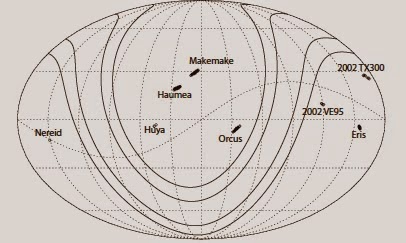
The 1192 quadruplets recovered from the Catalina Sky Survey data yielded eight distinct objects, all of which were previously known (Makemake, Haumea, Orcus, Eris, 2002 TX300, Nereid, Huya and 2002 VE95). It was therefore concluded that requiring four observations per opposition season (an opposition season being the period when an object outside the Earth’s orbit is on the same side of the Sun as us, and therefore on the opposite side of the Earth to the Sun, the only time when faint objects visible only from reflected sunlight are visible) was sufficient to exclude false positives from the data.

The eight objects detected in the Catalina Sky Survey. Each of theobjects is found to be a previously discovered object in the Outer Solar System. Brown et al. (2015).

This means that the Catalina Sky Survey data found every object in the Solar System beyond 25 AU brighter than magnitude 19.1 (though Uranus and Neptune were very bright objects which swamped observations and were therefore excluded from the data processing) except Pluto, which is known to have been in an area of the galactic plane excluded from the study for the entire period and Quaoar, which was actually observed twice in the first season, but then also moved into the galactic plane.The detections included seven Kuiper Belt Objects in heliocentric Keplerian Orbits, plus Nereid, an irregular satellite of Neptune. This strongly suggests that there were no undetected objects in the field survey area brighter then magnitude 19.1.

However none of the 5515 quadruplets observed by the Siding Spring Survey could be resolved to one another, suggesting that for this field raising the number of detections to four was insufficient to remove the false positives, probably due to the far larger number of original detections. Attempting to raise the bar to five detections also resulted in an observation rate of zero.  Thus while it is highly likely that Siding Spring was observing objects, a way to recover these from the data was not found.

See also…

http://sciencythoughts.blogspot.co.uk/2014/09/observations-of-new-horizons-candidate.htmlObservations of New Horizons candidate bodies with the Hubble Space Telescope.      The New Horizons Spacecraft was launched in January 2006, and is due to pass through the Pluto System (Pluto is now recognized to be...

The dwarf planet Pluto will reach opposition slightly before 3.00 am GMT on Friday 4 July 2014; this means that it will be directly opposite the Sun in the sky when viewed from Earth, on this occasion in the...
The Kuiper Belt is a region of the Solar System extending from the orbit of Neptune at about 30 AU (i.e. 30 times the distance between the Sun and the...
Follow Sciency Thoughts on Facebook.

Thursday, 21 July 2011

Pluto gains a fourth moon.

NASA scientists announced this week (20 July 2011) that they had discovered a new moon around the dwarf planet Pluto. The discovery was made by scientists using the Hubble Space Telescope in a set of five long exposure pictures taken over a period of two months and is referred to as 'P4' or 'S/2011 p1'. The moon has since been identified in earlier Hubble images, from 2006 and 2010.
The Pluto system as we currently understand it, incorporating the new moon P4.

Pluto was discovered in 1930 by Clyde Tombaugh, a young astronomer working at the Lowell Observatory in Arizona; its existence had been predicted as early as 1909, due to anomalies in the orbit of Neptune. At the time it was assumed that Pluto was a planet of some size, capable of disturbing the orbit of Neptune. Pluto spends part of its 248 earth year orbit inside the orbit of Neptune; this is not the same on every orbit, but alternates between a 20 and a 14 year stay.

In 1979 the first moon of Pluto was discovered by James Christy at the United States Naval Observatory. Dubbed 'Charon' it enabled scientists to make an estimate of the size of Pluto; to their surprise they found it has only 2% of the mass of Earth or 18% of that of the moon, making it far to small to affect the orbit of Neptune, re-starting the hunt for new planets in the outer solar-system. In fact it is now understood that (due to orbital effects) Pluto passes closer to Uranus than it ever does to Neptune. Charon is so large (relative to Pluto) that their mutual centre of gravity, the point about which they both rotate, is 2040 km above the surface of Pluto; they are the only known planet/moon system for which this is true (671 Patroclus is a pair of asteroids orbiting a mutual centre of gravity at Jupiter's trailing Lagrangian Point, but these are nothing like planets), and for this reason some scientists suggest they should be referred to as a pair of binary planets rather than a planet and its moon. Charon has a mass 2% that of the moon (1520 × 10¹⁸ kg) and a diameter of 1205 km. It orbits the systems centre of gravity at a distance of 17 530 km.

The Pluto/Charon system.

In 2004 another Pluto-like object was located in the outer solar system by a team led by Mike Brown at the California Institute of Technology (this is disputed; José Luis Ortiz Moreno of the Instituto de Astrofísica de Andelucía and his team at the Sierra Nevada Observatory in Grenada, Spain). Haumea has only a third the mass of Pluto, and orbits slightly further out, but it confirmed what scientists were beginning to suspect, that the outer solar system might contain a number of such objects.


An artists impression of Haumea. It is ellipsoid in shape and has a distinctive red patch. These cannot be directly imaged, but are the best interpretation of the available data on Haumea.

In 2005 Mike Brown's team working at Caltech's Palomar Observatory discovered two further objects in the outer solar system.

Makemake is similar to Haumea, roughly third the mass of Pluto, and further out, but the other new object, Eris, was more interesting. Eris is half again as far from the sun as Pluto - and a third again as big. Clearly if Pluto is a planet, then Eris is too.

Hubble images of Eris and it's moon Dysnomia.

Since it was likely that there are many more objects of this size in the outer solar system many astronomers were becoming uncomfortable with the term 'planet' to describe them. Thus in 2006 the International Astronomical Union settled on the term 'Dwarf Planet', to designate objects large enough to form a roughly spherical shape under their own gravity, but no so massive as to have cleared the area around their orbit of all other objects. Pluto, Haumea, Makemake, and Eris were placed in this category, as was Ceres in the asteroid belt. Ceres had also been classified as a planet at the time of its discovery in 1801, as were a number of other asteroids until the mid-nineteenth century, when it became clear that asteroids were too abundant to be classed as planets.

Also in 2005 two more moons of Pluto were discovered by the Hubble Space Telescope Pluto Companion Search Team. Nix and Hydra are further out and smaller than Charon, but orbit the same centre of gravity, so logically if Charon should be considered a planet, then so should Nix and Hydra. This is rather more problematic, as Nix is only 91 km in diameter and Hydra 114 km. Nix orbits the system's centre of gravity at 48 708 km and Hydra at 64 749 km.

The new moon, S/2011 p1, orbits the same centre of gravity as the rest of the system and therefore logically could also potentially be considered a planet, despite having a radius of between 14 and 34 km. It orbits between Nix and Hydra, at a distance of about 59 000 km.

Clearly the Pluto system is something very different to anything in the inner solar system, a cloud of objects more than a planet with satellites. Some scientists theorize that this may be the result of a collision early in the solar system's history, in the same way that Earth's moon (larger in comparison to its parent body than any other moon in the solar system except Charon) is thought to be the result of a collision between the early Earth and a Mars-sized object.

The images we have at the moment, even those taken with our best telescopes, are still pretty faint. In July 2015 NASA's New Horizon spacecraft is due to reach Pluto and will hopefully bring us far more information, and probably a good few more surprises.

See also Visiting Vesta and Dwarf Planets on Sciency Thoughts Youtube.